
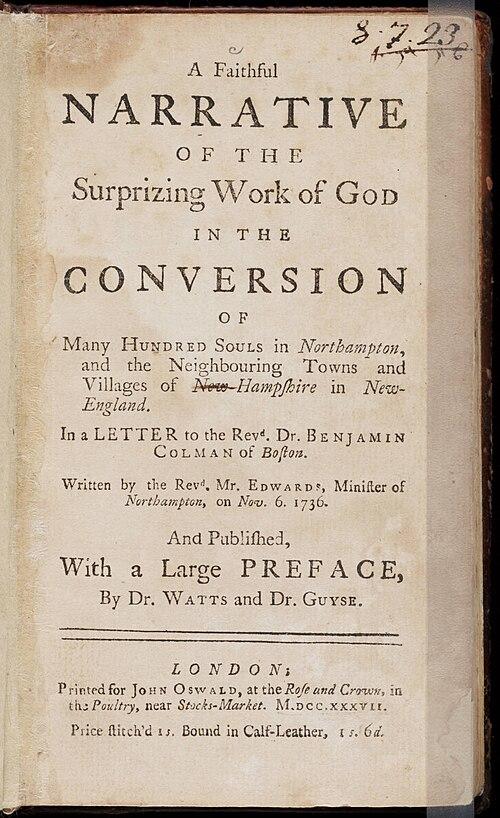
Jonathan Edwards, A Faithful Narrative of the Surprizing Work of God, 1737. Public domain.
1737 to 1910 · Subject · Featured Study
How to Read a Revival Account
Edwards's Faithful Narrative set the form, and Gillies, Prime, Stead and Blair wrote in it, each telling the reader who saw what.
Edwards hoped that more than three hundred souls had been converted at Northampton in half a year, and he did not guess how many more.
Many have undertaken to compose an account of the things that have been fulfilled among us, just as they were handed down to us by the initial eyewitnesses and servants of the word. Therefore, having carefully investigated everything from the beginning, it seemed good also to me to write an orderly account for you, most excellent Theophilus, so that you may know the certainty of the things you have been taught.
Many have undertaken to compose an account of the things that have been fulfilled among us, just as they were handed down to us by the initial eyewitnesses and servants of the word. Therefore, having carefully investigated everything from the beginning, it seemed good also to me to write an orderly account for you, most excellent Theophilus, so that you may know the certainty of the things you have been taught.
- Books
- Acts, Luke, 1 Thessalonians
- Hold in memory
- Luke 1:1 to 4, Acts 2:41
Summary
A revival account is a report by someone who saw a season of conversions, or who gathered letters from those who did. The form began with Edwards. Each account can be read by asking who wrote it, how near he stood and for whom he wrote.
- Edwards's narrative reached print in London in 1737, with a preface by two ministers there.
- John Gillies of Glasgow set the narratives of Acts as the standard of the form in 1754.
- Samuel Irenaeus Prime built his book of 1859 on one man's private journal.
- W. T. Stead marked in 1905 where a link in his story rested on the papers.
The Pattern Gillies Found in Acts
Gillies set Luke's narratives as the true standard of this kind of writing.
Gillies opened his collection with the verses he took as models. He found two sorts of narrative in the New Testament, one telling of many converted at once and one telling of a single person.
Many at once
Those who embraced his message were baptized, and about three thousand were added to the believers that day.
Gillies cites the three thousand as a count given in a particular way.
Acts 2:41BSB
But many who heard the message believed, and the number of men grew to about five thousand.
He cites the five thousand men as a second count of the same kind.
Acts 4:4BSB
With one accord they continued to meet daily in the temple courts and to break bread from house to house, sharing their meals with gladness and sincerity of heart, praising God and enjoying the favor of all the people. And the Lord added to their number daily those who were being saved.
He cites the converts' daily life as the fruit an account should show.
The writer and his witnesses
because our gospel came to you not only in word, but also in power, in the Holy Spirit, and with great conviction—just as you know we lived among you for your sake. And you became imitators of us and of the Lord when you welcomed the message with the joy of the Holy Spirit, in spite of your great suffering. As a result, you have become an example to all the believers in Macedonia and Achaia.
Gillies quotes Paul's report of how the gospel came to Thessalonica in power.
1 Thessalonians 1:5 to 7
Five Accounts and Four Questions
Each account answers the same four questions in its own way.
The five writers stood at different distances from what they told and wrote for different readers.
| Question | Edwards, 1737 | Gillies, 1754 | Prime, 1859 | Stead, 1905 | Blair, 1910 |
|---|---|---|---|---|---|
| Who wrote it? | The pastor of the town | A Glasgow minister compiling | A New York editor | A London editor | A missionary in the city |
| How near did he stand? | In the pulpit through the season | At a distance, through letters | Through Lanphier's journal | In the meetings he attended | In the room, writing about three years later |
| For whom? | Colman of Boston, then London readers | Readers who knew the Scriptures | American church readers | Readers of his magazine | Churches at home during his furlough |
| How is the count given? | More than three hundred, with a hedge | As each letter gives it | Each meeting counted from the journal | A thousand or fifteen hundred in one meeting | The whole room praying together |
The Faithful Narrative of 1737
A pastor's letter became a book, with two London ministers vouching for it.
Edwards wrote his account as a letter to Dr. Colman of Boston, who had asked for a fuller report of the work at Northampton. Colman sent the original to London, where Isaac Watts and John Guyse published it in 1737 with a preface signed in October.
The two ministers named their grounds for trusting it. They pointed to the writer's character and to the agreeing reports of many others in New England.
They also warned their readers. Edwards was free to choose his cases, they said, and he had chosen a woman who had died and a very young child.
Edwards himself wrote with care about numbers. He gave only the figure that seemed probable to him and set a hedge beside it.
He noted that Northampton, unlike many churches in the colony, did not require a relation of inward experience before the Lord's Supper.
The Accounts After Edwards
Gillies collected, Prime edited, Stead reported and Blair remembered.
John Gillies, a minister of Glasgow, printed two volumes of Historical Collections in 1754. His preface lists what an account of many conversions should hold, from the numbers and the means to the prayers before and the fruit after.
He drew a line under the whole collection. However close the pattern, Gillies wrote, uninspired writings stand at an infinite distance below inspired ones.
Samuel Irenaeus Prime told the Fulton Street meetings of 1857 from Lanphier's private journal. He says no one but he and its author had read it, and he calls it the only record kept of the early meetings.
W. T. Stead edited the Review of Reviews in London and went to Wales to see the revival for himself. He took part of Evan Roberts's story from Roberts at tea and part from the newspapers.
Where the papers' version could not be checked, Stead said so in his text.
William Newton Blair wrote his recollections of Pyeng Yang while on furlough, about three years after the meetings of 1907. He set the history of the Korean church first, so that readers would not misunderstand events he called dramatic and unusual.
In Their Own Words
Isaac Watts (1674 to 1748)
Preface signed by Isaac Watts and John Guyse to Jonathan Edwards, A Faithful Narrative of the Surprizing Work of God, the preface
Watts and Guyse named the grounds of their trust.
“We are abundantly satisfy'd of the Truth of this Narrative, not only from the pious Character of the Writer, but from the concurrent Testimony of many other Persons in New-England; for this thing was not done in a Corner.”
Independent
About this saying1 paragraph
Watts and Guyse wrote this after his letter reached them in London.
Jonathan Edwards (1703 to 1758)
A Faithful Narrative of the Surprizing Work of God, pages 25 to 26
Edwards gave his count with a hedge.
“I hope that more than 300 Souls were savingly brought home to Christ, in this Town, in the space of half a Year, (how many more I don't guess)”
Congregationalist
About this saying1 paragraph
Edwards set down this estimate while he was pastor at Northampton.
John Gillies
Historical Collections Relating to Remarkable Periods of the Success of the Gospel, volume I, Preface, page v
Gillies set Scripture above every account.
“There is indeed an infinite disparity betwixt inspired and uninspired writings”
Church of Scotland
About this saying1 paragraph
Gillies wrote this in his preface, before his collection's first account.
Three Ways the Accounts Have Been Read
Readers have taken the accounts as testimony, as reports to weigh link by link, or as warnings.
Watts and Guyse received Edwards's account as testimony, vouched for by the writer's character and by other witnesses. Gillies read every account against the pattern of Acts.
Stead read as a journalist, setting what he saw beside what he was told and saying which was which.
Charles Chauncy of Boston printed Seasonable Thoughts in 1743, and its title page promised to point out what was dangerous in the religious stir.
MannaFest's own tradition reads the accounts as testimony and holds them under Scripture, as Gillies did.
Books to Read Next
A Faithful Narrative of the Surprizing Work of God
Jonathan Edwards · 1737
It is the London printing with the preface by Watts and Guyse.
Read the London printingHistorical Collections, volume I
John Gillies · 1754
Its preface sets out how an account of the gospel's success should be written and read.
Read the Glasgow printingThe Welsh Revival
W. T. Stead and G. Campbell Morgan · 1905
Stead reports what he saw in the Welsh meetings and marks what he took from the papers.
Free at the Internet ArchiveReading Them Well
Each of these accounts names its writer and tells how he came to know what he wrote. A reader who asks those four questions of each one can hear it as testimony and still see where it rests on one witness.
Sources
Scripture is the Berean Standard Bible.
- The Holy Bible, Berean Standard Bible (read 2026)
- Jonathan Edwards, A Faithful Narrative of the Surprizing Work of God in the Conversion of Many Hundred Souls in Northampton (London: John Oswald, 1737), the preface by I. Watts and J. Guyse and pages 25 to 26.
- John Gillies, Historical Collections Relating to Remarkable Periods of the Success of the Gospel (Glasgow: R. and A. Foulis, 1754), volume I, Preface, pages iii to v.
- Samuel Irenaeus Prime, The Power of Prayer, eleventh edition (New York: Charles Scribner, 1859), pages 21 to 25.
- W. T. Stead, The Revival in the West, in The Welsh Revival (Boston: The Pilgrim Press, 1905), pages 49 to 50 and 55.
- William Newton Blair, The Korea Pentecost and Other Experiences on the Mission Field (New York: Board of Foreign Missions of the Presbyterian Church in the U.S.A., dated 1910 by the Internet Archive), the foreword.
- Charles Chauncy, Seasonable Thoughts on the State of Religion in New-England (Boston, 1743), title page.