
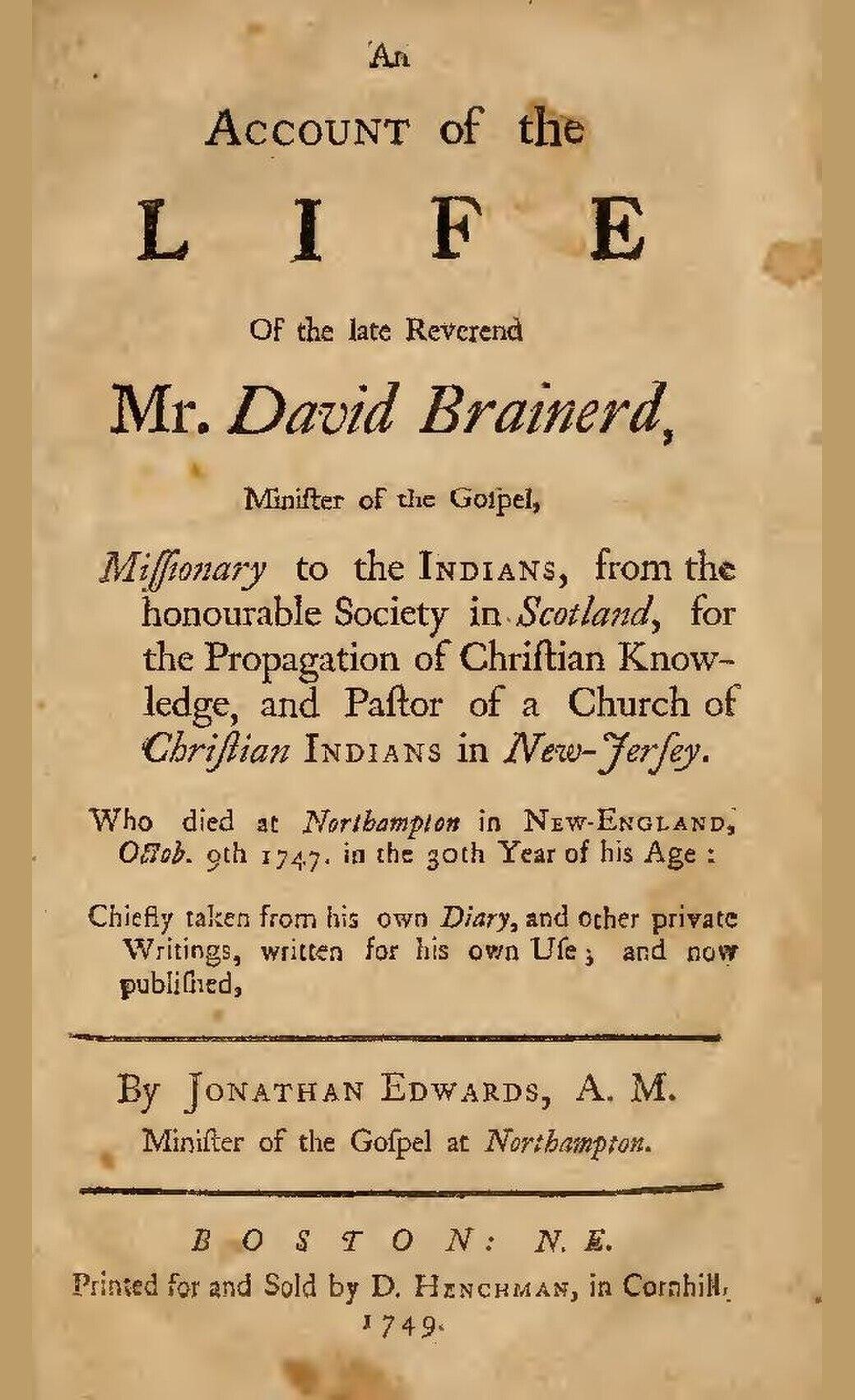
Jonathan Edwards, An Account of the Life of the Late Reverend Mr. David Brainerd, 1749. Public domain.
About 203 to 1907 · Subject · Featured Study
The Testimony and the Witness
Perpetua's prison narrative, Wesley's journal of Aldersgate and Brainerd's diary, read as the witnesses wrote them.
The compiler of Perpetua's story stopped his own telling and let her finish it in the words she had written in prison.
They have conquered him by the blood of the Lamb and by the word of their testimony. And they did not love their lives so as to shy away from death.
They have conquered him by the blood of the Lamb and by the word of their testimony. And they did not love their lives so as to shy away from death.
- Books
- John, Acts, 1 John, Revelation
- Hold in memory
- Revelation 12:11, 1 John 1:3
Summary
A testimony is a believer's own account of what God did, told by the one it happened to. Three of the oldest written testimonies were printed with the witness's own words kept and marked.
- Perpetua wrote her own account in prison, and the Passion that tells of her death keeps her words.
- John Wesley wrote that his heart was strangely warmed at a quarter before nine on 24 May 1738.
- Edwards printed Brainerd's life in 1749 chiefly from Brainerd's own diary.
- Blair wrote that Korean believers bore the same witness as the missionaries at Pyeng Yang in 1907.
The Verses on Testimony and Witness
Jesus sends his followers as witnesses, and John and Revelation name what a witness tells.
The New Testament gives the word witness to those who tell what they have seen and heard. These verses run from the promise of the Spirit to the overcomers of Revelation.
Sent as witnesses
When the Advocate comes, whom I will send to you from the Father—the Spirit of truth who proceeds from the Father—He will testify about Me. And you also must testify, because you have been with Me from the beginning.
Jesus says the Spirit will testify about him and his disciples will testify too.
But you will receive power when the Holy Spirit comes upon you, and you will be My witnesses in Jerusalem, and in all Judea and Samaria, and to the ends of the earth.”
Jesus promises power when the Spirit comes and sends the apostles as his witnesses to the ends of the earth.
Acts 1:8BSB
What a witness tells
That which was from the beginning, which we have heard, which we have seen with our own eyes, which we have gazed upon and touched with our own hands—this is the Word of life. And this is the life that was revealed; we have seen it and testified to it, and we proclaim to you the eternal life that was with the Father and was revealed to us. We proclaim to you what we have seen and heard, so that you also may have fellowship with us. And this fellowship of ours is with the Father and with His Son, Jesus Christ.
John grounds his letter in what he heard, saw and touched.
1 John 1:1 to 3
Three Witnesses and How Their Words Reached Print
Each testimony was written by the witness and carried into print by someone else.
In each case a second hand printed the testimony and marked where the witness's own words began.
| Witness | Date | Written by | Carried into print by |
|---|---|---|---|
| Perpetua in prison | About 203 | Her own hand, in prison | The compiler of the Passion, in English in the Ante-Nicene Fathers, 1885 |
| John Wesley at Aldersgate Street | 24 May 1738 | His own journal | Wesley himself, in the published Journal, and Curnock's edition of 1909 |
| David Brainerd in the woods | 1739 | His own diary, kept for his own use | Jonathan Edwards, Boston, 1749 |
Perpetua, Wesley and Brainerd
Each of the three wrote in prison, in a journal or in a private diary.
The Passion of Perpetua and Felicitas opens in the compiler's voice. At its second chapter he hands the story to Perpetua, saying that from that point she narrates the whole course of her martyrdom as she left it described by her own hand.
In her first vision she saw a golden ladder of great height reaching up to heaven, so narrow that only one person could climb it at a time, with iron weapons fixed on its sides.
John Wesley went unwillingly one evening to a society in Aldersgate Street, where someone was reading Luther's preface to the Epistle to the Romans. He wrote that about a quarter before nine he felt he did trust in Christ alone for salvation and was given an assurance that his sins were taken away.
When Brainerd died in 1747, Jonathan Edwards built his life from Brainerd's diary and other private writings. The title page of 1749 says so, and the preface tells the reader that the rest is Brainerd's account of himself in his own words.
The diary for 12 July 1739 tells how, walking in a dark thick grove, Brainerd felt an unspeakable glory open to his soul.
Testimony in the Revival Record
The revival writers counted testimony as evidence and said whose it was.
John Gillies set two sorts of narrative side by side in 1754. One told of many converted at once, and the other told of single persons such as Paul, Cornelius and the jailer at Philippi.
William Newton Blair, writing of the meeting at Pyeng Yang in January 1907, said the room felt full of God's presence. He added that Koreans as well as missionaries testified to the same thing, so the claim did not rest on the missionaries alone.
MannaFest's own tradition, Wesleyan and Pentecostal, reads such records as testimony. It names the witness, quotes the witness's own words and holds every testimony under Scripture.
In Their Own Words
The Passion of Saints Perpetua and Felicity (died 203)
The Passion of the Holy Martyrs Perpetua and Felicitas, chapter 1.2, page 699
The compiler handed the story to Perpetua.
“From this point onward she shall herself narrate the whole course of her martyrdom, as she left it described by her own hand and with her own mind.”
Patristic
About this saying1 paragraph
The compiler of the Passion, writing after the martyrdom of about 203, set this at the start of its second chapter.
Jonathan Edwards (1703 to 1758)
An Account of the Life of the Late Reverend Mr. David Brainerd, the preface, page x
Edwards said the rest was Brainerd's own.
“The rest is the Account that he gives of himself in his private Writings, in his own Words.”
Congregationalist
About this saying1 paragraph
Edwards wrote this at the end of his preface to the Life of Brainerd in 1749, to say that what follows comes from Brainerd's private writings.
John Wesley (1703 to 1791)
The Journal of the Rev. John Wesley, Curnock's Standard Edition, volume 1 (1909), pages 475 to 476
Wesley dated the warming of his heart.
“About a quarter before nine, while he was describing the change which God works in the heart through faith in Christ, I felt my heart strangely warmed. I felt I did trust in Christ, Christ alone for salvation; and an assurance was given me that He had taken away my sins, even mine, and saved me from the law of sin and death.”
Evangelical
About this saying1 paragraph
This is Wesley's own entry, from the eighteenth century.
Testimony and Scripture
Two readings that the site's tradition holds together.
The compiler of the Passion and Edwards both gave the witness's own words the last say on what the witness felt and saw. Each told the reader exactly where those words began.
Gillies held that every such record stands far below Scripture, and he measured revival writing against the narratives of Acts.
Books to Read Next
Ante-Nicene Fathers, volume 3
Alexander Roberts and James Donaldson, editors · 1885
It carries the Passion of Perpetua and Felicitas in Wallis's English.
Read volume 3The Journal of the Rev. John Wesley, volume 1
John Wesley, edited by Nehemiah Curnock · 1909
It carries the Aldersgate entry.
Read the JournalAn Account of the Life of the Late Reverend Mr. David Brainerd
Jonathan Edwards · 1749
Edwards prints Brainerd's diary with his own preface.
Read the Boston printingThe Witness Kept
Perpetua, Wesley and Brainerd each wrote down what God did in them, and those who printed their words marked where the witness began to speak. The church still reads them in the witnesses' own words.
Sources
Scripture is the Berean Standard Bible.
- The Holy Bible, Berean Standard Bible (read 2026)
- The Passion of the Holy Martyrs Perpetua and Felicitas, translated by R. E. Wallis, in Ante-Nicene Fathers, volume 3 (Buffalo: Christian Literature Publishing Co., 1885), pages 699 to 700.
- John Wesley, Journal, 24 May 1738, in N. Curnock, ed., The Journal of the Rev. John Wesley, Standard Edition, volume 1 (London: Robert Culley, 1909), pages 475 to 476.
- Jonathan Edwards, An Account of the Life of the Late Reverend Mr. David Brainerd (Boston: D. Henchman, 1749), title page, preface and page 13.
- John Gillies, Historical Collections Relating to Remarkable Periods of the Success of the Gospel (Glasgow: R. and A. Foulis, 1754), volume I, Preface, pages iii to v.
- William Newton Blair, The Korea Pentecost and Other Experiences on the Mission Field (New York: Board of Foreign Missions of the Presbyterian Church in the U.S.A., dated 1910 by the Internet Archive), pages 45 to 46.