
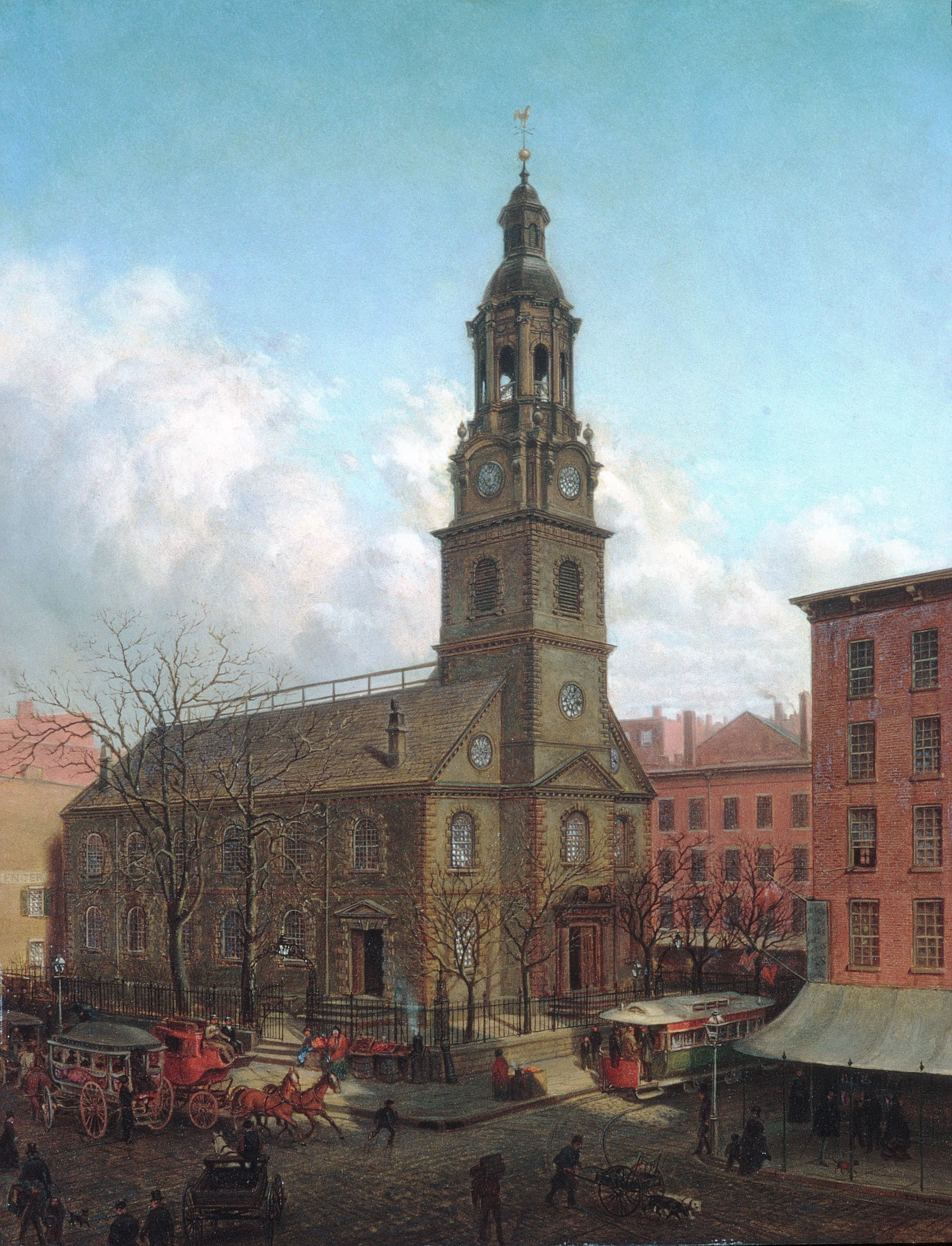
The story
Jeremiah Lanphier was a businessman in the clothing trade, not a minister. In July 1857 the North Dutch Church at Fulton and William Streets in lower Manhattan hired him as a lay missionary, the neighborhood was emptying of residents as it filled with offices, and the congregation was shrinking with it. He walked the streets, knocked on doors, and got very little. So he printed a handbill inviting working men to come and pray on their lunch hour, and set a room aside on the third floor of the building behind the church.
The first meeting was Wednesday, September 23, 1857, at twelve noon. Lanphier prayed alone. Around half past twelve one man came up the stairs, then another; six were there when the hour ended. Twenty came the next week, then about forty, and at that point the men decided not to wait a week between meetings. From October 7 it met every day.
Again, I tell you truly that if two of you on the earth agree about anything you ask for, it will be done for you by My Father in heaven.This is the promise the noon meeting stood on: two agreeing, Christ in the middle. It asks for agreement, not eloquence, which is why laymen could carry it.
The rules were posted and they were strict, which is part of why it worked. The meeting began at twelve and ended at one, on the bell. Anyone could pray, speak, or start a hymn, but no one could hold the floor longer than five minutes. Nothing controversial was to be raised, no arguing about denominations, no doctrinal debate. Written prayer requests went into a box by the door and were read out loud, and men prayed for the names in them.
Three weeks after the meeting began, the country's money collapsed. Banks suspended payment in mid-October 1857, businesses failed, and thousands of men in that district had their afternoons freed against their will. It matters for accuracy that the prayer meeting started before the crash, not because of it, but the crash filled the room, then the floor below it, then the whole building.
The revival ledger's two lines: what marked the outpouring and what it left standing.
| The ledger | What the record holds |
|---|---|
| What marked it | A businessman named Jeremiah Lanphier advertised a noon prayer meeting for working men. Six came the first day; within six months the room, the building, and then halls all over the city were full. The rules were strict and simple: one hour, no sermon, no argument over doctrine, no speaker longer than five minutes. It had almost no famous preachers, laymen ran it, and the newspapers, not the pulpits, carried it across the country. |
| What was left standing | Contemporary accounts speak of hundreds of thousands of converts across the United States within about two years; the most-quoted figure, one million, is a period estimate and should be held loosely. Similar noon meetings opened in Britain, and the awakening ran on into Ulster and Wales in 1859. It came just before the Civil War, and many of the men converted in it carried the meetings into the army camps. |
By early 1858 New York had noon meetings in churches, halls, and even theatres; Burton's Theatre on Chambers Street was taken over for prayer. Horace Greeley of the New York Tribune is said to have sent a reporter around the city by horse to count, and the man managed a dozen meetings in an hour with thousands of men in them. The newspapers, not the pulpits, carried this awakening. Greeley's Tribune and Bennett's Herald competed to print revival news, and the telegraph put a meeting in Manhattan on a breakfast table in Ohio.
Then it moved city to city, mostly by imitation. Philadelphia's meeting in Jayne's Hall began with a few dozen men in November 1857 and was soon reported in the thousands. Chicago, Boston, Cincinnati, St. Louis, Charleston, Mobile, New Orleans, the same hour, the same five-minute rule, the same absence of a famous name. Among the men at the Chicago noon meetings was a young shoe salesman named Dwight Moody, whose life's work was still ahead of him.
The 3 people and groups the revival ledger names, in its order.
| Who the ledger names |
|---|
| Jeremiah Lanphier; Talbot W. Chambers; Samuel Irenaeus Prime |
The numbers are the hard part. Prime, editing a New York religious paper at the time, reckoned tens of thousands of converts in the city alone. The figure most often repeated for the whole country is a million added to the churches in about two years, out of a population near thirty million; it comes from period estimates gathered up later by J. Edwin Orr, not from any count anyone actually took. Kathryn Long's careful modern study shows how much the newspapers shaped the story as they reported it. Something very large happened; the exact size is an estimate and should be held loosely.
It should also be said plainly that the no-controversy rule had a cost. The meetings kept slavery off the floor in the last years before the war, and men prayed side by side in 1858 who would be shooting at each other by 1862. Many of those converts carried the noon meeting into the army camps of both sides, where the wartime revivals were among the largest in American history.
and the residents of one city will go to another, saying: ‘Let us go at once to plead before the LORD and to seek the LORD of Hosts. I myself am going.’"Let us go at once to entreat the LORD," one city saying it to another, is almost a description of how 1857 spread, by invitation rather than by campaign.
What was left standing was a habit rather than an institution. Noon prayer meetings opened in Britain and helped touch off Ulster and Wales in 1859. The lay leadership that ran the rooms went on to build the YMCA and, during the war, the Christian Commission. And the Fulton Street meeting itself simply kept meeting, at noon, for generations after the awakening that made it famous had ended, which may be the most convincing thing about it.
With one accord they all continued in prayer, along with the women and Mary the mother of Jesus, and with His brothers.Before the preaching in Acts there is a room of ordinary people praying with one accord; Fulton Street reversed the usual order back to that one.