
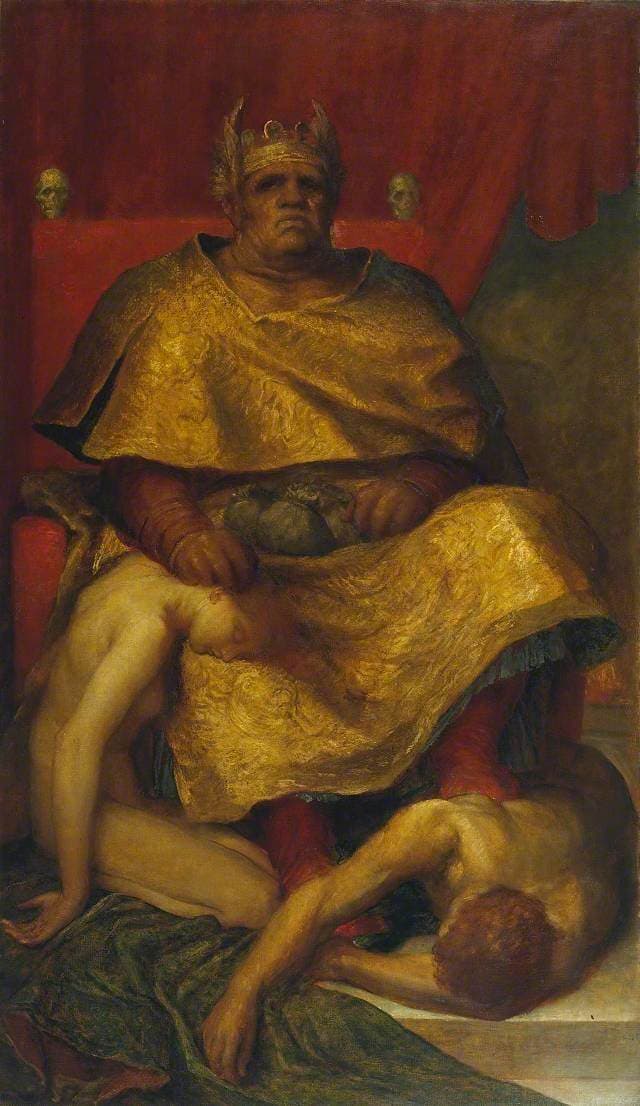
Matthew 6:24 · Symbol · Money and Want
The Words Mammon and Ebyon
Jesus used the word mammon for wealth that claims a servant's loyalty, and the Hebrew ebyon names the needy whom the law protects.
The Berean text renders the one Greek word mammon as “money” in two verses and as “worldly wealth” in two.
So if you have not been faithful with worldly wealth, who will entrust you with true riches?
- The word
- μαμμωνᾶς (mammonas), G3126
- First appears
- Matthew 6:24 “No one can serve two masters: Either he…”
Summary
Mammon is the word Jesus used for wealth when He set it up as a rival master to God, in Matthew 6 and Luke 16. Ebyon is the Hebrew word for the needy, the person who lacks what he must have to live, and Scripture sets him under God's care and the law's protection.
- Hebrew has more than one word for the poor, and its writers often set two of them side by side.
- Mammon stands only on the lips of Jesus.
- Commentators have long asked whether mammon is a plain word for riches or the name of a power that rules them.
Mammon in the Gospels
In Luke the word stands in the teaching that follows the story of the rich man's manager (Luke 16:1 to 8).
This study asks what Scripture means by mammon and by ebyon, the one a name for wealth and the other for the needy. Both words bear on how a believer holds money and how he treats the poor.
The study gives the count of each word and of three other words for the poor. It gives the places where ebyon stands in the Law, the Psalms and the Prophets, and three readings of what mammon names, each with its holders and the objection to it.
Mammon stands in Matthew 6:24 and in three verses of Luke 16 (Luke 16:9, Luke 16:11 and Luke 16:13). The saying of Matthew 6:24, that no one can serve two masters, returns in Luke 16:13, and the page Two Masters and Mammon teaches it.
I tell you, use worldly wealth to make friends for yourselves, so that when it is gone, they will welcome you into eternal dwellings.The verse stands here because Jesus tells His disciples to use mammon, so the word names a thing they handle as well as a master they could serve.
Mammon and the Words for the Poor
One Greek word for wealth stands beside three Hebrew words and one Greek word for the poor.
Mammon is rare in Scripture, while each Hebrew word for the poor stands dozens of times.
| Word | Meaning in the Tyndale House lexicon | Uses | One use in the Berean words |
|---|---|---|---|
| Wealth | |||
| mammonas, μαμμωνᾶς, G3126, noun | wealth | 4 | Luke 16:13, “You cannot serve both God and money.” |
| The poor | |||
| ebyon, אֶבְיוֹן, H34, adjective | needy | 61 | Psalm 113:7, “lifts the needy from the dump” |
| ani, עָנִי, H6041, adjective | afflicted | 73 | Proverbs 22:22, “do not crush the afflicted at the gate” |
| dal, דַּל, H1800, adjective | poor | 47 | Proverbs 14:31, “Whoever oppresses the poor taunts their Maker” |
| ptochos, πτωχός, G4434, noun | poor | 34 | Luke 16:20, “a beggar named Lazarus” |
Ebyon book by book1 figure
The Psalms hold more verses with ebyon than any other book.
The eleven counts as a table
| Book | Verses |
|---|---|
| Psalms | 22 |
| Job | 6 |
| Deuteronomy | 5 |
| Isaiah | 5 |
| Amos | 5 |
| Proverbs | 4 |
| Jeremiah | 4 |
| Ezekiel | 3 |
| Exodus | 2 |
| 1 Samuel | 1 |
| Esther | 1 |
11 bars from zero, one for each book where ebyon (H34) stands, counting the verses that carry it, in the order of their counts.
The Needy in the Law, the Psalms and the Prophets
Deuteronomy, the Psalms, Amos and Ezekiel each speak of the needy.
For there will never cease to be poor in the land; that is why I am commanding you to open wide your hand to your brother and to the poor and needy in your land.The verse joins ani and ebyon in one command, so the law that foresees the poor in the land also tells Israel what to do for them.
A few verses earlier the same chapter says, “There will be no poor among you”, if Israel obeyed the LORD (Deuteronomy 15:4 to 5), and the word there is ebyon as well.
In the Psalms the needy man is often the one who prays. The psalmist prays, “But I am poor and needy; may the Lord think of me” (Psalm 40:17), and Psalm 109:22 has the same confession. Psalm 86 opens, “Incline Your ear, O LORD, and answer me, for I am poor and needy” (Psalm 86:1).
The prophets accuse those who exploit the needy. Amos charges Israel with selling “the needy for a pair of sandals” (Amos 2:6), and Ezekiel names among the iniquity of Sodom that “they did not help the poor and needy” (Ezekiel 16:49).
The law protects three others beside the needy, and their study is The Widow, the Orphan and the Stranger.
Four Words for the Poor
Hebrew calls the poor ebyon, ani and dal, and the Greek of the New Testament calls them ptochos.
Strong's dictionary defines ebyon as “destitute”, ani as “depressed, in mind or circumstances”, and dal as “properly, dangling, i.e. (by implication) weak or thin”. Hannah sang that the LORD “raises the poor from the dust and lifts the needy from the ash heap” (1 Samuel 2:8), with dal for the poor and ebyon for the needy.
Strong's dictionary gives ptochos as “a beggar”, the word “strictly denoting absolute or public mendicancy”. Jesus used it in the blessing “Blessed are you who are poor” (Luke 6:20), and Matthew 5:3 gives the same blessing to “the poor in spirit”.
Wealth as a Test of Faithfulness
Luke 16 sets the use of worldly wealth beside the true riches God entrusts.
In Luke 16 Jesus makes the handling of wealth a test of the one who handles it, and He calls what lies beyond it “true riches” (Luke 16:11). Three neighbouring word studies teach the use of what a person holds. The study of nadab and haplotes teaches the willing and single heart of the giver.
The study of autarkes teaches the contentment Paul learned in plenty and in need.
The study of oikonomos teaches the steward who manages goods that belong to another.
Three Readings of Mammon
Each reading has its holder and the objection to it.
Mammon is the common word for wealthJerome; John Wesley
Jerome, as the Catena Aurea of Thomas Aquinas gives him, said that riches “are so termed in Syriac”. He added, “Yet He said not, he who has riches, but, he who is the servant of riches.”
John Wesley, in his Explanatory Notes upon the New Testament (1755), wrote on Luke 16:9, “Mammon means riches or money.”
The objection: Jesus speaks of mammon as a master whom a servant loves or despises (Luke 16:13), which is more than a plain word for money.
Mammon was the name of an idol of richesAlbert Barnes
Albert Barnes, in his Notes, Explanatory and Practical (1832 to 1869), wrote, “Mammon is a Syriac word, a name given to an idol worshipped as the god of riches.”
He added, “It is not known that the Jews ever formally worshipped this idol, but they used the word to denote wealth.”
Strong's dictionary likewise glosses the word “avarice (deified)”.
The objection: Barnes cites no ancient writer who names such an idol.
Mammon stands for the devil, the lord of moneyAugustine of Hippo
Augustine, in his Sermon on the Mount as the Catena Aurea gives it, wrote that “he who is mammon's servant endures a hard master”, and that he “has been made subject to the Devil”.
The objection: Augustine himself, in another sermon on Luke 16:9, wrote, “That which the Hebrews call mammon, in Latin is "riches."”
The Needy Who Cry Out
Psalm 72 is a prayer for the king.
For he will deliver the needy who cry out and the afflicted who have no helper.The verse stands here because it sets ebyon and ani in one line and names the king's deliverance of both.
The psalm opens, “Endow the king with Your justice, O God”, and asks that he judge “Your afflicted with justice” (Psalm 72:1 to 2).
Sources
Scripture is the Berean Standard Bible.
- STEP Bible, the brief lexicons of Extended Strongs for Hebrew and Greek (Tyndale House, Cambridge), CC BY 4.0.
- James Strong, The Exhaustive Concordance of the Bible, with its dictionaries of the Hebrew and Greek words (1890)
- STEP Bible, Translators Amalgamated Hebrew Old Testament and Greek New Testament, the tagged texts (Tyndale House, Cambridge), CC BY 4.0.
- Jerome, in Thomas Aquinas, Catena Aurea, on Matthew 6:24.
- John Wesley, Explanatory Notes upon the New Testament (1755), on Luke 16:9.
- Albert Barnes, Notes, Explanatory and Practical, on the Old and New Testaments (1832 to 1869), on Matthew 6:24.
- Augustine of Hippo, Our Lord's Sermon on the Mount 2.14, in Thomas Aquinas, Catena Aurea, on Matthew 6:25.
- Augustine of Hippo, Sermon 113, in Thomas Aquinas, Catena Aurea, on Luke 16:9.
Keep Studying
Studies1
In this trial5
People and groups7
Show the next 1 title
Symbols4
Doctrines1