
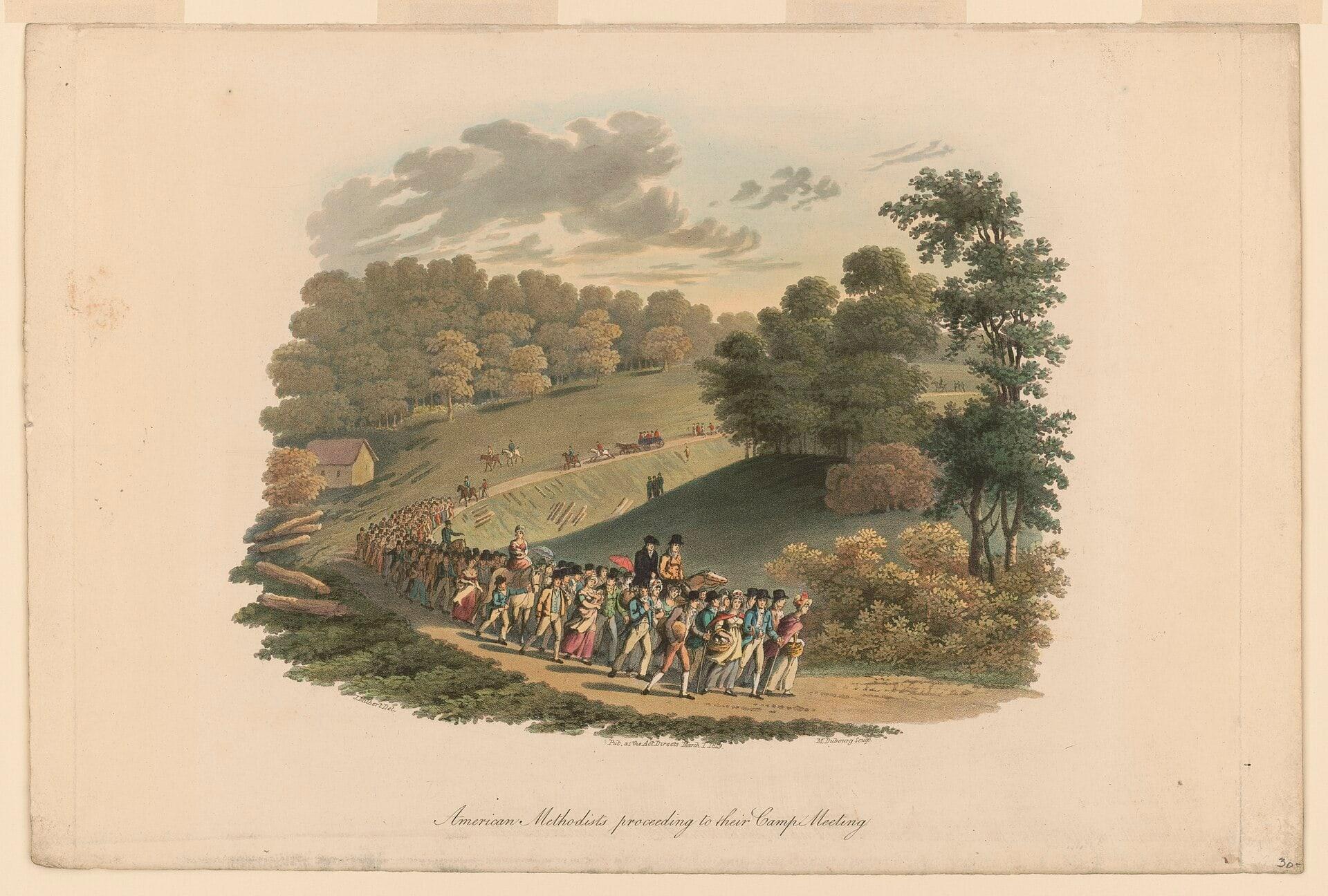
M. Dubourg after Jacques Gérard Milbert, American Methodists Proceeding to Their Camp Meeting, 1819. Public domain.
1801 to 1830 · Subject · Featured Study
The Second Great Awakening
Stone's memoir, Cartwright's autobiography, Asbury's journal and the Methodist minutes record how the revival spread and how far.
- Books
- 1 Timothy, 2 Corinthians, Romans
- Hold in memory
- 1 Timothy 1:15, Romans 5:5
Barton Stone wrote that military men at Cane Ridge in August 1801 judged the crowd at between twenty and thirty thousand.
This is a trustworthy saying, worthy of full acceptance: Christ Jesus came into the world to save sinners, of whom I am the worst.
Summary
The Second Great Awakening was a wave of revivals in America after 1800. On the frontier it spread by camp meetings. Preachers of three churches spoke there for days in the open air. Methodist riders carried it from place to place. Later Charles Finney took it to the towns of New York.
- Stone counted its bodily exercises a work of God, and his editor did not.
- Asbury reported camp meetings from Albany to New Hampshire by 1805.
- The Methodist count of members grew about eightfold in forty years.
The Verses of the Frontier Preachers
Each quotation further down stands under one of these verses, which tell the revival's message, its labour and its experience.
The three verses below stand under the words of Stone, Asbury and Finney quoted further down the page.
The message and the labour
Apart from these external trials, I face daily the pressure of my concern for all the churches.
Paul's care for all the churches stands under Asbury's account of his own yearly round.
The experience
And hope does not disappoint us, because God has poured out His love into our hearts through the Holy Spirit, whom He has given us.
Finney described the love poured into his heart when he was converted.
Romans 5:5BSB
Romans 5:5
The Methodist Returns, 1790 to 1830
The printed minutes and Bangs's history give the members the Methodist Episcopal Church counted.
The Methodist Episcopal Church counted 476,153 members in 1830, about eight times its count forty years before.
| Year and column | Members | Record |
|---|---|---|
| 1790, white members | 45949 | Minutes of the Methodist Conferences (1795), page 146 |
| 1790, coloured members | 11682 | Minutes of the Methodist Conferences (1795), page 146 |
| 1829, all members | 447743 | Bangs, History, volume 4 (1841), page 55 |
| 1830, all members | 476153 | Bangs, History, volume 4 (1841), page 60 |
The returns count Methodists alone and do not measure the revival among Presbyterians and Baptists.
How the Exercises Were Read
Stone and the editor of his memoir weighed the falling and the jerks differently.
Stone held the exercises a work of God mixed with fanaticism, and his editor held them no evidence of God's favour.
| The question | Barton Stone | John Rogers, his editor |
|---|---|---|
| Was the work of God? | His conviction was complete that it was | The exercises are no evidence of divine favour |
| What of the excesses? | Much was fanaticism, and that should not condemn the work | They promote fanaticism and censoriousness |
| Who was affected? | The deist who mocked him fell as well as the devout | In most cases the ignorant and imaginative |
The Wesleyan and Pentecostal tradition reads the revival as a work of the Holy Spirit and weighs its manifestations by their fruit, as Stone did.
The Camp Meeting at Cane Ridge
Stone, the minister of the place, and Peter Cartwright each left an account of the meeting.
Barton Stone was the Presbyterian minister of Cane Ridge in Bourbon County, Kentucky. He wrote that the meeting began on the Thursday or Friday before the third Lord's day in August. The roads were crowded with wagons, carriages, horsemen and people on foot.
He wrote that four or five preachers often spoke at once in different parts of the encampment without confusion.
Stone listed the bodily exercises by their names as the falling exercise, the jerks, the dancing, the barking, the laughing and the singing.
After watching many who fell and then spoke to those around them, Stone wrote that he was convinced it was “a good work, the work of God,” though he saw much he considered fanaticism.
The Circuit Riders
Methodist preachers rode long rounds of appointments, and the camp meeting spread north and east with them.
Peter Cartwright wrote of the circuit preacher's life that he climbed mountains, plunged through swamps, swam swollen streams and lay out all night wet, weary and hungry.
On 12 December 1805 the Methodist bishop Francis Asbury wrote of camp meetings at Albany, at Lebanon in Vermont and in the New Hampshire districts. He wrote that all had been successful.
The revival in the towns of New York under Charles Finney, in the 1820s, is told on its own page.
In Their Own Words
Francis Asbury (1745 to 1816)
The Journal of the Rev. Francis Asbury, volume 3, 9 August 1803, pages 123 to 124
Asbury counted the cost of his round.
“I have little to leave, except a journey of five thousand miles a year, the care of more than a hundred thousand souls, and the arrangement of about four hundred preachers yearly”
Methodist
About this saying1 paragraph
Asbury wrote this on 9 August 1803, thirty-two years after he sailed for America in 1771.
Barton W. Stone (1772 to 1844)
The Biography of Eld. Barton Warren Stone, Written by Himself (Cincinnati, 1847), pages 37 to 38
Stone saw the churches united in the work.
“The Methodist and Baptist preachers aided in the work, and all appeared cordially united in it—of one mind and one soul, and the salvation of sinners seemed to be the great object of all.”
Presbyterian
About this saying1 paragraph
Stone wrote this of the Methodist and Baptist preachers who joined him in August 1801.
Charles G. Finney (1792 to 1875)
Memoirs of Rev. Charles G. Finney, Written by Himself, pp. 20 to 21
Finney felt waves of love at his conversion.
“I could feel the impression, like a wave of electricity, going through and through me. Indeed it seemed to come in waves and waves of liquid love; for I could not express it in any other way.”
Presbyterian and Congregational revivalist
About this saying1 paragraph
Finney described the evening of his conversion in his Memoirs, written in the nineteenth century.
Peter Cartwright
Autobiography of Peter Cartwright, the Backwoods Preacher, chapter III, page 30
Cartwright remembered the crowd and its fallen.
“It was supposed that there were in attendance at times during the meeting from twelve to twenty-five thousand people. Hundreds fell prostrate under the mighty power of God, as men slain in battle.”
Methodist
About this saying1 paragraph
Cartwright set down his memory of the meeting in the autobiography he published in 1856.
Where the Revival Was Weighed
The friends of the revival granted its excesses, and its critics denied that the exercises came from God.
Stone wrote that the warmest friends of the excitement granted its many eccentricities. He added that its good effects were seen in every neighbourhood and silenced contention among the sects for a while.
John Rogers, who edited Stone's memoir, added a chapter on the exercises. Its summary reports that Professor Charles Hodge held them to come from natural causes and not from any divine influence.
The same chapter grants that genuine Christians, and some of great talent, were among those affected.
Books to Read Next
The Biography of Eld. Barton Warren Stone, Written by Himself
Barton W. Stone, with additions by John Rogers · 1847
Stone tells the great meeting as its minister, and Rogers adds a chapter that weighs the exercises.
Free at the Internet ArchiveAutobiography of Peter Cartwright, the Backwoods Preacher
Peter Cartwright · 1856
Cartwright tells the camp meetings and the circuits from the saddle.
Free at the Internet ArchiveThe Journal of the Rev. Francis Asbury, volume 3
Francis Asbury · 1852
Asbury records the camp meetings his preachers reported from the north and east.
Free at the Internet ArchiveWhat the Awakening Left
The frontier revival left the camp meeting, the circuit and a Methodist church many times larger than it had been forty years before. Stone's own congregations joined with those of Alexander Campbell in 1832.
Sources
Scripture is the Berean Standard Bible.
- The Holy Bible, Berean Standard Bible (read 2026)
- Barton W. Stone, The Biography of Eld. Barton Warren Stone, Written by Himself, with additions and reflections by John Rogers (Cincinnati: J. A. and U. P. James, 1847), pages 35, 37 to 39 and 42, and the contents, pages viii to ix.
- Peter Cartwright, Autobiography of Peter Cartwright, the Backwoods Preacher, edited by W. P. Strickland (New York: Carlton and Porter, 1857; copyright 1856), pages 30 to 31 and 243.
- Francis Asbury, The Journal of the Rev. Francis Asbury, volume 3 (New York: Lane and Scott, 1852), pages 123 to 124 and 210 to 211.
- Minutes of the Methodist Conferences, Annually Held in America, from 1773 to 1794 (Philadelphia: Henry Tuckniss, 1795), the minutes for 1790, page 146.
- Nathan Bangs, A History of the Methodist Episcopal Church, volume 4 (New York: G. Lane and P. P. Sandford, 1841), pages 55 and 60.
- Charles G. Finney, Memoirs of Rev. Charles G. Finney, Written by Himself (New York: A. S. Barnes, 1876), pages 20 to 21.
Keep Studying
Studies1
Go further1