
Psalms 119:25
in Psalms 119My soul cleaves to the dust; revive me according to Your word.
BSB
The same verse in ASV and KJV ▾
ASV
My soul cleaveth unto the dust: Quicken thou me according to thy word.
KJV
My soul cleaveth unto the dust: quicken thou me according to thy word.
⋯
This verse in Psalms 119
Commentary
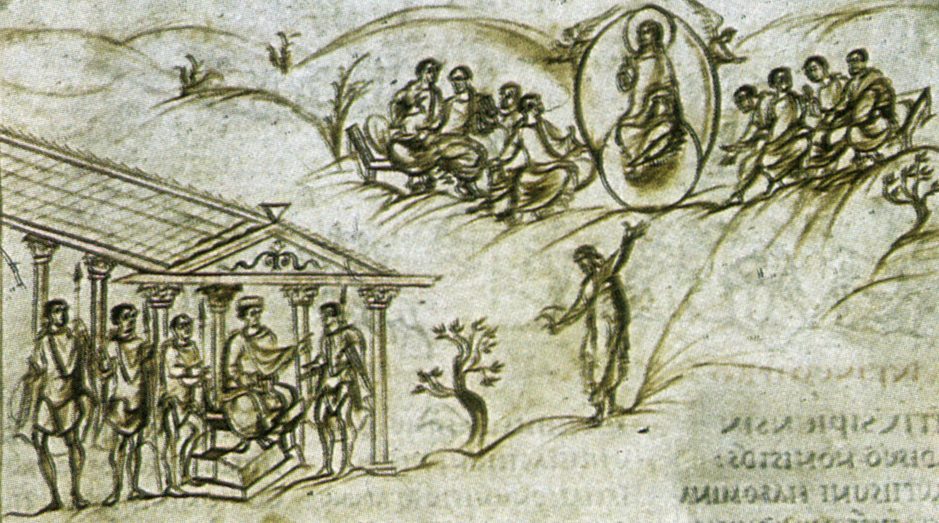
14 notes on this verseNow the very faithful emperor came boldly within the holy temple but did not pray to his Lord standing, or even on his knees, but lying prone upon the ground he uttered David's cry, "My soul cleaves to the dust; you give me life according …
This site's exposition
My soul cleaves to the dust
on Psalms 119:25-32
He begins on the floor, his soul clinging to the dust, and asks to be revived according to the word. By the end he is choosing and moving: the way of truth chosen, the path of the commandments run. Verse 32 has God enlarging the heart he runs with.
The record, by era
The Church Fathers1 voice
"My soul cleaveth to the pavement: O quicken Thou me according to Thy word" (ver. 25). What meaneth, "My soul cleaveth to the pavement, O quicken Thou me according to Thy word"? ...If we look upon the whole world as one great house, we see that the heavens represent its vaulting, the earth therefore will be its pavement. He wisheth therefore to be rescued from earthly things, and to say with the Apostle, "Our conversation is in heaven." To cling therefore to earthly things is the soul's death; the contrary of which evil, life is prayed for, when he saith, "O quicken Thou me." ...The body itself also, because it is of the earth, is reasonably understood by the word pavement; since, because it is still corruptible and weigheth down the soul, we justly groan while in it, and say unto God, "O quicken Thou me." For we shall not be without our bodies when we shall be for evermore with the Lord; but then because they will not be corruptible, nor will they weigh down our souls, if we view it strictly, we shall not cleave unto them, but they rather unto us, and we unto God. ...
The Medieval Church1 voice
A commentator
BonaventureCollations on the Hexaemeron, Collation 14 · Written in the 13th century.
proposed
The sacraments of Scripture, which externally seem arid, are yet alive within. No other Scripture besides this one is able to give life. Hence, in the Psalm: "For the sake of Your promise, give me life."
The Puritans and the Awakening3 voices
ד DALETH.--The Fourth Part. DALETH. My soul cleaveth unto the dust,....
The dust - I am in danger of present death: I am like one laid in the grave. Quicken - Preserve my life, or raise me out of the dust. Word - According to thy promise.
Heaviness in the heart of man makes it to melt, to drop away like a candle that wastes. The penitent soul melts in sorrow for sin, and even the patient soul may melt in the sense of affliction, and it is then its interest to pour out its supplication before God. His request for God's grace.
7 more voices on this verse
The Nineteenth Century7 voices
A commentator
Jamieson, Fausset & Brown1802–1910
Commentary Critical and Explanatory on the Whole Bible (1871)
proposed
Submitting ourselves in depression to God, He will revive us by His promises, and lead us to declare His mercy to others.
Here, it seems to me, we have the Psalmist in trouble bewailing the bondage to earthly things in which he finds his mind to be held. His soul cleaves to the dust, melts for heaviness, and cries for enlargement from its spiritual prison. In these verses we shall see the influence of the divine word upon a heart which laments its downward tendencies, and is filled with mourning because of its deadening surroundings.
Here, it seems to me, we have the Psalmist in trouble bewailing the bondage to earthly things in which he finds his mind to be held. His soul cleaves to the dust, melts for heaviness, and cries for enlargement from its spiritual prison. In these verses we shall see the influence of the divine word upon a heart which laments its downward tendencies, and is filled with mourning because of its deadening surroundings. The word of the Lord evidently arouses prayer (Psa 119:25-29), confirms choice (Psa 119:30), and inspires renewed resolve (Psa 119:32): it is in all tribulation whether of body or mind the surest source of help. This portion has 'D' for its alphabetical letter: it sings of Depression, in the spirit of Devotion, Determination, and Dependence. "My soul cleaveth unto the dust." He means in part that he was full of sorrow; for mourners in the east cast dust on their heads, and sat in ashes, and the Psalmist felt as if these ensigns of woe were glued to him, and his very soul was made to cleave to them because of his powerlessness to rise above his grief. Does he not also mean that he felt ready to die? Did he not feel his life absorbed and fast held by the grave's mould, half choked by the death dust? It may not be straining the language if we conceive that he also felt and bemoaned his earthly mindedness and spiritual deadness. There was a tendency in his soul to cling to earth which he greatly bewailed. Whatever was the cause of his complaint, it was no surface evil, but an affair of his inmost spirit; his soul cleaved to the dust; and it was not a casual and accidental falling into the dust, but a continuous and powerful tendency, or cleaving to the earth. But what a mercy that the good man could feel and deplore whatever there was of evil in the cleaving!
You will frequently find David uttering this petition. It is a favorite prayer of his, "Quicken me, O Lord!" And, as David was like the rest of us—indeed, his experience is the mirror of the experience of all Believers—you may depend upon it, we all have a great need to pray as he did, "Quicken me, O Lord!" If he felt a coldness and deadness frequently stealing over him, so do we. Did he find it hard to endure such a wretched state? So ought we, also, to loathe and abhor it.
You will frequently find David uttering this petition. It is a favorite prayer of his, "Quicken me, O Lord!" And, as David was like the rest of us—indeed, his experience is the mirror of the experience of all Believers—you may depend upon it, we all have a great need to pray as he did, "Quicken me, O Lord!" If he felt a coldness and deadness frequently stealing over him, so do we. Did he find it hard to endure such a wretched state? So ought we, also, to loathe and abhor it. And as he cried to the Strong for strength and knew that quickening must come from God, we ought to know—I trust we know—the same resource under the same necessity. Therefore, let it be our prayer now and let the prayer be repeated often—"Quicken me, O Lord, according to Your Word." How are we to understand this quickening? It means, of course, making alive, keeping alive, and giving more life— in a word, enlivening. He was alive—he was a spiritual man, or else he would not have asked for life. Dead men never pray, "Quicken me." It is a sign that there is life, already, when a man is able to say, "Give me life, O Lord!" This is not the prayer of the unconverted! It is the prayer of a man who is already regenerate and has the love of God in his soul— "Quicken me, O Lord, according to Your Word." Quickening, of course, comes to us, first, by regeneration. It is then that we receive spiritual life. And as there is no natural life in the world except that of which God is the Author, so assuredly in the new world there is no spiritual life except that which God has created. The first quickening is that which comes upon us when we begin to feel our need of a Savior, when we begin to perceive the preciousness of that Savior and when, with a feeble finger, we touch the hem of the Savior's garment. Then are we quickened into newness of life! But that spiritual life needs to be kept alive.
My soul cleaveth unto the dust - It would be best to translate נפשי naphshi, my life; and then cleaving to the dust may imply an apprehension of approaching death; and this agrees best with the petition. Quicken thou me - חיני chaiyeni, “make me alive.” Keep me from going down into the dust.
A commentator
Albert Barnes1798–1870
Notes, Explanatory and Practical, on the Old and New Testaments (1832-1869)
proposed
My soul cleaveth unto the dust - This commences a new division of the psalm, in which each verse begins with the “fourth” letter of the Hebrew alphabet - Daleth (ד d), equivalent to the English “d.” There is nothing in the sense to separate it from the other parts of the psalm. The word rendered “cleaveth” means to be glued to; to stick fast. It has the sense of adhering firmly to anything, so that it cannot easily be separated from it. Compare the notes at Psa 63:8. The word “dust” here may mean either the earth, and earthly things, considered as low, base, unworthy, worldly; or it may mean the grave, as if he were near to that, and in danger of dying. DeWette understands it in the latter sense. Compare Psa 44:25; Psa 22:29. Yet the word cleave would hardly suggest this idea; and the force of that word would be better represented by the idea that his soul, as it were, adhered to the things of earth; that it seemed to be so fastened to them - so glued to them - that it could not be detached from them; that his affections were low, earthly, grovelling, so as to give him deep distress, and to lead him to cry to God for life and strength that he might break away from them. This expresses what is often felt by good people, and thus presents one of the forms of religious experience. Compare Rom 7:14-15. Quicken thou me - Cause me to live; give me vigor and strength to break away from this which binds me fast, and to rise above these low propensities. According to thy word - That is, either according to thy promises made to thy people to aid them when they are in distress; or, according to the principles of thy word, that I may live as thy word requires. […]
The words behind it
5 Hebrew wordsEvery Hebrew word of this verse in the order it stands, with what it means and the door to its own study. The last column counts the times a word stands in the whole Bible: the rarer the word, the more the places it appears belong together.
| Hebrew | Sound | Meaning | Word study | In the Bible |
|---|---|---|---|---|
| דָּֽבְקָ֣ה | davekah | it clings | H1692 → | 54 times |
| לֶעָפָ֣ר | leafar | to the dust | H6083 → | 110 times |
| נַפְשִׁ֑י | nafshi | self my | H5315 → | 754 times |
| חַ֝יֵּ֗נִי | chaiyeni | preserve alive me | H2421 → | 282 times |
| כִּדְבָרֶֽךָ׃ | kidvarekha | according to word your | H1697 → | 1440 times |
דָּֽבְקָ֣הit clings
davekahH1692 →54 times
לֶעָפָ֣רto the dust
leafarH6083 →110 times
נַפְשִׁ֑יself my
nafshiH5315 →754 times
חַ֝יֵּ֗נִיpreserve alive me
chaiyeniH2421 →282 times
כִּדְבָרֶֽךָ׃according to word your
kidvarekhaH1697 →1440 times
A shaded row is a word that stands 400 times or fewer in the Bible.
The walk
8 stopsEach card is a verse this one points to, and under it the verses that one points to in turn. Where several paths arrive at the same place, that place is listed first: the text keeps returning to it.
Through
Colossians 3:2Set your minds on things above, not on earthly things.
it leads to
- 1 John 2:15–17
Do not love the world or anything in the world. If anyone loves the world, the love of the Father is not in him.
- 1 Chronicles 22:19
Now set your heart and soul to seek the LORD your God. Get started building the sanctuary of the LORD God, so that you may bring the ark of the covenant of the LORD…
- Colossians 3:1
Therefore, since you have been raised with Christ, strive for the things above, where Christ is seated at the right hand of God.
- Matthew 16:23
But Jesus turned and said to Peter, “Get behind Me, Satan! You are a stumbling block to Me. For you do not have in mind the things of God, but the things of men.”
- Romans 8:4–6
so that the righteous standard of the law might be fulfilled in us, who do not walk according to the flesh but according to the Spirit.
- 1 John 2:15–17
Through
Deuteronomy 30:6The LORD your God will circumcise your hearts and the hearts of your descendants, and you will love Him with all your heart and with all your soul, so that you may live.
it leads to
- Ezekiel 36:26–27
I will give you a new heart and put a new spirit within you; I will remove your heart of stone and give you a heart of flesh.
- Deuteronomy 10:16
Circumcise your hearts, therefore, and stiffen your necks no more.
- Jeremiah 32:39
I will give them one heart and one way, so that they will always fear Me for their own good and for the good of their children after them.
- Ezekiel 36:26–27
Where this verse is studied
On this page
About Psalms
This page draws on 13 works. Open the list of works
This page draws on Adam Clarke, Commentary on the Bible; Albert Barnes, Notes on the Book of Psalms; Albert Barnes, Notes, Explanatory and Practical, on the Old and New Testaments (1832-1869); Augustine of Hippo, Exposition on Psalm 119; Bonaventure, Collations on the Hexaemeron, Collation 14; Charles Spurgeon, The Treasury of David; Charles Spurgeon, The Treasury of David, Vol. 6; Charles Spurgeon, The Metropolitan Tabernacle Pulpit, Sermon No. 1350: “Enlivening and Invigorating” (lightly modernized text, CCEL edition); Jamieson, Fausset & Brown, Commentary Critical and Explanatory on the Whole Bible; John Gill, Exposition of the Old Testament (1748-1763); John Wesley, Explanatory Notes upon the Old Testament; Matthew Henry, Commentary on the Whole Bible and Theodoret of Cyrus, ECCLESIASTICAL HISTORY 5:17.