
Jeremiah 28:10
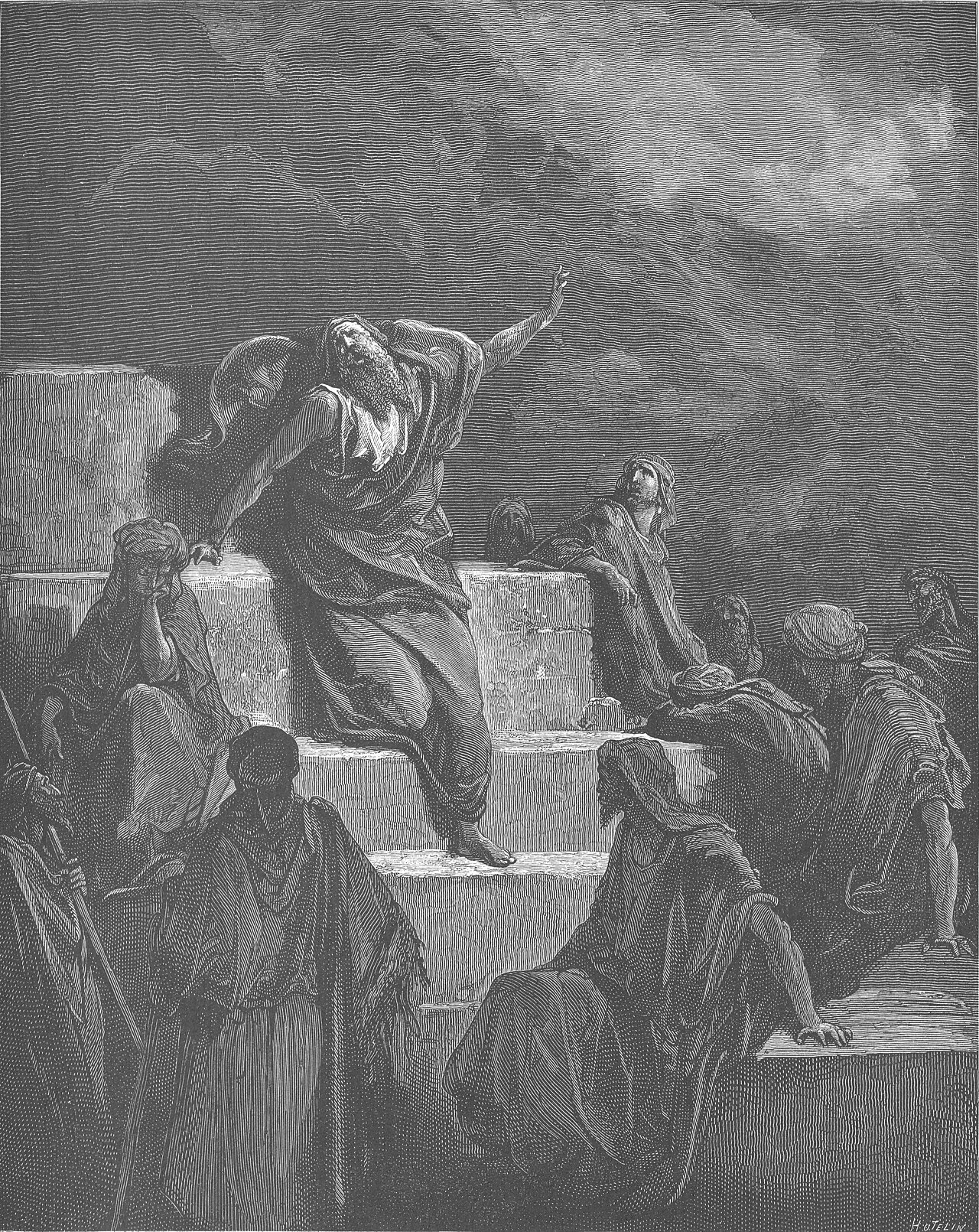
in Jeremiah 28Then the prophet Hananiah took the yoke off the neck of Jeremiah the prophet and broke it.
BSB
The same verse in ASV and KJV ▾
ASV
Then Hananiah the prophet took the bar from off the prophet Jeremiah’s neck, and brake it.
KJV
Then Hananiah the prophet took the yoke from off the prophet Jeremiah’s neck, and brake it.
⋯
This verse in Jeremiah 28
Commentary
8 notes on this verseThe Septuagint does not translate "two years," nor does it call Hananiah a "prophet," lest it appear to name someone a prophet who was in fact no prophet, as if not many persons in sacred Scripture were named in accordance with the opinion of the time in which they lived or according to the truth of the matter. But Joseph is called the father of the Lord.
This site's exposition
took the yoke from off the prophet Jeremiah's neck, and brake it
on Jeremiah 28:10-11
Hananiah answers with an act rather than a further word, taking the yoke from Jeremiah's own neck and breaking it before the people, repeating his message that within two years every nation's yoke will be broken the same way. Jeremiah offers no reply and simply goes his way, a silence the commentators find strange until the next verses explain it, the word had not yet come to him for an answer. Prophecy in the book is shown here as something received rather than produced on demand, even for Jeremiah himself.
The record, by era
The Church Fathers3 voices
(Ver. 2 and following) And the word of the Lord came to Jeremiah after Ananias the prophet broke the chain (or yoke) from the neck of the prophet Jeremiah, saying: Go and tell Ananias, this is what the Lord says: You have broken the wooden chains (or yokes), and I will make iron yokes in their place. For this is what the Lord, the God of Israel, says: I have put an iron yoke on the neck of all these nations, so they will serve Nebuchadnezzar, the king of Babylon. And what follows: 'And they shall serve him, and the beasts of the earth I have given to him. But in the present place, according to the Septuagint, Ananias the prophet is not written, and in the following, lest they should seem to call a false prophet a prophet. But what about the Hebrew truth? After Jeremiah the prophet went on his way and swallowed up the injury in silence, the word of the Lord came to him, so that he would not speak in his own words to the false prophet boasting in lies; but he should say: thus says the Lord: even though Ananias, breaking the wooden yoke, spoke with the same authority in the presence of the Lord: thus says the Lord.' For falsehood always imitates the truth. And that which it has brought in: You have shattered wooden forks, and instead of them have made iron chains, shows this, that, rejecting the lesser punishment, it was for the sake of a greater penalty among the people. The allegorical interpreter also raves in this passage, calling the wooden forks and chains, ethereal and airy bodies, namely, of demons and adverse powers. […]
(Verse 10, 11) And Ananias the prophet took a chain (or a yoke, which in Hebrew is called Mutoth) from the neck of Jeremiah the prophet, and broke it. And Ananias said in the presence of all the people, saying: Thus says the Lord: I will break the yoke of Nebuchadnezzar, the king of Babylon, within two years from the necks of all nations. And Jeremiah went his way (The Vulgate adds prophet). The Seventy did not transfer two years. Moreover, they did not call Ananias a prophet, lest they seem to be calling someone a prophet who was not a prophet. It is as if not many things are said in the holy Scriptures, according to the opinion of that time in which the events are recounted, and not according to what the truth of the matter contained. Finally, even Joseph is called the father of the Lord in the Gospel, and Mary herself, who knew that she had conceived by the Holy Spirit, and she had responded to the angel: 'How will this be, since I do not know a man?' (Luke 1:34). He speaks to the Son: Son, what have you done to us like this? Look, your father and I have been searching for you in sorrow. At the same time, the prudence of Jeremiah, and humility, and patience must be considered. The false prophet does wrong things, and crushes the snatched club from his neck, which he certainly could not do with an iron one. He is silent, and disguises his pain: for the Lord had not yet revealed to him what he should speak. As the holy Scripture shows, prophets do not speak by their own will alone, but by the will of the Lord, especially about the future, of which only God has knowledge. He left, he said, and went on his way, as if defeated, and fulfilling that prophecy: I have become like a deaf man, and like a man who does not have reproofs in his mouth.
About four hundred years have passed since the preaching of Christ burst on the world, and during that time in which his robe has been torn by countless heresies, almost the whole body of error has been derived from the Chaldaean, Syriac and Greek languages. Basilides, the master of licentiousness and the grossest sensuality, after the lapse of so many years and like a second Euphorbus, was changed by transmigration into Jovinian, so that the Latin tongue might have a heresy of its own. Was there no other province in the whole world to receive the gospel of pleasure and into which the serpent might insinuate itself, except that which was founded by the teaching of Peter, on the rock Christ? Idol temples had fallen before the standard of the cross and the severity of the gospel. Now, on the contrary, lust and gluttony endeavor to overthrow the solid structure of the cross. And so God says by Isaiah, "O my people, they which bless you cause you to err, and trouble the paths of your feet." Also by Jeremiah, "Flee out of the midst of Babylon, and save every one his life," and do not believe the false prophets who say, "Peace, peace, and there is no peace," who are always repeating, "The temple of the Lord, the temple of the Lord." "Your prophets have foreseen false and foolish things for you. They have not exposed your iniquity in order to call you to repentance. They devour God's people like bread. They have not called on God. Jeremiah announced the captivity and was stoned by the people. Hananiah, the son of Azzur, broke the bars of wood for the present but was preparing bars of iron for the future. False prophets always promise pleasant things and please for a time. Truth is bitter, and those preaching it are filled with bitterness. For with the unleavened bread of sincerity and truth the Lord's Passover is kept, and it is eaten with bitter herbs.
The Puritans and the Awakening1 voice
Then Hananiah the prophet took the yoke from off the prophet Jeremiah's neck,.... Which he wore as a symbol of the subjection of Judea, and other nations, to the king of Babylon: an impudent and insolent action this was, to take the prophet's yoke from his neck; and the more so, as it was by the command of God that he made it, and wore it: and brake it; being made of wood, as it afterwards appears, and so might easily be broken.
The Nineteenth Century1 voice
Then Hananiah - took the yoke - and brake it - He endeavored by this symbolical act to persuade them of the truth of his prediction.
1 more voice on this verse
The Nineteenth Century1 voice
A commentator
Albert Barnes1798–1870
Notes, Explanatory and Practical, on the Old and New Testaments (1832-1869)
proposed
The multitude would see in Hananiah’s act a symbol of deliverance.
The words behind it
10 Hebrew wordsEvery Hebrew word of this verse in the order it stands, with what it means and the door to its own study. The last column counts the times a word stands in the whole Bible: the rarer the word, the more the places it appears belong together.
| Hebrew | Sound | Meaning | Word study | In the Bible |
|---|---|---|---|---|
| וַיִּקַּ֞ח | vaiyikach | and he took | H3947 → | 966 times |
| חֲנַנְיָ֤ה | chananyah | Hananiah | H2608 → | 29 times |
| הַנָּבִיא֙ | hanavi' | the prophet | H5030 → | 314 times |
| אֶת־ | ʾet- | <obj.> | H853 → | 10935 times |
| הַמּוֹטָ֔ה | hamotah | the yoke-bar | H4133 → | 12 times |
| מֵעַ֕ל | meal | from on | H5921 → | 5755 times |
| צַוַּ֖אר | tzavar | [the] neck of | H6677 → | 42 times |
| יִרְמְיָ֣ה | yirmeyah | Jeremiah | H3414 → | 147 times |
| הַנָּבִ֑יא | hanavi' | the prophet | H5030 → | 314 times |
| וַֽיִּשְׁבְּרֵֽהוּ׃ | vaiyishberehu | and he broke it | H7665 → | 147 times |
וַיִּקַּ֞חand he took
vaiyikachH3947 →966 times
חֲנַנְיָ֤הHananiah
chananyahH2608 →29 times
הַנָּבִיא֙the prophet
hanavi'H5030 →314 times
אֶת־<obj.>
ʾet-H853 →10935 times
הַמּוֹטָ֔הthe yoke-bar
hamotahH4133 →12 times
מֵעַ֕לfrom on
mealH5921 →5755 times
צַוַּ֖אר[the] neck of
tzavarH6677 →42 times
יִרְמְיָ֣הJeremiah
yirmeyahH3414 →147 times
הַנָּבִ֑יאthe prophet
hanavi'H5030 →314 times
וַֽיִּשְׁבְּרֵֽהוּ׃and he broke it
vaiyishberehuH7665 →147 times
A shaded row is a word that stands 400 times or fewer in the Bible.
The walk
8 stopsEach card is a verse this one points to, and under it the verses that one points to in turn. Where several paths arrive at the same place, that place is listed first: the text keeps returning to it.
Through
Malachi 3:13“Your words against Me have been harsh,” says the LORD. “Yet you ask, ‘What have we spoken against You?’
it leads to
- Malachi 2:17
You have wearied the LORD with your words; yet you ask, “How have we wearied Him?” By saying, “All who do evil are good in the sight of the LORD, and in them He…
- Romans 9:20
But who are you, O man, to talk back to God? Shall what is formed say to Him who formed it, “Why did You make me like this?”
- Isaiah 37:23
Whom have you taunted and blasphemed? Against whom have you raised your voice and lifted your eyes in pride? Against the Holy One of Israel!
- Malachi 1:6–8
“A son honors his father, and a servant his master. But if I am a father, where is My honor? And if I am a master, where is your fear of Me?” says the…
- Malachi 2:17
Through
Jeremiah 28:4And I will restore to this place Jeconiah son of Jehoiakim king of Judah, along with all the exiles from Judah who went to Babylon,’ declares the LORD, ‘for I will break the yoke…
it leads to
- Jeremiah 22:24
“As surely as I live,” declares the LORD, “even if you, Coniah son of Jehoiakim king of Judah, were a signet ring on My right hand, I would pull you off.
- Jeremiah 28:2
“This is what the LORD of Hosts, the God of Israel, says: ‘I have broken the yoke of the king of Babylon.
- Jeremiah 24:1
After Nebuchadnezzar king of Babylon had carried away Jeconiah son of Jehoiakim king of Judah, as well as the officials of Judah and the craftsmen and metalsmiths from Jerusalem, and had brought them to…
- 2 Kings 25:27–30
On the twenty-seventh day of the twelfth month of the thirty-seventh year of the exile of Judah’s King Jehoiachin, in the year Evil-merodach became king of Babylon, he released King Jehoiachin of Judah from…
- Jeremiah 22:24
Where this verse is studied
On this page
Studies1
About Jeremiah
Who and where
1 name in this verse with a page on the site.
This page draws on Adam Clarke, Commentary on the Bible; Albert Barnes, Notes, Explanatory and Practical, on the Old and New Testaments (1832-1869); Jerome, SIX BOOKS ON JEREMIAH 5:60.2-4; Jerome, Commentary on Jeremiah; Jerome, Against Jovinianus 2.37; John Gill, Exposition of the Old Testament and John Gill, Exposition of the Old Testament (1748-1763).