
Ecclesiastes 1:12
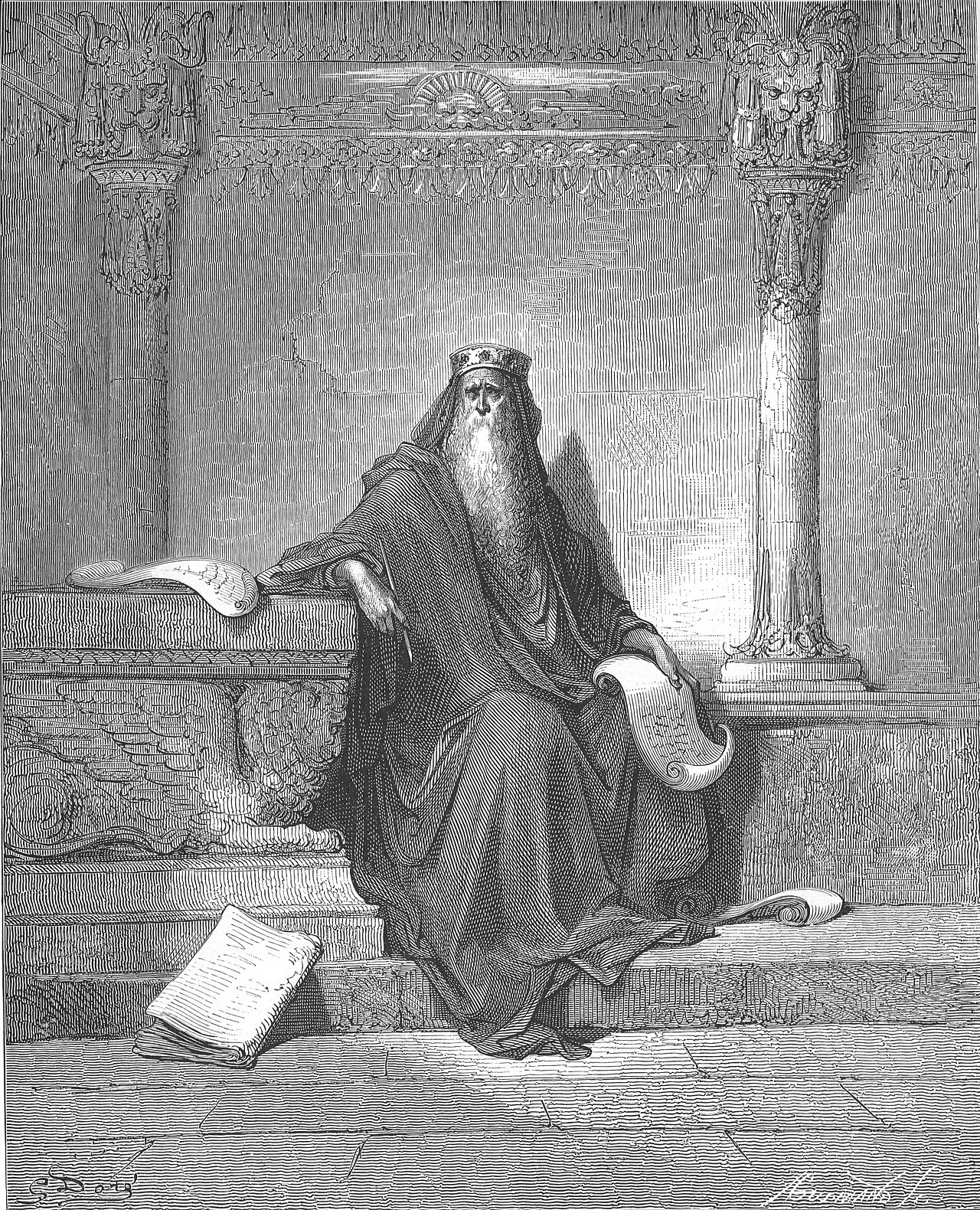
in Ecclesiastes 1I, the Teacher, was king over Israel in Jerusalem.
BSB
The same verse in ASV and KJV ▾
ASV
I the Preacher was king over Israel in Jerusalem.
KJV
I the Preacher was king over Israel in Jerusalem.
⋯
This verse in Ecclesiastes 1
Commentary
12 notes on this verse"I, Ecclesiastes, was King over Israel in Jerusalem. "Until now the preface has spoken only generally about all arguments; but here he returns to the subject of himself, and reveals who he was, and how he knew and experienced all things. The Hebrews say that Solomon, who was doing repentance, wrote this book, and who, having put his trust in wisdom and riches, failed God because of his wives.
This site's exposition
I the Preacher was king over Israel
on Ecclesiastes 1:12-15
I the Preacher was king over Israel in Jerusalem restates the credentials of verse 1 in the Preacher's own voice, and verse 13 states the method: I gave my heart to seek and search out by wisdom concerning all things that are done under heaven, an investigation rather than a mood. The travail is named as God's own gift to the sons of man to be exercised with it, which the bench reads as keeping the search itself inside providence rather than treating it as rebellion. Verse 15 gives the first finding in proverb form, that which is crooked cannot be made straight, and that which is wanting cannot be numbered, limits wisdom meets before it has even begun its work.
The record, by era
The Church Fathers2 voices
We have learned who the Ecclesiast is, he who unites what has gone astray and has been scattered abroad, and makes it all one church and one flock, that none may be deaf to the shepherd's kindly voice, which gives life to all. For "the words which I speak," he says, "are spirit and are life." This is the one who calls himself Ecclesiast, just as he calls himself "Physician," and "Life," and "Resurrection," and "Light," and "Way," and "Door," and "Truth," and all the names of his love for humankind. … What does the Ecclesiast say? "I have become King over Israel in Jerusalem." When is this? Surely when "he was set up as king by him on Mount Zion, his holy mountain, proclaiming the Lord's commandment." To him the Lord said, "You are my Son," and "Today I have begotten you." He says that today he has begotten the Maker of all, the Father of the ages, so that by applying a temporal term to the moment of his birth, the text might demonstrate not his existence before the ages but his fleshly birth in time, for the salvation of humankind.
We now learn the identity of Ecclesiastes who gathers into one what is scattered and dispersed. He makes one flock and church in order that everyone may hear the Shepherd's lovely voice who bestows life to all. "The words that I speak are spirit and life." [Christ] calls himself Ecclesiastes that he might be doctor, life, resurrection, light, way, gate, truth and any other benevolent name for humankind. What does he say? "I have been king over Israel in Jerusalem." At what time? Was it not when God set up a king in holy Mount Zion to proclaim his precepts? Of him the Lord says "You are my son; today I have begotten you." The Maker of all things, the eternal Father, said that he begot him today. Thus this temporal name does not refer to [Christ's] eternal essence but to a birth through the flesh in time for man's salvation.
The Medieval Church1 voice
A commentator
BonaventureCommentary on Ecclesiastes, Chapter 1 · Written in the 13th century.
proposed
Here from the consideration of the mutability of things he reproves his own curiosity. And first he manifests his curiosity; second, he reproves his curiosity on account of vanity, in the second chapter. First he manifests his curiosity, first indeed in the works of prudence …
The Puritans and the Awakening2 voices
I was king - Having asserted the vanity of all things in the general, he now comes to prove his assertion in those particulars wherein men commonly seek, and with greatest probability expect to find, true happiness.
I the preacher was king over Israel in Jerusalem.
5 more voices on this verse
The Puritans and the Awakening2 voices
It aggravated the sin of Jehoiakim that he was the son of Josiah, Jer. xxii. (3.) That his being the son of David encouraged him to repent and hope for mercy, for David had fallen into sin, by which he should have been warned not to sin, but was not; but David repented, and therein he took example from him and found mercy as he did.
He that is the preacher of this doctrine was king over Israel, whom all their neighbours admired as a wise and understanding people, Deut. iv. He had his royal seat in Jerusalem, which then deserved, better than Athens ever did, to be called the eye of the world. The heart of a king is unsearchable; he has reaches of his own, and a divine sentence is often in his lips.
The Nineteenth Century3 voices
I the Preacher was king - This is a strange verse, and does not admit of an easy solution. It is literally, “I, Choheleth, have been king over Israel, in Jerusalem.” This book, as we have already seen, has been conjectured by some to have been written about the time that Ptolemy Philadelphus formed his great library at Alexandria, about two hundred and eighty-five years before our Lard; and from the multitude of Jews that dwelt there, and resorted to that city for the sake of commerce, it was said there was an Israel in Alexandria. See the introduction.
A commentator
Jamieson, Fausset & Brown1802–1910
Commentary Critical and Explanatory on the Whole Bible (1871)
Therefore, "the Preacher" (Koheleth) is repeated. was king--instead of "am," because he is about to give the results of his past experience during his long reign. in Jerusalem--specified, as opposed to David, who reigned both in Hebron and Jerusalem; whereas Solomon reigned only in Jerusalem.
A commentator
Albert Barnes1798–1870
Notes, Explanatory and Practical, on the Old and New Testaments (1832-1869)
proposed
Solomon relates his personal experience Eccl. 2; the result of which was “no profit,” and a conviction that all, even God’s gifts of earthly good to good men, in this life are subject to vanity. His trial of God’s first gift, wisdom, is recounted in Ecc 1:12-18. Was - This tense does not imply that Solomon had ceased to be king when the word was written. See the introduction to Ecclesiastes. He begins with the time of his accession to the throne, when the gifts of wisdom and riches were especially promised to him 1Ki 3:12-13.
How the passage was read
What the Jewish commentators add
I, Koheles, have been king. Over the whole world, and later, over Yisroel, and then, over Yerusholayim alone, and finally, over my staff, 39 See Maseches Sanhedrin 20b. for it says, “[I] have been king.. in Yerusholayim,” but now, I am no longer king.
1 more on this passage, in their own words ▾
Also of the later generations that are to come. After us, will have no recollection in the generations that will be after them.
This section is reception history: how the passage was read and kept in the Jewish tradition. Where a reading parts from an essential of the Christian faith, the section says so at that point.
Texts and citation data: Sefaria; each excerpt follows its version’s licence. 6 further sources are cited on this chapter that carry no English text this site may quote or only restate the verse.
The words behind it
7 Hebrew wordsEvery Hebrew word of this verse in the order it stands, with what it means and the door to its own study. The last column counts the times a word stands in the whole Bible: the rarer the word, the more the places it appears belong together.
| Hebrew | Sound | Meaning | Word study | In the Bible |
|---|---|---|---|---|
| אֲנִ֣י | ʾani | I | H589 → | 874 times |
| קֹהֶ֗לֶת | kohelet | Teacher | H6953 → | 7 times |
| הָיִ֥יתִי | hayiti | I was | H1961 → | 3559 times |
| מֶ֛לֶךְ | melekh | king | H4428 → | 2525 times |
| עַל־ | ʾal- | over | H5921 → | 5755 times |
| יִשְׂרָאֵ֖ל | yisrael | Israel | H3478 → | |
| בִּירוּשָׁלִָֽם׃ | birushalim | in Jerusalem | H3389 → | 643 times |
אֲנִ֣יI
ʾaniH589 →874 times
קֹהֶ֗לֶתTeacher
koheletH6953 →7 times
הָיִ֥יתִיI was
hayitiH1961 →3559 times
מֶ֛לֶךְking
melekhH4428 →2525 times
עַל־over
ʾal-H5921 →5755 times
יִשְׂרָאֵ֖לIsrael
yisraelH3478 →
בִּירוּשָׁלִָֽם׃in Jerusalem
birushalimH3389 →643 times
A shaded row is a word that stands 400 times or fewer in the Bible.
The walk
5 stopsEach card is a verse this one points to, and under it the verses that one points to in turn. Where several paths arrive at the same place, that place is listed first: the text keeps returning to it.
Through
Ecclesiastes 1:1These are the words of the Teacher, the son of David, king in Jerusalem:
it leads to
- Ecclesiastes 12:8–10
“Futility of futilities,” says the Teacher. “Everything is futile!”
- Ecclesiastes 7:27
“Behold,” says the Teacher, “I have discovered this by adding one thing to another to find an explanation.
- 1 Kings 11:42–43
Thus the time that Solomon reigned in Jerusalem over all Israel was forty years.
- 2 Chronicles 10:17–19
but Rehoboam still reigned over the Israelites living in the cities of Judah.
- Isaiah 61:1
The Spirit of the Lord GOD is on Me, because the LORD has anointed Me to preach good news to the poor. He has sent Me to bind up the brokenhearted, to proclaim liberty…
- Ecclesiastes 12:8–10
Where this verse is studied
On this page
Studies4
About Ecclesiastes
Who and where
1 name in this verse with a page on the site.
This page draws on 12 works. Open the list of works
This page draws on Adam Clarke, Commentary on the Bible; Albert Barnes, Notes, Explanatory and Practical, on the Old and New Testaments (1832-1869); Bonaventure, Commentary on Ecclesiastes, Chapter 1; Charles Bridges, An Exposition of the Book of Ecclesiastes; Franz Delitzsch, Commentary on the Song of Songs and Ecclesiastes; Gregory of Nyssa, Commentary (church-history corpus); Gregory of Nyssa, HOMILIES ON ECCLESIASTES 2; Jamieson, Fausset & Brown, Commentary Critical and Explanatory on the Whole Bible; Jerome, Commentary on Ecclesiastes; John Gill, Exposition of the Old Testament (1748-1763); John Wesley, Explanatory Notes upon the Old Testament and Matthew Henry, Commentary on the Whole Bible.