
1 Kings 10:5
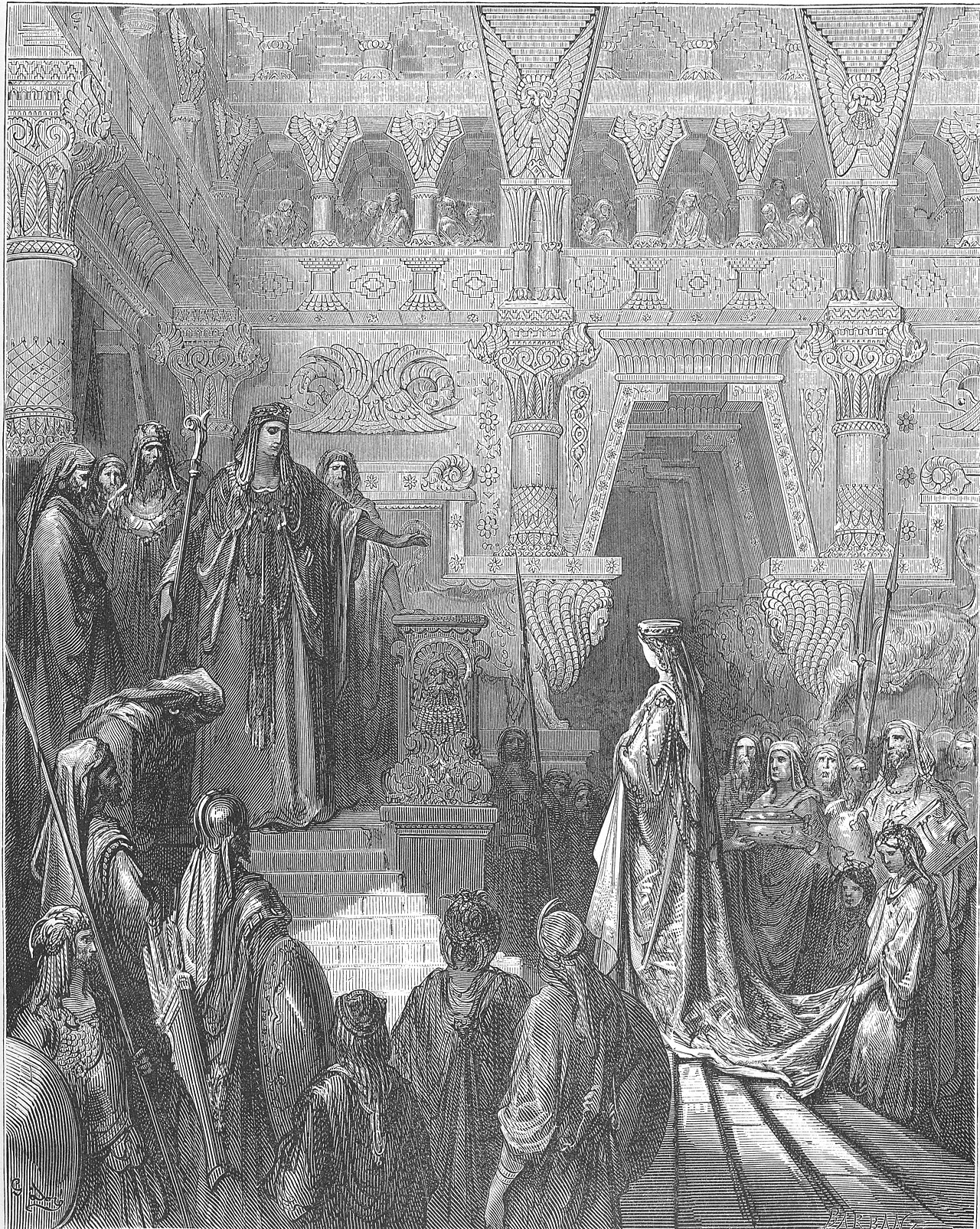
in 1 Kings 10the food at his table, the seating of his servants, the service and attire of his attendants and cupbearers, and the burnt offerings he presented at the house of the LORD, it took her breath away.
BSB
The same verse in ASV and KJV ▾
ASV
and the food of his table, and the sitting of his servants, and the attendance of his ministers, and their apparel, and his cupbearers, and his ascent by which he went up unto the house of Jehovah; there was no more spirit in her.
KJV
And the meat of his table, and the sitting of his servants, and the attendance of his ministers, and their apparel, and his cupbearers, and his ascent by which he went up unto the house of the Lord; there was no more spirit in her.
⋯
This verse in 1 Kings 10
Commentary
7 notes on this verseThe words "the attendance of the servants [and their clothing]." It seems that Solomon, in his wisdom, had divided into classes all his servants, that is, all the craftsmen that did their duty, so that they might be identifiable from their clothing and uniforms which …
This site's exposition
the house that he had built
on 1 Kings 10:4-7
She has already heard the fame; now she sees a whole working court, the table, the servants seated, the ministers attending, the cupbearers' array, and the ascent by which Solomon went up to the house of the Lord, and it leaves her with no more spirit in her, an idiom for astonishment past words. Her own verdict follows at verse 7, the half was not told me, admitting that report, however true, could not carry what sight did. Order, not oratory, is what finally overwhelms her, an entire household running in wisdom.
This site's exposition
the burnt offerings he presented
The Hebrew word here can mean his ascent or his burnt offerings, and the Berean takes the second. Adam Clarke thought a stairway an odd sight to list. Ishodad of Merv held that Solomon dressed his servants by rank, so each class of attendants could be known by its attire.
The record, by era
The Medieval Church1 voice
A commentator
BonaventureCollations on the Hexaemeron, Collation 2 · Written in the 13th century.
proposed
For the beauty of Wisdom is wondrous, and no one looks upon her without admiration and ecstasy, as it is said of Esther and of Solomon, for "all the earth desired to see Solomon's face"; and the Queen of Sheba "came from the ends of …
The Puritans and the Awakening1 voice
And the meat of his table,....
The Nineteenth Century2 voices
A commentator
Albert Barnes1798–1870
Notes, Explanatory and Practical, on the Old and New Testaments (1832-1869)
And the meat of his table - Compare 1Ki 4:22-23. The scene here described receives very apt illustration from the Assyrian banquet scenes, where we have numerous guests sitting, dressed handsomely in fringed robes, with armlets upon their arms, and bracelets round their wrists, attendants standing behind them, and magnificent drinking-cups, evidently of a costly metal, in the hands of the guests, which are filled from a great wine-bowl at one end of the chamber.
The meat of his table - The immense supply of all kinds of food daily necessary for the many thousands which were fed at and from his table. See 1Ki 4:22-23 (note). And the sitting of his servants - The various orders and distinctions of his officers. The attendance of his ministers - See the account of these and their attendance, 1Ki 4:1, etc. And their apparel - The peculiarity of their robes, and their splendor and costliness. And his cup-bearers - The original משקיו mashkaiv may as well be applied to his beverage, or to his drinking utensils, as to his cup-bearers. And his ascent by which he went up - It seems very strange that the steps to the temple should be such a separate matter of astonishment. The original is ועלתו אשר יעלה בית יהוה which all the versions have translated, And the holocausts which he offered in the house of the Lord. The Vulgate, Septuagint, Chaldee, Syriac, and Arabic, all express this sense: so does the German translation of Luther, from which, in this place, we have most pitifully departed: And seine Brandopfer, die er in dem Hause des Herrn opferte; “And his burnt-offering which he offered in the house of the Lord.” There was no more spirit in her - She was overpowered with astonishment; she fainted. I have seen precisely the same effect produced; a lady who was herself an artist, viewing some exquisitely finished oriental paintings, was so struck with astonishment that she twice nearly fainted, and was obliged to leave the room. What happened to the queen of Sheba is a natural and not an uncommon effect which will be produced in a delicate sensible mind at the sight of rare and extraordinary productions of art. Of the profusion of Solomon’s sacrifices we have already had proof, 1Ki 8:63; 1Ki 9:25.
The words behind it
18 Hebrew wordsEvery Hebrew word of this verse in the order it stands, with what it means and the door to its own study. The last column counts the times a word stands in the whole Bible: the rarer the word, the more the places it appears belong together.
| Hebrew | Sound | Meaning | Word study | In the Bible |
|---|---|---|---|---|
| וּמַאֲכַ֣ל | umaakhal | and [the] food of | H3978 → | |
| שֻׁלְחָנ֡וֹ | shulchano | table his | H7979 → | 71 times |
| וּמוֹשַׁ֣ב | umoshav | and [the] seating of | H4186 → | |
| עֲבָדָיו֩ | ʾavadav | servants his | H5650 → | 799 times |
| וּמַעֲמַ֨ד | umaamad | and [the] standing of | H4612 → | |
| מְשָׁרְתָ֜יו | mesharetov | servants his | H8334 → | 97 times |
| וּמַלְבֻּֽשֵׁיהֶם֙ | umalbusheihem | and clothes their | H4403 → | |
| וּמַשְׁקָ֔יו | umashkav | and cup-bearers his | H4945 → | |
| וְעֹ֣לָת֔וֹ | veolato | and burnt offering[s] his | H5930 → | 287 times |
| אֲשֶׁ֥ר | ʾasher | which | H834 → | 5497 times |
| יַעֲלֶ֖ה | yaaleh | he offered up | H5927 → | 890 times |
| בֵּ֣ית | beit | [the] house of | H1004 → | 2046 times |
| יְהוָ֑ה | yahweh | Yahweh | H3068 → | 6520 times |
| וְלֹא־ | velo'- | and not | H3808 → | 5168 times |
| הָ֥יָה | hayah | it was | H1961 → | 3559 times |
| בָ֛הּ | vah | in her | ||
| ע֖וֹד | od | still | H5750 → | 490 times |
| רֽוּחַ׃ | ruach | breath | H7307 → | 378 times |
וּמַאֲכַ֣לand [the] food of
umaakhalH3978 →
שֻׁלְחָנ֡וֹtable his
shulchanoH7979 →71 times
וּמוֹשַׁ֣בand [the] seating of
umoshavH4186 →
עֲבָדָיו֩servants his
ʾavadavH5650 →799 times
וּמַעֲמַ֨דand [the] standing of
umaamadH4612 →
מְשָׁרְתָ֜יוservants his
mesharetovH8334 →97 times
וּמַלְבֻּֽשֵׁיהֶם֙and clothes their
umalbusheihemH4403 →
וּמַשְׁקָ֔יוand cup-bearers his
umashkavH4945 →
וְעֹ֣לָת֔וֹand burnt offering[s] his
veolatoH5930 →287 times
אֲשֶׁ֥רwhich
ʾasherH834 →5497 times
יַעֲלֶ֖הhe offered up
yaalehH5927 →890 times
בֵּ֣ית[the] house of
beitH1004 →2046 times
יְהוָ֑הYahweh
yahwehH3068 →6520 times
וְלֹא־and not
velo'-H3808 →5168 times
הָ֥יָהit was
hayahH1961 →3559 times
בָ֛הּin her
vah
ע֖וֹדstill
odH5750 →490 times
רֽוּחַ׃breath
ruachH7307 →378 times
A shaded row is a word that stands 400 times or fewer in the Bible.
The walk
8 stopsEach card is a verse this one points to, and under it the verses that one points to in turn. Where several paths arrive at the same place, that place is listed first: the text keeps returning to it.
Through
Ezekiel 44:3Only the prince himself may sit inside the gateway to eat in the presence of the LORD. He must enter by way of the portico of the gateway and go out the same way.”
it leads to
- Ezekiel 46:2
The prince is to enter from the outside through the portico of the gateway and stand by the gatepost, while the priests sacrifice his burnt offerings and peace offerings. He is to bow in…
- Ezekiel 37:25
They will live in the land that I gave to My servant Jacob, where your fathers lived. They will live there forever with their children and grandchildren, and My servant David will be their…
- Ezekiel 34:24
I, the LORD, will be their God, and My servant David will be a prince among them. I, the LORD, have spoken.
- 1 Corinthians 10:18–33
Consider the people of Israel: Are not those who eat the sacrifices fellow partakers in the altar?
- Genesis 31:54
Then Jacob offered a sacrifice on the mountain and invited his relatives to eat a meal. And after they had eaten, they spent the night on the mountain.
- Ezekiel 46:2
Through
Joshua 5:1Now when all the Amorite kings west of the Jordan and all the Canaanite kings along the coast heard how the LORD had dried up the waters of the Jordan before the Israelites until…
it leads to
- Joshua 2:9–11
and said to them, “I know that the LORD has given you this land and that the fear of you has fallen on us, so that all who dwell in the land are melting…
- Numbers 13:29
The Amalekites live in the land of the Negev; the Hittites, Jebusites, and Amorites live in the hill country; and the Canaanites live by the sea and along the Jordan.”
- Joshua 2:9–11
Through
1 Chronicles 9:18Shallum was their chief; he was previously stationed at the King’s Gate on the east side. These were the gatekeepers from the camp of the Levites.
it leads to
- Ezekiel 46:1–2
“This is what the Lord GOD says: ‘The gate of the inner court that faces east must be kept shut during the six days of work, but on the Sabbath day and on the…
- Ezekiel 46:1–2
Where this verse is studied
On this page
Studies1
About 1 Kings
This page draws on Adam Clarke, Commentary on the Bible; Albert Barnes, Notes, Explanatory and Practical, on the Old and New Testaments (1832-1869); Bonaventure, Collations on the Hexaemeron, Collation 2; F. W. Farrar, The First Book of Kings (Expositor's Bible); Ishodad of Merv, BOOKS OF SESSIONS 1 KINGS 10:5 and John Gill, Exposition of the Old Testament (1748-1763).