
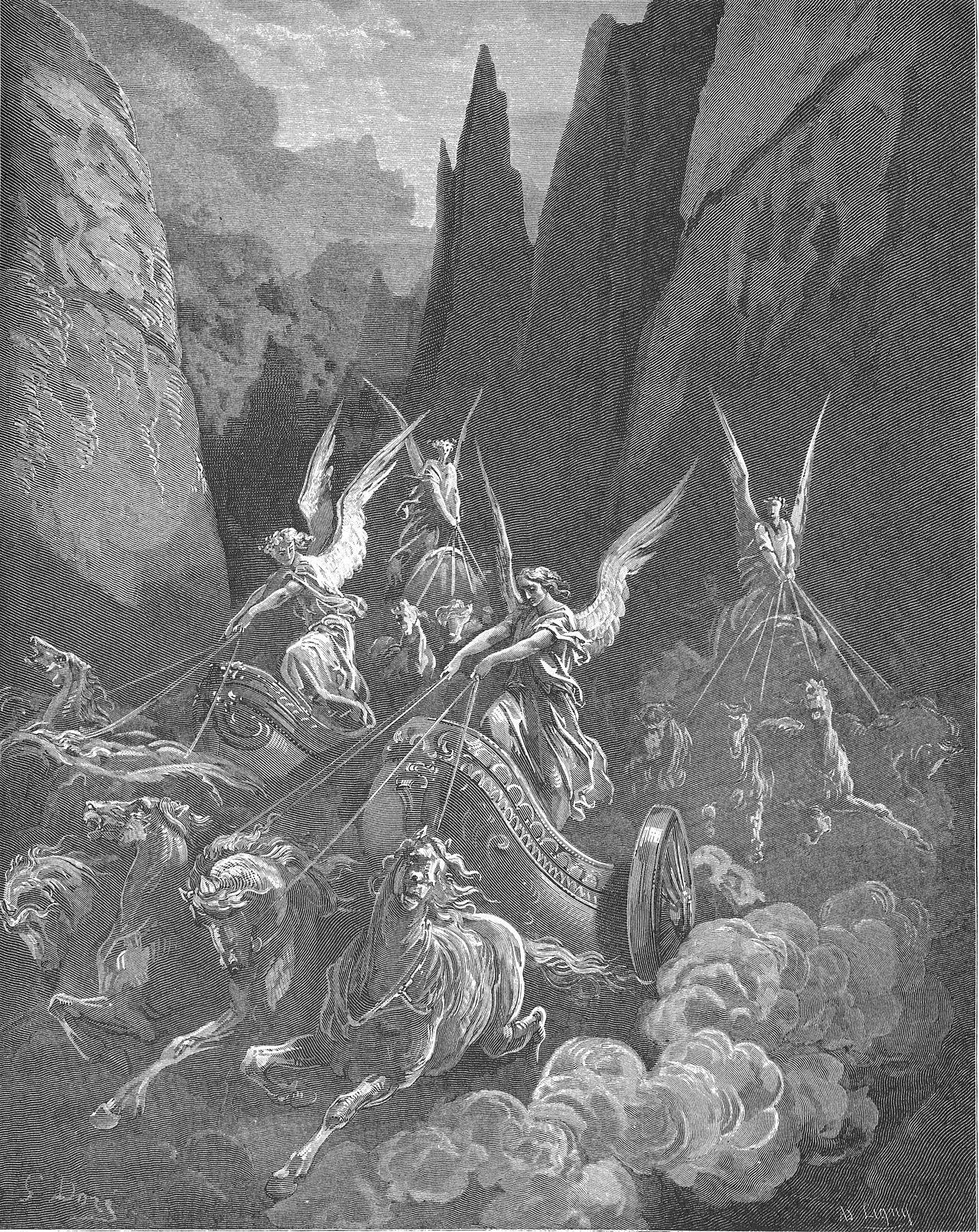
Zechariahchapter 3
10 verses · Zechariah · 520 to 518 BC · The Twelve
Then the angel showed me Joshua the high priest standing before the angel of the LORD, with Satan standing at his right hand to accuse him.
Introduction
Zechariah, The Twelve, Zechariah Overview.
Zechariah was himself of a priestly family, and this vision concerns the high priest of his own day, Joshua son of Jehozadak. Joshua's grandfather had been high priest when Jerusalem fell, and the office had gone into exile with the people. The chapter asks whether a priest with such a past could stand before God for Israel at all. It is set as a hearing in a court, with an accuser present. Listen for who speaks for Joshua and what is done about his clothing. Listen also for the names given to a servant who is still to come.
Context
- Who
- A community whose priesthood had to prove it was still legitimate after the exile
- What
- A vision of Joshua the high priest standing in filthy garments before the angel of the LORD, with Satan at his right hand to accuse him, and of his cleansing and new clothing.
- Where
- Jerusalem; in the vision, a court held before the angel of the LORD.
- When
- The night of 15 February 519 BC.
- Why
- To show that the priesthood of the returned community could serve again because God Himself had taken away its guilt, and to point to a coming servant called the Branch.
Historical context
Joshua son of Jozadak was the high priest of the returned community, named alongside Zerubbabel in Haggai and Ezra. His grandfather had been the high priest taken away when Jerusalem fell.
Show the rest of the historical context, 4 more paragraphs
That is the problem this vision addresses. The priesthood had gone into exile with everyone else. The temple had been destroyed, the line interrupted, the nation defiled. On what basis could this man stand at an altar and represent Israel to God?
The scene is a legal hearing. Joshua stands before the angel of the LORD, and "Satan", the word means the accuser, and in this setting it is a courtroom role, stands at his right hand to resist him. The right hand was the accuser's place in a hearing.
The accusation is never answered on its merits, because it does not need to be. The LORD rebukes the accuser and calls Joshua a brand plucked out of the fire, a half-burned stick pulled off the hearth. Then the filthy garments are taken away, iniquity is passed from him, and he is dressed in clean priestly robes and a clean turban.
The chapter closes with two promises: a servant called the BRANCH, and a stone with seven eyes on it, and iniquity removed from the land in one day. "Branch" had already been used by Isaiah and Jeremiah for a coming king from David's line, and it is applied here in a priestly setting.
Significance
The returnees knew exactly why they had been exiled. The accusation against their high priest was, in one sense, accurate, and God does not contest it. He changes the clothes.
Show the rest of the significance, 1 more paragraph
That is what allowed worship to restart. Their priest did not stand at the altar on the strength of an unbroken record. He stood there because God had pulled him out of the fire and dressed him Himself.
This chapter in Jewish lifeWhat this chapter is in Jewish life and reading.
What is done
The site's own table in src/lib/hebraic/readings.ts, probed for this lane, printed one use of this chapter. It stands in the Haftarah of Beha'alotcha, the portion of Numbers 8:1 to 12:16, which the table gives as Zechariah 2:14 to 4:7 and marks as read in both rites. The same probe printed no Haftarah use for any other chapter of the book, and no festival reading for it.
The whole of this chapter stands inside that reading, between its start in the fourteenth verse of chapter 2 and its end in the seventh verse of chapter 4. A congregation that reads the Haftarah of Beha'alotcha hears the vision of Joshua the high priest read aloud.
How it is read
Rashi is the one commentator on this chapter whose English the corpus carries. He is quoted from The Judaica Press complete Tanach with Rashi, translated by A. J. Rosenberg, which Sefaria reports as CC-BY, and every quotation is held to fifty words or fewer.
Rashi reads the accusation and the filthy garments together, through the Book of Ezra. The Satan stands to accuse Joshua "because his sons were married to gentile women", and he cites Ezra 10:18 for it (Rashi on Zechariah 3:1:1). Following the Targum, Joshua "was punished because he did not interfere" (Rashi on Zechariah 3:3:1). The cure is as plain. "Let his sons separate from their wives, and he will be forgiven" (Rashi on Zechariah 3:4:1). The clean garments are merits (Rashi on Zechariah 3:4:2).
The brand plucked from the fire he reads from the Aggadah in Sanhedrin 93a. There Joshua was cast into the fire with Ahab son of Kolaiah and his colleague and was saved (Rashi on Zechariah 3:2:2). The companions of the eighth verse are Hananiah, Mishael and Azariah, men for whom a miracle was also done (Rashi on Zechariah 3:8:1 and 3:8:2).
The stone ties the vision to the building. Rashi reads it as "The foundation of the house that you laid in the days of Cyrus", which seemed small, and he sends the reader to Ezra and Haggai (Rashi on Zechariah 3:9:1). The seven eyes mean it "will eventually be widened seven times as much" (Rashi on Zechariah 3:9:2).
The corpus carries 9 further notes on this chapter without an English text, each marked linked because Sefaria holds no English version of the ref. They stand cited and unquoted here. Ibn Ezra on Zechariah is cited at 3:1:1, 3:2:1, 3:3:1, 3:4:1, 3:6:1 and 3:10:1. Radak on Zechariah is cited at 3:1:1, 3:3:1 and 3:10:1.
What the rabbis say
The corpus carries 37 rabbinic locators on this chapter and the text of none, so each is cited and linked here and none is quoted. The verse numbers are the corpus's own.
At 3:1 it holds Ein Yaakov (Glick Edition), Sanhedrin 11:20, Ein Yaakov, Sanhedrin 11:19 and Pirkei DeRabbi Eliezer 33:14. It also holds Sanhedrin 93a:16, Shir HaShirim Rabbah 5:5:1 and Tanna DeBei Eliyahu Rabbah 4:1 there. At 3:2 it holds Berakhot 51a:15, Bereshit Rabbah 56:4 and Ein Yaakov, Berakhot 7:20. It also holds Jerusalem Talmud Taanit 4:5:18, Midrash Aggadah, Leviticus 5:1:3 and Midrash Tanchuma, Vayikra 6:1 there. It also holds Otzar Midrashim, Pesikta, Pesikta Chadata 22 and Pesikta DeRav Kahana 24:15 there.
At 3:3 it holds Midrash Lekach Tov, Genesis 27:15:1 and Sanhedrin 93a:18. At 3:5 it holds Jerusalem Talmud Shabbat 6:4:4. At 3:7 it holds Midrash Tehillim 1:2 and Shemot Rabbah 25:2. At 3:8 it holds Avot DeRabbi Natan, Recension B 11:12, Bamidbar Rabbah 6:1 and Bereshit Rabbah 56:11. It also holds Ein Yaakov (Glick Edition), Horayot 3:3, Ein Yaakov (Glick Edition), Sanhedrin 11:18 and Ein Yaakov, Horayot 3:12 there.
It also holds Ein Yaakov, Sanhedrin 11:17, Horayot 13a:12 and Jerusalem Talmud Horayot 3:5:6 there. It also holds Midrash Tanchuma, Vaera 3:1, Sanhedrin 93a:7 and Shemot Rabbah 9:1 there. It also holds Yalkut Shimoni on Torah 102:2 there. At 3:9 it holds Bereshit Rabbati, Parashat Vayeshev 16 and Ruth Rabbah (Lerner) 4:12:1. At 3:10 it holds Midrash Lekach Tov, Genesis 41:2:5 and Midrash Tehillim 72:3.
At 3:11 it holds Ein Yaakov (Glick Edition), Ketubot 13:14.
What each of them teaches is a saying of the rabbis, and is reported as theirs wherever this site quotes one. The quotations wait on a fetch that carries the text.
Sources: Rashi, Rashi on Zechariah 3:1:1 to 3:9:2, The Judaica Press complete Tanach with Rashi, translated by A. J. Rosenberg, reported CC-BY; Ibn Ezra, Ibn Ezra on Zechariah 3:1:1, 3:2:1, 3:3:1, 3:4:1, 3:6:1 and 3:10:1, cited by ref because the corpus carries no text it may quote; Radak, Radak on Zechariah 3:1:1, 3:3:1 and 3:10:1, cited by ref because the corpus carries no text it may quote; The Sefaria corpus, scripts/data/sources/sefaria/zechariah/3.json, the 37 Talmud and Midrash locators of this chapter; The site's own files, src/lib/hebraic/readings.ts, probed for this lane through haftarahUsesForChapter("zechariah", 3) and festivalReadingForBook("zechariah").
The heads below are this chapter's scenes. The numbered points under each are its verses.
Filthy garments taken off Joshua the high priest
Zechariah 3:1-5
Joshua the high priest standing before the angel: The fourth vision is a courtroom. The LORD rebukes Satan on two grounds: He “has chosen Jerusalem”, and Joshua is “a firebrand snatched from the fire”. Joshua's filthy garments come off with the word “I have removed your iniquity”, and “a clean turban” on his head restores him to office.
Zechariah 3:1
“And He - God, (for the office of the attendant angel was to explain, not to show the visions) “showed me Joshua the high priest, standing before the Angel of the Lord;” probably to be judged by him ; as in the New Testament, “to stand before the Son of Man;” for although “standing before,” whether in relation to man or God, , expresses attendance upon, yet here it appears only as a condition, contemporaneous with that of Satan’s, to accuse him.”
2 more voices on this verseWhat preachers and commentators have said about this verse, in their own words.
Zechariah 3:1
“THE original intention of this vision was to foretell the revival of the Jewish state after its long depression through the Babylonian captivity. Joshua, the high priest, with his tattered garments, must be looked upon as the type of the Jewish people in their deep distress. He was ministering before the Lord in worn and filthy garments, to show at once the sin of Israel and the poverty into which they had fallen.”
Zechariah 3:1
“The full accomplishment of Israel's justification and of Satan the accuser's being "rebuked" finally, is yet future (Re 12:10). Compare Re 11:8, wherein "Jerusalem," as here, is shown to be meant primarily, though including the whole Church in general (compare Job 1:9). Satan--the Hebrew term meaning "adversary" in a law court: as devil is the Greek term, meaning accuser.”
Jamieson, Fausset & Brown · Commentary Critical and Explanatory on the Whole Bible (1871)reformed
Wesley took the one who rebukes Satan in the name of the LORD as Christ speaking for his Father. Clarke read the firebrand as the remnant of Judah, snatched from the fire of exile. The LORD rebukes Satan on the ground of having chosen Jerusalem.
Zechariah 3:2
“But perhaps an inquisitive reader will object this too: how we can assert that God stands at the right of the just man, and the devil at the left of the sinner, when concerning our Lord it is read in Zechariah, "And the devil was standing at his right hand to oppose him." Let him, then, who objects this read also what follows: that when the devil was standing at his right hand, Jesus had filthy garments.”
Jerome · written before 420 · Homilies on the Psalms, Alternate Series 61patristic
2 more voices on this verse
Zechariah 3:2
“Is not this a brand plucked out of the fire? - The Jews were nearly destroyed because of their sins; a remnant of them is yet left, and God is determined to preserve them. He has had mercy upon them, and forgiven them their sins. Wouldst thou have them destroyed? It is God that hath justified them; who art thou that condemnest them? The Lord rebuke thee! God confound thee for what thou hast done, and for what thou desirest farther to do!”
Adam Clarke · Commentary on the Bible (1810-1826)evangelical
Zechariah 3:2
“The Lord - Christ, as a mediator, rather chuses to rebuke him in his father's name, than in his own.”
John Wesley · Explanatory Notes upon the Old Testament (1765)evangelical
dressed in filthy garments: Spurgeon took Joshua the high priest as the whole people, his filthy garments showing both Israel's sin and its poverty. Matthew Henry noted that Joshua still stood before the angel in them. For Henry the covenant of the priest held even then.
Zechariah 3:3
“Yet Joshua was permitted to stand before the angel of the Lord. Though his children did not as they should, yet the covenant of priesthood was not broken. Note, Christ bears with his people, whose hearts are upright with him, and admits them into communion with himself, notwithstanding their manifold infirmities.”
Matthew Henry · Commentary on the Whole Bible (1707-1721)puritan
I have removed your iniquity: The angel gives two orders, one to the attendants and one to Joshua. Wesley took the attendants as ministering angels who strip the garments, while the removal of guilt belongs to the speaker alone. Clarke took the filthy clothes for sackcloth, worn in public calamity.
Zechariah 3:4
“Take away the filthy garments - The Jews wore sackcloth in times of public calamity; probably the filthy garments refer to this. Let their clothing be changed. I have turned again their captivity; I will fully restore them, and blot out all their iniquities.”
Adam Clarke · Commentary on the Bible (1810-1826)evangelical
2 more voices on this verse
Zechariah 3:4
“Unto those - Ministerial angels. I have caused - What angels could not take away, Christ did; he removed the filth of sin, the guilt and stain of it. With change of raiment - Clean and rich, the emblem of holiness.”
John Wesley · Explanatory Notes upon the Old Testament (1765)evangelical
Zechariah 3:4
“God will make them wise, and humble, and diligent, and faithful, and examples of every thing that is good; and then Joshua is clothed with change of raiment. Thus those whom Christ makes spiritual priests are clothed with the spotless robe of his righteousness and appear before God in that, and with the graces of his Spirit, which are ornaments to them.”
Matthew Henry · Commentary on the Whole Bible (1707-1721)puritan
Barnes held that the clean turban was set aside for last, so that it would be placed on the head at the prophet's word. The angel of the LORD stood by as Joshua was clothed. Jamieson, Fausset and Brown kept the Hebrew reading, where the prophet himself speaks.
Zechariah 3:5
“And I said, let them set a fair mitre on his head - This seems to have been purposely omitted, in order to leave something, and that, the completion of all, to be done at the intercession of the prophet.”
1 more voice on this verse
Zechariah 3:5
“He does not command, but prays; not "Set," but "Let them set." Vulgate and Syriac version read it, "He then said," which is the easier reading; but the very difficulty of the present Hebrew reading makes it less likely to come from a modern corrector of the text. angel of . . .”
Jamieson, Fausset & Brown · Commentary Critical and Explanatory on the Whole Bible (1871)reformed
If you walk in my ways, you will judge my house
Zechariah 3:6-7
the angel of the LORD gave this charge to Joshua: The restored office comes with a charge: “If you walk in My ways and keep My instructions, then you will govern My house”. Joshua is also promised “a place among these who are standing here”, among the attendants of the vision itself.
Zechariah 3:6
“And the Angel of the Lord protested unto Joshua, saying. He not only gave his word, but annexed his oath; he called as it were heaven and earth to witness; and this he did to confirm the faith of Joshua in the promises he was about to make, as well as in the blessings of grace bestowed upon him; as the pardon of his sins, the justification of his person, and acceptance with God.”
2 more voices on this verse
Zechariah 3:6
“And the angel of the Lord protested - Solemnly (etymologically, called God to witness) as in, “Did I not make thee swear by the Lord and protested unto thee” 1Ki 2:42, laying it as an obligation upon him. The charge is given to Joshua, and in him to all successive high priests, while Israel should continue to be God’s people, as the condition of their acceptance.”
Zechariah 3:6
“Christ is a high priest, as Joshua was, for sinners and sufferers, to mediate for those that have been under guilt and wrath. And it was fit that Joshua should understand the priesthood of Christ, because all the virtue of his priesthood, its value and usefulness to the church, depended upon and was derived from the priesthood of Christ.”
Matthew Henry · Commentary on the Whole Bible (1707-1721)puritan
Barnes traced walking in the ways and keeping the LORD's instructions to the Law, and to David's charge to Solomon at 1 Kings 2:3. To govern the house of the LORD included judging, as Deuteronomy 17:9-13 gives it to the priests. The place among those standing here rewards that obedience.
My servant the BRANCH, and a stone with seven eyes
Zechariah 3:8-10
I am going to bring My servant, the Branch: Joshua and his companions are “a sign” of “My servant, the Branch”, the title of Isaiah 4:2 and Jeremiah 23:5. On a stone with “seven eyes”, compared with Isaiah 28:16, the LORD will “remove the iniquity of this land in a single day”.
Zechariah 3:8
“O Joshua - thou, and thy fellows - Thy countrymen, who have now returned from your captivity, in a very wonderful manner. אנשי מופת anshey mopheth, figurative men, men whose office and ministration prefigured the Lord Jesus Christ; and therefore it is immediately added, “I will bring forth my servant The Branch.” Abp. Newcome thinks this means Zerubbabel, so called because he was the grandson of Jehoiakim, or Jeconiah, king of Judah, Mat 1:12, and heir to the throne of Judah. The Chaldee has, “My servant the Messiah.” See the note on Isa 4:2 (note).”
Adam Clarke · Commentary on the Bible (1810-1826)evangelical
3 more voices on this verse
Zechariah 3:8
“Wondered at - The unbelieving Jews wonder at them; at their labour and expense in attempting to build such a house. Bring forth - God the Father will bring forth a much more wonderful work. The Branch - The Messiah.”
John Wesley · Explanatory Notes upon the Old Testament (1765)evangelical
Zechariah 3:8
Of Him He has also spoken by the mouth of the prophet Ezekiel, saying, "I will set up one Shepherd over them, and He shall feed them, even My Servant David, He shall feed them, and He shall be their Shepherd. And I the Lord will be their God, and My Servant David a Prince among them."
Ambrose of Milan · written before 397 · LETTER 46:11patristic
Zechariah 3:8
“Joshua was so here, for the law made men priests that had infirmity, Heb. vii. And, as to both, we have relief from Jesus Christ, who is made of God to us both righteousness and sanctification. Joshua is accused as a criminal, but is justified.”
Matthew Henry · Commentary on the Whole Bible (1707-1721)puritan
on that one stone are seven eyes: Barnes placed the stone in the future: the LORD will engrave it himself and joins to it the removing of the iniquity of the land. He set aside Rashi's foundation stone as already laid. Wesley took the seven eyes on the one stone as sight in every direction.
Zechariah 3:9
“Behold - Behold (pointing to a particular stone) that stone which I have laid in the sight of Joshua. Upon one stone - On that stone are seven eyes, probably so placed, that they may look many ways; so it was a more exact emblem of Christ, and of his perfect knowledge and wisdom.”
John Wesley · Explanatory Notes upon the Old Testament (1765)evangelical
1 more voice on this verse
Zechariah 3:9
“For behold the stone, that I hare laid before Joshua - This must be an expansion of what he had said, or the ground of it, being introduced by, for. It must be something future, to be done by God Himself, since God says, “I will grave the graving thereof;” something connected with the remission of sins, which follows upon that graying. The stone, then, cannot be the stone of foundation of the material temple (Rashi). For this had long before been laid.”
Calvin read the call to invite a neighbor to sit under vine and fig tree as a picture of safe and quiet living. Matthew Henry joined it to the removal of iniquity in a single day. For Henry, that pardon brings rest from the fear of evil.
Zechariah 3:10
“He therefore adds, In that day, ye shall call every one his neighbor under his vine and under his fig-tree; that is, "Ye shall dwell secure, beyond the reach of fear or of danger; for no one will be incensed against you." This kind of expression signifies a safe and quiet state, that is, when it is said; that neighbors meet together under the vine and under the fig-tree.”
John Calvin · Commentaries (1554)reformed
2 more voices on this verse
Zechariah 3:10
“When iniquity is taken away, (1.) We reap precious benefits and privileges from our justification, more precious than the products of the vine or the fig-tree, Rom. v. 1 . (2.) We repose in a sweet tranquillity and are quiet from the fear of evil. What should terrify us when iniquity is taken away, when nothing can hurt us?”
Matthew Henry · Commentary on the Whole Bible (1707-1721)puritan
Zechariah 3:10
“Shall ye call every man his neighbour - See on Isa 36:16 (note). Every one shall be inviting and encouraging another to believe on the Lord Jesus Christ; and thus taste and see that God is good. See on Isa 2:2 (note), Isa 2:3 (note). And there shall be the utmost liberty to preach, believe on, and profess the faith of our Lord Jesus Christ.”
Adam Clarke · Commentary on the Bible (1810-1826)evangelical
ConnectionsMicah 4:4
Keep studying
Studies12
People and groups1
Places1
Sources for this chapter
The summary
Jamieson, Fausset & Brown, Commentary Critical and Explanatory; John Calvin, Commentaries; John Wesley, Notes on the Old Testament and Matthew Henry, Complete Commentary.
The exposition
Adam Clarke, Commentary on the Bible; Albert Barnes, Notes, Explanatory and Practical, on the Old and New Testaments (1832-1869); Carl Friedrich Keil, The Twelve Minor Prophets; Charles Spurgeon, The Metropolitan Tabernacle Pulpit, Sermon No. 611: “Zechariah'S Vision Of Joshua The High Priest” (lightly modernized text, CCEL edition); Edward Bouverie Pusey, The Minor Prophets: A Commentary; Jamieson Fausset and Brown, Commentary Critical and Explanatory on the Whole Bible; Jamieson, Fausset & Brown, Commentary Critical and Explanatory on the Whole Bible; John Calvin; John Wesley, Explanatory Notes upon the Old Testament and Matthew Henry, Commentary on the Whole Bible.