
Psalm 81
16 verses · Festival psalm of praise
Sound the ram’s horn at the New Moon, and at the full moon on the day of our Feast.
Introduction
Asaph, the Feast Day Summons, Book 3: The crisis of the throne, Poetry, Psalms Overview.
This psalm belongs to Asaph, the Levite David set over the singing, and to the singers who kept his name after him. It was written for a feast day, when the nation gathered at the sanctuary to remember its rescue from Egypt. It opens as a celebration and then does something a festival crowd did not expect, because the singing stops and God Himself begins to speak. Listen for that change of voice, and for the tone of what He says, which is grief more than anger. Read it as a feast that asks whether the people keeping it are listening.
Context
- Who
- A festival crowd celebrating the rescue from Egypt
- What
- A festival psalm in which the singing gives way to God speaking to His people.
- Where
- The sanctuary at the new moon, with the ram's horn sounding and a feast crowd gathered
- When
- The monarchy, sung at a feast opened with the horn at the new moon, and the psalm gives no year.
- Why
- To call a people keeping a feast to listen to the God who brought them out of Egypt.
Historical context
The psalm is headed for Asaph, and the Jewish traditions preserved in the Mishnah record it as the psalm the Levites sang in the temple on the fifth day of the week, so it was a festival song and part of the ordinary weekly round in the courts. Its own words fix its day, and it gives no year. Israel's calendar ran on the moon, and the seventh month opened with a day of horn blasts, followed ten days later by the Day of Atonement and then by the week-long harvest feast of booths. The instrument the psalm calls for is the shofar, a ram's horn with a few notes, used to gather a crowd or an army, so a first hearer heard a summons in it. What God says He did for the people describes brick work: Egyptian tomb paintings at Thebes show foreign workers forming bricks in wooden moulds and carrying them in baskets slung from a shoulder pole. The waters of Meribah point back to the quarrel in the wilderness where the people asked whether God was among them at all, so the feast that celebrated the rescue also named the failure that followed it.
Significance
A crowd in a festival mood was handed a rebuke inside the celebration, since God says in the psalm that His people would not listen to Him and that He gave them up to their own devices. An offer stands in the middle of the complaint all the same, which is to open the mouth wide so that God will fill it. The picture is a nestling being fed, and what God says He would have given is the finest wheat and honey from the rock, which wild bees really did store in the cliff crevices of the land.
This chapter in Jewish lifeWhat this chapter is in Jewish life and reading.
What is done
The Mishnah records this psalm as the one the Levites sang in the temple on the fifth day of the week, in tractate Tamid 7:4 in the Danby translation. This site carries that record with the chapter's historical context at scripts/data/historical-context/psalms-76-90.mjs. So the psalm belonged to the ordinary weekly round in the courts as well as to a feast. Rashi ties its instruments to a particular day. The horn of verse 4 he takes as the shofar sounded at Rosh Hashanah. The statute of verse 5 is the statute to sound it on the day of God's judgment (Rashi on Psalms 81:2:1 and 81:5:1).
How it is read
Rashi reads the psalm's history through the New Year. The testimony for Joseph in verse 6 he explains by a tradition, that Joseph went out of prison on Rosh Hashanah. The unknown language of the same verse he takes from tractate Sotah 36b, where the angel Gabriel teaches Joseph seventy languages (Rashi on Psalms 81:6:1 and 81:6:2). The cauldron of verse 7 he reads as the slave labour of the pots in Egypt (Rashi on Psalms 81:7:1). On the instruments of verse 3 he passes on a dispute between two sages. Rabbi Chiyya bar Abba holds the kinnor and the nevel to be one instrument, and Rabbi Simon holds that the number of strings tells them apart (Rashi on Psalms 81:3:1). The offer at the middle of the psalm he keeps open and plain. To open the mouth wide is "to request of Me whatever your heart desires" (Rashi on Psalms 81:11:1). Ibn Ezra and Radak stand in the corpus on this psalm by reference alone. Rashi is quoted here from the Judaica Press complete Tanach with Rashi, translated by A. J. Rosenberg, under CC-BY.
What the rabbis say
The corpus records forty places where the Midrash and the Talmud draw on this psalm, cited here by reference, and the New Year material is the heaviest part of it. Verse 2 is read in the Jerusalem Talmud at Rosh Hashanah 4:4:2 and in Avot DeRabbi Natan 1:8. Verse 3 stands in the Babylonian Talmud at Arakhin 11a:18, 11a:19 and 13b:10, on the music of the temple. Verse 4, on the new moon and the appointed feast, is drawn into Beitzah 16a:2 and into the Jerusalem Talmud at Rosh Hashanah 1:3:2 and 1:3:5. Verse 11, the mouth opened wide, stands at Berakhot 50a:4. Verse 14, the wish that the people would listen, is read at Avodah Zarah 5a:20 and Bamidbar Rabbah 20:21. Midrash Tehillim treats the psalm at 81:1 and cites its verses at 8:1 and 84:1.
Sources: Mishnah, Tamid 7:4, Danby translation, as recorded at scripts/data/historical-context/psalms-76-90.mjs, about AD 200; Rashi, Rashi on Psalms 81:1 to 81:17, the Judaica Press complete Tanach with Rashi, translated by A. J. Rosenberg, CC-BY, 1040 to 1105; Babylonian Talmud, Sotah 36b, cited by Rashi, and Arakhin 11a:18, 11a:19 and 13b:10, Beitzah 16a:2 and Berakhot 50a:4, cited by reference; Jerusalem Talmud, Rosh Hashanah 1:3:2, 1:3:5 and 4:4:2, cited by reference; Midrash Tehillim, 81:1, 8:1 and 84:1, cited by reference; The Sefaria corpus, scripts/data/sources/sefaria/psalms/81.json, fetched 2026-09-19, 2026.
Psalms 81:1-3
Sing for joy to God: God is named twice in the opening call, the strength of His people and the God of Jacob. The instruments follow, the tambourine and the sweet-sounding harp and lyre. The ram's horn sounds at the New Moon and again at the full moon of the Feast.
Psalms 81:1
“This, though spoken primarily of Israel of old, is written for our learning, and is therefore to be sung with application. To the chief musician upon Gittith. 1 Sing aloud unto God our strength: make a joyful noise unto the God of Jacob.”
Matthew Henry · Commentary on the Whole Bible (1707-1721)puritan
1 more voice on this verseWhat preachers and commentators have said about this verse, in their own words.
Psalms 81:1
“To the end, for the winepresses, of Asaph. In the Law it is written that there are three solemn feasts: Passover, Pentecost, and the Feast of Tabernacles. Before the Feast of Tabernacles, ten days before, there was a fast, and the fast lasted until evening. At that time they sounded the trumpets — that is, they fasted, and during the fast they sounded the trumpets — and after ten days came the Feast of Tabernacles. Attend carefully. There are three solemn feasts described in the Law: first Passover, then Pentecost, then the Feast of Tabernacles.”
Jerome · written before 420 · Homily 13, on Psalm 80patristic
strike the tambourine: Albert Barnes read Lift up a song as a call to raise the tune. Adam Clarke took song for the name of an instrument. Charles Spurgeon heard a purpose in the mix, the tambourine for sound and the harp for sweetness, with the other strings for variety.
at the New Moon: Commentators differ on which feast is meant. Albert Barnes noted the high festival at the new moon of Tisri, which opened Israel's civil year. Spurgeon read it as the beginning of months, when the LORD brought His people out of bondage, and that fits the Egypt of verse 5.
Psalms 81:3
“Blow up the trumpet in the new moon. Announce the sacred month, the beginning of months, when the Lord brought his people out of the house of bondage. Clear and shrill let the summons be which calls all Israel to adore the Redeeming Lord. In the time appointed, on our solemn feast day. Obedience is to direct our worship, not whim and sentiment: God's appointment gives a solemnity to rites and times which no ceremonial pomp or hierarchical ordinance could confer.”
Charles Spurgeon · The Treasury of David, Vol. 4 (1874)Particular Baptist
Psalms 81:4-5
a statute for Israel: The feast rests on a statute of the God of Jacob. Joseph stands here for the whole nation, the name carried back to the exodus out of Egypt. Verse 5 ends on a single speaker, and from verse 6 to the close the words are God's own.
Psalms 81:4
“For this was a statute for Israel, and a law of the God of Jacob. It was a precept binding upon all the tribes that a sacred season should be set apart to commemorate the Lord's mercy; and truly it was but the Lord's due, he had a right and a claim to such special homage. When it can be proved that the observance of Christmas, Whitsuntide, and other Popish festivals was ever instituted by a divine statute, we also will attend to them, but not till then.”
Charles Spurgeon · The Treasury of David, Vol. 4 (1874)Particular Baptist
1 more voice on this verse
Psalms 81:4
“For it is a commandment for Israel, and a judgment of the God of Jacob. What is the commandment of God? To sing to God in victory: not to think it one's own, but the Lord's.”
Jerome · written before 420 · Homily 13, on Psalm 80patristic
an unfamiliar language: Adam Clarke called this clause difficult: who heard, and what was heard? Nearly all the ancient versions read he heard, and many took the unfamiliar language to be the speech of Egypt, as Matthew Henry did. Others took it as God's own voice, newly heard through Moses.
Psalms 81:5
“This he ordained in Joseph for a testimony. The nation is called Joseph, because in Egypt it would probably be known and spoken of as Joseph's family, and indeed Joseph was the foster father of the people. The passover, which is probably here alluded to, was to be a standing memorial of the redemption from Egypt; and everything about it was intended to testify to all ages, and all peoples, the glory of the Lord in the deliverance of his chosen nation. When he went out through the land of Egypt.”
Charles Spurgeon · The Treasury of David, Vol. 4 (1874)Particular Baptist
1 more voice on this verse
Psalms 81:5
“When he came out of the land of Egypt, he heard a tongue which he did not know. We too, when we came out of Egypt, heard a tongue which we did not know. Which of us knew the Gospel? which the Apostle? which the prophets? We came out of Egypt, and we heard a tongue which we did not know; we learned a tongue which we did not know.”
Jerome · written before 420 · Homily 13, on Psalm 80patristic
Psalms 81:6-7
relieved his shoulder of the burden: God speaks of the burden lifted off the shoulder and the hands freed from the basket, the load of Egyptian brickwork. The answer came from the cloud of thunder. At Exodus 17:7 Israel tested the LORD at Meribah, and here the LORD says He tested Israel.
Psalms 81:6
“I removed his shoulder from the burden. Israel was the drudge and slave of Egypt, but God gave him liberty. It was by God alone that the nation was set free. Other peoples owe their liberties to their own efforts and courage, but Israel received its Magna Charta as a free gift of divine power. Truly may the Lord say of everyone of his freed men, I removed his shoulder from the burden. His hands were delivered from the pots.”
Charles Spurgeon · The Treasury of David, Vol. 4 (1874)Particular Baptist
the cloud of thunder: The answer from the cloud of thunder is read two ways. Albert Barnes and Adam Clarke placed it at Sinai, where Israel heard a voice and saw no form. Charles Spurgeon read it of the cloud from which the LORD sent a storm on the foes at the Red Sea.
Psalms 81:7
“In tribulation you called upon me, and I delivered you. The prophets and the psalms are for this reason obscure, because suddenly, when you are not expecting it, the speaker is changed. Up to this point the prophet has been speaking: now suddenly the person of God is brought in, speaking to the people. In tribulation you called upon me, and I delivered you. Whoever you are that are in tribulation, be secure: call upon me, and you will be heard. I heard you in the hiding-place of the tempest.”
Jerome · written before 420 · Homily 13, on Psalm 80patristic
1 more voice on this verse
Psalms 81:7
“Or it may be meant of the giving of the law at Mount Sinai, which was the secret place, for it was death to gaze ( Exod. xix. 21 ), and it was in thunder that God then spoke. Even the terrors of Sinai were favours to Israel, Deut. iv.”
Matthew Henry · Commentary on the Whole Bible (1707-1721)puritan
Psalms 81:8-10
Hear, O My people: The command against a foreign god comes first here, and the words that open the Ten Commandments follow it. Exodus 20:2 and 3 give them the other way round, the LORD naming Himself before He forbids other gods. The mouth opened wide is the one God fills.
Psalms 81:8
“Hear, my people, and I will testify to you. God is speaking to us. Whatever he said to the people, he speaks also to us. Israel, if you will hear me. Why do you ask that I hear you? Let us see what he commands.”
Jerome · written before 420 · Homily 13, on Psalm 80patristic
1 more voice on this verse
Psalms 81:8
“The reproof follows to Ps 81:12. if thou wilt hearken--He then propounds the terms of His covenant: they should worship Him alone, who (Ps 81:10) had delivered them, and would still confer all needed blessings.”
Jamieson, Fausset & Brown · Commentary Critical and Explanatory on the Whole Bible (1871)reformed
no strange god among you: Two Hebrew words are used here. Albert Barnes noted that strange (zar) and foreign (nekar) are different terms with nearly the same sense, both pointing to the gods of other nations. Jerome pressed the verse inward: whatever a person desires and reveres, anger or lust or gold, becomes his god.
Psalms 81:9
“There shall be no new god in you. He whose god is his belly, a new god is his. As many vices as we have, as many sins, so many new gods do we have. I have been angered: anger is a god to me. I have seen a woman, and I have lusted: lust is a god to me. For each one, whatever he desires and reveres, this is his god as well. The greedy man has gold for his god. Nor shall you adore a strange god. Our God is virtue; the god of others, vices and sins.”
Jerome · written before 420 · Homily 13, on Psalm 80patristic
1 more voice on this verse
Psalms 81:9
“There shall no strange god be in thee. No alien god is to be tolerated in Israel's tents. Neither shalt thou worship any strange god. Where false gods are, their worship is sure to follow. Man is so desperate an idolater that the image is always a strong temptation: while the nests are there the birds will be eager to return. No other god had done anything for the Jews, and therefore they had no reason for paying homage to any other. To us the same argument will apply.”
Charles Spurgeon · The Treasury of David, Vol. 4 (1874)Particular Baptist
Open wide your mouth: Albert Barnes noted that brought you up means literally caused to ascend, and that this rescue grounds God's claim to sole worship. Charles Spurgeon tied the rescue to the promise. The God who had proved His power in Egypt could fill the widest mouth His people opened.
Psalms 81:10
“I am the Lord thy God, which brought thee out of the land of Egypt. Thus did Jehovah usually introduce himself to his people. The great deliverance out of Egypt was that claim upon his people's allegiance which he most usually pleaded. If ever people were morally bound to their God, certainly Israel was a thousand times pledged unto Jehovah, by his marvellous deeds on their behalf in connection with the Exodus. Open thy mouth wide, and I will fill it. Because he had brought them out of Egypt he could do great things for them.”
Charles Spurgeon · The Treasury of David, Vol. 4 (1874)Particular Baptist
Psalms 81:11-12
My people would not listen: Israel would not listen and would not obey. God hands them over to their own stubborn hearts, which Romans 1:24 calls giving men over to the desires of their hearts. Their own devices became the punishment.
Psalms 81:11
“But my people would not hearken to my voice. His warnings were rejected, his promises forgotten, his precepts disregarded. Though the divine voice proposed nothing but good to them, and that upon an unparalleled scale of liberality, yet they turned aside. And Israel would none of me. They would not consent to his proposals, they walked in direct opposition to his commands, they hankered after the ox god of Egypt, and their hearts were bewitched by the idols of the nations round about.”
Charles Spurgeon · The Treasury of David, Vol. 4 (1874)Particular Baptist
1 more voice on this verse
Psalms 81:11
"I would have gathered them, but they would not." They had none of him; and why had they not? It was not because they might not; they were fairly invited into covenant with God. It was not because they could not; for the word was nigh them, even in their mouth and in their heart.
Matthew Henry · Commentary on the Whole Bible (1707-1721)puritan
their stubborn hearts: Albert Barnes gave the Hebrew as sent them away to the hardness of their hearts. Jerome called it the last step. God had struck them often and they took no correction, so He let them go their own way.
Psalms 81:12
“And I let them go according to the desires of their heart: they shall go on in their own devices. Unhappy is he who is not corrected by God. If anyone sinning is not struck, he is wretched. Therefore he says: I let them go according to the desires of their heart. For this reason I let them go, because I often struck them and they did not accept discipline. I entreated, they did not hear; I struck, they did not feel the pain.”
Jerome · written before 420 · Homily 13, on Psalm 80patristic
1 more voice on this verse
Psalms 81:12
“So I gave them up unto their own hearts' lust. No punishment is more just or more severe than this. If men will not be checked, but madly take the bit between their teeth and refuse obedience, who shall wonder if the reins are thrown upon their necks, and they are let alone to work out their own destruction. It were better to be given up to lions than to our hearts' lusts. And they walked in their own counsels.”
Charles Spurgeon · The Treasury of David, Vol. 4 (1874)Particular Baptist
Psalms 81:13-16
If only My people would listen: The close is a conditional that never came true. Had Israel listened, their enemies would have been subdued and God's hand turned against their foes. The withheld gift is the finest wheat and honey from the rock, the same honey Deuteronomy 32:13 gives Israel in the land.
Psalms 81:13
“O that my people had hearkened unto me, and Israel had walked in my ways! The condescending love of God expresses itself in painful regrets for Israel's sin and punishment. Such were the laments of Jesus over Jerusalem. Certain doctrinalists find a stumbling stone in such passages, and set themselves to explain them away, but to men in sympathy with the divine nature the words and the emotions are plain enough. A God of mercy cannot see men heaping up sorrow for themselves through their sins without feeling his compassion excited toward them.”
Charles Spurgeon · The Treasury of David, Vol. 4 (1874)Particular Baptist
1 more voice on this verse
Psalms 81:13
“Obedience would have secured all promised blessings and the subjection of foes. In this passage, "should have," "would have," &c., are better, "should" and "would" expressing God's intention at the time, that is, when they left Egypt.”
Jamieson, Fausset & Brown · Commentary Critical and Explanatory on the Whole Bible (1871)reformed
how soon I would subdue: Soon is literally like a little, as Albert Barnes noted, a victory won in little time. Matthew Henry drew the contrast. Israel would have been spared a long and weary war, and the delay came from their own sin.
Psalms 81:14
“I should soon have subdued their enemies. As he did in Egypt overthrow Pharaoh, so would he have baffled every enemy. And turned my hand against their adversaries. He would have smitten them once, and then have dealt them a return blow with the back of his hand. See what we lose by sin. Our enemies find the sharpest weapons against us in the armoury of our transgressions. They could never overthrow us if we did not first overthrow ourselves. Sin strips a man of his armour, and leaves him naked to his enemies.”
Charles Spurgeon · The Treasury of David, Vol. 4 (1874)Particular Baptist
would feign obedience: Feign obedience renders the Hebrew for lied, as Albert Barnes noted, and Charles Spurgeon called it a false and flattering submission. The last clause divides readers. Adam Clarke took the lasting time as Israel's prosperity, while the text here reads it as the doom of those who hate the LORD.
Psalms 81:15
“The haters of the Lord should have submitted themselves unto him. Though the submission would have been false and flattering, yet the enemies of Israel would have been so humiliated that they would have hastened to make terms with the favoured tribes. Our enemies become abashed and cowardly when we, with resolution, walk carefully with the Lord. It is in God's power to keep the fiercest in check, and he will do so if we have a filial fear, a pious awe of him. But their time should have endured for ever.”
Charles Spurgeon · The Treasury of David, Vol. 4 (1874)Particular Baptist
honey from the rock: The finest wheat is literally the fat of wheat, which Albert Barnes explained as the best and most abundant. Charles Spurgeon pictured bees storing honey in the clefts of rocks. Augustine noted that the rock in the wilderness gave water, and he read the honey as wisdom.
Psalms 81:16
“He should have fed them also with the finest of the wheat. Famine would have been an unknown word, they would have been fed on the best of the best food, and have had abundance of it as their every day diet. And with honey out of the rock should I have satisfied thee. Luxuries as well as necessaries would be forthcoming, the very rocks of the land would yield abundant and sweet supplies; the bees would store the clefts of the rocks with luscious honey, and so turn the most sterile part of the land to good account.”
Charles Spurgeon · The Treasury of David, Vol. 4 (1874)Particular Baptist
1 more voice on this verse
Psalms 81:16
“And he fed them from the fat of the wheat. He led them into the land of promise: he fed them not with manna, as in the desert, but with the wheat that fell, that rose again. And he fed them from the fat of the wheat. See the mystery of the Scriptures. From the fat of the wheat. Does wheat have fat? does it perhaps even have entrails? But he wished to show the bounty and richness of spiritual grace, and therefore he named it 'fat.' And with honey from the rock he satisfied them.”
Jerome · written before 420 · Homily 13, on Psalm 80patristic
How this psalm is built
The form: A festival psalm, sung at a feast the law itself appointed, that turns into God's own address, as Henry classes it.
The patterns in this chapter
| Device | What it does | Where to see it |
|---|---|---|
| The instruments named one by one | Verses 1 to 3 call for the song, the tambourine, the sweet-sounding harp, the lyre and the ram's horn in turn. Adam Clarke reads the ram's horn as a wind instrument set against the two stringed instruments before it, and takes the sequence as a real order of accompaniment rather than as a general call to praise.Adam Clarke, Commentary on the Bible, 1832, on Psalm 81:3. | Psalm 81:2, Psalm 81:3 |
| The speaker exchanged in the middle of a verse | Verses 1 to 5 are addressed to the congregation about God. At the end of verse 5 a first person appears who heard an unfamiliar language, and from verse 6 to the last verse God Himself is speaking. The psalm hands over its voice and never takes it back. | Psalm 81:5, Psalm 81:6, Psalm 81:16 |
| If only you would listen | The wish is said twice, at verse 8 and again at verse 13, and between them verse 11 states the fact that answers it, that the people would not listen. The second saying of the wish opens the psalm's closing promise, so the same sentence stands once as a plea and once as a regret. | Psalm 81:8, Psalm 81:11, Psalm 81:13 |
| The open mouth filled and the mouth that would not hear | Verse 10 tells the people to open wide the mouth so that God will fill it. Verse 11 says they would not listen, and the closing verse returns to feeding, with the finest wheat and honey from the rock. The psalm works one part of the body two ways, as the organ that takes and the organ that refuses. | Psalm 81:10, Psalm 81:11, Psalm 81:16 |
The psalm belongs with Psalm 95, which makes the same move from a call to worship into God's own voice recalling Meribah, and it stands in the Asaph group where the nation's history is regularly put to the nation as a charge. Psalm 78 tells that history at length from a teacher's mouth; Psalm 81 lets God tell a short piece of it in His own.
8 more paragraphs on the patterns
Inside the psalm the pattern is a promise held open and then closed. Verse 10 says open wide your mouth and I will fill it. Verse 16 says I would feed you the finest wheat and satisfy you with honey from the rock. The two sentences are the same offer, and between them stands verse 11, which is the reason the psalm ends in the conditional mood.
The verb to listen is the thread. God asks Israel to hear at verse 8, says they would not at verse 11, and wishes they would at verse 13. Every turn of the psalm after the feast is a turn on that one word.
The New Testament's use
No verse of Psalm 81 is quoted in the New Testament. Its nearest relation is Psalm 95, which Hebrews 3 and 4 quote at length, and the two psalms make the same move from a summons into God's own voice recalling the wilderness. Romans 1 states the same judgment as verse 12, that God gave them over, without citing the psalm.
The debated point
Which feast the psalm names is disputed. Jerome reads it against the Feast of Tabernacles and sets out the calendar of the three solemn feasts and the fast that fell ten days before it (Homily on Psalm 80, 420). Adam Clarke works from the ram's horn of verse 3 and the New Moon, which points to the seventh month's opening day. The psalm names the New Moon and the full moon of the same month and does not name the feast, so the identification rests on the calendar rather than on the text.
Where to go deeper
The festival calendar is set out at the Hebrew calendar and the horn of verse 3 at trumpets and the trumpet. The testing at verse 7 is set out at Moses strikes the rock.
Keep studying
Studies5
Places1
Sources for this chapter
The summary
Jamieson, Fausset & Brown, Commentary Critical and Explanatory; John Calvin, Commentaries; John Wesley, Notes on the Old Testament and Matthew Henry, Complete Commentary.
The form and classifications
Jerome, Homily on Psalm 80, 420 and Matthew Henry.
The exposition
Adam Clarke, Commentary on the Bible; Albert Barnes, Notes on the Book of Psalms; Augustine of Hippo, Expositions on the Psalms; Charles Spurgeon, The Treasury of David; Franz Delitzsch, Biblical Commentary on the Psalms; Jerome, Homilies on the Psalms; John Gill, Exposition of the Old Testament and Matthew Henry, Commentary on the Whole Bible.
The painting
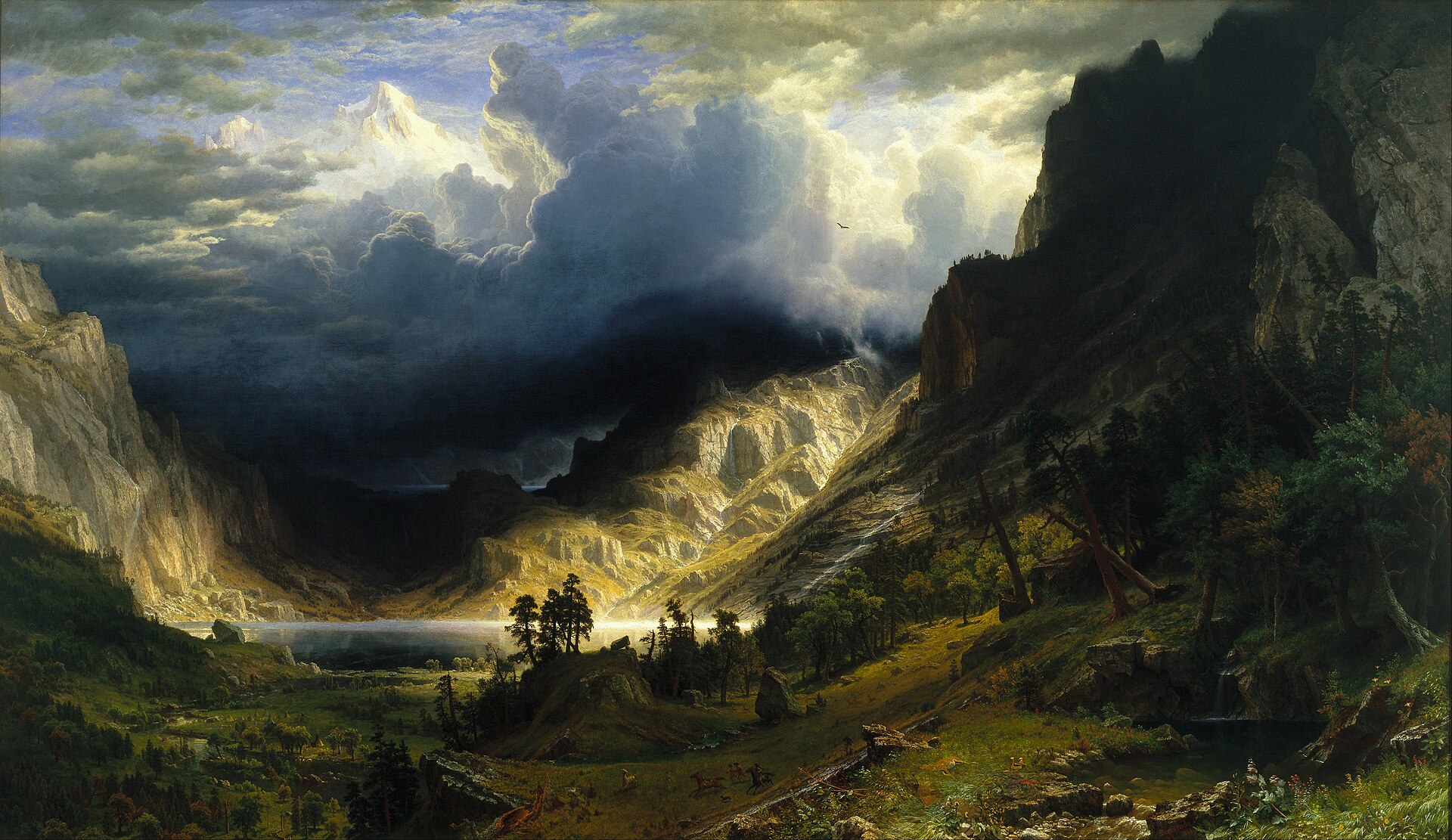
A Storm in the Rocky Mountains, Mt. Rosalie. Albert Bierstadt, 1866. Wikimedia Commons. Public domain.