
Psalm 33
22 verses · Hymn of praise
Our soul waits for the LORD; He is our help and our shield.
Introduction
Author unstated, the Creating Word, Book 1: The book of David, Poetry, Psalms Overview.
This psalm carries no title and names no writer, which is rare in the first book of the Psalter. It was written for the congregation of Israel at worship, with trained singers and players leading. It gives the assembly a reason to praise that holds in any week, because its ground is God's work in making the world and His rule over the nations. Listen for the call to play with skill, and for the claim that God's speech made all things and still governs them. Listen also for the close, where the singers speak together of what they trust.
Context
- Who
- The congregation of Israel, called to praise on grounds larger than its own circumstances
- What
- A hymn calling the congregation to praise God as the maker of the world and the ruler of the nations.
- Where
- The assembly at worship, with the temple musicians and their instruments
- When
- The date is unstated, since the psalm carries no superscription, and it was sung in Israel's temple worship.
- Why
- To give Israel a reason for praise that holds in any week, and to name what the nation trusts in place of armies and horses.
Historical context
The psalm carries no title and names no writer, which is rare in Book One. It has been read as the continuation of Psalm 32, whose last verse had already called the righteous to shout for joy. The harp and the ten-stringed lyre were the instruments of the Levitical singers appointed for the sanctuary. The psalm asks for a new song and for playing done well, so the praise it calls for is skilled work by trained men. The horse of verse 17 is the psalm's one piece of military realism. In that world a chariot horse was the decisive weapon and the thing a small nation could least afford. The law at Deuteronomy 17:16 had already told a king of Israel to acquire no more of them. A hearer who knew that law heard verse 17 as the law put to music.
Significance
For the congregation that sang it, the psalm supplied a reason to praise that did not depend on the week's news. Nothing in it reports a rescue, an enemy or a harvest. Its last three verses put the whole doctrine into the first person plural, which answered the army and the horse of verses 16 and 17 by naming what Israel trusted instead.
This chapter in Jewish lifeWhat this chapter is in Jewish life and reading.
How it is read
This psalm carries no heading in the Hebrew, and the corpus holds four English comments of Rashi on it, in The Judaica Press complete Tanach with Rashi, translated by A. J. Rosenberg, under a CC-BY licence. He explains the instrument of the second line as a matter of melody:
with a lyre of ten melodies Heb. בנבל עשור, of ten kinds of melody. (Rashi on Psalms 33:2:1)
On the gathering of the sea he sets the psalm's word beside the Targum of Onkelos at Exodus 15:8, at Rashi on Psalms 33:7:1. On the line about the God who forms every heart he gives the plain sense first:
He Who forms their hearts together All of their hearts together and knows all the thoughts. (Rashi on Psalms 33:15:1)
He then turns to the reading of the Sages in the same comment, which ties the line back to the watching from God's dwelling place and draws from it that all are examined with a single glance, citing the tractate Rosh Hashanah at Rashi on Psalms 33:15:1. Ibn Ezra stands on this chapter more fully than on any other in this range, at Ibn Ezra on Psalms 33:1:1, 33:2:1, 33:3:1, 33:4:1, 33:5:1, 33:6:1, 33:8:1, 33:9:1, 33:10:1, 33:11:1, 33:13:1, 33:16:1, 33:17:1, 33:18:1, 33:19:1, 33:20:1, 33:21:1 and 33:22:1, and Radak at Radak on Psalms 33:1:1 and 33:12:1. Sefaria holds no English version of those references, so this card cites them and quotes neither.
What the rabbis say
The corpus records 40 places where the rabbinic literature takes up a line of this psalm, 37 of them in the Midrash. Rashi reports one of the Talmud's readings at Rashi on Psalms 33:15:1, where the Sages are cited from the tractate Rosh Hashanah for the teaching that all are examined with a single glance. Bereshit Rabbah takes up lines of the psalm at Bereshit Rabbah 10:9, 5:6, 40:1, 62:1 and 92:2, which is the midrash on Genesis reading the psalm's account of creation by a word back into the first chapter of the Torah. The Midrash on the Psalms treats it at Midrash Tehillim 121:1 and 149:2. The Talmud takes up a line at Arakhin 13b:13, Avot DeRabbi Natan, Recension B 8:2 and Avot DeRabbi Natan, Recension B 21:2.
Sources: Rashi, Rashi on Psalms, in The Judaica Press complete Tanach with Rashi, translated by A. J. Rosenberg, under a CC-BY licence; Ibn Ezra, Ibn Ezra on Psalms, cited at Ibn Ezra on Psalms 33:1:1, 33:2:1, 33:3:1, 33:4:1, 33:5:1, 33:6:1, 33:8:1, 33:9:1, 33:10:1, 33:11:1, 33:13:1, 33:16:1, 33:17:1, 33:18:1, 33:19:1, 33:20:1, 33:21:1 and 33:22:1; Radak, Radak on Psalms, cited at Radak on Psalms 33:1:1 and 33:12:1; Bereshit Rabbah, cited at Bereshit Rabbah 10:9, 5:6, 40:1, 62:1 and 92:2; The Talmud, cited at Arakhin 13b:13, Avot DeRabbi Natan, Recension B 8:2 and Avot DeRabbi Natan, Recension B 21:2; MannaFest, the Sefaria corpus at scripts/data/sources/sefaria/psalms/33.json, fetched 2026-09-19, 2026.
Psalms 33:1-3
Rejoice in the LORD: Praise here is a command, and verse 1 gives its reason, that praise is fitting for the upright. Verses 2 and 3 name the instrument and the skill, the harp, ten strings, and playing done well. The song asked for is a new one.
Psalms 33:1
"Rejoice," therefore, "in the Lord, O you righteous," not when the interests of your home are flourishing, not when you are in good health of body, not when your fields are filled with all sorts of fruits, but when you have the Lord—such immeasurable Beauty, Goodness, Wisdom. Let the joy that is in him suffice for you.… For the just person, the divine and heavenly joy is lasting, since the Holy Spirit dwells in him once and for all. "But the firstfruit of the Spirit is charity, joy, peace." Therefore, "rejoice in the Lord, O you just."
Basil of Caesarea · written before 379 · Homilies on the Psalms 15:1 (Ps 33)patristic
2 more voices on this verseWhat preachers and commentators have said about this verse, in their own words.
Psalms 33:1
“Rejoice in the Lord. Joy is the soul of praise. To delight ourselves in God is most truly to extol him, even if we let no notes of song proceed from our lips. That God is, and that he is such a God, and our God, ours for ever and ever, should wake within us an unceasing and overflowing joy. To rejoice in temporal comforts is dangerous, to rejoice in self is foolish, to rejoice in sin is fatal, but to rejoice in God is heavenly.”
Charles Spurgeon · The Treasury of David, Vol. 2 (1870)Particular Baptist
Psalms 33:1
“The amount of the matter is, that the principal exercise in which it becomes the righteous to be employed is to publish among men the righteousness, goodness, and power of God, the knowledge of which is implanted in their minds.”
John Calvin · Commentaries (1554)reformed
make music to Him with ten strings: Adam Clarke and Albert Barnes both read the Hebrew as one instrument, the nebel with ten strings, where older English versions counted a third. Basil of Caesarea and Augustine read the harp as the body itself, its members turned to the service of God.
Psalms 33:2
“Praise the Lord with harp. Men need all the help they can get to stir them up to praise. This is the lesson to be gathered from the use of musical instruments under the old dispensation. Israel was at school, and used childish things to help her to learn; but in these days, when Jesus gives us spiritual manhood, we can make melody without strings and pipes.”
Charles Spurgeon · The Treasury of David, Vol. 2 (1870)Particular Baptist
2 more voices on this verse
Psalms 33:2
“It is necessary to praise the Lord on the harp; that is, to render harmoniously the actions of the body. Since, indeed, we sinned in the body, "when we yielded our members as slaves of sin, to lawlessness," let us give praise with our body, using the same instrument for the destruction of sin. Have you reviled? Bless. Have you defrauded? Make restitution. Have you been intoxicated? Fast. Have you made false pretensions? Be humble. Have you been envious? Console. Have you murdered? Bear witness, or afflict your body with the equivalent of martyrdom through confession.”
Basil of Caesarea · written before 379 · Homilies on the Psalms 15:2 (Ps 33)patristic
Psalms 33:2
“Praise Jehovah upon the harp. It is evident that the Psalmist here expresses the vehement and ardent affection which the faithful ought to have in praising God, when he enjoins musical instruments to be employed for this purpose. He would have nothing omitted by believers which tends to animate the minds and feelings of men in singing God's praises.”
John Calvin · Commentaries (1554)reformed
a shout of joy: John Gill tied the new song to new mercies, which come every morning and call for a fresh song each day. Basil of Caesarea heard the shout of joy as the cry of soldiers fighting side by side. Adam Clarke asked that the sound suit the words.
Psalms 33:3
“Sing unto him a new song,.... One newly composed on account of recent mercies received; and as the mercies of God are new every morning, there ought to be a daily song of praise to him; and so a new song is a continual song, as Christ is called the "new and living way", Heb 10:20; because he is the everliving way; or the constant and only one, which always was, is, and will be.”
2 more voices on this verse
Psalms 33:3
“Sing unto him a new song. All songs of praise should be unto him. Singing for singing's sake is nothing worth; we must carry our tribute to the King, and not cast it to the winds. Do most worshippers mind this? Our faculties should be exercised when we are magnifying the Lord, so as not to run in an old groove without thought; we ought to make every hymn of praise a new song. To keep up the freshness of worship is a great thing, and in private it is indispensable.”
Charles Spurgeon · The Treasury of David, Vol. 2 (1870)Particular Baptist
Psalms 33:3
“The loud noise is a certain inarticulate sound, when those who are fighting side by side in a war shout out in unison with each other. Sing, then, in harmony and in agreement and in union through charity.”
Basil of Caesarea · written before 379 · Homilies on the Psalms 15:3 (Ps 33)patristic
Psalms 33:4-5
For the word of the LORD: Verse 4 sets what God says beside what God does, and both are sound. Verse 5 names what He loves, righteousness and justice, and then fills the whole earth with His loving devotion. Praise in this psalm rests on the character named here.
Psalms 33:4
“For the word of the Lord is right. His ordinances both natural, moral, and spiritual, are right, and especially his incarnate Word, who is the Lord our righteousness. Whatever God has ordained must be good, and just, and excellent. There are no anomalies in God's universe, except what sin has made; his word of command made all things good. When we look at his word of promise, and remember its faithfulness, what reasons have we for joy and thankfulness! And all his works are done in truth.”
Charles Spurgeon · The Treasury of David, Vol. 2 (1870)Particular Baptist
1 more voice on this verse
Psalms 33:4
"If you see the heavens," he says, "and the order in them," they are a guide to faith, for through themselves they show the Craftsman; and, if you see the orderly arrangement about the earth, again through these things also your faith in God is increased. In fact, it is not by acquiring knowledge of God with our carnal eyes that we believe in him, but by the power of the mind we have perceived the invisible God through visible things. Therefore, "all his works are done with faithfulness."
Basil of Caesarea · written before 379 · Homilies on the Psalms 15:3 (Ps 33)patristic
the earth is full of His loving devotion: Augustine took mercy and judgment as a sequence, mercy shown first and judgment afterward asking an account of what mercy gave. Basil of Caesarea pictured a kind doctor who tries soft poultices before he takes up the knife. Adam Clarke found mercy marked on everything God made.
Psalms 33:5
“He loveth righteousness and judgment. The theory and practice of right he intensely loves. He doth not only approve the true and the just, but his inmost soul delights therein. The character of God is a sea, every drop of which should become a wellhead of praise for his people. The righteousness of Jesus is peculiarly dear to the Father, and for its sake he takes pleasure in those to whom it is imputed.”
Charles Spurgeon · The Treasury of David, Vol. 2 (1870)Particular Baptist
2 more voices on this verse
Psalms 33:5
“The copy in all God's works agrees exactly with the great original, the plan laid in the Eternal Mind, and varies not in the least jot. God has made it to appear in his works, (1.) That he is a God of inflexible justice: He loveth righteousness and judgment. There is nothing but righteousness in the sentence he passes and judgment in the execution of it.”
Matthew Henry · Commentary on the Whole Bible (1707-1721)puritan
Psalms 33:5
“The Judge wishes to have mercy on you and to share his own compassion.… But if he sees your heart unrepentant, your mind proud, your disbelief of the future life and your fearlessness of the judgment, then he desires the judgment for you, just as a reasonable and kind doctor tries at first with hot applications and soft poultices to reduce a tumor, but, when he sees that the mass is rigidly and obstinately resisting, casting away the olive oil and the gentle method of treatment, he prefers henceforth the use of the knife.”
Basil of Caesarea · written before 379 · Homilies on the Psalms 15:3 (Ps 33)patristic
Psalms 33:6-7
By the word of the LORD: Word and breath stand side by side here as what made the heavens, the same speech as Genesis 1:3. Augustine read the word and the breath of this verse as the Son and the Spirit. Verse 7 puts the depths into storehouses.
Psalms 33:6
“By the word of the Lord were the heavens made. The angelic heavens, the sidereal heavens, and the firmament or terrestrial heavens, were all made to start into existence by a word; what if we say by the Word, "For without him was not anything made that is made." It is interesting to note the mention of the Spirit in the next clause, and all the host of them by the breath of his mouth; the breath is the same as is elsewhere rendered Spirit. Thus the three persons of the Godhead unite in creating all things.”
Charles Spurgeon · The Treasury of David, Vol. 2 (1870)Particular Baptist
1 more voice on this verse
Psalms 33:6
The rule of truth which we hold, is, that there is one God Almighty, who made all things by His Word, and fashioned and formed, out of that which had no existence, all things which exist. Thus saith the Scripture, to that effect "By the Word of the Lord were the heavens established, and all the might of them, by the spirit of His mouth." And again, "All things were made by Him, and without Him was nothing made."
Irenaeus · written before 202 · Against Heresies 1:22.1patristic
He piles up the waters of the sea: Albert Barnes noted that the Hebrew verb is a participle, so the gathering goes on and the sea is held in place still. He set the word for heap, ned, beside the waters that stood up at the Red Sea and at the Jordan.
Psalms 33:7
“He gathereth the waters of the sea together as an heap. The waters were once scattered like corn strewn upon a threshing floor: they are now collected in one spot as an heap. Who else could have gathered them into one channel but their great Lord, at whose bidding the waters fled away? The miracle of the Red Sea is repeated in nature day by day, for the sea which now invades the shore under the impulse of sun and moon, would soon devour the land if bounds were not maintained by the divine decree.”
Charles Spurgeon · The Treasury of David, Vol. 2 (1870)Particular Baptist
Psalms 33:8-9
Let all the earth fear: The call widens from Israel to all the earth and all the people of the world. Verse 9 gives the ground, He spoke and it came to be, with no second cause named. The command that made it also holds it firm.
Psalms 33:8
“Let all the earth fear the Lord. Not only Jews, but Gentiles. The psalmist was not a man blinded by national prejudice, he did not desire to restrict the worship of Jehovah to the seed of Abraham. He looks for homage even to far off nations. If they are not well enough instructed to be able to praise, at least let them fear. There is an inferior kind of worship in the trembling which involuntarily admits the boundless power of the thundering God.”
Charles Spurgeon · The Treasury of David, Vol. 2 (1870)Particular Baptist
He spoke, and it came to be: Albert Barnes listed eight places in Genesis 1 where creation waits on a divine command, and he heard this verse answering them. He and the Jamieson, Fausset and Brown commentary both judged that the word done, added in older English, weakens the Hebrew.
Psalms 33:9
The psalm bids us to exult in the one who has come to earth from heaven, as in one who is set over the entirety, and who has brought the entirety into being from not being and who maintains all things in being, whose command becomes reality. For this is the meaning of the divine words, "He spoke, and they were made; he commanded, and they were created."
Gregory of Nyssa · written before 395 · On the Inscriptions of the Psalms 2:8.79patristic
1 more voice on this verse
Psalms 33:9
“For he spake, and it was done. Creation was the fruit of a word. Jehovah said, "Light be, "and light was. The Lord's acts are sublime in their ease and instantaneousness. "What a word is this?" This was the wondering enquiry of old, and it may be ours to this day. He commanded, and it stood fast. Out of nothing creation stood forth, and was confirmed in existence. The same power which first uplifted, now makes the universe to abide; although we may not observe it, there is as great a display of sublime power in confirming as in creating.”
Charles Spurgeon · The Treasury of David, Vol. 2 (1870)Particular Baptist
Psalms 33:10-11
frustrates the plans of the nations: The same Hebrew word, etsah, stands behind the plans of the nations in verse 10 and the counsel of the LORD in verse 11. One is frustrated and the other stands forever. What holds is the purposes of His heart, kept to every generation.
Psalms 33:10
“The Lord bringeth the counsel of the heathen to nought. While his own will is done, he takes care to anticipate the wilfulness of his enemies. Before they come to action he vanquishes them in the council chamber; and when, well armed with craft, they march to the assault, he frustrates their knaveries, and makes their promising plots to end in nothing.”
Charles Spurgeon · The Treasury of David, Vol. 2 (1870)Particular Baptist
1 more voice on this verse
Psalms 33:10
“It is possible to refer these things to the time of Jesus' passion when they thought that they were crucifying the King of glory, but he through the economy of the cross was renewing humanity. For in the resurrection the counsel of nations, of Pilate and his soldiers, and of whoever was active in the matter of the cross was brought to nought; the counsels of the princes were rejected, and also those of the high priests and scribes and kings of the people.”
Basil of Caesarea · written before 379 · Homilies on the Psalms 15:6 (Ps 33)patristic
The counsel of the LORD stands forever: Fulgentius of Ruspe held that no thought in God changes with time, the same before the world was made as after. Adam Clarke traced it from the making of the world to the gospel preached in all the world. Cassiodorus named the incarnation as that counsel.
Psalms 33:11
“The counsel of the Lord standeth for ever. He changes not his purpose, his decree is not frustrated, his designs are accomplished. God has a predestination according to the counsel of his will, and none of the devices of his foes can thwart his decree for a moment. Men's purposes are blown to and from like the thread of the gossamer or the down of the thistle, but the eternal purposes are firmer than the earth. The thoughts of his heart to all generations.”
Charles Spurgeon · The Treasury of David, Vol. 2 (1870)Particular Baptist
1 more voice on this verse
Psalms 33:11
“The counsel of the Lord standeth for ever,.... By which are meant, not the doctrines of the Gospel, nor the ordinances of it; though these will stand firm, and remain to the end of the world; but the purposes and decrees of God, which are wisely formed in himself, are eternal and unfrustrable, and relate to all things in providence and grace.”
Blessed is the nation: Blessed falls on a whole nation here, and the ground of it is which God is theirs. The people are called His inheritance, the portion He has taken for Himself. The choosing is His own act.
Psalms 33:12
“Blessed is the nation whose God is the Lord. Israel was happy in the worship of the only true God. It was the blessedness of the chosen nation to have received a revelation from Jehovah. While others grovelled before their idols, the chosen people were elevated by a spiritual religion which introduced them to the invisible God, and led them to trust in him. All who confide in the Lord are blessed in the largest and deepest sense, and none can reverse the blessing. And the people whom he hath chosen for his own inheritance.”
Charles Spurgeon · The Treasury of David, Vol. 2 (1870)Particular Baptist
Psalms 33:13-15
looks down from heaven: The lens widens from the chosen nation to all the sons of men, watched from one place. He shapes the hearts of each, so the maker of every heart is the one who considers every work. No plan is hidden from Him.
Psalms 33:13
“The Lord looketh from heaven. The Lord is represented as dwelling above and looking down below; seeing all things, but peculiarly observing and caring for those who trust in him. It is one of our choicest privileges to be always under our Father's eye, to be never out of sight of our best Friend. He beholdeth all the sons of men. All Adam's sons are as well watched as was Adam himself, their lone progenitor in the garden.”
Charles Spurgeon · The Treasury of David, Vol. 2 (1870)Particular Baptist
1 more voice on this verse
Psalms 33:13
“Consider the lofty spectator; consider him who is bending down regarding the affairs of humankind. Wherever you may go, whatever you may do, whether in the darkness or in the daytime, you have the eye of God watching. "From his habitation that he has prepared." The gates are not being opened, the curtains are not being drawn together, the habitation of God is ready for viewing. He looks on all people. No one escapes his sight; no darkness, no concealing walls, nothing is a hindrance to the eyes of God.”
Basil of Caesarea · written before 379 · Homilies on the Psalms 15:8 (Ps 33)patristic
From His dwelling place: Thomas Aquinas read this line as an answer to those who thought God dwelt too far off in heaven to know human affairs. He cited Job 22. Charles Spurgeon pictured the Lord as a great man at a window watching the crowd below.
Psalms 33:14
“From the place of his habitation he looketh upon all the inhabitants of the earth. Here the sentiment is repeated: it is worth repeating, and it needs repeating, for man is most prone to forget it. As great men sit at their windows and watch the crowd below, so doth the Lord; he gazes intently upon his responsible creatures, and forgets nothing of what he sees.”
Charles Spurgeon · The Treasury of David, Vol. 2 (1870)Particular Baptist
1 more voice on this verse
Psalms 33:14
“From the place of his habitation,.... Which is heaven, that is, the habitation of his holiness, and of his glory, Isa 63:15; he looketh upon all the inhabitants of the earth; good and bad; and not the nation of Israel only, but the Gentile world, whom in former times he overlooked, but under the Gospel dispensation visits in a way of mercy; by sending his son to die for them, by spreading his Gospel among them, by calling them by his grace, by planting churches in the midst of them, and by continuing his word and ordinances with them.”
He shapes the hearts of each: Charles Spurgeon and John Wesley took the verse to mean all hearts equally, kings and beggars, Jews and Gentiles. Augustine read it as each heart given its own gift, as members differ in one body. Evagrius Ponticus drew from it that God alone knows hearts.
Psalms 33:15
“When we fail to remember the one who formed each one of us in the womb, and formed all our hearts individually and understands all our works, we do not perceive that God is a helper of those who are lowly and inferior, a protector of the weak, a shelterer of those who have been given up in despair and Savior of those who have been given up as hopeless.”
Origen of Alexandria · written before 253 · Commentary on the Gospel of John 13:168patristic
2 more voices on this verse
Psalms 33:15
“He fashioneth their hearts alike. By which is meant that all hearts are equally fashioned by the Lord, kings' hearts as well as the hearts of beggars. The text does not mean that all hearts are created originally alike by God, such a statement would scarcely be true, since there is the utmost variety in the constitutions and dispositions of men. All men equally owe the possession of life to the Creator, and have therefore no reason to boast themselves. What reason has the vessel to glorify itself in presence of the potter? He considereth all their words.”
Charles Spurgeon · The Treasury of David, Vol. 2 (1870)Particular Baptist
Psalms 33:15
“Fashioneth - Having said that God sees and observes all men, he now adds, that he rules and governs them; yea, even the hearts which are most unmanageable, he disposes and inclines according to the counsel of his will. Alike - Or, equally, one as well as another: whether they be Jews or Gentiles, princes or peasants; all are alike subject to his jurisdiction.”
John Wesley · Explanatory Notes upon the Old Testament (1765)evangelical
Psalms 33:16-17
No king is saved: The psalm turns to what kings actually trust, the size of an army and the strength of a warrior. The horse was the chief weapon of that world, and Deuteronomy 17:16 already told a king of Israel to acquire no more of them. Neither army nor horse can save.
Psalms 33:16
“There is no king saved by the multitude of an host. Mortal power is a fiction, and those who trust in it are dupes. Serried ranks of armed men have failed to maintain an empire, or even to save their monarch's life when a decree from the court of heaven has gone forth for the empire's overthrow. The all seeing God preserves the poorest of his people when they are alone and friendless, but ten thousand armed men cannot ensure safety to him whom God leaves to destruction. A mighty man is not delivered by much strength.”
Charles Spurgeon · The Treasury of David, Vol. 2 (1870)Particular Baptist
A horse is a vain hope for salvation: John Wesley and Albert Barnes both note that the Hebrew word behind vain means a lie, a promise of safety the horse cannot keep. Arnobius the Younger recalled the horse and rider thrown into the sea in Israel's song at the Exodus. Charles Spurgeon added the cavalry of Sennacherib.
Psalms 33:17
“An horse is a vain thing for safety. Military strength among the Orientals lay much in horses and scythed chariots, but the psalmist calls them a lie, a deceitful confidence. Surely the knight upon his gallant steed may be safe, either by valour or by flight? Not so, his horse shall bear him into danger or crush him with its fall. Neither shall he deliver any by his great strength. Thus the strongest defences are less than nothing when most needed. God only is to be trusted and adored.”
Charles Spurgeon · The Treasury of David, Vol. 2 (1870)Particular Baptist
Psalms 33:18-19
the eyes of the LORD are on: Against the horse that cannot save, the psalm sets the eyes of the LORD. Fear and hope stand together in one line, those who fear Him and those who put their hope in His loving devotion. The two dangers named are death and famine.
Psalms 33:18
“He who does not trust in his own good deeds or expect to be justified by his works has, as his only hope of salvation, the mercies of God. For, when he considers that the expression "Behold the Lord and his reward" refers to each according to his work, and when he ponders his own evil deeds, he fears the punishment and cowers beneath the threats. There is good hope that gazes steadfastly at the mercies and kindness of God lest it be swallowed up by grief.”
Basil of Caesarea · written before 379 · Homilies on the Psalms 15:10 (Ps 33)patristic
1 more voice on this verse
Psalms 33:18
“He does not say that he will give them abundance (they have no reason either to desire it or to expect it), but he will keep them alive; they shall not starve; and, when destroying judgments are abroad, it ought to be reckoned a great favour, for it is a very striking one, and lays us under peculiar obligations, to have our lives given us for a prey.”
Matthew Henry · Commentary on the Whole Bible (1707-1721)puritan
keep them alive in famine: Adam Clarke read the pair as two kinds of death, sudden danger and the slow death of want. Matthew Henry noticed that the promise is life, with no promise of abundance. Charles Spurgeon recalled the meal and oil God kept for Elijah.
Psalms 33:19
“To deliver their soul from death. The Lord's hand goes with his eye; he sovereignly preserves those whom he graciously observes. Rescues and restorations hedge about the lives of the saints; death cannot touch them till the King signs his warrant and gives him leave, and even then his touch is not so much mortal as immortal; he doth not so much kill us as kill our mortality. And to keep them alive in famine. Gaunt famine knows its master. God has meal and oil for his Elijahs somewhere.”
Charles Spurgeon · The Treasury of David, Vol. 2 (1870)Particular Baptist
Psalms 33:20-22
Our soul waits for the LORD: The psalm ends in the congregation's own voice, He is our help and our shield. That help and that shield answer the army and the horse of verses 16 and 17. The last verse asks that loving devotion rest on them.
Psalms 33:20
“Our soul waiteth for the Lord,.... This, and what follows, are the words of the church, expressing her expectation, faith, and joy, by reason of what is suggested in the preceding verses.”
1 more voice on this verse
Psalms 33:20
“We must not only in word and tongue profess a believing regard to God, but it must be inward and sincere, a secret and silent attendance on him. [2.] We must rely on God, hope in his mercy, in the goodness of his nature, though we have not an express promise to depend upon. Those that fear God and his wrath must hope in God and his mercy; for there is no flying from God, but by flying to him.”
Matthew Henry · Commentary on the Whole Bible (1707-1721)puritan
we trust in His holy name: Charles Spurgeon saw the joy commanded in verse 1 now offered by the singers themselves. The trust is the ground of the joy, and he called faith the root and rejoicing its flower. Albert Barnes took the name to mean God Himself.
Psalms 33:21
“For our hearts shall rejoice in him. The duty commended and commanded in the first verse is here presented to the Lord. We, who trust, cannot but be of a glad heart, our inmost nature must triumph in our faithful God. Because we have trusted in his holy name. The root of faith in due time bears the flower of rejoicing. Doubts breed sorrow, confidence creates joy.”
Charles Spurgeon · The Treasury of David, Vol. 2 (1870)Particular Baptist
2 more voices on this verse
Psalms 33:21
“For our heart shall rejoice in him,.... Not in sin, nor in themselves and in their boastings, all such rejoicing is evil; but in the Lord, "in his Word"; as the Targum is, in the essential Word of God, Christ Jesus; in his person, righteousness, and salvation; and this joy is heart joy, inward joy, real joy, joy in the Holy Ghost; and is unspeakable and full of glory.”
Psalms 33:21
“Our faith measures mercy (Mt 9:29); and if of grace, it is no more of debt (Ro 11:6).”
Jamieson, Fausset & Brown · Commentary Critical and Explanatory on the Whole Bible (1871)reformed
as we put our hope in You: The word as sets a measure, and Charles Spurgeon and Albert Barnes both took the hope as the scale of the mercy asked. Spurgeon and Jamieson, Fausset and Brown tie it to Matthew 9:29. The same loving devotion filled the earth in verse 5.
Psalms 33:22
“Here is a large and comprehensive prayer to close with. It is an appeal for mercy, which even joyful believers need; and it is sought for in a proportion which the Lord has sanctioned. "According to your faith be it unto you, "is the Master's word, and he will not fall short of the scale which he has himself selected. Yet, Master, do more than this when hope is faint, and bless us far above what we ask or even think.”
Charles Spurgeon · The Treasury of David, Vol. 2 (1870)Particular Baptist
How this psalm is built
The form: A hymn of praise to the creating and governing word of God, sung by the congregation, as Delitzsch classes it.
The patterns in this chapter
| Device | What it does | Where to see it |
|---|---|---|
| The word of the LORD, carried from speech to making to rule | The word stands at verse 4 as what is right, at verse 6 as what made the heavens, and at verse 11 as the counsel that stands forever. One noun runs the whole argument, so the praise of verse 1 and the waiting of verse 20 rest on the same thing.Albert Barnes, Notes on the Book of Psalms, 1832 to 1869, on Psalm 33:4. | Psalm 33:4, Psalm 33:6, Psalm 33:11 |
| Etsah, the same word for the plan that fails and the counsel that stands | Verse 10 frustrates the plans of the nations and verse 11 keeps the counsel of the LORD forever, and the Hebrew noun behind both is etsah. The contrast is made in the vocabulary before it is made in the argument.Franz Delitzsch, Biblical Commentary on the Psalms, on Psalm 33:10. | Psalm 33:10, Psalm 33:11 |
| The army and the horse against the eye of the LORD | Verses 16 and 17 name what kings actually trust, the size of a host and the strength of a warhorse, and call both useless for saving. Verse 18 answers with the eyes of the LORD on those who fear Him. Deuteronomy 17:16 had already told a king of Israel to acquire no more horses.Charles Spurgeon, The Treasury of David, Vol. 2, 1870, on Psalm 33:16. | Psalm 33:16, Psalm 33:17, Psalm 33:18 |
| The widening lens, from the upright to the chosen nation to all the sons of men | The psalm opens on the righteous at verse 1, widens to all the earth at verse 8, narrows to the nation whose God is the LORD at verse 12, and widens again to all the inhabitants of the world at verse 14. The movement is deliberate and it puts Israel inside a picture rather than alone in one.John Gill, Exposition of the Old Testament, 1748 to 1763, on Psalm 33:13. | Psalm 33:1, Psalm 33:8, Psalm 33:12, Psalm 33:14 |
The pattern inside the psalm
7 more paragraphs on the patterns
Verse 6 puts the word and the breath of God's mouth side by side as what made the heavens, and it is the same speech as Genesis 1:3. Augustine read the word and the breath here as the Son and the Spirit, which is the oldest Christian reading of the verse and the reason it appears in discussions of creation by the Trinity.
The psalm has an internal pairing that is easy to miss. Verse 7 gathers the waters of the sea into storehouses, and verse 8 asks all the earth to fear. The fear is asked because of the gathering, so the sea under control is the ground of the reverence.
The eye is the psalm's governing image at the end. God looks down at verse 13, sees all the sons of men at verse 13, considers all their works at verse 15, and His eyes rest on those who fear Him at verse 18. The same faculty that surveys everybody rests on somebody.
The debated concept
Augustine read the word and the breath of verse 6 as the Son and the Spirit, and that reading has been standard in Christian exposition since. John Calvin holds the verse to its plain sense, the speech of God as the means of creation, and warns against resting a doctrine of the Trinity on a Hebrew parallelism where the second line restates the first. Both readings agree that the verse teaches creation by the word of God, and they differ on how much more it carries. The psalm makes no claim of its own about persons.
The divine connection
Verses 6 and 9 state that the heavens were made by speech and that what God said came to be with no second cause named. The psalm's claim is about agency rather than about mechanism, and it should not be read as a description of how the world came to be. What it does is put creation and providence under one act, which is why verse 10, where a war council comes to nothing, follows verse 9 without a change of subject.
Keep studying
Sources for this chapter
The summary
Jamieson, Fausset & Brown, Commentary Critical and Explanatory; John Calvin, Commentaries; John Wesley, Notes on the Old Testament and Matthew Henry, Complete Commentary.
The form and classifications
Charles Spurgeon, The Treasury of David, Vol. 2, 1870, on Psalm 33; Franz Delitzsch, Biblical Commentary on the Psalms, on Psalm 33; John Calvin, Commentary on the Book of Psalms, 1557, on Psalm 33:16 and Matthew Henry, Commentary on the Whole Bible, 1710, on Psalm 33.
The exposition
Adam Clarke, Commentary on the Bible; Albert Barnes; Arnobius the Younger, Commentary on the Psalms; Augustine, Expositions on the Psalms; Augustine of Hippo, Exposition on Psalm 33; Basil of Caesarea, Homilies on the Psalms; Cassiodorus, Explanation of the Psalms; Charles Spurgeon, The Treasury of David; Evagrius Ponticus, On Thoughts; Franz Delitzsch, Biblical Commentary on the Psalms; Fulgentius of Ruspe, Book to Victor against the Sermon of Fastidiosus the Arian; Gregory of Nyssa, On the Inscriptions of the Psalms; Jamieson, Fausset & Brown, Commentary Critical and Explanatory on the Whole Bible; John Calvin; John Gill, Exposition of the Old Testament; John Wesley, Explanatory Notes upon the Old Testament; Matthew Henry, Commentary on the Whole Bible and Thomas Aquinas, Exposition on the Psalms of David.
The painting
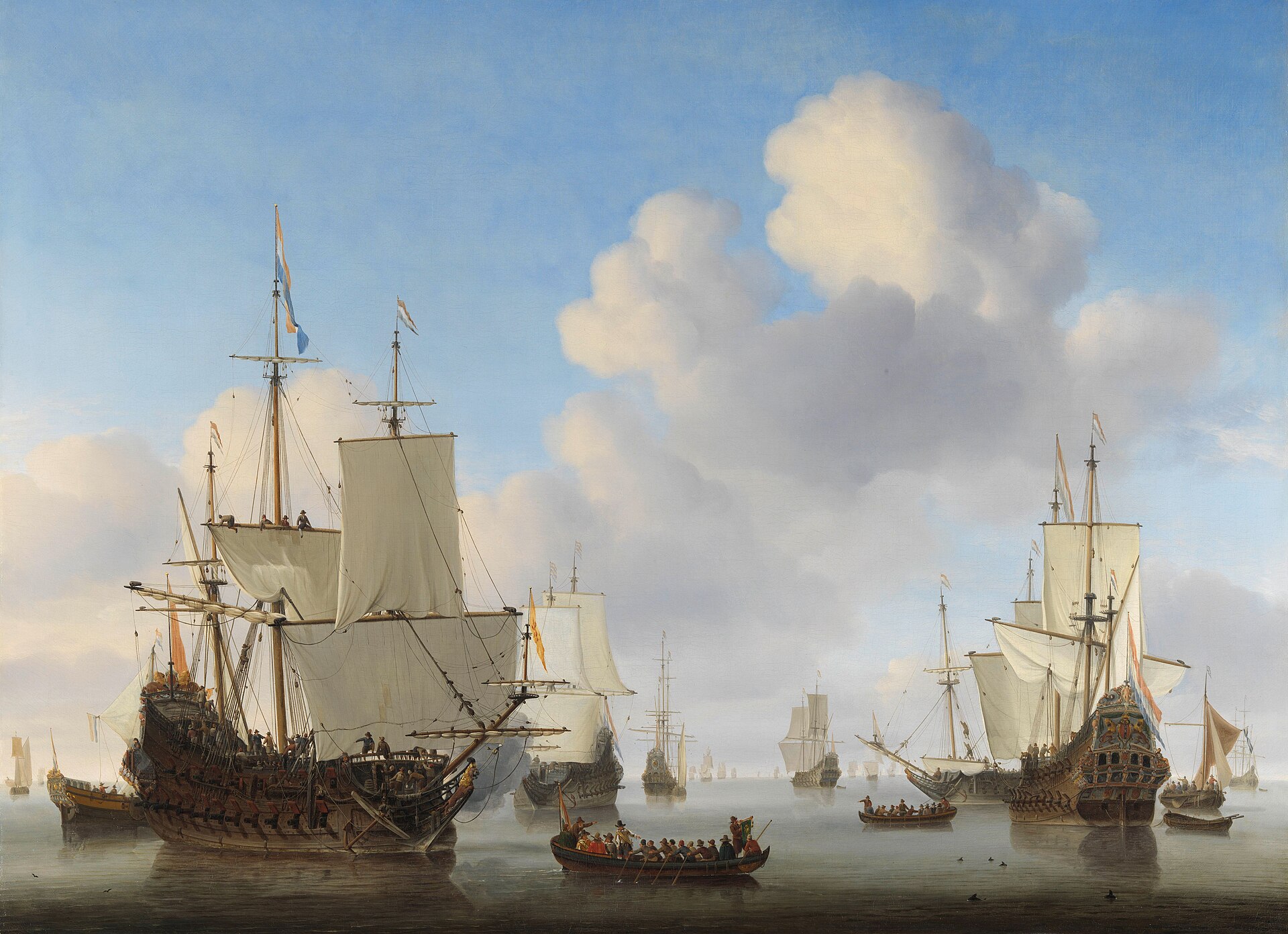
Dutch Ships in a Calm. Willem van de Velde the Younger, Circa 1665. Wikimedia Commons. Public domain.