
Psalm 29
11 verses · Hymn of praise
Ascribe to the LORD, O heavenly beings, ascribe to the LORD glory and strength.
Introduction
David, the Voice in the Storm, Book 1: The book of David, Poetry, Psalms Overview.
David is named in the heading of this psalm, and it follows a thunderstorm across the whole land, from the sea in the west to the desert in the south. Israel's neighbours sang of their storm god in the same kind of weather, and this psalm gives every crash of it to the LORD by name. Listen for the one phrase repeated like thunder through the middle of the psalm, and count it. Listen also for where the storm ends, since the psalm closes on a word of blessing for God's own people.
Context
- Who
- Israelites surrounded by neighbours who credited the storms to Baal
- What
- A hymn that follows a thunderstorm across the land and credits every stroke of it to the LORD.
- Where
- A thunderstorm tracked from the Mediterranean coast across Lebanon and down into the southern desert
- When
- The reign of David, about 1010 to 970 BC by the superscription.
- Why
- To claim the storm, which Israel's neighbours gave to Baal, for the LORD alone.
Historical context
The psalm follows a real weather pattern. Storms in that region form over the Mediterranean and drive inland from the west, and this one comes over many waters, strikes the cedar forests of Lebanon, shakes the mountains and passes on to the Wilderness of Kadesh in the far south. The cedars of Lebanon were the great timber of the ancient world, and breaking them is how the psalm measures the voice that does it. Israel's neighbours told these stories about Baal, the storm god of Canaan, and the texts recovered at Ugarit on the Syrian coast describe him thundering and riding the clouds. Psalm 29 uses the same weather and gives every stroke of it to the LORD by name, seven times over.
Significance
An Israelite farmer's harvest turned on the rain, and the pull to hedge his worship toward whoever was thought to send it was constant. This psalm says the storm has one owner. The last verse closes with the LORD blessing his people with peace, so the voice that snaps cedars gives quiet to the people it belongs to.
This chapter in Jewish lifeWhat this chapter is in Jewish life and reading.
What is done
Of all the first thirty psalms, this is the one whose words shaped a fixed prayer said every day. Rashi is quoted here from the Judaica Press Tanach with Rashi, and he reads the opening verses as the source of the order of the Amidah, the standing prayer. From the first call he derives the first blessing, which names the Patriarchs, and he cites the rabbinic discussions behind that (Rashi on Psalms 29:1:1). From the glory and might of the same verse he derives the second blessing, of God's mighty deeds (Rashi on Psalms 29:1:3). From the glory due the Name, in the second verse, he derives the third, the blessing of the sanctity of the Name. He then counts the whole psalm. "In this psalm, there are eighteen mentions of God's name, and corresponding to them, they instituted eighteen blessings" (Rashi on Psalms 29:2:1). That is why the standing prayer is known by the number eighteen, and a Christian reader who wants to understand how a Jewish service is built can start here.
The psalm is also widely said at the reception of the Sabbath on Friday evening, and at the return of the Torah scroll to the ark. That is the writer's reading, because no file in this repository names Kabbalat Shabbat or the Torah procession, and it is marked as the writer's reading until a source is filed. What this repository does carry about the psalm is a claim of another kind, that the sons of God of the first verse have been read in several ways. That question and the storm language this psalm shares with the texts recovered at Ugarit are both owed pages under docs/lanes/FEATURE-PAGES-OWED.md.
How it is read
Rashi reads the seven voices of the Lord in this psalm as two events, the sea and the mountain. The voice upon the waters, in the third verse, is the Sea of Reeds (Rashi on Psalms 29:3:1). Everything after it he refers to the giving of the Torah at Sinai. At the fourth verse he says that God "moderated His voice according to the strength of Israel", so that the people could bear it (Rashi on Psalms 29:4:1). At the fifth he adds the sharp edge of that mercy. Israel heard the living God speak out of the fire and lived, and "the nations of the world would hear it and die" (Rashi on Psalms 29:5:1). The skipping of the sixth verse is the cedars and the mountains that "came to hear the giving of the Torah" (Rashi on Psalms 29:6:1). At the seventh he reports what the Sages taught about the flames. "The utterance of the Decalogue emanated from His mouth with a flame of fire and was engraved on the tablets according to their form" (Rashi on Psalms 29:7:1).
Two of his notes carry the kind of detail the founder's order asks this card to show. At the eighth verse Rashi names the five names the wilderness carried in the Sages' teaching. They are the desert of Sinai, of Zin, of Kadesh, of Kedemoth and of Paran. The third is so called "because Israel was sanctified on its account" (Rashi on Psalms 29:8:2). At the ninth verse he carries a saying of Rabbi Phinehas about the word the psalm uses for the hinds. The verse says hinds rather than harts, the females rather than the males, "because the feet of the females stand straighter than those of the males" (Rashi on Psalms 29:9:1).
The tenth verse draws the best story in the chapter. Rashi gives his own reading first, of God enthroned alone at the flood and alone now. Then he reports what the Sages expounded. The nations heard a great stirring and were frightened, and they came to Balaam to ask whether God was bringing another flood. Balaam answered that God had sworn against a second flood. "The sound of the stirring that you heard is that the Holy One, blessed be He, is giving a Torah to His people" (Rashi on Psalms 29:10:1). The rabbis teach it, and this site reports it as their teaching rather than as a fact of the text. Ibn Ezra, Radak and Metzudat David comment on this chapter, and the corpus carries their refs without English text. They stand here cited and unquoted at Ibn Ezra on Psalms 29:4:1, 29:7:1, 29:10:1 and 29:11:1, at Radak on Psalms 29:2:1, 29:5:1 and 29:11:1, and at Metzudat David on Psalms 29:2:1.
What the rabbis say
The corpus carries forty locators on this psalm and the text of none, so each is cited and linked here rather than quoted. Seven are Talmudic, and all of them stand in the tractate on prayer or in its Jerusalem counterpart, which fits a psalm read as the source of the Amidah. They are Berakhot 28b:17 on the first verse, Berakhot 30b:18 on the second, Berakhot 28b:22 on the third, and Rosh Hashanah 30b:12 on the eighth. Three stand in the Jerusalem Talmud, at Berakhot 5:1:7 on the second verse, 2:4:10 on the fifth and 2:4:13 on the tenth.
The Mekhilta carries nine, more than any other midrashic work here, because the psalm is read of Sinai. They are Mekhilta DeRabbi Yishmael, Bachodesh 1:19, 9:1 and 9:2 on the fourth and seventh verses, and Amalek 3:1 on the tenth. Beside them stand Mekhilta DeRabbi Shimon Ben Yochai 18:1 on the ninth verse, 19:16 on the tenth, and an entry of its Additions at 6:2 on the fifth.
Bamidbar Rabbah carries six, at 2:1 on the first verse, 10:1 and 14:21 on the fourth, and 1:3, 11:7 and 12:12 on the eleventh. Bereshit Rabbah carries three, at 49:8 on the first verse, 5:4 on the third and 31:3 on the fifth, with two entries of Bereshit Rabbati on Bereshit at 64 and 32. Three entries of Midrash Sekhel Tov stand on the eighth and ninth verses, on Exodus 15:14:2, Genesis 30:37:3 and Exodus 18:27:3.
The rest are scattered. On the eighth verse the corpus carries Midrash Tannaim on Deuteronomy 11:12:4 and Sifrei Devarim 40:4. On the seventh it carries Midrash Tanchuma, Vaera 5:6, Midrash Tannaim on Deuteronomy 33:2:32, and an entry of Otzar Midrashim from the Pesikta Chadata. On the second verse it carries Midrash Tehillim 87:5 and Ein Yaakov, Berakhot 5:1, with Ein Yaakov, Pesakhim 10:9 on the third and Rosh Hashanah 4:5 in the Glick Edition on the fifth. Three close the chapter, at Midrash Aggadah on Numbers 6:26:3, Midrash Lekach Tov on Esther 3:5:1, and an entry of Sifra on Vayikra. What each of them teaches is a saying of the rabbis, and is reported as theirs wherever this site quotes one. The quotations wait on a fetch that carries the text.
Sources: Rashi, Rashi on Psalms 29:1:1 to 29:10:1, the Judaica Press complete Tanach with Rashi, translated by A. J. Rosenberg; Ibn Ezra, Ibn Ezra on Psalms 29:4:1, 29:7:1, 29:10:1 and 29:11:1, cited by ref because the corpus carries no English text; Radak, Radak on Psalms 29:2:1, 29:5:1 and 29:11:1, cited by ref because the corpus carries no English text; Metzudat David, Metzudat David on Psalms 29:2:1, cited by ref because the corpus carries no English text; MannaFest, the sons of God and the storm gods rows of docs/lanes/FEATURE-PAGES-OWED.md; The Sefaria corpus, scripts/data/sources/sefaria/psalms/29.json, the 7 Talmud and 33 Midrash locators of this chapter.
Ascribe to the LORD: The call goes to heavenly beings, bene elim in Hebrew, the sons of the mighty. Ascribe sounds three times in two verses. They are told to give glory and strength, and to worship in holy splendour.
Psalms 29:1
“Give unto Jehovah, ye sons of the mighty. It was no doubt David's design to lead all men to worship and reverence God; but as it is more difficult to reduce great men, who excel in rank, to order, he expressly addresses himself to them. It is obvious, that the LXX, in giving the translation, sons of rams, were led into a mistake by the affinity of the Hebrew words.”
John Calvin · Commentaries (1554)reformed
Psalms 29:2
“Give unto the Lord the glory due unto his name. A third time the admonition is given, for men are backward in glorifying God, and especially great men, who are often too much swollen with their own glory to spare time to give God his rightful praise, although nothing more is asked of them than is most just and right. Surely men should not need so much pressing to give what is due, especially when the payment is so pleasant.”
Charles Spurgeon · The Treasury of David, Vol. 2 (1870)Particular Baptist
1 more voice on this verse
Psalms 29:2
“The sanctuary then was the beauty of holiness, Ps. xlviii. The beauty of the sanctuary was the exact agreement of the worship there performed with the divine appointment--the pattern in the mount. Now, under the gospel, solemn assemblies of Christians (which purity is the beauty of) are the places where God is to be worshipped.”
Matthew Henry · Commentary on the Whole Bible (1707-1721)puritan
the God of glory thunders: The voice of the LORD sounds seven times from verse 3 to verse 9, and here it thunders over the waters. The waters it crosses become His throne at verse 10. Verse 4 calls the voice powerful and majestic before it touches a tree.
Psalms 29:3
“The voice of the Lord is upon the waters. The thunder is not only poetically but instructively called "the voice of God, "since it peals from on high; it surpasses all other sounds, it inspires awe, it is entirely independent of man, and has been used on some occasions as the grand accompaniment of God's speech to Adam's sons. There is a peculiar terror in a tempest at sea, when deep calleth unto deep, and the raging sea echoes to the angry sky.”
Charles Spurgeon · The Treasury of David, Vol. 2 (1870)Particular Baptist
2 more voices on this verse
Psalms 29:3
“The waters - Above in the clouds, which are called waters, Gen. i, 7 chap. xviii, 11. The Divine power displays itself in those high places, which are far above the reach of all earthly potentates. Many - Upon the clouds, in which there are vast treasures of water, and upon which God is said to sit or ride, chap. xviii, 10, 11; civ, 3.”
John Wesley · Explanatory Notes upon the Old Testament (1765)evangelical
Psalms 29:3
“The waters are also the saints, because rivers flow from within them, that is, spiritual teaching that refreshes the souls of the hearers. Again, they receive water that springs up to eternal life, wherefore it becomes in those who receive it rightly "a fountain of water, springing up unto life everlasting." On such waters, then, is the Lord.”
Basil of Caesarea · written before 379 · Homilies on the Psalms 13:4 (Ps 29)patristic
Psalms 29:4
“The voice of the Lord is not in the weak and dissolute soul but in that which vigorously and powerfully achieves the good.… Magnificence is virtue extraordinarily great. One who performs great actions becomingly … hears himself called magnificent. When the soul is not enslaved by the pride of the flesh but assumes a greatness and dignity proper to it because of its awareness of its attributes received from God, in this soul is the voice of the Lord.”
Basil of Caesarea · written before 379 · Homilies on the Psalms 13:4 (Ps 29)patristic
1 more voice on this verse
Psalms 29:4
“The voice of the Lord is powerful. An irresistible power attends the lightning of which the thunder is the report. In an instant, when the Lord wills it, the force of electricity produces amazing results.”
Charles Spurgeon · The Treasury of David, Vol. 2 (1870)Particular Baptist
breaks the cedars: Cedars of Lebanon were the strongest timber the ancient world knew, and the voice breaks them. Sirion is the Sidonian name for Mount Hermon, given at Deuteronomy 3:9. Both mountains skip under the thunder, one like a calf and one like a young wild ox.
Psalms 29:5
“The voice of the Lord breaketh the cedars. "Black from the stroke above, the smouldering pine Stands a sad shattered trunk." Noble trees fall prostrate beneath the mysterious bolt, or stand in desolation as mementoes of its power. Lebanon itself is not secure, high as it stands, and ancient as are its venerable woods: Yea, the Lord breaketh the cedars of Lebanon. The greatest and most venerable of trees or men, may not reckon upon immunity when the Lord is abroad in his wrath.”
Charles Spurgeon · The Treasury of David, Vol. 2 (1870)Particular Baptist
Psalms 29:6
“He maketh them also to skip like a calf; Lebanon and Sirion like a young unicorn. Not only the trees, but the mountains themselves move as though they frisked and leaped like young bulls or antelopes. As our own poets would mention hills and valleys known to them, so the Psalmist hears the crash and roar among the ranges of Libanus, and depicts the tumult in graphic terms.”
Charles Spurgeon · The Treasury of David, Vol. 2 (1870)Particular Baptist
1 more voice on this verse
Psalms 29:6
“Them - The cedars; which being broken by the thunder, the parts of them are suddenly and violently hurled hither and thither. Sirion - An high mountain beyond Jordan joining to Lebanon. Lebanon and Sirion are said to skip or leap, both here, and chap. cxiv, 4, by a poetical hyperbole.”
John Wesley · Explanatory Notes upon the Old Testament (1765)evangelical
strikes with flames of fire: The voice strikes with flames of fire and shakes the Wilderness of Kadesh in the southern desert. The storm has crossed the land from Lebanon to the wilderness, and in verse 9 the voice twists the oaks. In His temple all cry Glory while the thunder still rolls.
Psalms 29:7
“The voice of the Lord divideth the flames of fire. Or "cutteth with flames of fire" (e); that is, the thunder breaks through the clouds with flames of fire, or lightning, as that is sometimes called, Psa 105:32; and with which it cleaves asunder trees and masts of ships, cuts and hews them down, and divides them into a thousand shivers.”
2 more voices on this verse
Psalms 29:7
“Although fire seems to human intelligence to be incapable of being cut or divided, yet by the command of the Lord it is cut through and divided. I believe that the fire prepared in punishment for the devil and his angels is divided by the voice of the Lord, in order that, since there are two capacities in fire, the burning and the illuminating, the fierce and punitive part of the fire may wait for those who deserve to burn, while its illuminating and radiant part may be allotted for the enjoyment of those who are rejoicing.”
Basil of Caesarea · written before 379 · Homilies on the Psalms 13:6 (Ps 29)patristic
Psalms 29:7
“Horace, the poet, owns that he was reclaimed from atheism by the terror of thunder and lightning, which he describes somewhat like this of David, lib. The thunder is said here to discover the forest, that is, it so terrifies the wild beasts of the forest that they quit the dens and thickets in which they hid themselves are so are discovered.”
Matthew Henry · Commentary on the Whole Bible (1707-1721)puritan
Psalms 29:8
“As the storm travelled, it burst over the desert. The voice of the Lord shaketh the wilderness; the Lord shaketh the wilderness of Kadesh. God courts not the applause of men—his grandest deeds are wrought where man's inquisitive glance is all unknown. Where no sound of man was heard, the voice of God was terribly distinct. The vast and silent plains trembled with affright. Silence did homage to the Almighty voice. Low lying plains must hear the voice of God as well as lofty mountains; the poor as well as the mighty must acknowledge the glory of the Lord.”
Charles Spurgeon · The Treasury of David, Vol. 2 (1870)Particular Baptist
1 more voice on this verse
Psalms 29:8
“The desert was the church that, at first, had no children. By the preaching of Christ, this wilderness "was shaken" and "came to labor and gave birth, and there was born in a single day an entire nation." She who before was called the "wilderness of Cades," the desert of holiness—inasmuch as she had been barren of virtues—begins "to bring forth stags" and send out in throngs holy people who kill the serpents on earth, contemptuous of their poisons. While they are running throughout the world proclaiming the gospel of Christ, "in his temple all say 'Glory' " to God!”
Jerome · written before 420 · Homily on the Epiphany and Psalm 28patristic
Psalms 29:9
The voice of the Lord maketh the hinds to calve, those timid creatures, in deadly fear of the tempest, drop their burdens in an untimely manner. Perhaps a better reading is, "the oaks to tremble, "especially as this agrees with the next sentence, and discovereth the forests. The dense shades of the forest are lit up with the lurid glare of the lightning, and even the darkest recesses are for a moment laid bare. "The gloomy woods Start at the flash, and from their deep recesses Wide flaming out, their trembling inmates shake."
Charles Spurgeon · The Treasury of David, Vol. 2 (1870)Particular Baptist
1 more voice on this verse
Psalms 29:9
“Terror-stricken animals and denuded forests close the illustration. In view of this scene of awful sublimity, God's worshippers respond to the call of Ps 29:2, and speak or cry, "Glory!" By "temple," or "palace" (God's residence, Ps 5:7), may here be meant heaven, or the whole frame of nature, as the angels are called on for praise.”
Jamieson, Fausset & Brown · Commentary Critical and Explanatory on the Whole Bible (1871)reformed
sits enthroned over the flood: The word for flood here is mabbul, used elsewhere only of Noah's flood in Genesis. The LORD sits enthroned over that water as King forever. The voice that breaks cedars gives His people strength and peace.
Psalms 29:10
“The Lord sitteth upon the flood. Flood follows tempest, but Jehovah is ready for the emergency. No deluge can undermine the foundation of his throne. He is calm and unmoved, however much the deep may roar and be troubled: his government rules the most unstable and boisterous of created things. Far out on the wild waste of waters, Jehovah "plants his footsteps in the sea, and rides upon the storm, " Yea, the Lord sitteth King for ever. Jesus has the government upon his shoulders eternally: our interests in the most stormy times are safe in his hands.”
Charles Spurgeon · The Treasury of David, Vol. 2 (1870)Particular Baptist
1 more voice on this verse
Psalms 29:10
“God sits in the soul that shines from its washing, as if he were making it a throne for himself.”
Basil of Caesarea · written before 379 · Homilies on the Psalms 13:8 (Ps 29)patristic
Psalms 29:11
“Power was displayed in the hurricane whose course this Psalm so grandly pictures; and now, in the cool calm after the storm, that power is promised to be the strength of the chosen. He who wings the unerring bolt, will give to his redeemed the wings of eagles; he who shakes the earth with his voice, will terrify the enemies of his saints, and give his children peace. Why are we weak when we have divine strength to flee to? Why are we troubled when the Lord's own peace is ours?”
Charles Spurgeon · The Treasury of David, Vol. 2 (1870)Particular Baptist
1 more voice on this verse
Psalms 29:11
“Peace is a blessing of inestimable value, which God designs for all his people. The work of righteousness is peace (great peace have those that love thy law ); but much more the crown of righteousness: the end of righteousness is peace; it is endless peace. When the thunder of God's wrath shall make sinners tremble the saints shall lift up their heads with joy.”
Matthew Henry · Commentary on the Whole Bible (1707-1721)puritan
How this psalm is built
The form: A description of the effects produced by a thunderstorm lately passed, as Clarke classes it.
The patterns in this chapter
| Device | What it does | Where to see it |
|---|---|---|
| The voice of the LORD, named seven times | The phrase the voice of the LORD opens verse 3 and returns through the psalm until it has been used seven times, twice inside verse 4 alone. Adam Clarke notes that thunder is called the voice of the LORD elsewhere in Scripture and lists Exodus 9:23, Job 37:4, Psalm 18:13 and Isaiah 30:30 for it. Matthew Henry reads the effect of the repetition on the hearer, since a man whose ear tingles with the thunder will grant that the voice is full of majesty and will ask what the arm must be.Adam Clarke, Commentary on the Bible, 1832, on Psalm 29:3. | Psalm 29:3, Psalm 29:4, Psalm 29:5, Psalm 29:7, Psalm 29:8, Psalm 29:9 |
| The command to ascribe, given three times | Verses 1 and 2 give the same command three times over to the heavenly beings, and the psalm speaks to no one else until its last line. Spurgeon counts the third call and explains it by the hearers, since men are slow to give God His due and great men slowest of all. John Calvin reads the address as aimed at those who excel in rank, because they are the hardest to bring to order, and he notes that the Septuagint took the Hebrew for a different word and rendered it sons of rams.Charles Spurgeon, The Treasury of David, Vol. 2, 1870, on Psalm 29:2. | Psalm 29:1, Psalm 29:2 |
| The storm named place by place | The psalm lists what the voice does in order: the waters, the cedars of Lebanon, Lebanon and Sirion, the flames of fire, the Wilderness of Kadesh, the oaks and the stripped forests. Adam Clarke holds that the whole psalm is taken up with the effects of one storm. Spurgeon follows the list as a route and marks the point where the storm travels on and bursts over the desert, where no man was there to hear it.Charles Spurgeon, The Treasury of David, Vol. 2, 1870, on Psalm 29:8. | Psalm 29:3, Psalm 29:5, Psalm 29:6, Psalm 29:8, Psalm 29:9 |
| The strength ascribed at the start and given at the close | Verse 1 tells the heavenly beings to ascribe to the LORD glory and strength. Verse 11 says the LORD gives His people strength, and the cry of Glory has already been raised in His temple at verse 9. Spurgeon reads the last verse against the hurricane the psalm has just described: the power shown in the storm is promised in the calm afterwards to the people God has chosen. Matthew Henry takes the peace of the same verse as a blessing designed for all of them.Charles Spurgeon, The Treasury of David, Vol. 2, 1870, on Psalm 29:11. | Psalm 29:1, Psalm 29:9, Psalm 29:11 |
The structure and the counted pattern
This site's published summary of the chapter calls it the psalm of the sevenfold voice of Jehovah, and the phrase the voice of the LORD stands in the Berean text at verses 3, 4 twice, 5, 7, 8 and 9. The command to ascribe is given three times in verses 1 and 2, which Spurgeon counts and explains by the slowness of the hearers. The glory and strength ascribed at verse 1 are given away at verse 11, so the psalm is framed by the same two words.
3 more paragraphs on the patterns
Psalms of the same weather
Adam Clarke names Psalm 18:13, Exodus 9:23, Job 37:4 and Isaiah 30:30 as the places where thunder is called the voice of the LORD. John Wesley reads the waters of verse 3 as the clouds, and names Genesis 1:7 for the waters above and Psalm 18:10 and Psalm 104:3 for God riding upon them. Albert Barnes sets the skipping of verse 6 beside Psalm 114:4 and Psalm 68:16, and explains Sirion from Deuteronomy 3:9, where the Sidonians are said to call Hermon by that name.
How the fathers read the storm
Augustine takes the voice over the waters at verse 3 as the voice of Christ over the peoples, the breaking of the cedars at verse 5 as the humbling of the proud, and the moving of the wilderness at verse 8 as the Gentiles brought to faith who had been without God in the world. Jerome reads the same wilderness as the church that at first had no children and then bore a nation in a single day, and he ends where verse 9 ends, with all in the temple saying Glory.
The pattern inside the psalm
The psalm is a frame around a storm. What the heavenly beings are told to ascribe in verse 1 is what God gives away in verse 11. Jamieson, Fausset and Brown make the link plain at verse 9: the worshippers who cry Glory are answering the call of verse 2, and the temple there may mean heaven or the whole frame of nature.
Keep studying
Studies4
Words12
Subjects1
Sources for this chapter
The summary
Jamieson, Fausset & Brown, Commentary Critical and Explanatory; John Calvin, Commentaries; John Wesley, Notes on the Old Testament and Matthew Henry, Complete Commentary.
The form and classifications
Adam Clarke, Commentary on the Bible, 1832, on Psalm 29:1; Augustine of Hippo, Exposition on Psalm 29, 430, on Psalm 29:3; John Calvin, Commentaries, 1554, on Psalm 29:1 and Matthew Henry, Commentary on the Whole Bible, 1710, on Psalm 29:8.
The exposition
Albert Barnes, Notes on the Book of Psalms; Charles Spurgeon, The Treasury of David; Franz Delitzsch, Biblical Commentary on the Psalms; John Gill, Exposition of the Old Testament and Matthew Henry, Commentary on the Whole Bible.
The painting
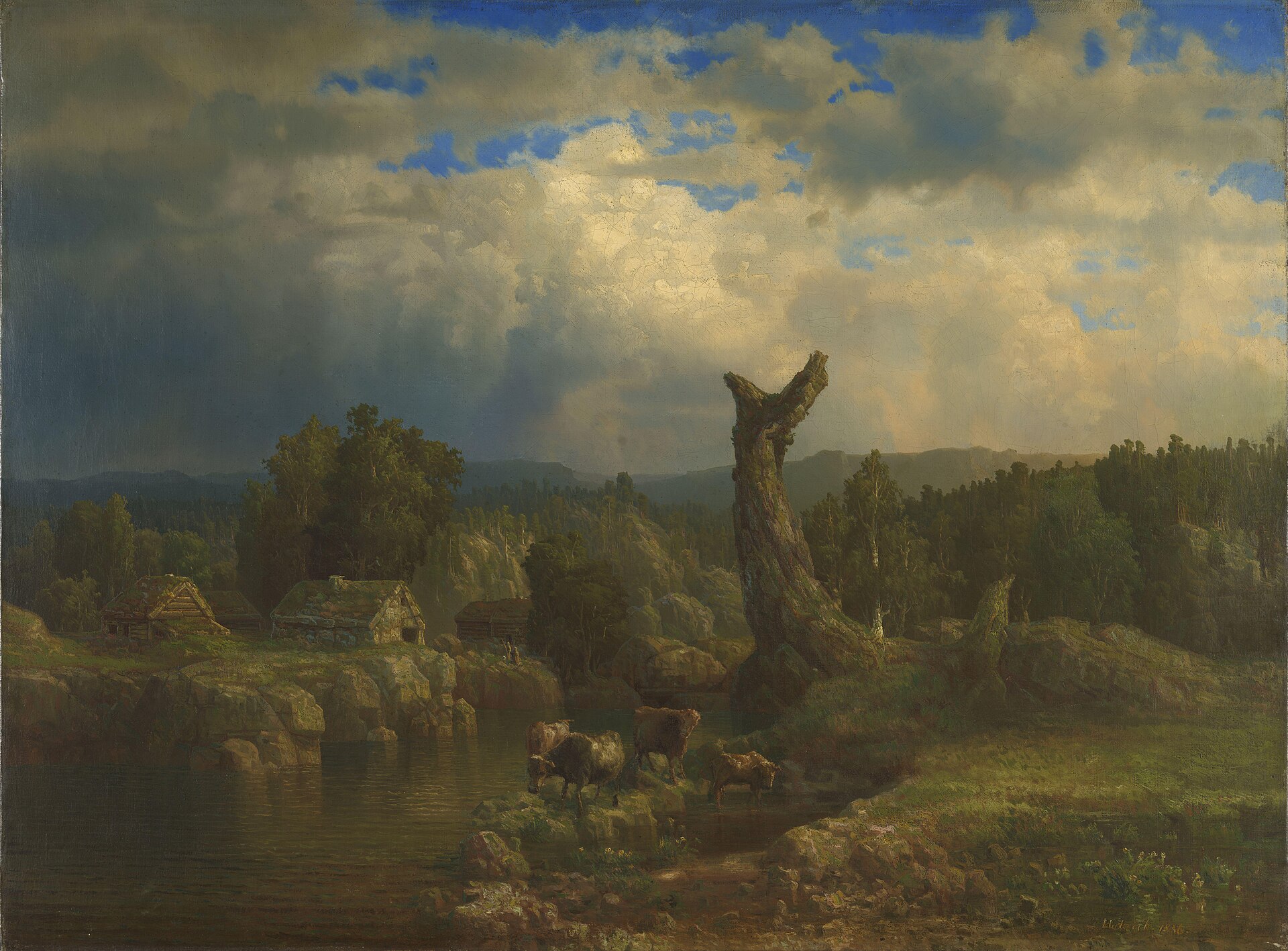
Summer Landscape, Thunder looms. Lars Hertervig, 1856. National Museum of Art, Architecture and Design. Public domain.