
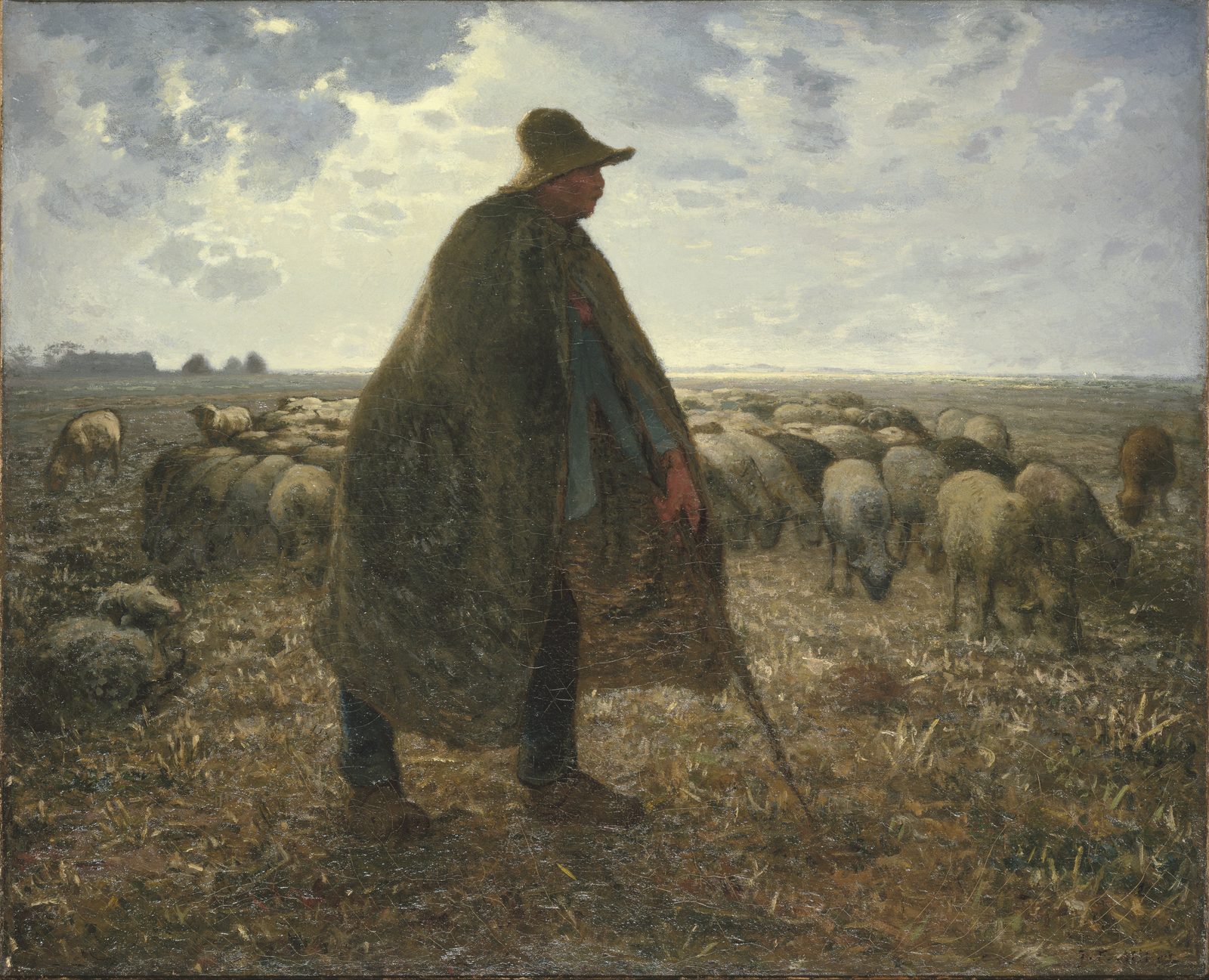
Psalm 23
6 verses · Psalm of trust
The LORD is my shepherd; I shall not want.
Introduction
David, the Shepherd, Book 1: The Davidic Core, Poetry, Psalms Overview.
Written for a people who kept flocks for a living, this psalm is David speaking of God in the trade he had worked himself before he was king. He takes the place of the animal rather than the keeper, and he says that the care he once gave is the care he now receives. Listen for the quiet turn partway through, where he stops speaking about God and begins speaking to Him, and for the second picture that follows, a host receiving a guest at his own table. It is a psalm of trust, said in the plainest words the Psalter uses.
Context
- Who
- Israelites who knew shepherding as ordinary work rather than as a picture
- What
- A psalm of trust in which one man says what the LORD is to him, first as a shepherd and then as a host.
- Where
- The grazing country of Judah, its dry hills, ravines and sheepfolds, and then a host's table
- When
- The reign of David, about 1010 to 970 BC by the superscription.
- Why
- To give a settled confidence to a person walking through danger, on the ground of who is with him.
Historical context
David wrote this as a king who had done the work. A shepherd in Judah moved his flock every day, because the hills are dry and the grass thin, so the animals were led from one patch to the next and down to water. Sheep will not drink from fast noisy water, so the shepherd dammed a pool or found a still stretch, and the quiet waters of verse 2 are a job description. The rod of verse 4 was a short heavy club used against predators, and the staff the long crook that guided a straying animal. The valley of the shadow of death is the deep narrow ravines cut into that country, dark and echoing. The oil of verse 5 was veterinary before it was ceremonial, poured on a sheep's head against the flies that laid eggs there.
Significance
Kings across the ancient Near East called themselves the shepherds of their people, and the title is stamped on royal inscriptions from Mesopotamia to Egypt. David hands the title to God and takes the sheep's place. The last line held the deepest claim in it for an Israelite, to dwell in the house of the LORD forever. The festivals brought a man to that house for a few days in the year, and the psalm asks to stay.
This chapter in Jewish lifeWhat this chapter is in Jewish life and reading.
How it is read
Rashi opens the best known psalm in the book with a rule about its own heading, and the rule covers the whole Psalter. He is quoted here from the Judaica Press Tanach with Rashi. The Rabbis taught that the order of the words in a heading records the order of events. Where a heading reads a song of David, "he would play his musical instrument and afterwards the Shechinah would rest on him". Where it reads of David a song, the Spirit came first and the song followed (Rashi on Psalms 23:1:1). So the two forms mark two ways the same man came to write, one where the playing drew the Spirit down and one where the Spirit moved first.
Rashi then puts the psalm in a place and a year. He reads it as spoken in the wilderness, with David confident of lacking nothing "in this desert where I am going" (Rashi on Psalms 23:1:2). He names the place as the forest of Hereth, where David hid from Saul, and carries a midrashic reading of the name. The forest was called that "because it was as dry as a potsherd and the Holy One, blessed be He, moistened it with the good of the world to come" (Rashi on Psalms 23:2:1). That is the kind of traditional insight this card exists to show a Christian reader. A dry place is renamed by what God poured into it, and the green pastures of the psalm are that moistening. The valley of darkness in the fourth verse Rashi ties to another hiding place, the desert of Ziph. He names Dunash ben Labrat as the authority for reading the word as darkness (Rashi on Psalms 23:4:1).
The rod and the staff are read in a way most Christian readers will find unfamiliar, and it repays attention. Rashi takes the two as the two halves of David's experience, "the pains that came upon me, and the support, that I rely upon Your loving kindness". Both comfort him, and the reason he gives is that the pains "will serve to expiate my iniquity" (Rashi on Psalms 23:4:2). Suffering atones on that reading, and the comfort of the verse is the comfort of a debt being paid. Christian teaching holds that the debt was paid once by Christ, and reads the rod and staff as the shepherd's protection rather than as a chastening that expiates. The site sets the two readings beside each other here and reports each in its own words.
The last images Rashi keeps royal. The table set before the speaker "is the throne", which he expects to receive (Rashi on Psalms 23:4:2). The anointing of the fifth verse he takes as already done: "I have already been anointed king by Your orders" (Rashi on Psalms 23:5:1). The restoring of the soul in the third verse he reads as a spirit "weakened by troubles and haste" brought back to what it was (Rashi on Psalms 23:3:1). The paths of righteousness are straight paths that keep David out of his enemies' hands (Rashi on Psalms 23:3:2). Ibn Ezra, Radak, Malbim and Metzudat David all comment on this chapter, and the corpus carries their refs without English text. Ibn Ezra stands here cited and unquoted at Ibn Ezra on Psalms 23:1:1 to 23:6:1, and Radak at Radak on Psalms 23:1:1 to 23:6:1. Two more stand at Malbim on Psalms 23:6:1 and Metzudat David on Psalms 23:2:1 and 23:6:1. What a shepherd's work actually was in Judah is set out on the site at /featured/the-lord-is-my-shepherd.
What the rabbis say
The corpus carries forty locators on this psalm and the text of none, so each is cited and linked here rather than quoted. Three are Talmudic, at Pesachim 118a:1 on the first verse, Pesachim 111a:14 on the fourth, and Jerusalem Talmud Pesachim 10:1:7 on the fifth.
Midrash Tehillim carries nine. They stand at 23:1, 23:2, 80:2 and 136:5 on the first verse, at 23:3 and 23:6 on the second, 23:4 on the third, 1:18 on the fourth, and 30:3 with 73:1 on the sixth. Four entries of Shir HaShirim Rabbah stand across the chapter, at 2:16:1 and 7:3:1 on the first verse, 4:11:2 on the second and 2:1:3 on the fourth.
The fifth verse, where the table is set and the head anointed, carries the largest share. On it the corpus holds Bereshit Rabbah 62:1, 88:5 and 92:2, Bamidbar Rabbah 21:21, Mekhilta DeRabbi Shimon Ben Yochai 16:14, and two entries of Mekhilta DeRabbi Yishmael on Vayassa at 4:7 and 4:18. Two entries of Ein Yaakov stand on the same verse, at Yoma 8:7 in the Glick Edition and at Yoma 8:7.
On the second verse the corpus carries Bamidbar Rabbah 19:26, and two entries of Midrash Sekhel Tov on Genesis 33:14:3 and 47:17:3. Beside them stand Midrash Tanchuma, Chukat 21:1 with Chukat 48:3 in the Buber recension, and two entries of Yalkut Shimoni on Torah at 17:1 and 764:25. On the fourth it carries Aggadat Bereshit 66:1 and two entries of Otzar Midrashim, one on the apple tree among the trees of the forest and one from the book of Gehinnom. The rest are single, at Bereshit Rabbah 59:5 and Ein Yaakov, Pesakhim 10:13 in the Glick Edition with Pesakhim 10:24 on the first verse, and Shemot Rabbah 8:1 later in the chapter. What each of them teaches is a saying of the rabbis, and is reported as theirs wherever this site quotes one. The quotations wait on a fetch that carries the text.
Sources: Rashi, Rashi on Psalms 23:1:1 to 23:5:2, the Judaica Press complete Tanach with Rashi, translated by A. J. Rosenberg; Ibn Ezra, Ibn Ezra on Psalms 23:1:1 to 23:6:1, cited by ref because the corpus carries no English text; Radak, Radak on Psalms 23:1:1 to 23:6:1, cited by ref because the corpus carries no English text; Malbim, Malbim on Psalms 23:6:1, cited by ref because the corpus carries no English text; Metzudat David, Metzudat David on Psalms 23:2:1 and 23:6:1, cited by ref because the corpus carries no English text; MannaFest, the shepherd's work, at /featured/the-lord-is-my-shepherd; The Sefaria corpus, scripts/data/sources/sefaria/psalms/23.json, the 3 Talmud and 37 Midrash locators of this chapter.
Psalms 23:1-2
The LORD is my shepherd: Israel called God the Shepherd of Israel at Psalm 80:1; here one man says the LORD is my shepherd. Green pastures and quiet waters are a shepherd's provision, food and water calm enough for a sheep to drink. The line closes on a settled thing, I shall not want.
Psalms 23:1
“How often have you heard Psalm 23 and not understood it! See how it is applicable to the heavenly sacraments: "The Lord feeds me, and I shall want nothing; he has set me in a place of pasture; he has brought me on the water of refreshment; he has converted my soul. He has led me on the paths of justice for his own name's sake.”
Ambrose of Milan · written before 397 · On the Sacraments, Book 5, Chapter 3patristic
2 more voices on this verseWhat preachers and commentators have said about this verse, in their own words.
Psalms 23:1
"The Lord is my shepherd." What condescension is this, that the infinite Lord assumes towards his people the office and character of a Shepherd! It should be the subject of grateful admiration that the great God allows himself to be compared to anything which will set forth his great love and care for his own people. David had himself been a keeper of sheep, and understood both the needs of the sheep and the many cares of a shepherd.
Charles Spurgeon · The Treasury of David, Vol. 1 (1869)Particular Baptist
Psalms 23:1
“Christ's relation to His people is often represented by the figure of a shepherd (Joh 10:14; 5:4), and therefore the opinion that He is the Lord here so described, and in Ge 48:15; Isa 40:11, is not without some good reason.”
Jamieson, Fausset & Brown · Commentary Critical and Explanatory on the Whole Bible (1871)reformed
ConnectionsJohn 10:11
green pastures: Both verbs have the shepherd as their subject. Charles Spurgeon read lying down as the believer's rest and being led as his active life, and he found both provided for. Matthew Henry took the green pastures as God's word, a pasture never eaten bare.
Psalms 23:2
"He maketh me to lie down in green pastures: he leadeth me beside the still waters." The Christian life has two elements in it, the contemplative and the active, and both of these are richly provided for. First, the contemplative. "He maketh me to lie down in green pastures." What are these "green pastures" but the Scriptures of truth—always fresh, always rich, and never exhausted? There is no fear of biting the bare ground where the grass is long enough for the flock to lie down in it.
Charles Spurgeon · The Treasury of David, Vol. 1 (1869)Particular Baptist
2 more voices on this verse
Psalms 23:2
“God's ordinances are the green pastures in which food is provided for all believers; the word of life is the nourishment of the new man. It is milk for babes, pasture for sheep, never barren, never eaten bare, never parched, but always a green pasture for faith to feed in.”
Matthew Henry · Commentary on the Whole Bible (1707-1721)puritan
Psalms 23:2
“He hints at the water of rebirth, in which the baptized person longs for grace and sheds the old age of sin and is made young instead of being old.”
Theodoret of Cyrus · written before 458 · Commentary on the Psalms 23:2patristic
He restores my soul: Restore is what a shepherd does with a sheep that has wandered off or given out. The paths of righteousness are the right tracks, ground where the flock is safe. The guidance rests on God's own name and reputation.
Psalms 23:3
“To restore the soul is to revive or quicken it (Ps 19:7), or relieve it (La 1:11, 19). paths of righteousness--those of safety, as directed by God, and pleasing to Him. for his name's sake--or, regard for His perfections, pledged for His people's welfare.”
Jamieson, Fausset & Brown · Commentary Critical and Explanatory on the Whole Bible (1871)reformed
3 more voices on this verse
Psalms 23:3
“And those only are led by the still waters of comfort that walk in the paths of righteousness. The way of duty is the truly pleasant way. It is the work of righteousness that is peace.”
Matthew Henry · Commentary on the Whole Bible (1707-1721)puritan
Psalms 23:3
“My soul was torn by life and only the restorative presence of God could mend it.”
Dr. Rob Reimer · The Restorative Presence of God (Renewal International blog) (2018)Christian and Missionary Alliance
Psalms 23:3
“He bringeth it back; from its errors and wandering. For - Not for any worth in me, but for the glory of his justice, and faithfulness, and goodness.”
John Wesley · Explanatory Notes upon the Old Testament (1765)evangelical
the valley of the shadow of death: The Hebrew tsalmaveth is read as the shadow of death and as deep darkness. The valley is walked through, and You are with me. The rod beats off a wild animal and the staff hooks a straying sheep back.
Psalms 23:4
"Yea, though I walk through the valley of the shadow of death, I will fear no evil: for thou art with me; thy rod and thy staff they comfort me." This unspeakably delightful verse has been sung on many a dying bed, and has helped to make the dark valley bright times out of mind. Every word in it has a wealth of meaning. "Yea, though I walk," as if the believer did not quicken his pace when he came to die, but still calmly walked with God.
Charles Spurgeon · The Treasury of David, Vol. 1 (1869)Particular Baptist
1 more voice on this verse
Psalms 23:4
“To walk in the midst of the shadow of death is not the same as to sit in the shadow of death; one who sits in the shadow of death is firmly fixed in that shadow and strengthened in evil. On account of this, he is in darkness and lacks mercy so that the light may rise for him. He who does not sit, but who passes or walks through the midst of the shadow of death, not standing and hurrying across, does not walk alone because the Lord goes through with him.”
Origen of Alexandria · written before 253 · Selections from the Psalms 23:4patristic
You prepare a table before me: The table is set in full view of the enemies, while they watch. Oil on the head and a cup filled past the brim are what a host gives a guest he honors. The picture has changed from shepherd to host.
Psalms 23:5
“By them he guides his sheep. Another figure expresses God's provided care. a table--or, "food," anointing oil--the symbol of gladness, and the overflowing cup--which represents abundance--are prepared for the child of God, who may feast in spite of his enemies, confident that this favor will ever attend him.”
Jamieson, Fausset & Brown · Commentary Critical and Explanatory on the Whole Bible (1871)reformed
3 more voices on this verse
Psalms 23:5
“His table was not spread with any thing that came next to hand, but prepared, and prepared before him. (3.) That he was not stinted, was not straitened, but had abundance: " My cup runs over, enough for myself and my friends too." (4.) That he had not only for necessity, but for ornament and delight: Thou anointest my head with oil.”
Matthew Henry · Commentary on the Whole Bible (1707-1721)puritan
Psalms 23:5
"You have prepared a banquet in my sight." This banquet consists of the living Bread, the Word of God. At this banquet there is the oil of sanctification, poured richly over the head of the just. This oil strengthens the inner senses. It does away with the oil of the sinner that fattens the head. In this banquet, too, you have the cup that inebriates: "how excellent" it is, or "how powerful," for the Greek has kratiston, meaning most mighty, strong or powerful. Surely it is a powerful cup that washes away every stain of sin.
Ambrose of Milan · written before 397 · Commentaries on the Twelve Davidic Psalmspatristic
Psalms 23:5
"Thou preparest a table before me in the presence of mine enemies." The good man has his enemies. He would not be like his Lord if he had not. If we were without enemies we might fear that we were not the friends of God, for the friendship of the world is enmity to God. Yet see the quietude of the godly man in spite of, and in the sight of, his enemies. How refreshing is his calm bravery! "Thou preparest a table before me."
Charles Spurgeon · The Treasury of David, Vol. 1 (1869)Particular Baptist
Surely goodness and mercy: The verb behind follow is radaph, the word for a hunter running down his prey. Goodness and mercy chase the psalmist all the days of his life. He ends in God's house, and the psalm says forever.
Psalms 23:6
"Surely goodness and mercy shall follow me all the days of my life." This is a fact as indisputable as it is encouraging, and therefore a heavenly verily, or "surely" is set as a seal upon it. This sentence may be read, "only goodness and mercy," for there shall be unmingled mercy in our history. These twin guardian angels will always be with me at my back and my beck. Just as when great princes go abroad they must not go unattended, so it is with the believer.
Charles Spurgeon · The Treasury of David, Vol. 1 (1869)Particular Baptist
1 more voice on this verse
Psalms 23:6
“We are saved by hope, and that hope will not make us ashamed, because it is well grounded. It is the duty of Christians to encourage themselves in the Lord their God; and we are here directed to take that encouragement both from the relation wherein he stands to us and from the experience we have had of his goodness according to that relation.”
Matthew Henry · Commentary on the Whole Bible (1707-1721)puritan
How this psalm is built
The form: A psalm in which every mercy the believer receives is traced back to one source, the Good Shepherd Himself, as Spurgeon classes it.
The patterns in this chapter
| Device | What it does | Where to see it |
|---|---|---|
| What the shepherd does, said one act at a time | Verses 1 to 3 do not describe the shepherd. They list his acts: he makes me lie down, he leads me, he restores my soul, he guides me in the paths of righteousness. Spurgeon preaches the psalm by asking after each clause why it is so, and answering every time from the shepherd rather than from the sheep, because he makes me, he leads me, he restores me.Charles Spurgeon, The Metropolitan Tabernacle Pulpit, Sermon No. 1149, "My Restorer" (lightly modernized text, CCEL edition), 1873. | Psalm 23:1, Psalm 23:2, Psalm 23:3 |
| The turn from He to You at verse 4 | The first three verses speak of the LORD in the third person, and verse 4 begins to speak to Him. The change happens in the ravine, at the words for You are with me, and it holds through the table and the oil and the overflowing cup in verse 5. Augustine reads the line as the nearness of the one who dwells in the heart by faith, so that the fear goes out of a walk through the shadow of death. Verse 6 returns to the third person and names the house.Augustine of Hippo, Exposition on Psalm 23, 430, on Psalm 23:4. | Psalm 23:1, Psalm 23:4, Psalm 23:5, Psalm 23:6 |
| The rod and the staff | Verse 4 names two tools in one clause and says they do one thing, they comfort me. Origen reads the rod by the places where Scripture uses that word of punishment and scourging, and holds that a man who sees the rod of God threatening him should know the mercy of God is not far off. Augustine reads the pair as discipline, a rod for the flock and a staff for those grown past infancy.Origen of Alexandria, SELECTIONS FROM THE PSALMS 23:4, 253. | Psalm 23:4 |
The structure
10 more paragraphs on the patterns
Six verses, and three things hold them. Verses 1 to 3 list the shepherd's acts one at a time rather than describing him. Verse 4 changes from speaking about the LORD to speaking to Him, and the change holds through verse 5. Verse 4 names two tools in one clause and says they do one thing. The psalm opens on the LORD in verse 1 and closes on the house of the LORD in verse 6.
The debate
The table of verse 5 is read two ways, and both readings are old. Ambrose of Milan, Eusebius of Caesarea and Augustine read it of the church's own table, with the banquet as the living Bread and the cup as the cup that washes away sin; Eusebius names the memorial kept with the symbols of the body and the saving blood. Matthew Henry reads the same verse as a table prepared beforehand, with the oil and the full cup as ornament and delight, and Jamieson, Fausset and Brown read it as food, gladness and abundance for the child of God.
The prophecy and the New Testament
Jamieson, Fausset and Brown say the relation of Christ to His people is often put under the figure of a shepherd, and name John 10:14 as the place He takes the title Himself. They set Genesis 48:15 and Isaiah 40:11 beside this psalm as the older uses of the same figure. Read that way, the first line of Psalm 23 is a claim the rest of the Bible keeps making in other words.
Where it stands in the Psalter
Arnobius the Younger, in his Commentary on the Psalms at this psalm, takes Psalm 22 as the tribulation of the passion and this one as the joy that follows, which puts the shepherd immediately after the sufferer and reads the two as one movement. Psalm 24 then asks who may ascend the hill of the LORD, so the three psalms run from the dust of death to the pasture to the gate of the holy place.
Inside the psalm the pattern is a steady widening. Verse 1 says the sheep will not want, verse 5 says the cup runs over, and verse 6 says the following goodness lasts all the days of a life. Matthew Henry reads the goodness and mercy of the last verse as all the streams of one fountain, pardoning, protecting, sustaining and supplying, and the psalm ends by naming the house those streams run to.
Where to go deeper
The working life behind the psalm has its own page at /featured/the-shepherds-life. The figure itself has pages at /featured/the-lord-is-my-shepherd and /featured/the-good-shepherd.
Keep studying
Sources for this chapter
The summary
Jamieson, Fausset & Brown, Commentary Critical and Explanatory; John Calvin, Commentaries; John Wesley, Notes on the Old Testament and Matthew Henry, Complete Commentary.
The form and classifications
Ambrose of Milan, On the Sacraments, Book 5, Chapter 3, 397; Augustine of Hippo, Exposition on Psalm 23, 430, on Psalm 23:1 and Charles Spurgeon, The Metropolitan Tabernacle Pulpit, Sermon No. 1149, "My Restorer" (lightly modernized text, CCEL edition), 1873.
The exposition
Adam Clarke, Commentary on the Bible; Albert Barnes, Notes on the Book of Psalms; Alexander Maclaren, The Psalms, Expositor's Bible; Charles Spurgeon, The Treasury of David; Franz Delitzsch, Biblical Commentary on the Psalms; John Gill, Exposition of the Old Testament and Matthew Henry, Commentary on the Whole Bible.
The painting
Shepherd Tending His Flock. Jean-François Millet, early 1860s. Wikimedia Commons. Public domain.