
Psalm 19
14 verses · Hymn of creation and the Law
The heavens declare the glory of God; the skies proclaim the work of His hands.
Introduction
David, the Heavens and the Law, Book 1: The book of David, Poetry, Psalms Overview.
David wrote this psalm in two halves that seem at first to belong to different poems. The first half listens to the sky and the sun, and the second listens to the written instruction of the LORD. The pairing is deliberate, since both are ways God makes Himself known, one without words and one in words. Listen for the change in the name of God between the halves, and for the prayer at the close, where the singer turns from what God has said to what he himself says. Read it as a lesson in reading both creation and Scripture.
Context
- Who
- Israelites living under a sun their neighbours worshipped and a Law their neighbours lacked
- What
- A hymn that sets God's witness in the sky beside His witness in the written Law.
- Where
- The daytime sky over the Judean hills, and the reading of the Law in the sanctuary
- When
- The reign of David, about 1010 to 970 BC by the superscription.
- Why
- To teach Israel to hear God in creation and in Scripture, and to answer with a prayer for a clean heart.
Historical context
Egypt worshipped the sun as Ra and as Aten, and Mesopotamia worshipped it as Shamash, who was also the god of justice and whose image sits at the head of the stone pillar carrying Hammurabi's laws. In that world, saying that the LORD has pitched a tent for the sun is a demotion of the sun to a servant that does its work. The bridegroom emerging from his chamber pictures a real wedding procession, the most conspicuous man in the village that week. The second half turns to the written word, and its comparisons are priced, since gold was the standard of value and honey from the comb was the sweetest thing an Israelite ever tasted. Israel's law provided offerings for sin committed unknowingly, and for the sin done with a high hand it provided none, which is what the prayer of verse 13 asks to be kept from.
Significance
The psalm sets two witnesses side by side. The sky preaches everywhere without speech or language, and the Scripture speaks in words and does what the sky cannot, reviving the soul and making the simple wise. Its closing line is a worshipper's words at the altar, and the word behind pleasing is the word used of a sacrifice being received.
This chapter in Jewish lifeWhat this chapter is in Jewish life and reading.
How it is read
The opening of this psalm raises a question the commentators answer carefully. The heavens tell God's glory, and the fourth verse says there is no speech and no words. Rashi is quoted here from the Judaica Press Tanach with Rashi. He holds that the telling happens through the people who watch. The heavens "do not speak with people". Their line goes out over the earth and they give light, so that "the creatures recite the glory of God and give thanks and bless Him for the luminaries" (Rashi on Psalms 19:2:1). The speech of the third verse works the same way, since sunset and sunrise "teach the people to praise and to give thanks" (Rashi on Psalms 19:3:1). So the heavens are a cause of praise rather than a voice, and men supply the words.
The sun of the sixth and seventh verses draws the best writing. Radak is quoted from the Finch translation of 1919, which is public domain. He reads the bridegroom of the sixth verse as a figure of welcome, since "all rejoice before him", as all rejoice at the sun's light. He then carries his own father's reading, which is a finer one. The bridegroom is "longing to return to his bride", and so "the sun returns each day to the place of his brightness" (Radak on Psalms 19:6:1). Rashi reads the circuit of the seventh verse as an orbit "from one end to the other" (Rashi on Psalms 19:7:1). What the psalm says at that verse about the sun's circuit is treated in its own right at the insight row of docs/lanes/FEATURE-PAGES-OWED.md.
Rashi's note on the sun's heat carries a whole cosmology in a few lines, and it is the kind of traditional material this card exists to show. He holds that if the sun had been set in the lowest sky, no one could hide from its heat. The sun and the moon stand in the second sky, and he names the seven skies in order as the rabbis counted them, from Vilon and Rakia up to Aravot. He cites the Talmudic discussion he is drawing on, at Hagigah 12b (Rashi on Psalms 19:7:2). At the eighth verse he turns the heat into a picture of the last day. He sets the burning sun of Malachi beside the Torah, which "protects those who study it from that burning" (Rashi on Psalms 19:8:1).
The second half of the psalm praises the law, and Radak sorts its words with care. He argues from the context that the word usually read as precepts should be read here as things treasured up, and takes them for "the things about which reason teaches" (Radak on Psalms 19:9:1). The clean fear of the tenth verse he reads as fear without alloy, and the test he gives is secrecy. A man will avoid a public wickedness from fear of other men, and "such metal is not pure, for there is alloy in it". The fear that keeps a man from a hidden theft or a false weight, from the fear of God only, "is clean, for in it there is no alloy" (Radak on Psalms 19:10:1). Rashi reads the reward of the twelfth verse two ways, as the good God has hidden away, and as the greatness that comes at the end to those who study (Rashi on Psalms 19:12:1). At the thirteenth verse he states the psalm's own limit plainly. A man may be careful and still err, "and You cleanse me of hidden sins, which were hidden from me" (Rashi on Psalms 19:13:1). That admission is the ground a Christian reader will recognise, since the psalm asks for cleansing from sins the man cannot name. Malbim and Ibn Ezra comment on the opening verses, and the corpus carries their refs without English text, so they stand cited and unquoted at Malbim on Psalms 19:1:1 and Ibn Ezra on Psalms 19:4:1.
What the rabbis say
The corpus carries forty locators on this psalm and the text of none, so each is cited and linked here rather than quoted. Eight are Talmudic. Three stand in Avot DeRabbi Natan, at 20:1 on the ninth verse, and at 25:7 and 31:11 of Recension B on the eighth and ninth. Two stand at Berakhot 4b:14 and 9b:19 on the last verse, where the psalm asks that its words be acceptable. Three more stand at Arakhin 11a:11 on the seventh verse, Jerusalem Talmud Ketubot 1:1:3 on the sixth, and Jerusalem Talmud Sanhedrin 10:5:3 on the seventh.
Bamidbar Rabbah carries five, at 10:1 on the eighth verse, 13:20 across the eighth to the tenth, 13:16 on the tenth, and 12:4 and 14:11 on the eleventh. Devarim Rabbah carries three, at 10:2 on the second verse, 8:4 on the ninth and 11:6 on the tenth. Bereshit Rabbah carries four, at 48:8 and 6:6 on the fifth verse and 11:2 on the seventh. Four entries of Midrash Tanchuma stand on the third and fourth verses, at Mishpatim 12:1 and 15:5, and at Emor 2:1 and Mishpatim 7:1 in the Buber recension.
Five entries of Learning to Read Midrash stand on the twelfth, thirteenth and fourteenth verses, in one chapter on David's heart after his sin. Two entries of Ein Yaakov stand in the Glick Edition, at Yoma 7:7 on the tenth verse and Sanhedrin 11:105 on the thirteenth, with Pesakhim 10:20 on the first. The rest are single. They are Tanna DeBei Eliyahu Rabbah 2:1 on the first verse, and two entries of Bereshit Rabbati on Bereshit at 10 and 30 on the second. Three more are Kohelet Rabbah 1:5:2 on the fifth verse, and Midrash Tannaim on Deuteronomy 32:1:10 with Midrash Tehillim 19:9 on the sixth. Two stand at Aggadat Bereshit 84:3 and Yalkut Shimoni on Torah 846:3, on the eleventh and twelfth verses. Two more stand later in the chapter, at Midrash Tehillim 23:1 and an entry of Otzar Midrashim on Psalm 118. What each of them teaches is a saying of the rabbis, and is reported as theirs wherever this site quotes one. The quotations wait on a fetch that carries the text.
Sources: Rashi, Rashi on Psalms 19:2:1 to 19:15:1, the Judaica Press complete Tanach with Rashi, translated by A. J. Rosenberg; Radak, Radak on Psalms 19:1:1 to 19:10:1, R. David Kimhi on the first book of Psalms, translated by R. G. Finch, London, 1919; Malbim, Malbim on Psalms 19:1:1, cited by ref because the corpus carries no English text; Ibn Ezra, Ibn Ezra on Psalms 19:4:1, cited by ref because the corpus carries no English text; MannaFest, the insight ahead of its time row of docs/lanes/FEATURE-PAGES-OWED.md; The Sefaria corpus, scripts/data/sources/sefaria/psalms/19.json, the 8 Talmud and 32 Midrash locators of this chapter.
Psalms 19:1-2
The heavens declare the glory of God: The heavens declare God's glory without words. Day after day and night after night the telling goes on, speech poured out and knowledge revealed by the skies. Verses 1 to 6 are the sky, and verses 7 to 11 are the law.
Psalms 19:1
“The heavens declare the glory of God - They announce, proclaim, make known his glory. The word heavens here refers to the material heavens as they appear to the eye - the region of the sun, moon, and stars. The Hebrew word is used in the Scriptures uniformly in the plural number, though in our common translation the singular number is often used. Gen 1:1, Gen 1:8-9, Gen 1:14, Gen 1:17, Gen 1:20; Gen 6:17; Gen 7:11, Gen 7:19, Gen 7:23; et soepe.”
2 more voices on this verseWhat preachers and commentators have said about this verse, in their own words.
Psalms 19:1
“Creation … points to God as its Maker and Artificer, who reigns over creation and over all things, even the Father of our Lord Jesus Christ; whom would-be philosophers turn from to worship and deify the creation that proceeded from him, which yet itself worships and confesses the Lord whom they deny on its account.”
Athanasius of Alexandria · written before 373 · Against the Heathen 27:3-5patristic
Psalms 19:1
"The heavens declare the glory of God." The book of nature has three leaves, heaven, earth, and sea, of which heaven is the first and the most glorious, and by its aid we are able to see the beauties of the other two. Any book without its first page would be sadly imperfect, and especially the great Natural Bible, since its first pages, the sun, moon, and stars, supply light to the rest of the volume, and are thus the keys, without which the writing which follows would be dark and undiscerned.
Charles Spurgeon · The Treasury of David, Vol. 1 (1869)Particular Baptist
ConnectionsGenesis 1:14, Job 38:32, Romans 1:20
Day after day they pour forth speech: John Wesley said the Hebrew verb pictures a fountain that pours forth water. Adam Clarke heard each day pass its speech to the next. Eusebius found the knowledge in the order itself, day and night kept in equal measure to reveal the wisdom and power of God.
Psalms 19:2
“Day unto day uttereth speech - Each day is represented as teaching another relative to some new excellence discovered in these manifold works of God. The nights also, by the same figure, are represented as giving information to each other of the increase of knowledge already gained. “The labors of these our instructers know no intermission; but they continue incessantly to lecture us in the science of Divine wisdom. There is one glory of the sun, which shines forth by day; and there are other glories of the moon and of the stars, which become visible by night.”
Adam Clarke · Commentary on the Bible (1810-1826)evangelical
2 more voices on this verse
Psalms 19:2
“The days and the nights teach those people who desire to be taught what ineffable wisdom, what incomprehensible power God has, who has measured out the intervals of time for them. If there were no one who would determine the space and the intervals for the seasons, but they existed in a thoughtless and unconsidered way by chance, it would happen that the days would not be ordered in equal spaces through the ages and there would be a confusion of things, and likewise the times of the nights would pass by chance or happenstance.”
Eusebius of Caesarea · written before 339 · Commentary on Psalms 19:3patristic
Psalms 19:2
"Day unto day uttereth speech, and night unto night sheweth knowledge." As if one day took up the story where the other left it, and each night passed over the wondrous tale to the next. The original has in it the thought of pouring out or welling over, with speech; as though days and nights were but as a fountain flowing evermore with Jehovah's praise. Oh to drink often at the celestial well, and learn to utter the glory of God!
Charles Spurgeon · The Treasury of David, Vol. 1 (1869)Particular Baptist
Psalms 19:3-4
Without speech or language: There is no sound to be heard, and the voice still reaches all the earth. Paul quotes this line at Romans 10:18, answering whether they have heard. In the heavens a tent is pitched for the sun.
Psalms 19:3
“There is no speech nor language where their voice is not heard - Margin, Without these their voice is heard. Hebrew, “without their voice heard.” The idea in the margin, which is adopted by Prof. Alexander, is, that when the heavens give expression to the majesty and glory of God, it is not by words - by the use of language such as is employed among men. That is, there is a silent but real testimony to the power and glory of their great Author. The same idea is adopted substantially by DeWette.”
2 more voices on this verse
Psalms 19:3
“The accord and affinity of all things with one another that is controlled in an orderly and sequential manner is the primal, archetypal, true music. It is this music that the conductor of the universe skillfully strikes up in the unspoken speech of wisdom through these ever-occurring movements.”
Gregory of Nyssa · written before 395 · On the Inscriptions of the Psalms 1:3.21patristic
Psalms 19:3
"There is no speech nor language, where their voice is not heard." Every man may hear the voices of the stars. Many are the languages of terrestrials, to celestials there is but one, and that one may be understood by every willing mind. The lowest heathen are without excuse, if they do not discover the invisible things of God in the works which he has made. Sun, moon, and stars are God's traveling preachers; they are apostles upon their journey confirming those who regard the Lord, and judges on circuit condemning those who worship idols.
Charles Spurgeon · The Treasury of David, Vol. 1 (1869)Particular Baptist
their voice has gone out: The Hebrew word behind voice is qav, a line. Albert Barnes traced it from a measuring line to the string of a lyre, and so to a sound, as the Septuagint read it. Charles Spurgeon took the line as the measure of the domain of the heavens.
Psalms 19:4
“Behold the Lord's greatness. "The sound of his teaching has gone out into every land." Our Lord Jesus has been spread out to the whole world, because he is God's power.… The power of the Lord and Savior is with those who are in Britain, separated from our world, and with those who are in Mauretania and with everyone under the sun who has believed in his name. Behold the Savior's greatness. It extends to all the world.”
Origen of Alexandria · written before 253 · Homilies on the Gospel of Luke 6:9patristic
2 more voices on this verse
Psalms 19:4
“Their line - That is, of the heavens. The word used here - קו qav - means properly a cord, or line: (a) a measuring line, Eze 47:3; Job 38:5; Isa 44:13; and then (b) a cord or string as of a lyre or other instrument of music; and hence, a sound. So it is rendered here by the Septuagint, φθόγγος phthongos. By Symmachus, ἦχος ēchos. By the Vulgate, sonus. DeWette renders it Klang, sound. Prof.”
Psalms 19:4
“Paul (Ro 10:8), quoting from the Septuagint, uses "sound," which gives the same sense. The sun, as the most glorious heavenly body, is specially used to illustrate the sentiment; and his vigorous, cheerful, daily, and extensive course, and his reviving heat (including light), well display the wondrous wisdom of his Maker.”
Jamieson, Fausset & Brown · Commentary Critical and Explanatory on the Whole Bible (1871)reformed
Cross references
Psalms 19:4
- Quoted inRomans 10:18But I ask, did they not hear? Indeed they did: “Their voice has gone out into all the earth, their words to the ends of the world.”
'Their sound went into all the earth' (creation's witness)
ConnectionsRomans 10:18
Psalms 19:5-6
Like a bridegroom emerging from his chamber: The psalm gives the sun two pictures. It comes out like a bridegroom from his chamber and runs like a champion glad to be running. Its course reaches from one end of the heavens to the other, and nothing is left out of its warmth.
Psalms 19:5
"Which is as a bridegroom coming out of his chamber." A bridegroom comes forth sumptuously apparelled, his face beaming with a joy which he imparts to all around; such, but with a mighty emphasis, is the rising Sun. "And rejoiceth as a strong man to run a race." As a champion girt for running cheerfully addresses himself to the race, so does the sun speed onward with matchless regularity and unwearying swiftness in his appointed orbit. It is but mere play to him; there are no signs of effort, flagging, or exhaustion.
Charles Spurgeon · The Treasury of David, Vol. 1 (1869)Particular Baptist
ConnectionsJoel 2:16
runs its circuit to the other: Albert Barnes read circuit as a return, like the seasons. Cyril of Jerusalem saw the course of the sun set higher in summer for work and lower in winter for rest. Ambrose applied the verse to Christ, whose light and warmth reach all the earth.
Psalms 19:6
“His going forth - The psalmist now describes that race which he has to run, as borne over the entire circuit of the heavens, from one end of it to another - sweeping the whole space across the firmament. Is from the end of the heaven - From one end of the heaven; that is, from the East, where he starts. And his circuit - The word used here - תקופה teqûphâh - means properly a coming about, or a return, as of the seasons, or of the year.”
3 more voices on this verse
Psalms 19:6
“Christ fills his world with copious lights, since "his going out is from the end of heaven, and his circuit even to the end of it, and there is no one who can hide himself from his heat." Benignly he gives light to all, wishing not to repel the foolish but to correct them and desiring not to exclude the hard of heart from the church but to soften them. Hence … Christ in the Gospel invites them, saying, "Come to me, all you who labor, and are burdened, and I will give you rest.”
Ambrose of Milan · written before 397 · On the Death of Satyrus 2.117patristic
Psalms 19:6
"His going forth is from the end of the heaven, and his circuit unto the ends of it." He bears his light to the boundaries of the solar heavens, traversing the zodiac with steady motion, denying his light to none who dwell within his range. "And there is nothing hid from the heat thereof." Above, beneath, around, the heat of the sun exercises an influence. The bowels of the earth are stored with the ancient produce of the solar rays, and even yet earth's inmost caverns feel their power.
Charles Spurgeon · The Treasury of David, Vol. 1 (1869)Particular Baptist
Psalms 19:6
“Consider the apt disposition of the sun, or rather of him whose ordering determined its course; how in summer it is higher in the heavens and makes the days longer, thereby giving people good time for their works, while in winter it contracts its course that the cold season might not be too long and that the nights, becoming longer, might serve as the repose of people and for the fruitfulness of the earth's products.”
Cyril of Jerusalem · written before 386 · Catechetical Lecture 9:6patristic
Psalms 19:7-8
The Law of the LORD is perfect: The psalm turns from the sky to the law. The Law revives the soul, the testimony makes the simple wise, the precepts bring joy to the heart, and the commandments enlighten the eyes. Perfect, trustworthy, right and radiant are the four words used of them.
Psalms 19:7
"The law of the Lord is perfect;" by which he means not merely the law of Moses but the doctrine of God, the whole run and rule of sacred Writ. The doctrine revealed by God he declares to be perfect, and yet David had but a very small part of the Scriptures, and if a fragment, and that the darkest and most historical portion, be perfect, what must the entire volume be? How more than perfect is the book which contains the clearest possible display of divine love, and gives us an open vision of redeeming grace.
Charles Spurgeon · The Treasury of David, Vol. 1 (1869)Particular Baptist
1 more voice on this verse
Psalms 19:7
“Here are six several titles of the word of God, to take in the whole of divine revelation, precepts and promises, and especially the gospel. Here are several good properties of it, which proves its divine original, which recommend it to our affection, and which extol it above all other laws whatsoever.”
Matthew Henry · Commentary on the Whole Bible (1707-1721)puritan
Connections2 Peter 1:19
The precepts of the LORD are right: Adam Clarke traced precepts to a Hebrew verb for taking charge, and right to a word for straight and smooth. Charles Spurgeon marked a progress from verse 7, the soul revived, the simple made wise, now joy brought to the heart. Truth that sets the heart right gives it joy.
Psalms 19:8
"The statutes of the Lord are right." His precepts and decrees are founded in righteousness, and are such as are right or fitted to the right reason of man. As a physician gives the right medicine, and a counsellor the right advice, so does the Book of God. "Rejoicing the heart." Mark the progress; he who was converted was next made wise and is now made happy; that truth which makes the heart right then gives joy to the right heart. Free-grace brings heart-joy.
Charles Spurgeon · The Treasury of David, Vol. 1 (1869)Particular Baptist
1 more voice on this verse
Psalms 19:8
“The statutes of the Lord - פקודים pikkudim, from פקד pakad, he visited, cared, took notice of, appointed to a charge. The appointments, or charge delivered by God to man for his regard and observance. Are right - ישרים yesharim, from ישר yashar, to make straight, smooth, right, upright, opposed to crookedness in mind or conduct; showing what the man should be, both within and without. This is Their character.”
Adam Clarke · Commentary on the Bible (1810-1826)evangelical
The fear of the LORD is pure: The last two of the six pairs land here. The fear of the LORD is pure and endures forever, and His judgments are true and altogether righteous. These two describe what the law is, where the four before them described what it does.
Psalms 19:9
"The fear of the Lord is clean." The doctrine of truth is here described by its spiritual effect, viz., inward piety, or the fear of the Lord; this is clean in itself, and cleanses out the love of sin, sanctifying the heart in which it reigns. Mr. Godly-fear is never satisfied till every street, lane, and alley, yea, and every house and every corner of the town of Mansoul is clean rid of the Diablolonians who lurk therein. "Enduring for ever." Filth brings decay, but cleanness is the great foe of corruption.
Charles Spurgeon · The Treasury of David, Vol. 1 (1869)Particular Baptist
2 more voices on this verse
Psalms 19:9
“Clean - Sincere, not adulterated with any mixture. Constant and unchangeable, the same for substance in all ages. Judgments - God's laws are frequently called his judgments, because they are the declarations of his righteous will, and as it were his judicial sentence by which he expects that men should govern themselves, and by which he will judge them at the last day.”
John Wesley · Explanatory Notes upon the Old Testament (1765)evangelical
Psalms 19:9
“The fear of the Lord - The word rendered fear in this place - יראה yir'âh - means properly fear, terror, Jon 1:10; then, reverence, or holy fear, Psa 2:11; Psa 5:7; and hence, reverence toward God, piety, religion - in which sense it is often used. Compare Pro 1:7; Job 28:28; Isa 11:2. Hence, by metonymy, it means the precepts of piety or religion.”
Psalms 19:10-11
more precious than gold: Gold and honey are the two measures. The law is rated above gold, even much pure gold, and above honey straight from the comb. The servant is warned by them, and the reward is in the keeping.
Psalms 19:10
“More to be desired are they than gold - This is strictly true; but who believes it? By most men gold is preferred both to God and his judgments; and they will barter every heavenly portion for gold and silver! Sweeter also than honey - To those whose mental taste is rectified, who have a spiritual discernment. Honey-comb - Honey is sweet; but honey just out of the comb has a sweetness, richness and flavour, far beyond what it has after it becomes exposed to the air.”
Adam Clarke · Commentary on the Bible (1810-1826)evangelical
1 more voice on this verse
Psalms 19:10
"More to be desired are they than fine gold, yea, than much fine gold." Bible truth is enriching to the soul in the highest degree; the metaphor is one which gathers force as it is brought out;—gold—fine gold—much fine gold; it is good, better, best, and therefore it is not only to be desired with a miser's avidity, but with more than that. As spiritual treasure is more noble than mere material wealth, so should it be desired and sought after with greater eagerness. Men speak of solid gold, but what is so solid as solid truth?
Charles Spurgeon · The Treasury of David, Vol. 1 (1869)Particular Baptist
By them indeed Your servant is warned: Albert Barnes traced the Hebrew verb for warned to a word for shining, so a warning throws light on a duty and its consequences. Augustine placed the great reward in the keeping itself, which brings joy. The warning puts the light of verse 8 to use.
Psalms 19:11
"Moreover by them is thy servant warned." We are warned by the Word both of our duty, our danger, and our remedy. On the sea of life there would be many more wrecks, if it were not for the divine storm-signals, which give to the watchful a timely warning. The Bible should be our Mentor, our Monitor, our Memento Mori, our Remembrancer, and the Keeper of our Conscience. Alas, that so few men will take the warning so graciously given; none but servants of God will do so, for they alone regard their Master's will.
Charles Spurgeon · The Treasury of David, Vol. 1 (1869)Particular Baptist
1 more voice on this verse
Psalms 19:11
In the guarding of the precepts of God there is so much reward, that "the sufferings of this time are not worth (comparing) to the future glory that will be revealed to us."
Arnobius the Younger · written before 460 · Commentary on the Psalms 19patristic
Psalms 19:12-14
Who can discern his own errors?: The law that gives light now shows the man himself. Hidden faults are those he cannot see, and willful sins are those that would rule over him. The psalm closes on a prayer that the words of his mouth and thoughts of his heart please God, his Rock and Redeemer.
Psalms 19:12
It is not my will to conceive sin; I do not want to entertain bad thoughts, and yet I do; I do not want to entertain evil, and, like a captive against my will, I am drawn into evil reflections. Because it is not in my power either to think or not to think evil, that is why I declare, "Surely they are wanton sins that come into my heart," but since I cannot seem to avoid them, I plead, "Cleanse me from my unknown faults."
Jerome · written before 420 · Homily on Psalm 114[116a]patristic
2 more voices on this verse
Psalms 19:12
"Who can understand his errors?" A question which is its own answer. It rather requires a note of exclamation than of interrogation. By the law is the knowledge of sin, and in the presence of divine truth, the psalmist marvels at the number and heinousness of his sins. He best knows himself who best knows the Word, but even such an one will be in a maze of wonder as to what he does not know, rather than on the mount of congratulation as to what he does know.
Charles Spurgeon · The Treasury of David, Vol. 1 (1869)Particular Baptist
Psalms 19:12
“But I fall infinitely short of it. Cleanse - Both by justification, through the blood of thy son; and by sanctification thro' thy Holy Spirit. Though the first may seem to be principally intended, because he speaks of his past sins.”
John Wesley · Explanatory Notes upon the Old Testament (1765)evangelical
Keep Your servant also from willful sins: Albert Barnes set willful sins against the hidden faults of verse 12, from a Hebrew word for pride boiling over. Charles Spurgeon drew from the prayer that even the best servant must be held back by grace, as a horse by the bit.
Psalms 19:13
"Keep back thy servant also from presumptuous sins; let them not have dominion over me." This earnest and humble prayer teaches us that saints may fall into the worst of sins unless restrained by grace, and that therefore they must watch and pray lest they enter into temptation. There is a natural proneness to sin in the best of men, and they must be held back as a horse is held back by the bit or they will run into it. Presumptuous sins are peculiarly dangerous. All sins are great sins, but yet some sins are greater than others.
Charles Spurgeon · The Treasury of David, Vol. 1 (1869)Particular Baptist
2 more voices on this verse
Psalms 19:13
“Note, First, Presumptuous sins are very heinous and dangerous. those that sin against the habitual convictions and actual admonitions of their consciences, in contempt and defiance of the law and its sanctions, that sin with a high hand, sin presumptuously, and it is a great transgression.”
Matthew Henry · Commentary on the Whole Bible (1707-1721)puritan
Psalms 19:13
“Keep back thy servant also - Restrain thy servant; or, do not suffer him to commit those sins. From presumptuous sins - The word used here is manifestly designed to stand in some respects in contrast with the secret faults mentioned in the previous verse. The word - זד zêd - means properly that which is boiling, swelling, inflated; then proud, arrogant; with the accessory notion of shameless wickedness or impiety. Gesenius, Lexicon.”
May the words of my mouth: Adam Clarke heard sacrifice in the word pleasing, an offering without blemish. He saw the prayer move from the body to the mouth and the heart. Charles Spurgeon said a man prays aright when he sees the LORD as the One who enables him and the Redeemer who saves.
Psalms 19:14
"Let the words of my mouth, and the meditation of my heart, be acceptable in thy sight, O Lord, my strength, and my Redeemer." A sweet prayer, and so spiritual that it is almost as commonly used in Christian worship as the apostolic benediction. Words of the mouth are mockery if the heart does not meditate; the shell is nothing without the kernel; but both together are useless unless accepted; and even if accepted by man, it is all vanity if not acceptable in the sight of God.
Charles Spurgeon · The Treasury of David, Vol. 1 (1869)Particular Baptist
2 more voices on this verse
Psalms 19:14
“The third division is one of praise that teaches the impossibility of the Law, and since through transgressing it more sin had appeared in the world, the grace of the gospel has been made complete; nor is anyone able to be freed from the filthiness of his thinking except through the advent of the Holy Spirit.”
Jerome · written before 420 · Brief Commentary on Psalm 19patristic
Psalms 19:14
“Let the words of my mouth - He has prayed against practical sin, the sins of the body; now, against the sins of the mouth and of the heart. Let my mouth speak nothing but what is true, kind, and profitable; and my heart meditate nothing but what is holy, pure, and chaste. Acceptable in thy sight - Like a sacrifice without spot or blemish, offered up with a perfect heart to God.”
Adam Clarke · Commentary on the Bible (1810-1826)evangelical
How this psalm is built
The form: A psalm in three divisions, the third of them praise, which shows the grace that completes what the Law exposed, as Jerome classes it.
The patterns in this chapter
| Device | What it does | Where to see it |
|---|---|---|
| The day handing the story to the night | Verse 2 gives one action twice over, day after day pouring forth speech and night after night revealing knowledge. Spurgeon reads the two halves as a relay, with one day taking up the story where the last one left it and each night passing the tale on to the next. Wesley notes that the Hebrew verb means to pour out constantly and abundantly, as a fountain pours water, so the speech never stops for either half of the day. Eusebius adds that the measured length of the days and the nights is itself part of what they teach.Charles Spurgeon, The Treasury of David, Vol. 1, 1869, on Psalm 19:2. | Psalm 19:2 |
| The voice that uses no words | Verses 3 and 4 say there is no speech and no sound, and then say the voice has gone out into all the earth. Barnes works the key word, which means a cord or a measuring line and also the string of a lyre and so a sound, which is why the Septuagint rendered it as a sound and the Vulgate followed. Wesley reads the point as universality, since the heavens teach every nation at once without needing any of their languages. Chrysostom presses the same paradox, that the heavens have no mouth and no tongue and instruct through the sight rather than the ear.Albert Barnes, Notes, Explanatory and Practical, on the Old and New Testaments (1832 to 1869), on Psalm 19:4. | Psalm 19:3, Psalm 19:4 |
| Six names for the word, each with its effect | Verses 7 to 9 name the word of God six times and attach a quality and a result to each: law, testimony, precepts, commandments, fear and judgments. Matthew Henry counts the six titles and says they take in the whole of divine revelation, precepts and promises together. Jamieson, Fausset and Brown count the same six and list the effects beside them. Spurgeon adds that David held only a small part of the Scriptures when he called what he had perfect.Matthew Henry, Commentary on the Whole Bible, 1710, on Psalm 19:7. | Psalm 19:7, Psalm 19:8, Psalm 19:9 |
| Speech at the start and speech at the close | The psalm opens with heavens that declare and skies that proclaim, and it ends with a man asking that the words of his mouth and the meditation of his heart be pleasing in God's sight. Chrysostom reads the opening as a declaration made with no voice and no tongue, heard through the sight of the thing itself. Adam Clarke reads the closing verse as the last of three prayers, first against the sins of the body, then against the sins of the mouth and of the heart. The psalm therefore begins with speech that has no words and finishes with words that ask to be accepted.Adam Clarke, Commentary on the Bible, 1832, on Psalm 19:14. | Psalm 19:1, Psalm 19:14 |
The structure
13 more paragraphs on the patterns
The psalm runs fourteen verses with no Selah, in three parts of unequal length that Jerome names as divisions. The first six verses stand under one figure, the sun. The next five run a single pattern six times, a title of the word with a quality and an effect. The last three turn to the first person. The whole is framed by speech, declared without words at verse 1 and offered in words at verse 14.
In the New Testament
Paul quotes verse 4 in Romans 10, where he is arguing that the message did reach those who are asked to believe it. Jamieson, Fausset and Brown note that he quotes it in the form the Septuagint gives, with sound in place of line, which is the reading Barnes traces to the Hebrew word itself. Augustine and Origen both read that verse of the apostles rather than of the stars, since the Gospel was preached in every tongue and its sound went out over the whole world.
The church has read the first half of the psalm as the witness available to everyone and the second half as the word given to one people and then carried to all.
The insight and what confirms it
The psalm's account of the sun is one of the places where readers have claimed an insight ahead of its time, so the claim is set out here at its own weight. What the text says stands in verse 6. The sun is given a starting point at one end of the heavens, a circuit that carries it to the other end, and a warmth that reaches everything under it.
What the holders hold is this. Barnes reports that the Hebrew word behind circuit means properly a coming about or a return, as of the seasons or of the year. Wesley reads the course as constant from east to west and back again to the east, so that no part of the earth misses the light and the heat at some time.
Spurgeon reads the sun as traversing its round with steady motion and denying its light to none within range. Cyril of Jerusalem, writing in the fourth century, reads the yearly variation as ordered, with the sun higher in summer to lengthen the working day and its course contracted in winter.
What is contested is how much the verse asserts. The word Barnes traces carries a return or a coming round, and the commentators quoted here read the verse of the daily course across the sky and of the yearly return of the seasons. A reading that makes the verse settle a modern astronomical question goes past what these sources support. The psalm's own claim is the second half of the verse, that nothing is outside the sun's heat, which Jerome turns into his reading that nobody lacks the seeds of the knowledge of God.
The subject of what the Psalms state ahead of their time belongs to a feature page that has yet to be built, so the full presentation stands here rather than behind a door.
Where it sits in the Psalter
The opening verse has a partner elsewhere in the book. Matthew Henry reads the heavens here as the works of God's fingers and sends the reader to Psalm 8:3, where the same hand made the moon and the stars. Psalm 8 asks what man is when he stands under that sky, and Psalm 19 asks what a man should say once he has heard both the sky and the law.
Inside the psalm the two halves are built to match. The sky reaches every place on earth and misses nobody, and the law reaches into the places a man keeps hidden from himself. Jamieson, Fausset and Brown put it in one line, that the clearer a man's view of the law, the plainer his own faults become.
The three Torah psalms
Three psalms make the law of the LORD their subject rather than their background, and the form critics group them together as one kind. Psalms that teach rather than petition: the two ways, the law as delight, the prosperity of the wicked, and the shortness of a life. Psalms 127 and 128 teach in the same way and stand under the ascents.
- Psalm 16 versesThe two ways, and the tree planted by streams of water.
- Psalm 1914 verses, this chapterThe heavens tell of God, and the law of the LORD is perfect.
- Psalm 119176 versesOne hundred and seventy-six verses on the word of God.
The grouping is the form criticism of Hermann Gunkel, Einleitung in die Psalmen, 1933, as C. Hassell Bullock sets it out in Encountering the Book of Psalms, 2001. Frank-Lothar Hossfeld writes that Psalm 119 is deemed to be the Torah psalm per se.
Keep studying
Studies6
Words11
Sources for this chapter
The summary
Jamieson, Fausset & Brown, Commentary Critical and Explanatory; John Calvin, Commentaries; John Wesley, Notes on the Old Testament and Matthew Henry, Complete Commentary.
The form and classifications
Augustine of Hippo, Exposition on Psalm 19, 430, on Psalm 19:1; Charles Spurgeon, The Treasury of David, Vol. 1, 1869, on Psalm 19:1; Jerome, Brief Commentary on Psalm 19, 420, on Psalm 19:14 and Matthew Henry, Commentary on the Whole Bible, 1710, on Psalm 19:7.
The exposition
Adam Clarke, Commentary on the Bible; Albert Barnes; Alexander Maclaren, The Psalms, Expositor's Bible; Ambrose of Milan, On the Death of Satyrus 2.117; Augustine of Hippo, Exposition on Psalm 19; Charles Spurgeon, The Treasury of David; Cyril of Jerusalem, Catechetical Lecture 9:6; Eusebius of Caesarea, COMMENTARY ON PSALMS 19:3; Franz Delitzsch, Biblical Commentary on the Psalms; John Gill, Exposition of the Old Testament; John Wesley, Explanatory Notes upon the Old Testament and Matthew Henry, Commentary on the Whole Bible.
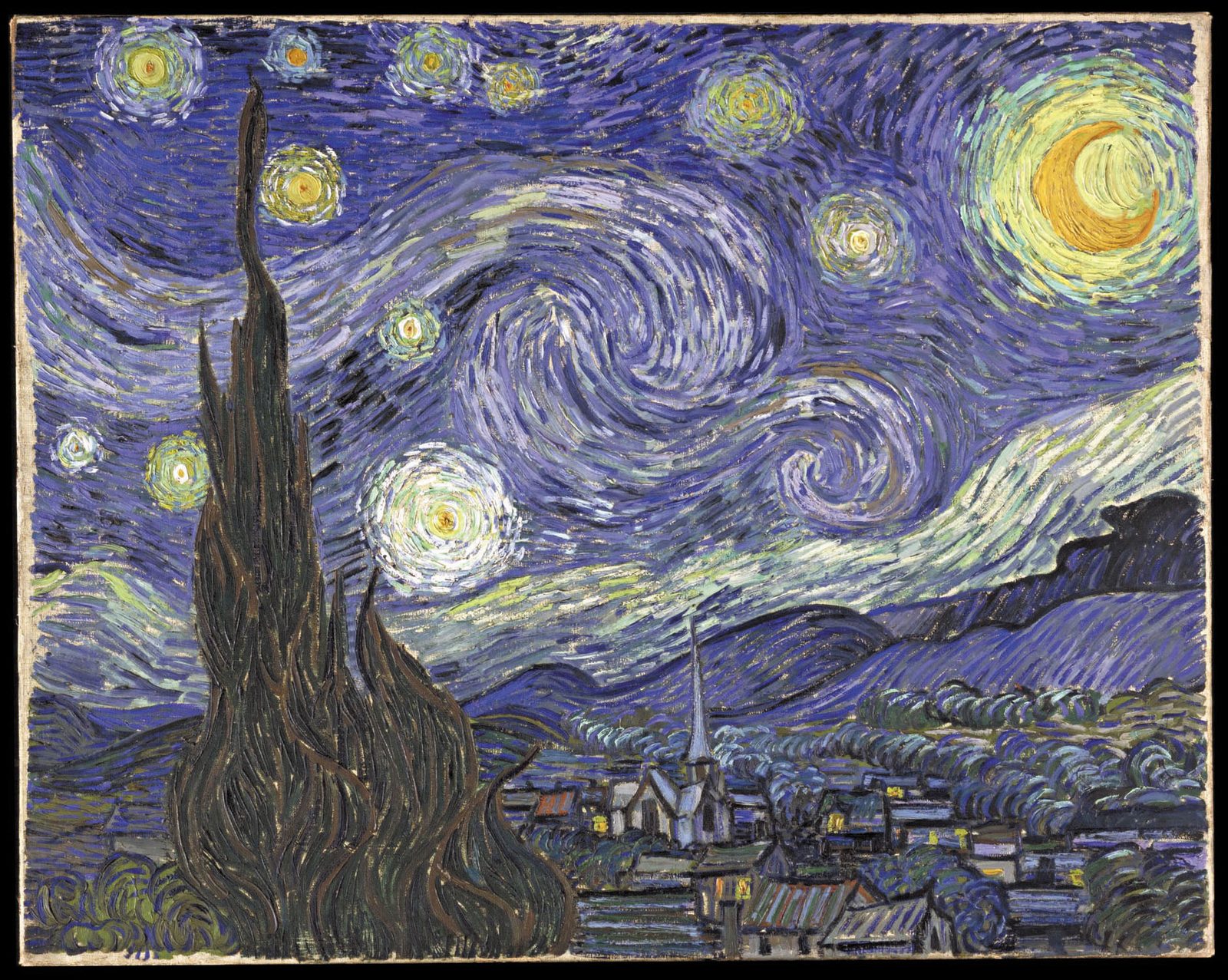
The painting
The Starry Night. Vincent van Gogh, 1889. Wikimedia Commons. Public domain.