
Psalm 16
11 verses · Psalm of trust
You have made known to me the path of life; You will fill me with joy in Your presence, with eternal pleasures at Your right hand.
Introduction
David, the Chosen Portion, Book 1: The book of David, Poetry, Psalms Overview.
David wrote this psalm as a song of settled confidence, and its heading calls it a miktam, a term whose meaning has not been recovered. He speaks as a man content with what God has allotted him, and he borrows Israel's law of land and inheritance to describe his portion in God. The psalm moves from choosing God, to delighting in Him, to trusting Him in the face of death. Listen for the language of property and surveyed fields, and for the closing lines that reach past the grave. Peter and Paul both preached from those lines in Acts, reading them of the resurrection of Jesus.
Context
- Who
- Israelites whose whole security was a family plot of ground
- What
- A psalm of confidence in which David names the LORD as his portion and trusts Him past death.
- Where
- Israel's land allotments and altars, with the shrines of the surrounding peoples in view
- When
- The reign of David, about 1010 to 970 BC by the superscription.
- Why
- To teach that the deepest security is God Himself, a hope the apostles read of the resurrection of Jesus.
Historical context
The superscription calls the psalm a miktam, a term it shares with Psalms 56 to 60, and what the word meant has not been recovered. The psalm is made of Israel's land law. When Israel took Canaan the ground was divided by lot, each family's portion marked by boundary stones and measured with a surveyor's cord, and that portion was meant to stay in the family for good. So the lines of a boundary falling in pleasant places is a farmer's sentence about a good inheritance, and the psalm turns it on God Himself. Behind that stand the Levites, the one tribe given no territory, whose portion the Law says is the LORD. Israel's drink offering was wine poured beside the altar, while the regional cults used blood rites and called their gods by name, and the psalm will not say those names aloud.
Significance
For an Israelite everything rested on holding your ground, and the psalm said the deepest holding was the God who assigned the field. Its closing lines press past the grave, asking that the singer's soul be left neither to Sheol nor to decay. First hearers took that as confidence that God would not abandon His servant to death, and Peter and Paul later argued in public that David died and was buried, so the words reach past him.
This chapter in Jewish lifeWhat this chapter is in Jewish life and reading.
How it is read
This is one of the chapters where the Jewish and the Christian readings stand furthest apart, and the corpus lets a reader see exactly where they separate. Rashi is quoted here from the Judaica Press Tanach with Rashi. He opens on the obscure word in the heading and reports the reading of the Sages first. They took it as two words, and read David as poor and perfect, "whose wound was perfect, for he was born circumcised". Rashi declines the reading because the word order of this heading will not carry it, and proposes a name for a kind of melody. He then offers a second reading, from the word for a crown, since David's habit of taking refuge in God "was to him as a crown" (Rashi on Psalms 16:1:1).
The second verse is read as a speech to the soul or to the people. Radak, quoted from the Finch translation of 1919, which is public domain, has David addressing his own soul (Radak on Psalms 16:2:1). Rashi carries both readings, the Congregation of Israel first and the soul second (Rashi on Psalms 16:2:1). At the same verse Rashi gives a sentence about merit that a Christian reader should weigh. The benefits God does for David are unowed, "because You do not benefit me on account of my righteousness" (Rashi on Psalms 16:2:2). At the fifth verse he pictures the allotted portion as a father's hand laid on the better share for a son he loves, saying choose this one for yourself (Rashi on Psalms 16:5:2). The lines fallen in pleasant places Radak reads as an inheritance "in the possession of good and right knowledge" (Radak on Psalms 16:6:1).
The eighth verse draws the most careful writing in the chapter. Radak reads it as a practice of the mind rather than a feeling. The glory of God is kept before him "as something which is before a man always so that it departs not from his eyes and mind" (Radak on Psalms 16:8:1). He then names a second authority on the verse, and cites the exposition of Moses ben Maimon in the Guide of the Perplexed. Rashi reads the same verse of the fear of God set before his eyes in every deed. He carries a further reading, of the scroll of the Torah that the king kept by him to read all his days (Rashi on Psalms 16:8:1).
Then comes the parting. The tenth verse says that God will not leave the speaker's soul to Sheol, nor let his holy one see the pit. Radak reads it of the soul rather than the body. God "will not leave my soul to go down to Sheol with the body, but wilt raise it to Thy glory" (Radak on Psalms 16:10:1). He adds a saying from the Midrash, that a man who hears himself reviled and holds his peace is called a holy one in judgment. Rashi reads the ninth verse as David's confidence after his sin was forgiven, and takes the promise as a promise of continued life with God (Rashi on Psalms 16:9:1). The apostles read the same verses as a prophecy of the resurrection of Jesus, and argue that David died and was buried while the psalm's holy one saw no decay. Peter makes that argument at Acts 2:25 to 31, and Paul makes it again at Acts 13:35. That is the disagreement in full: whether the verse promises the soul's ascent to glory or the body's rising from the grave, and whether the holy one of the verse is David or another. The site puts both readings in front of the reader at this verse and reports each in its own words. Ibn Ezra comments on the same verse, and the corpus carries his ref without English text, so he stands cited and unquoted at Ibn Ezra on Psalms 16:10:1. Rashi's last note reads the fullness of joys of the eleventh verse as "the joy of the future" (Rashi on Psalms 16:11:2).
What the rabbis say
The corpus carries forty locators on this psalm and the text of none, so each is cited and linked here rather than quoted. Eight are Talmudic. Three stand in Avot DeRabbi Natan, at 2:5 on the first verse, 33:1 on the seventh and 40:3 on the tenth. The rest stand at Jerusalem Talmud Berakhot 6:1:2 on the second verse, Sanhedrin 60b:6 on the fourth, Bava Batra 17a:5 and Bava Metzia 83b:13 on the ninth, and Arakhin 13b:10 on the eleventh.
Bereshit Rabbati carries six, more than in any other chapter of the first thirty. They stand on Chayei Sarah 12 and Toldot 4 at the second verse, on Lech Lecha 21, Vayetze 49 and Vayishlach 34 at the third, and on Vayechi 12 at the eleventh. Ein Yaakov carries six more. In the Glick Edition they are Megillah 4:8 on the sixth verse, Sanhedrin 2:14 and 2:15 on the eighth, Bava Batra 1:43 on the ninth, and Eiruvin 2:4 with Yoma 8:27 on the tenth. Beside them stand Menakhot 5:1 and Sanhedrin 2:15.
Midrash Tehillim carries four, at 16:1 and 16:11 on the first verse and 16:3 and 16:4 on the fourth. Bereshit Rabbah carries four, at 74:15 on the first verse, 88:5 on the fifth, and 61:1 and 95:3 on the seventh. On the fifth and sixth verses the corpus also carries Eikhah Rabbah 1:33, Bamidbar Rabbah 23:6, Midrash Lekach Tov on Lamentations 3:24:1, on Deuteronomy 32:9:1 and on Exodus 33:16:3. Three more stand at Aggadat Bereshit 18:1 on the third verse, Midrash Aggadah on Exodus 1:1:1 on the fourth, and Bamidbar Rabbah 15:11 on the eleventh. Two stand later in the chapter, at Pesikta Rabbati 10:1 and Midrash Tanchuma Buber, Vayigash 12:1. What each of them teaches is a saying of the rabbis, and is reported as theirs wherever this site quotes one. The quotations wait on a fetch that carries the text.
Sources: Rashi, Rashi on Psalms 16:1:1 to 16:11:2, the Judaica Press complete Tanach with Rashi, translated by A. J. Rosenberg; Radak, Radak on Psalms 16:1:1 to 16:10:1, R. David Kimhi on the first book of Psalms, translated by R. G. Finch, London, 1919; Moses ben Maimon, the Guide of the Perplexed 3:51, cited by Radak on Psalms 16:8:1; Ibn Ezra, Ibn Ezra on Psalms 16:10:1, cited by ref because the corpus carries no English text; The Sefaria corpus, scripts/data/sources/sefaria/psalms/16.json, the 8 Talmud and 32 Midrash locators of this chapter.
Psalms 16:1-2
Preserve me, O God: is a prayer for safekeeping, and its ground is refuge taken in the LORD. In verse 2 the psalmist calls the LORD his Lord and owns that he has no good thing apart from Him. The trust of verse 1 rests on who God is.
Psalms 16:1
An inscription of a title, to David himself. In place of this the fifth edition put the Hebrew word itself, "MACTHAM David," which Aquila translated as "of the humble and simple David," and Symmachus as "of the humble and unstained David." And Aquila himself again, in the fifty-fifth psalm and in the rest as far as the fifty-ninth, rendered this very thing so as to say "of the humble and perfect David."
Jerome · written before 420 · Homily 61, on Psalm 15patristic
1 more voice on this verseWhat preachers and commentators have said about this verse, in their own words.
Psalms 16:1
“I BELIEVE that we have in this verse a prayer of the Lord Jesus Christ. Some portions of this Psalm cannot apply to anyone but the Savior. And we have the examples of Peter and Paul to warrant us in saying that in this Psalm, David spoke of Jesus Christ. There is no apparent division in the Psalm, so that as one part of it refers most distinctly to Christ, we are justified in concluding that the whole of it refers to Him and belongs to Him!”
Charles Spurgeon · written before 1892 · The Metropolitan Tabernacle Pulpit, Sermon No. 3280: “Christ's Prayer and Plea” (lightly modernized text, CCEL edition)Particular Baptist
Augustine read the line as the LORD needing no good thing from the psalmist. Every good he has was first given by God. Jerome carried the thought into verse 3, where the saints in the land need the goods God has no need of.
Psalms 16:2
“Who has ever given him anything, since "from him, and through him and in him" are all things? The fount of life is that highest Good that bestows the substance of life on all, because it has life abiding in itself. It receives from no one as though it were needy; it lavishes goods on all and borrows from others nothing for itself, for it has no need of us. It says, too, in the person of humankind: "You do not need my goods." What is more lovely than to approach him and cling to him?”
Ambrose of Milan · written before 397 · Letter 29: To Irenaeuspatristic
1 more voice on this verse
Psalms 16:2
“It is the duty and interest of every one of us to acknowledge the Lord for our Lord, to subject ourselves to him, and then to stay ourselves upon him. Adonai signifies My stayer, the strength of my heart. This must be done with our souls: "O my soul! thou hast said it." Covenanting with God must be heart-work; all that is within us must be employed therein and engaged thereby.”
Matthew Henry · Commentary on the Whole Bible (1707-1721)puritan
Psalms 16:3-4
the saints in the land: are the psalmist's delight, and those who chase other gods are told their sorrows will multiply. He refuses their libations of blood and will not speak their names. Matthew Henry reads that as courtesy withheld from those gods.
Psalms 16:3
“To the saints who are in his land, he made all his wishes wonderful in them. In place of which it is written in the Hebrew: "To the saints who are in the land, and to my exalted ones, is all my will in them." These goods of which you have no need, O Father, my saints do need—the saints in whom I have made all my wishes to be wonderful.”
Jerome · written before 420 · Homily 61, on Psalm 15patristic
2 more voices on this verse
Psalms 16:3
"But to the saints that are in the earth." These sanctified ones, although still upon the earth, partake of the results of Jesus' mediatorial work, and by his goodness are made what they are. The peculiar people, zealous for good works, and hallowed to sacred service, are arrayed in the Saviour's righteousness and washed in his blood, and so receive of the goodness treasured up in him; these are the persons who are profited by the work of the man Christ Jesus; but that work added nothing to the nature, virtue, or happiness of God, who is blessed for evermore.
Charles Spurgeon · The Treasury of David, Vol. 1 (1869)Particular Baptist
Psalms 16:3
“But - I bear a singular respect and love to all saints, for thy sake, whose friends and servants they are, and whose image they bear. This more properly agrees to David, than to Christ, whose goodness was principally designed for, and imparted to sinners.”
John Wesley · Explanatory Notes upon the Old Testament (1765)evangelical
those who chase other gods: Verse 3 gave the psalmist's delight to the saints, and verse 4 turns to those who chase other gods. Charles Spurgeon noted how fast they run, and how their sorrows multiply as they multiply their sins. John Wesley said Gentiles sometimes drank the blood they offered.
Psalms 16:4
“Sorrows - Having shewed his affection to the servants of the true God, he now declares what an abhorrency he has for those that worship idols. Offerings - In which the Gentiles used sometimes to drink part of the blood of their sacrifices.”
John Wesley · Explanatory Notes upon the Old Testament (1765)evangelical
1 more voice on this verse
Psalms 16:4
“He expresses his abhorrence of those who seek other sources of happiness or objects of worship, and, by characterizing their rites by drink offerings of blood, clearly denotes idolaters. The word for "sorrows" is by some rendered "idols"; but, though a similar word to that for idols, it is not the same.”
Jamieson, Fausset & Brown · Commentary Critical and Explanatory on the Whole Bible (1871)reformed
Psalms 16:5-6
my chosen portion and my cup: makes the LORD Himself the inheritance, and Numbers 18:20 gives Aaron no land and names the LORD his portion. The lines of my boundary are a surveyor's measuring cord, and they have fallen in pleasant places. God keeps that lot secure.
Psalms 16:5
“The Lord - I rejoice in God as my portion, and desire no better, no other felicity. Cup - The portion which is put into my cup, as the ancient manner was in feasts, where each had his portion of meat, and of wine allotted to him. Lot - My inheritance divided to me by lot, as the custom then was.”
John Wesley · Explanatory Notes upon the Old Testament (1765)evangelical
2 more voices on this verse
Psalms 16:5
“The Lord is the portion of my inheritance and of my cup: it is you who will restore my inheritance to me. Our Savior in the Scriptures is called both high priest and king. High priest, in this: "You are a priest forever according to the order of Melchizedek." King, as in that place: "But I have been established as king by him over Zion, his holy mountain." According, then, to the fact that he is a priest, the Lord is his portion.”
Jerome · written before 420 · Homily 61, on Psalm 15patristic
Psalms 16:5
“God is the chief good, and supplies all need (De 10:9). portion of mine inheritance and of my cup--may contain an allusion to the daily supply of food, and also to the inheritance of Levi (De 18:1, 2). maintainest--or, drawest out my lot--enlargest it.”
Jamieson, Fausset & Brown · Commentary Critical and Explanatory on the Whole Bible (1871)reformed
surely my inheritance is delightful: John Wesley placed these pleasant places in a land flowing with milk and honey, and above all in the presence and knowledge of God. Augustine compared the lot to the portion of the priests and Levites, whose possession was God Himself. The delightful inheritance is the LORD of verse 5.
Psalms 16:6
“Those whose lot is cast, as David's was, in a land of light, in a valley of vision, where God is known and worshipped, have, upon that account, reason to say, The lines have fallen to me in pleasant places; much more those who have not only the means, but the end, not only Immanuel's land, but Immanuel's love.”
Matthew Henry · Commentary on the Whole Bible (1707-1721)puritan
1 more voice on this verse
Psalms 16:6
Jesus found the way of obedience to lead into "pleasant places." Notwithstanding all the sorrows which marred his countenance, he exclaimed, "Lo, I come; in the volume of the book it is written of me, I delight to do thy will, O my God: yea, thy law is within my heart."
Charles Spurgeon · The Treasury of David, Vol. 1 (1869)Particular Baptist
Psalms 16:7-8
the LORD who counsels me: The psalmist blesses the LORD who counsels me, and the instruction keeps going at night, when the conscience is what speaks. Setting the LORD always before me is a habit of attention. At my right hand names the place where a defender stands, so the psalmist will not be shaken.
Psalms 16:7
“I will bless the Lord who has given me understanding: moreover even until night my reins have rebuked me. He who speaks below, "My flesh shall rest in hope, for you will not leave my soul in hell, nor will you give your holy one to see corruption," consistently now too says: I will bless the Lord who has given me understanding, moreover even until night my reins have rebuked me. For he who is Wisdom, how does he receive understanding?”
Jerome · written before 420 · Homily 61, on Psalm 15patristic
2 more voices on this verse
Psalms 16:7
"I will bless the Lord, who hath given me counsel." Praise as well as prayer was presented to the Father by our Lord Jesus, and we are not truly his followers unless our resolve be, "I will bless the Lord." Jesus is called Wonderful, Counsellor, but as man he spake not of himself, but as his Father had taught him. Read in confirmation of this, John 7:16; 8:28; and 12:49, 50; and the prophecy concerning him in Isaiah 11:2, 3.
Charles Spurgeon · The Treasury of David, Vol. 1 (1869)Particular Baptist
Psalms 16:7
“Reins - My inward thoughts and affections, being inspired and moved by the Holy Spirit. Instruct - Direct me how to please God, and put my whole trust in him. Night - Even when others are asleep, my mind is working upon God, and improving the silence and solitude of holy meditations.”
John Wesley · Explanatory Notes upon the Old Testament (1765)evangelical
set the LORD always before me: Jerome said it lies within a person's power to set the LORD always before the eyes. John Wesley read David here as a type of Christ. Charles Spurgeon heard the Redeemer facing death secure in the presence of the LORD at his right hand.
Psalms 16:8
“I foresaw the Lord in my sight always: for he is at my right hand, that I may not be moved. In place of what we read in Latin, "I foresaw," and what in Greek is written "proōrōmēn," it stands better in the Hebrew SEBETHI, which we may render "I set before myself." So that it means: I set the Lord before me always at my right hand, and I could be overthrown by no fraud of my enemies. And at the same time consider that it is in our power to set the Lord before our eyes.”
Jerome · written before 420 · Homily 61, on Psalm 15patristic
2 more voices on this verse
Psalms 16:8
“The fear of death at one time cast its dark shadow over the soul of the Redeemer, and we read that, "he was heard in that he feared." There appeared unto him an angel, strengthening him; perhaps the heavenly messenger reassured him of his glorious resurrection as his people's surety, and of the eternal joy into which he should admit the flock redeemed by blood. Then hope shone full upon our Lord's soul, and, as recorded in these verses, he surveyed the future with holy confidence because he had a continued eye to Jehovah, and enjoyed his perpetual presence.”
Charles Spurgeon · The Treasury of David, Vol. 1 (1869)Particular Baptist
Psalms 16:8
“Hitherto David seems to have spoken with respect to himself, but now he is transported by the spirit of prophecy, and carried above himself, to speak as a type of Christ, in whom this and the following verses were truly accomplished. Christ as man did always set his father's will and glory before him.”
John Wesley · Explanatory Notes upon the Old Testament (1765)evangelical
Cross references
Psalms 16:8
- Quoted inActs 2:25“David says about Him: ‘I saw the Lord always before me; because He is at my right hand, I will not be shaken.”
'Thou wilt not leave my soul in hell', resurrection proof ('David speaketh concerning him')
ConnectionsActs 2:25
my heart is glad: follows straight from the LORD standing at his right hand, and the gladness reaches his speech, so the tongue rejoices. The last line brings the body into the same safety, dwelling securely. Verse 10 says why, and the hope reaches past the grave.
Psalms 16:9
“We die not by our own choice but by necessity of nature and against our will. However, the Lord, being himself immortal yet having mortal flesh, had power, as God, to separate from his body and to take it back again, when he would.… For it was fitting that the flesh, corruptible as it was, should no longer after its own nature remain mortal, but because of the Word who had put it on, should abide incorruptible.”
Athanasius of Alexandria · written before 373 · Discourses Against the Arians 3.28.57patristic
2 more voices on this verse
Psalms 16:9
“He clearly foresaw that he must die, for he speaks of his flesh resting, and of his soul in the abode of separate spirits; death was full before his face, or he would not have mentioned corruption; but such was his devout reliance upon his God, that he sang over the tomb, and rejoiced in vision of the sepulchre.”
Charles Spurgeon · The Treasury of David, Vol. 1 (1869)Particular Baptist
Psalms 16:9
“Shall rest - in confident assurance of its incorruption there, and of its resurrection to an immortal life: the flesh or body is in itself, but a dead lump of clay; yet hope is here ascribed to it figuratively, as it is to the brute creatures, Rom. viii, 19. Hell - In the state of the dead. Holy one - Me thy holy son, whom thou hast sanctified and sent into the world.”
John Wesley · Explanatory Notes upon the Old Testament (1765)evangelical
Your Holy One see decay: is the line Peter preaches at Acts 2:25 to 31, showing that David died and was buried. Paul preaches it at Acts 13:35 to 37, where David's body saw decay and the body God raised was untouched. The psalm looks past David to the Christ.
Psalms 16:10
“Moreover my flesh too shall rest in hope. For you will not leave my soul in hell, nor will you give your holy one to see corruption. It is superfluous to wish to treat of those things which have been explained by the apostles. We therefore say these things, which were passed over by them as being, as it were, of lesser importance: that he said, "My flesh shall dwell in hope," for this reason, that the Savior descended to the dead with the hope of rising again at once.”
Jerome · written before 420 · Homily 61, on Psalm 15patristic
1 more voice on this verse
Psalms 16:10
Our Lord Jesus was not disappointed in his hope. He declared his Father's faithfulness in the words, "thou wilt not leave my soul in hell, " and that faithfulness was proven on the resurrection morning. Among the departed and disembodied Jesus was not left; he had believed in the resurrection, and he received it on the third day, when his body rose in glorious life, according as he had said in joyous confidence, "neither wilt thou suffer thine Holy One to see corruption."
Charles Spurgeon · The Treasury of David, Vol. 1 (1869)Particular Baptist
Cross references
Psalms 16:10
- Quoted inActs 13:35“So also, He says in another Psalm: ‘You will not let Your Holy One see decay.’”
'Thou shalt not suffer thine Holy One to see corruption'
ConnectionsActs 13:35
the path of life: is the road God makes known, and verse 10 has already set it past the grave. Joy comes from being in God's presence, and the pleasures at Your right hand are eternal. The psalm ends where the LORD stood in verse 8.
Psalms 16:11
"Thou wilt shew me the path of life." To Jesus first this way was shown, for he is the first begotten from the dead, the first-born of every creature. He himself opened up the way through his own flesh, and then trod it as the forerunner of his own redeemed. The thought of being made the path of life to his people, gladdened the soul of Jesus. "In thy presence is fulness of joy."
Charles Spurgeon · The Treasury of David, Vol. 1 (1869)Particular Baptist
2 more voices on this verse
Psalms 16:11
"Fullness" means completely satisfying. And "forevermore" means those pleasures never stop.
Psalms 16:11
“If the heart rejoice in God, out of the abundance of that let the mouth speak, to his glory, and the edification of others. That dying Christians, as well as a dying Christ, may cheerfully put off the body, in a believing expectation of a joyful resurrection: My flesh also shall rest in hope.”
Matthew Henry · Commentary on the Whole Bible (1707-1721)puritan
How this psalm is built
The form: A prayer of the Lord Jesus Christ, read of Him throughout because the clearest part of it can belong to no one else, as Spurgeon classes it.
The patterns in this chapter
| Device | What it does | Where to see it |
|---|---|---|
| The saints set against those who chase other gods | Verses 3 and 4 put two groups side by side and give each a sentence. The saints in the land hold all his delight, and those who chase other gods gain multiplied sorrows and lose even the mention of their names. Spurgeon reads the two verses as one heart in two directions, open toward the chosen people and closed against those who continue in rebellion. He also notes the speed the psalm grants the wrong side, since the wicked hasten after another god.Charles Spurgeon, The Treasury of David, Vol. 1, 1869, on Psalm 16:4. | Psalm 16:3, Psalm 16:4 |
| The terms of a land grant gathered in two verses | Verses 5 and 6 name a holding four ways over: portion, cup, lot, and the lines of a boundary. Wesley explains the cup as the share set before a guest at a feast, where each man had his own portion of meat and wine allotted to him, and the lot as an inheritance divided by the old custom of casting lots. Jamieson, Fausset and Brown read the portion and the cup together as a reference to the daily supply of food. The list says one thing four times, that what he has was assigned to him rather than taken.John Wesley, Explanatory Notes upon the Old Testament, 1765, on Psalm 16:5. | Psalm 16:5, Psalm 16:6 |
| The speaker who turns at verse 8 | The psalm speaks to God in verse 1, speaks about the saints and the idolaters in verses 3 and 4, and returns to God in verse 5. Wesley marks verse 8 as the place where the change is more than grammatical, since David has spoken to that point with respect to himself and is now carried above himself to speak as a type of Christ. Matthew Henry reads the rest of the psalm the same way and points to the apostle's use of it in Acts 2. Augustine had already read the whole psalm as the words of the King speaking in the human nature He assumed.John Wesley, Explanatory Notes upon the Old Testament, 1765, on Psalm 16:8. | Psalm 16:1, Psalm 16:5, Psalm 16:8 |
The structure
9 more paragraphs on the patterns
The psalm runs eleven verses with no Selah and no refrain, and it keeps a single voice throughout. Its movements are short: the request in verse 1, the two companies in verses 2 to 4, the settlement in verses 5 to 7, and the confidence in verses 8 to 11. Wesley marks the hinge at verse 8, where David is carried above himself. The one repetition that shapes the whole is the place at God's right hand, claimed for this life in verse 8 and for what follows death in verse 11.
In the New Testament
Adam Clarke states that verse 8 and everything to the end of verse 11 is applied by Peter to the death and resurrection of Christ at Acts 2:25, and Matthew Henry says the rest of the psalm is expressly and at large applied there. The chapter summary records Paul preaching the same verses at Acts 13. Both apostolic arguments turn on one fact, that David died and was buried while the psalm says the Holy One would see no decay, which is the point Augustine presses in the City of God.
The church has read verse 10 as the resurrection text ever since, and Origen adds that the flesh of Christ is the first to rest in hope and the first carried into heaven.
Where it sits in the Psalter
The psalm that follows works the same seam from the other side. Psalm 17 ends with a man who expects to behold God's face in righteousness and to be satisfied in His presence when he awakes, and Matthew Henry notes that David closes the two psalms with the same prospect. Read as a pair they refuse to let the account be settled at the grave, one from the side of inheritance and one from the side of pursuit.
The lines about Sheol
The Sheol line of verse 10 and the portion of verse 5 belong to a subject larger than one psalm, and this study keeps the full presentation because the feature page on it has yet to be built.
What the text says is that God will not abandon the speaker's soul to Sheol nor let His Holy One see decay, and that He has made known the path of life. Wesley glosses the word as the state of the dead. Spurgeon reads the verse as a hope that was proved on the resurrection morning. Jerome adds that the Savior went down to the dead in the hope of rising again at once.
Keep studying
Studies11
Subjects1
Sources for this chapter
The summary
Jamieson, Fausset & Brown, Commentary Critical and Explanatory; John Calvin, Commentaries; John Wesley, Notes on the Old Testament and Matthew Henry, Complete Commentary.
The form and classifications
Albert Barnes, Notes, Explanatory and Practical, on the Old and New Testaments (1832 to 1869), on Psalm 16:1; Charles Spurgeon, The Metropolitan Tabernacle Pulpit, Sermon No. 3280, “Christ's Prayer and Plea”, 1911, on Psalm 16:1; Jerome, Homily 61, on Psalm 15, 420, on Psalm 16:1 and John Wesley, Explanatory Notes upon the Old Testament, 1765, on Psalm 16:8.
The exposition
Albert Barnes, Notes on the Book of Psalms; Augustine of Hippo; Charles Spurgeon, The Treasury of David; Franz Delitzsch, Biblical Commentary on the Psalms; Jerome, Homily 61, on Psalm 15; John Gill, Exposition of the Old Testament; John Wesley, Explanatory Notes upon the Old Testament and Matthew Henry, Commentary on the Whole Bible.
The painting
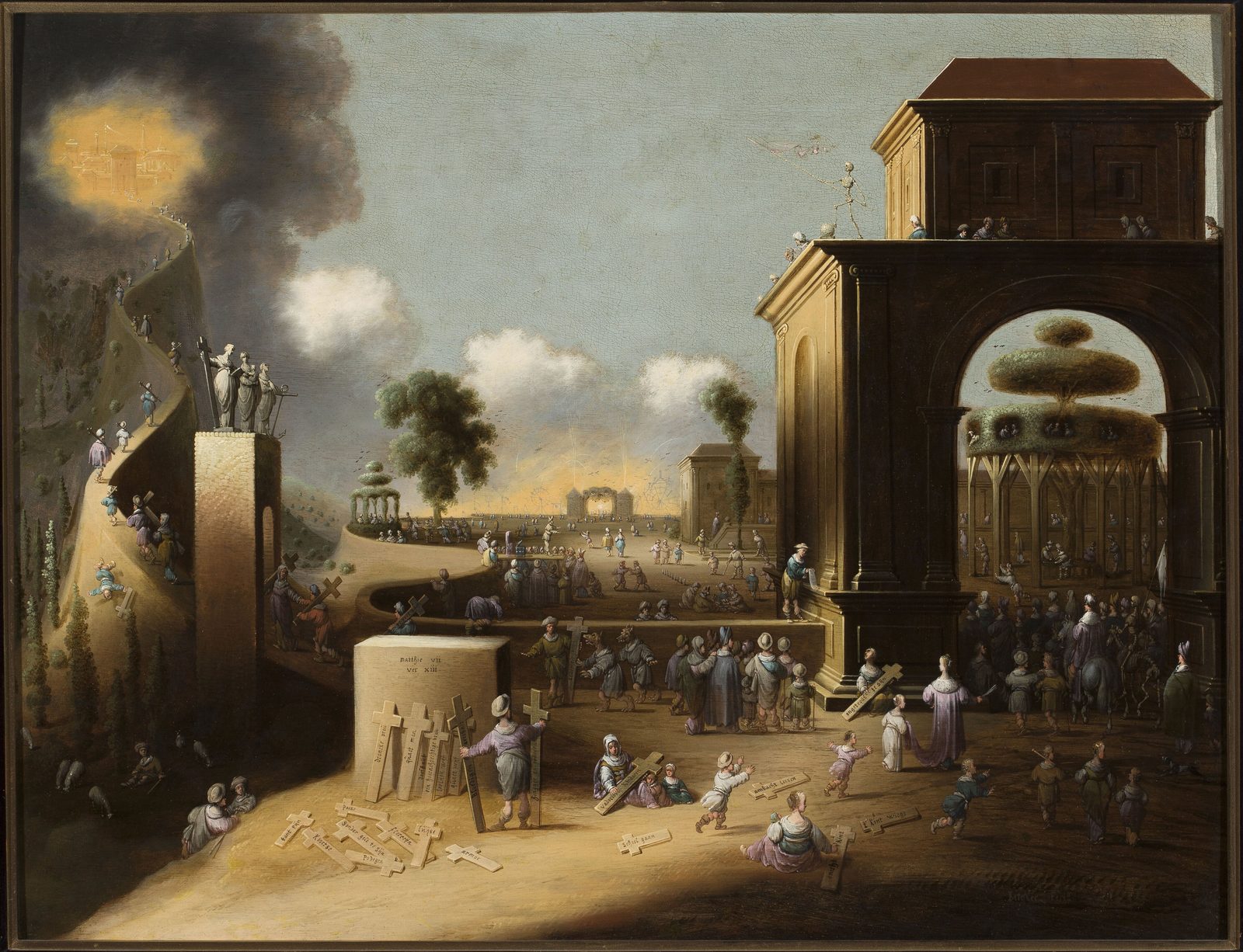
Narrow Road of Virtue and Wide Road of Sin. Jan Micker, not stated on the file page. National Museum in Warsaw. Public domain.