
Psalm 116
19 verses · David and others · 10th to 5th century BC · Wisdom and poetry
I will lift the cup of salvation and call on the name of the LORD.
Introduction
Author unstated, the Vow Paid, Book 5: The return and the great Hallelujah, Poetry, Psalms Overview.
This psalm is one man's thanks after he nearly died. Its writer is not named, and he speaks as someone who promised God something while he was in danger and has now come to keep his word. The setting is the temple courts, with a thanksgiving meal shared among neighbours. Listen for how physical his trouble was, and for the question he asks about what he can give back. His answer is to keep his promises where everyone can hear them, and the psalm itself is part of the paying.
Context
- Who
- Israelites who knew that a vow made in trouble was a debt, and that it was paid in public over a meal
- What
- A psalm of thanksgiving by one man rescued from death, who pays his vows in the temple courts.
- Where
- The courts of the temple in Jerusalem.
- When
- Sung in the Passover songs of the second temple period, with the author and the date of writing unnamed.
- Why
- To give thanks in public for a deliverance and to keep the promises made in distress before the people.
Historical context
The psalm is one man's account of a near death and what he did about surviving it. Verse 3 gives the trouble in two physical words: the ropes of death are chebel, a twisted cord used of a noose, and the anguish of Sheol is metsar, a narrow place with no room in it. A person in extremity promised God something, and if the deliverance came the promise was a debt, which Deuteronomy 23:21 to 23 treats as sin to leave unpaid. It was paid with a sacrifice of thanksgiving, the peace offering of Leviticus 7:12 to 15, which had to be eaten on the day it was offered, so the offering meant inviting the neighbours. That is why the psalm twice says in the presence of all His people. The cup of salvation at verse 13 is in the Hebrew plural, salvations.
Significance
To an Israelite this psalm was the script of a familiar occasion. A man came back from the edge, brought an animal to the temple, called the neighbours, lifted a cup and said out loud what had happened to him. Its question at verse 12, how can I repay the LORD, had a settled answer in that culture: keep the promise in public so that everyone within earshot learns what He did.
This chapter in Jewish lifeWhat this chapter is in Jewish life and reading.
What is done
This psalm stands fourth in the Hallel, Psalms 113 to 118, said as one unit at the appointed feasts, and it falls in the part finished over the fourth cup at the seder (src/app/featured/the-hallel/page.tsx, Mishnah Pesachim 10:6-7).
Rashi reads verse 13 of the cup that is lifted over an offering, and gives the rule behind the custom. The cup of salvations is the libation brought with the thanksgiving offering that was vowed, and the song is said over it because "the Levite does not recite a song unless over the wine" (Rashi on Psalms 116:13:1, Rashi on Psalms, The Judaica Press complete Tanach with Rashi, translated by A. J. Rosenberg, CC-BY). The corpus carries the Babylonian Talmud on that verse at Berakhot 51b:2 and 60b:10.
How it is read
Rashi reads the whole psalm of David, and dates it. He places the opening after the death of Saul, when David became king, and the life given back in verse 9 he reads as the land of Israel, out of which David's pursuers had chased him in the days of Saul and to which he returned against their will (Rashi on Psalms 116:1:1 and 116:9:1, same edition).
Two later verses he ties to named scenes in Samuel. Verse 10 he reads of David believing what Ziba said about Mephibosheth, and then humbling himself over the harsh word he had spoken, citing 2 Samuel 16:4, and the haste of verse 11 he reads as the flight from Absalom (Rashi on Psalms 116:10:1 and 116:11:1, same edition).
Verse 15 he reads as a word spoken to David rather than about him, that God showed him how difficult and heavy a thing it is in His eyes to kill His pious ones (Rashi on Psalms 116:15:1). On verse 16 he gives the reason a servant born in the house is named there, since there is no comparison between the training of a slave bought in the market and one born to a maidservant in the house (Rashi on Psalms 116:16:1).
Ibn Ezra and Radak carry nine comments for which Sefaria holds no English version, and they are cited by reference (Ibn Ezra on Psalms 116:2:1 and the eight references beside it).
What the rabbis say
The corpus records forty places where the Midrash and the Talmud cite this psalm, twenty nine under Midrash and eleven under Talmud, and it carries the locator for each one with no text. Verse 15, on the death of the pious, draws the Babylonian Talmud at Bava Batra 8b:3 and Chagigah 14b:9 and Bereshit Rabbah at 62:1.
The Talmud also cites verse 2 at Yevamot 12b:4, verse 4 at Pesachim 118a:17, verse 6 at Avodah Zarah 30b:4 and verse 13 at Berakhot 51b:2 and 60b:10. Avot DeRabbi Natan reads verse 4 at 41:15 and verse 9 at 34:11 and at Recension B 43:24.
Midrash Tehillim treats the psalm at 116:4, 116:7 and 116:12, and reads its verses from five other psalms at 5:3, 16:11, 18:7, 19:4 and 71:2. The site reports where the rabbis cite the verse and reports no saying, because the locator carries none.
Sources: The Mishnah, Pesachim 10:6-7, as recorded at src/app/featured/the-hallel/page.tsx, about AD 200; Rashi, Rashi on Psalms 116, in The Judaica Press complete Tanach with Rashi, translated by A. J. Rosenberg, CC-BY; Ibn Ezra and Radak, their comments on Psalms 116, cited by reference; Sefaria holds no English version; The Midrash and the Talmud, the forty locators on Psalms 116 in scripts/data/sources/sefaria/psalms/116.json.
Psalms 116:1-2
I love the LORD: The LORD inclined His ear to one appeal for mercy, and the love in verse 1 answers that hearing. The psalmist binds the rest of his life to it, calling on Him as long as he lives. The hearing comes first.
Psalms 116:1
“I have loved, because the Lord will hear the voice of my prayer. He did not say, I shall love: but, I have loved. He did not promise that he would do it, but he testifies that he has done it. I have loved. Why have I loved? Because the Lord will hear the voice of my prayer. "I have loved" belongs to time that is past; but in "will hear" it belongs to the future. For he did not say, I have loved because the Lord has heard me; but, I have loved because the Lord will hear me.”
Jerome · written before 420 · Homily 39, on Psalm 114patristic
1 more voice on this verseWhat preachers and commentators have said about this verse, in their own words.
Psalms 116:1
“I love the Lord. A blessed declaration: every believer ought to be able to declare without the slightest hesitation, "I love the Lord." It was required under the law, but was never produced in the heart of man except by the grace of God, and upon gospel principles. It is a great thing to say "I love the Lord"; for the sweetest of all graces and the surest of all evidences of salvation is love.”
Charles Spurgeon · The Treasury of David, Vol. 5 (1878)Particular Baptist
He has inclined His ear to me: Spurgeon pictured the LORD inclining His ear like a physician bending over a sick man whose voice is too faint to carry. The promise to call on Him as long as he lives is kept three times, at verses 4, 13 and 17. He calls before deliverance and after it.
Psalms 116:2
Because he hath inclined his ear unto me :—bowing down from his grandeur to attend to my prayer; the figure seems to be that of a tender physician or loving friend leaning over a sick man whose voice is faint and scarcely audible, so as to catch every accent and whisper. When our prayer is very feeble, so that we ourselves can scarcely hear it, and question whether we do pray or not, yet God bows a listening ear, and regards our supplications. Therefore will I call upon him as long as I live, or "in my days."
Charles Spurgeon · The Treasury of David, Vol. 5 (1878)Particular Baptist
1 more voice on this verse
Psalms 116:2
“And in my days I will call upon him. Here the question is asked: how is it that he calls upon him in the days, and does not call upon him in the nights? And how does he say in another place, "At midnight I rose to give praise to you," since the saints are more accustomed to pray in the nights? And in another psalm it is said: "In the nights lift up your hands to the holy places, and bless the Lord." How then does he say, And in my days I will call upon him?”
Jerome · written before 420 · Homily 39, on Psalm 114patristic
Psalms 116:3-4
The ropes of death entangled me: The ropes of death are chebel, a twisted cord used of a noose, and the anguish of Sheol is metsar, a tight place. Trouble and sorrow found him there, and he called on the name of the LORD. The prayer is four Hebrew words: deliver my soul.
Psalms 116:3
Do you hear him [the psalmist] saying, "The sorrows of death have compassed me"? "Still, I have loved the Lord even in the sorrows of death. The perils of hell have found me, not fearing indeed, but loving, but hoping, because no distress, no persecution, no dangers, no sword shall separate me from Christ." Therefore, he accepted tribulation and sorrow willingly, knowing that "suffering produces endurance, and endurance produces character, and character produces hope."
Ambrose of Milan · written before 397 · On the Death of Theodosius 23patristic
2 more voices on this verse
Psalms 116:3
“The sorrows of death compassed me,.... Christ, of whom David was a type, was a man of sorrows all his days; and in the garden he was surrounded with sorrow; exceeding sorrowful even unto death, in a view of the sins of his people imputed to him, and under a sense of wrath for them, he was about to bear; and his agonies in the article of death were very grievous, he died the painful and accursed death of the cross.”
Psalms 116:3
“The Psalmist now goes on to describe his condition at the time when he prayed unto God. The sorrows of death compassed me. As hunters surround a stag with dogs and men, so that no way of escape is left, so was David enclosed in a ring of deadly griefs. The bands of sorrow, weakness, and terror with which death is accustomed to bind men ere he drags them away to their long captivity were all around him.”
Charles Spurgeon · The Treasury of David, Vol. 5 (1878)Particular Baptist
Then I called on the name of the LORD: Spurgeon said the psalmist called in the trouble and sorrow of verse 3, when things were at their worst. He read calling on the name as calling on all the name of the LORD holds. Gill noted the Hebrew can be read as calling in the name of the LORD.
Psalms 116:4
“Then called I upon the name of the Lord,.... Upon the Lord himself in prayer for speedy deliverance; or "in the name of the Lord" (h), in the name of the Messiah, the only Mediator between God and man; "saying", as follows, and which word may be supplied, O Lord, I beseech thee, deliver my soul; from these sorrows and pains, from these afflictions and distresses, from death and the grave, and from wrath, and a sense of it, and fears about it. (h) בשם יהוה "in nomine Domini", Montanus, Musculus, Vatablus.”
2 more voices on this verse
Psalms 116:4
“Then I called upon the name of the Lord. Prayer is never out of season, he prayed then, when things were at their worst. When the good man could not run to God, he called to him. In his extremity his faith came to the front: it was useless to call on man, and it may have seemed almost as useless to appeal to the Lord; but yet he did with his whole soul invoke all the attributes which make up the sacred name of Jehovah, and thus he proved the truth of his confidence.”
Charles Spurgeon · The Treasury of David, Vol. 5 (1878)Particular Baptist
Psalms 116:4
“O Lord, deliver my soul. Neither the Greek nor the Latin can express the peculiar force of the Hebrew. For "O" the Hebrew has ANNA. Now anna is interpreted "I beg" and "I entreat." And what he says is this: I entreat you, Lord, deliver my soul. For it is not the feeling of one wondering, but of one entreating: for he is set in enormous peril.”
Jerome · written before 420 · Homily 39, on Psalm 114patristic
Psalms 116:5-7
The LORD is gracious and righteous: , and the ones He preserves are the simplehearted. The Hebrew word is pethi, the easily led, and the psalmist puts himself in that class when he says he was helpless. He then tells his own soul to return to its rest.
Psalms 116:5
“Gracious is the Lord, and righteous. In hearing prayer the grace and righteousness of Jehovah are both conspicuous. It is a great favour to hear a sinner's prayer, and yet since the Lord has promised to do so, he is not unrighteous to forget his promise and disregard the cries of his people. The combination of grace and righteousness in the dealings of God with his servants can only be explained by remembering the atoning sacrifice of our Lord Jesus Christ. At the cross we see how gracious is the Lord and righteous.”
Charles Spurgeon · The Treasury of David, Vol. 5 (1878)Particular Baptist
1 more voice on this verse
Psalms 116:5
“The Lord is merciful and just, and our God has mercy. Prick up your ears, sinner: the Lord is merciful. But do not be careless: for there follows, and just. If you are a great sinner, listen, the Lord is merciful: if you are careless, listen, he is also just. But it seems to be as it were equal, the Lord is merciful and just: for instance, he is merciful in ten parts, and just in ten parts, and I speak thus for the sake of the simpler folk.”
Jerome · written before 420 · Homily 39, on Psalm 114patristic
The LORD preserves the simplehearted: Gill noted the old versions render the simplehearted as babes, and he pointed to Matthew 11, where the Father reveals hidden things to little children. Helpless is literally brought low. The LORD who preserves the simple is the LORD who delivered this soul from death in verse 8.
Psalms 116:6
“The Lord keeps the little ones. If anyone is great, and exalts himself, and is proud, this man the Lord does not keep; if anyone thinks himself great, on this man the Lord has no mercy: but if anyone humbles himself, on this man the Lord has mercy, and the Lord keeps him. Since he says: "Behold, I and the children whom the Lord has given me." And again: I was humbled, and he saved me.”
Jerome · written before 420 · Homily 39, on Psalm 114patristic
Return to your rest, O my soul: Return implies a rest the soul once had. Spurgeon preached that a believer has a rest in God to go back to, one already entered, even while the road goes on. The reason given, that the LORD has been good, is the clause that closes Psalm 13:6.
Psalms 116:7
“You who have not be1ieved in our Lord Jesus Christ have no rest to which you can return, for you have never found any. May God grant to you the Grace to come to Christ that you may find rest unto your souls! But we who believe in Him do enter into rest. We are sometimes described as journeying through the wilderness towards Canaan, and the type is quite allowable, but still, it must not be pressed too far, for, in another sense, we have already entered into our rest.”
Charles Spurgeon · written before 1892 · The Metropolitan Tabernacle Pulpit, Sermon No. 2758: “'Return Unto Your Rest'” (lightly modernized text, CCEL edition)Particular Baptist
1 more voice on this verse
Psalms 116:7
“Turn, my soul, into your rest. When it is said, Turn into your rest, then he had a rest before, which he lost. For no one turns, except him who goes back to where he was before. For God created us good, and left us to our own free will, and placed us all with Adam in paradise. But because by our own free will we fell from that blessedness, and came into the valley of tears; for that reason the just man exhorts his soul, to turn back there whence it came down. Turn, my soul, into your rest.”
Jerome · written before 420 · Homily 39, on Psalm 114patristic
Psalms 116:8-9
You have delivered my soul from death: Three deliverances answer the three troubles of verse 3: the soul from death, the eyes from tears, the feet from stumbling. The psalmist spends the rest of his life on the answer, walking in the land of the living before the LORD. The land of the living is this life.
Psalms 116:8
“For thou hast delivered my soul from death, mine eyes from tears, and my feet from falling. The triune God has given us a trinity of deliverances: our life has been spared from the grave, our heart has been uplifted from its griefs, and our course in life has been preserved from dishonour. We ought not to be satisfied unless we are conscious of all three of these deliverance. If our soul has been saved from death, why do we weep? What cause for sorrow remains? Whence those tears?”
Charles Spurgeon · The Treasury of David, Vol. 5 (1878)Particular Baptist
1 more voice on this verse
Psalms 116:8
“Because he has rescued my soul from death. He has not yet returned into paradise, and already he says that he has returned into safety. He said, Turn, my soul, into your rest; and as though secure he says, Because he has rescued my soul from death. When did he rescue my soul from death? My God suffered for me, my God was crucified for me, and I say: "O death, where is your victory? O hell, where is your sting?" My eyes from tears.”
Jerome · written before 420 · Homily 39, on Psalm 114patristic
I will walk before the LORD: Walk is the Bible's word for a whole way of life, and before the LORD sets that life in His sight. Spurgeon counted this the psalmist's second resolution and set it against living for the eyes of other men. Psalm 56:13 closes on a near twin of this line.
Psalms 116:9
I will walk before the Lord in the land of the living. This is the Psalmist's second resolution, to live as in the sight of God in the midst of the sons of men. By a man's walk is understood his way of life: some men live only as in the sight of their fellow men, having regard to human judgment and opinion; but the truly gracious man considers the presence of God, and acts under the influence of his all observing eye. "Thou God seest me" is a far better influence than "My master sees me."
Charles Spurgeon · The Treasury of David, Vol. 5 (1878)Particular Baptist
Psalms 116:10-11
I believed, therefore I said: Faith speaks while the affliction is still on him. Paul quotes verse 10 at 2 Corinthians 4:13, I believed, therefore I have spoken, and claims the same spirit of faith for a ministry. The next line is spoken in alarm, that all men are liars.
Psalms 116:10
“Some make this to be no rash word of David's. He was greatly afflicted and forced to fly, but he did not trust in man, nor make flesh his arm. No: he said, " All men are liars; as men of low degree are vanity, so men of high degree are a lie, and therefore my confidence was in God only, and in him I cannot be disappointed." In this sense the apostle seems to take it.”
Matthew Henry · Commentary on the Whole Bible (1707-1721)puritan
2 more voices on this verse
Psalms 116:10
SOME translators render this passage, "I believed, though I have spoken as I have done," for the Psalmist had spoken words suggestive of unbelief. But, although he had spoken unwisely and unbelievingly, yet, deep down in his heart, he did still believe in his God. What a mercy it is for us that God does not judge us by our hasty speeches! If He can see only a spark of faith amidst the dense smoke of our unbelief, He accepts it! We will, however, take the text as we find it in our version—"I believed, therefore have I spoken."
Charles Spurgeon · written before 1892 · The Metropolitan Tabernacle Pulpit, Sermon No. 3200: “Faith Justifying Speech” (lightly modernized text, CCEL edition)Particular Baptist
Psalms 116:10
“I believed, therefore have I spoken,.... Here the Septuagint, Vulgate Latin, Arabic, and Ethiopic versions, begin a new psalm, but without any foundation in the original; nor is it countenanced by the Targum; and is manifestly against the connection with the preceding verses.”
Cross references
Psalms 116:10
- Quoted in2 Corinthians 4:13“And in keeping with what is written: “I believed, therefore I have spoken,” we who have the same spirit of faith also believe and therefore speak,”
'I believed, and therefore have I spoken' ('as it is written')
Verse 10 said he believed while greatly afflicted, and verse 11 gives what he said in his alarm. Spurgeon heard a hasty word, true in one sense: all men fail when trusted too far. Henry read it two ways, as rash or as wise.
Psalms 116:11
“I said in my haste, All men are liars. In a modified sense the expression will bear justification, even though hastily uttered, for all men will prove to be liars if we unduly trust in them; some from want of truthfulness, and others from want of power. But from the expression, "I said in my haste, "it is clear that the Psalmist did not justify his own language, but considered it as the ebullition of a hasty temper. In the sense in which he spoke his language was unjustifiable.”
Charles Spurgeon · The Treasury of David, Vol. 5 (1878)Particular Baptist
1 more voice on this verse
Psalms 116:11
“And some think it is especially a reflection on Samuel, who had promised him the kingdom, but deceived him; for, says he, I shall one day perish by the hand of Saul, 1 Sam. xxvii. The faith of the best of saints is not perfect, nor always alike strong and active.”
Matthew Henry · Commentary on the Whole Bible (1707-1721)puritan
Psalms 116:12-14
How can I repay the LORD: No payment answers the question of verse 12. He answers by lifting the cup of salvation, salvations in the Hebrew plural, and by calling on the name of the LORD. The vows are paid in front of all His people.
Psalms 116:12
“What shall I render unto the Lord for all his benefits toward me? He wisely leaves off fretting about man's falsehood and his own ill humour, and directs himself to his God. It is of little use to be harping on the string of man's imperfection and deceitfulness; it is infinitely better to praise the perfection and faithfulness of God.”
Charles Spurgeon · The Treasury of David, Vol. 5 (1878)Particular Baptist
1 more voice on this verse
Psalms 116:12
“Note, Those that believe with the heart must confess with the mouth, for the glory of God, the encouragement of others, and to evidence their own sincerity, Rom. x. Those that live in hope of the kingdom of glory must neither be afraid nor ashamed to own their obligation to him that purchased it for them, Matt. x.”
Matthew Henry · Commentary on the Whole Bible (1707-1721)puritan
I will lift the cup of salvation: Henry cited many who read the cup of salvation as the bitter cup of suffering, and he tied it to the cup Christ drank. Jesus took a cup at the Passover meal of Matthew 26:27, before the hymn of verse 30. He lifts the cup, then calls on the name.
Psalms 116:13
I will take the cup of salvation, and I will call upon the name of the Lord. In the Hebrew it stands thus: "I will take the cup of Jesus." This very thing the angel also interprets: "And you shall call his name Jesus, for he himself will save his people." I will take, then, the cup of Jesus. What is this cup of Jesus? "Father, if it is possible, let this cup pass from me," and "Are you able," he says, "to drink my cup?" And immediately there follows: "My cup indeed you shall drink."
Jerome · written before 420 · Homily 40, on Psalm 115patristic
1 more voice on this verse
Psalms 116:13
“Many good interpreters understand it of that cup, that bitter cup, which is yet sanctified to the saints, so that to them it is a cup of salvation. 19 , This shall turn to my salvation; it is a means of spiritual health. David's sufferings were typical of Christ's, and we, in ours, have communion with his, and his cup was indeed a cup of salvation.”
Matthew Henry · Commentary on the Whole Bible (1707-1721)puritan
I will fulfill my vows to the LORD: The vows were made in the trouble and sorrow of verse 3 and are paid once the LORD has delivered his soul. Spurgeon said a vow becomes a debt. Ecclesiastes 5:4 gives the same rule, that a vow to God is fulfilled without delay.
Psalms 116:14
“I will pay my vows unto the Lord now in the presence of all his people. The Psalmist has already stated his third resolution, to devote himself to the worship of God evermore, and here he commences the performance of that resolve. The vows which he had made in anguish, he now determines to fulfil: "I will pay my vows unto the Lord." He does so at once, "now, " and that publicly, "in the presence of all his people." Good resolutions cannot be carried out too speedily; vows become debts, and debts should be paid.”
Charles Spurgeon · The Treasury of David, Vol. 5 (1878)Particular Baptist
Precious in the sight of the LORD: The word for precious is yaqar, used of what is costly. Saints renders chasid, one who is faithful, and the death of such a man is costly in the LORD's own sight. This psalmist had just come that near to it.
Psalms 116:15
“By the death of the martyrs, religion has been defended, the faith spread and the church strengthened. The dead have been victorious, and the persecutors have been vanquished. Accordingly, we celebrate the deaths of those of whose lives we know nothing. So, too, David in prophecy rejoiced at the departure of his own soul, saying, "Precious in the sight of the Lord is the death of the saints." He held death in more esteem than life. The death itself of the martyrs is the prize of life. Furthermore, even the hatreds of enemies are dissolved by death.”
Ambrose of Milan · written before 397 · On the Death of Satyrus 2.45patristic
1 more voice on this verse
Psalms 116:15
“'Precious in the sight of the Lord is the death of his saints.''Psalm 116:15. DAVID SOUGHT DELIVERANCE from imminent peril, and he felt sure of obtaining it; for being a servant of the Lord he knew that his life was too precious in the sight of God for it to be lightly brought to an end. It should be a source of consolation to all tried saints that God will not deliver them over to the hands of their enemies; it is not the will of their Father who is in heaven that one of his little ones should perish.”
Psalms 116:16-17
I am Your servant: He says it twice, that he is the LORD's servant, and names his mother, so he was born into the house. The verb for the bonds is pathach, to loosen. A sacrifice of thanksgiving is the peace offering of Leviticus 7:12 to 15, eaten the same day it is offered.
Psalms 116:16
“THESE SENTENCES SUGGEST a contrast. David’s religion was one of perfect liberty;—“Thou hast loosed my bonds.” It was one of complete service;—“Truly l am thy servant. I am thy servant and the son of thine handmaid.” Did I say the text suggested a contrast? Indeed the two things need never be contrasted, for they are found to be but part of one divine experience in the Jives of all God’s people. The religion of Jesus is the religion of liberty. The true believer can say, when his soul is in a healthy state, “Thou hast loosed my bonds.”
1 more voice on this verse
Psalms 116:16
“When we read this, we correctly understand that Solomon was a natural and genuine son and do not consider him a servant just because we hear him so called. So also concerning the Savior, who is confessed to be in truth the Son and to be the Word by nature, as the saints say, "Who was faithful to him that made him," or if he says of himself, "The Lord created me," and, "I am your servant and the Son of your handmaid," and similar claims.”
Athanasius of Alexandria · written before 373 · Discourses Against the Arians 2.14.4patristic
a sacrifice of thanksgiving: Here the psalmist offers his sacrifice to the LORD directly, where verse 13 spoke about Him. Gill read the thanksgiving as praise offered through Christ, and Hebrews 13:15 calls the fruit of lips that confess His name a sacrifice of praise. The third call on the name comes here.
Psalms 116:17
“I will offer to thee the sacrifice of thanksgiving,.... For deliverance from afflictions and death; for loosing his bonds, in every sense; for all mercies, temporal and spiritual; see Rom 6:17; Such sacrifices are according to the will of God; are well pleasing to him, when offered up through Christ, and in faith, and are a glorifying of him. These are more acceptable than all ceremonial sacrifices; and therefore the psalmist determined to offer this, and not them; and will call upon the name of the Lord; See Gill on Psa 116:13.”
1 more voice on this verse
Psalms 116:17
“You have broken my bonds: to you I will sacrifice a victim of praise. Truly it is of great happiness so to go to the Lord that one has no defiled conscience. Whoever, being holy, dies his own death, although he be holy who has performed works of mercy, wrought signs, cast out demons, does not go to the Lord secure: his conscience shudders when he sees the Lord. But the martyr, even if he has sinned after baptism, yet washed by a second baptism, the baptism of martyrdom, goes secure to the Lord. You have broken my bonds.”
Jerome · written before 420 · Homily 40, on Psalm 115patristic
Psalms 116:18-19
I will fulfill my vows: The vow of verse 14 is said again, and this time the place is given. It is paid in the courts of the LORD's house at Jerusalem, in front of all His people. The psalm ends on one word, Hallelujah.
Psalms 116:18
“I will pay my vows unto the Lord,.... See Gill on Psa 116:14. And the Targum here, as there, paraphrases the latter clause, now in the presence of all his people, thus; "I will then declare his signs (or wonders) to all his people;'' the marvellous things he had done for him.”
1 more voice on this verse
Psalms 116:18
“I will pay my vows unto the Lord now in the presence of all his people. He repeats the declaration. A good thing is worth saying twice. He thus stirs himself up to greater heartiness, earnestness, and diligence in keeping his vow, —really paying it at the very moment that he is declaring his resolution to do so. The mercy came in secret, but the praise is rendered in public; the company was, however, select; he did not cast his pearls before swine, but delivered his testimony before those who could understand and appreciate it.”
Charles Spurgeon · The Treasury of David, Vol. 5 (1878)Particular Baptist
in your midst, O Jerusalem: Verse 19 names where all His people of verse 18 gathered: the courts of the LORD's house in Jerusalem. Spurgeon noted the turn to speak to the city itself. Gill placed these courts at the tabernacle, before the temple was built.
Psalms 116:19
“In the courts of the Lord's house,.... This is added by way of explanation of Psa 116:18, what he meant by "the presence of all his people"; the assembly of the saints met together in the house of the Lord, at the door of the tabernacle, in the courts of it, where the people got together to worship God; in the midst of thee, O Jerusalem; the Lord's house or tabernacle; for as yet the temple was not built, and the courts of it were in the midst of the city of Jerusalem.”
1 more voice on this verse
Psalms 116:19
“In the courts of the Lord'S house: in the proper place, where God had ordained that he should be worshipped. See how he is stirred up at the remembrance of the house of the Lord, and must needs speak of the holy city with a note of joyful exclamation—In the midst of thee, O Jerusalem. The very thought of the beloved Zion touched his heart, and he writes as if he were actually addressing Jerusalem, whose name was dear to him.”
Charles Spurgeon · The Treasury of David, Vol. 5 (1878)Particular Baptist
How this psalm is built
The form: An individual thanksgiving, spoken by a man the LORD heard and delivered from death, as Henry classes it.
The patterns in this chapter
| Device | What it does | Where to see it |
|---|---|---|
| The ropes of death and the tight place | The ropes of verse 3 are chebel in the Hebrew, a twisted cord used of a noose, and the anguish of Sheol is metsar, a narrow place with no room in it. The two words put the trouble as something that both binds and crowds.Albert Barnes, Notes, Explanatory and Practical, on the Old and New Testaments, 1832 to 1869, on Psalm 116:3. | Psalm 116:3 |
| Three troubles, three deliverances | Verse 3 names death, Sheol, and trouble and sorrow. Verse 8 answers with three rescues in the same order, the soul from death, the eyes from tears, the feet from stumbling. The answer is built to match the complaint item for item.Matthew Henry, Commentary on the Whole Bible, 1710, on Psalm 116:8. | Psalm 116:3, Psalm 116:8 |
| I will pay my vows to the LORD in the presence of all His people | The line stands twice, at verse 14 and verse 18, and the second time it is given a place, the courts of the LORD's house at Jerusalem. The repetition is the psalm keeping its own promise inside itself.Franz Delitzsch, Biblical Commentary on the Psalms, 1871, on Psalm 116:18. | Psalm 116:14, Psalm 116:18, Psalm 116:19 |
| I am Your servant, twice over | Verse 16 says it twice and then names his mother, so the speaker was born into the household rather than bought into it. The verb for loosening his bonds is pathach, to untie, which answers the ropes of verse 3.Albert Barnes, Notes, Explanatory and Practical, on the Old and New Testaments, 1832 to 1869, on Psalm 116:16. | Psalm 116:16 |
| The question at the centre | Verse 12 asks how the singer can repay the LORD for all His goodness, and the rest of the psalm is the answer. He lifts the cup, calls on the name, pays the vows and offers the sacrifice of thanksgiving. The question turns the psalm from report into act.Charles Spurgeon, The Treasury of David, Vol. 5, 1878, on Psalm 116:12. | Psalm 116:12, Psalm 116:13, Psalm 116:17 |
What the New Testament does with it
7 more paragraphs on the patterns
Paul quotes verse 10 at 2 Corinthians 4:13. I believed, therefore I have spoken, and he claims the same spirit of faith for a ministry under pressure. The psalm's speaker spoke while the affliction was still on him, which is the point Paul is making about his own work.
The debated line
Verse 15, precious in the sight of the LORD is the death of His saints, is read two ways and both readings are held by serious commentators. The first takes precious as costly, so that God does not spend the life of a faithful man lightly, which is why this speaker is still alive. The second takes it as honoured, so that the death itself is of value in God's sight. The psalm's own setting, a man who has just escaped death, supports the first without ruling out the second, and the Hebrew yaqar carries both senses.
The vow and the offering
The sacrifice of thanksgiving at verse 17 is the peace offering of Leviticus 7:12 to 15, which had to be eaten on the day it was offered. That is why the vows are paid in the presence of all His people. A thank offering was a meal the neighbours came to, so paying a vow in public was the ordinary shape of the act rather than a display.
The cup
Verse 13 lifts the cup of salvation, and the Hebrew is plural, salvations. It is the one place in the Psalter where a raised cup is the act of thanks, and it is sung at the Passover meal, where cups are raised in order. A reader who knows the Gospels will hear Luke 22:20 behind it, and should know that connection is the reader's and not the psalm's own claim.
Keep studying
Sources for this chapter
The summary
Jamieson, Fausset & Brown, Commentary Critical and Explanatory; John Calvin, Commentaries; John Wesley, Notes on the Old Testament and Matthew Henry, Complete Commentary.
The form and classifications
Charles Spurgeon, The Treasury of David, Vol. 5, 1878, on Psalm 116:6; Franz Delitzsch, Biblical Commentary on the Psalms, 1871, on Psalm 116:14 and Matthew Henry, Commentary on the Whole Bible, 1710, on Psalm 116:1.
The exposition
Albert Barnes, Notes on the Book of Psalms; Charles Spurgeon; Franz Delitzsch, Biblical Commentary on the Psalms; John Gill, Exposition of the Old Testament and Matthew Henry, Commentary on the Whole Bible.
The painting
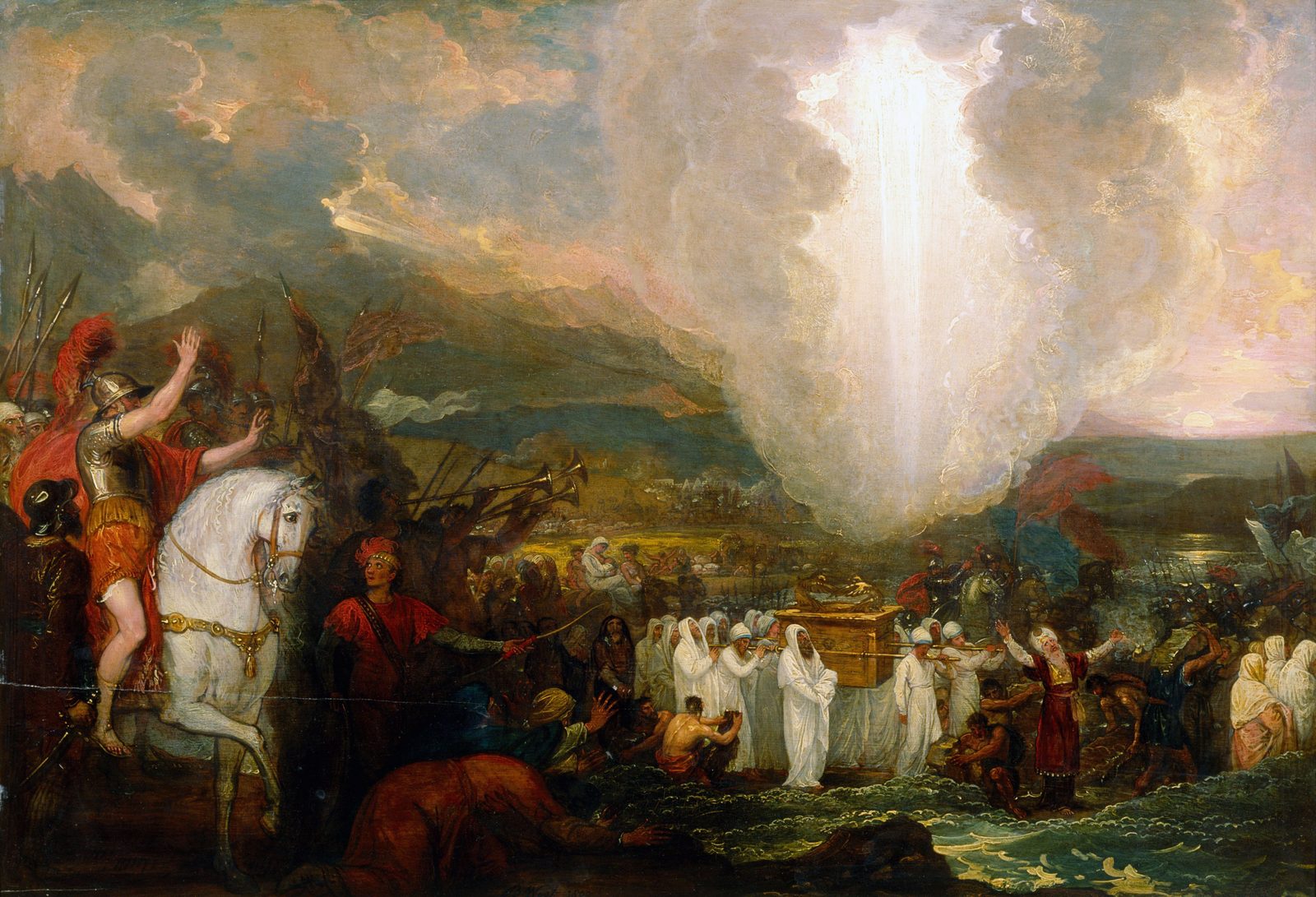
Joshua passing the River Jordan with the Ark of the Covenant. Benjamin West, 1800. Wikimedia Commons. Public domain.