
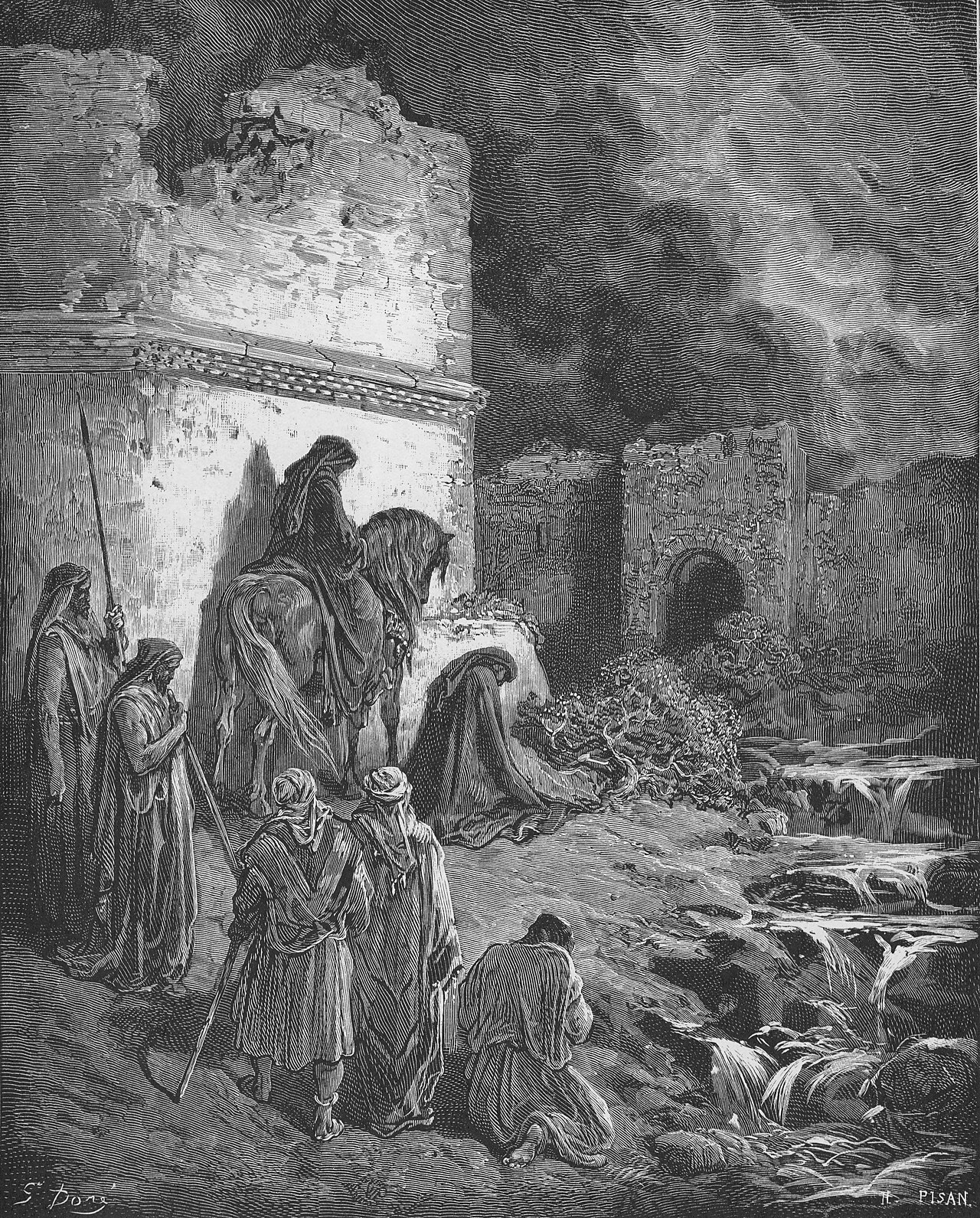
Nehemiahchapter 1
11 verses · Nehemiah · 5th century BC · History
These are the words of Nehemiah son of Hacaliah: In the month of Chislev, in the twentieth year, while I was in the citadel of Susa,
Introduction
Nehemiah, History, Nehemiah Overview.
Nehemiah wrote this in his own voice, as a Jew who served in the household of the Persian king. His first hearers were the small community that had come back to Judah and still lived under foreign rule. The chapter opens the book with a man who hears news from home and answers it before God. Most of it is a prayer, and the prayer is built from promises God had already given through Moses. Listen for the way he counts himself among the guilty, and for the plain request he holds back until the last line. The rest of the book grows out of this prayer.
Context
- Who
- A man with a good job in the empire, hearing news from home
- What
- A report that Jerusalem's walls and gates lie in ruins, and the prayer of confession and request Nehemiah makes in answer.
- Where
- The citadel of Susa, a royal residence of the Persian kings, in what is now southwestern Iran.
- When
- The month of Chislev in the twentieth year of Artaxerxes I, about December 445 BC.
- Why
- To show that the rebuilding of Jerusalem began with repentance and with a prayer grounded in God's word to Moses.
Historical context
Susa was one of several royal residences. Persian kings moved with the seasons, Susa in the cooler months, Ecbatana in the summer heat, Persepolis for ceremony, Babylon for administration. Nehemiah is in Susa in December, which is exactly where the court would be.
Show the rest of the historical context, 2 more paragraphs
The news that arrives is not about the old destruction. Jerusalem's walls had been down since 586, more than a century; nobody weeps for four months over hundred-year-old news. Ezra 4 records a later attempt at rebuilding that officials stopped "by force and power," and the report here, the wall broken down and the gates burned with fire, reads as a fresh setback.
What Nehemiah does with the report is fast, and then slow. He sits down and weeps, then mourns and fasts and prays for days, and does nothing about it for four months until the season is right.
Significance
His prayer is built out of Scripture. He quotes God's warning to Moses about scattering and His promise about gathering, and holds God to His own words, "remember, I beseech thee, the word that thou commandedst thy servant Moses."
Show the rest of the significance, 1 more paragraph
And, like Ezra and Daniel before him, he puts himself inside the guilt: "both I and my father's house have sinned." Then the last line of the chapter turns practical, asking for mercy "in the sight of this man", and only then does the reader learn that this man is the king, and Nehemiah is his cupbearer.
This chapter in Jewish lifeWhat this chapter is in Jewish life and reading.
What is done
The annual cycle of synagogue readings passes this book by. Probed for this lane, the site's own table in src/lib/hebraic/readings.ts printed parashot total 0 and haftarah uses total 0 for Nehemiah, chapters with a synagogue reading 0, and no festival reading. The same probe printed 54 weekly portions and 6 festival readings in the table as a whole. A congregation does not hear this chapter read aloud on a Sabbath or a feast.
Where the chapter does enter Jewish learning is the calendar. Its first verse dates Nehemiah's news to the month of Kislev of the twentieth year, and the corpus sets under that verse Rosh Hashanah 3a:3, 3a:14, 3b:1 and 3b:4, with Jerusalem Talmud Rosh Hashanah 1:1:3 and 1:2:2. That is the opening discussion of the tractate on the new year, which asks from which month the years of a king are counted. Rashi reports the answer the tractate draws from this verse and the first verse of the next chapter. "The years were calculated from the month of Tishrei." (Rashi on Nehemiah 1:1:2).
The place of the book in the Hebrew order is worth a Christian reader's attention too. The book dossier this site carries at src/components/book/dossier-content/nehemiah.ts records that Ezra and Nehemiah were counted as a single book in the Hebrew canon, and that the split into two entered Christian manuscripts first. Rashi's first note on the book fits that count. "Nehemiah wrote this book from here on." (Rashi on Nehemiah 1:1:1). He reads what comes before this verse as another man's record and what follows as Nehemiah's own.
How it is read
Rashi is the one commentator on this chapter whose English the corpus carries, quoted here from The Judaica Press complete Tanach with Rashi, translated by A. J. Rosenberg, which Sefaria reports as CC-BY. His longest note is on the date, and he states plainly where he cannot follow another reading. He will not read the chapters as counting the year from Nisan with the events told out of order. "Nevertheless, the chapters indicate that the second chapter took place only because of the events of the first chapter." (Rashi on Nehemiah 1:1:2).
The report from Jerusalem he reads closely. The men answered Nehemiah's two questions in the order he asked them, first about the Jews and then about the wall and the gates (Rashi on Nehemiah 1:3:1). The Jews who remained were in trouble because the gentiles plundered them (Rashi on Nehemiah 1:3:2). On the broken wall he gives the fact that explains the whole book, that the gates were burned as before "for Israel had not built the wall of the city or its gates, only the Temple." (Rashi on Nehemiah 1:3:3).
The prayer draws short grammatical notes. The word Nehemiah uses to open it is an expression of request and supplication (Rashi on Nehemiah 1:5:1). The ear he asks to be attentive is a listening ear, and Rashi explains the form of the Hebrew word (Rashi on Nehemiah 1:6:1). The confession that we have dealt corruptly he reads first as a noun, from the vowel under its first letter, and then as a verb set beside a line of Daniel (Rashi on Nehemiah 1:7:1 and 1:7:2). He notes that the prayer ends as it began, with the same request that God's ear be attentive, and that its last clause is what Nehemiah asked for himself (Rashi on Nehemiah 1:11:1 and 1:11:2).
The corpus carries eight further notes on this chapter without an English text, each marked linked because Sefaria holds no English version of the ref. They stand cited and unquoted at Ibn Ezra on Nehemiah 1:1:1, 1:4:1 and 1:6:1, Metzudat David on Nehemiah 1:5:1, 1:8:1 and 1:9:1 and Malbim on Nehemiah 1:8:1 and 1:10:1.
What the rabbis say
The corpus carries twenty-one rabbinic locators on this chapter and the text of none, so each is cited and linked here rather than quoted. On the first verse it holds Ein Yaakov, Rosh Hashanah 1:2, Jerusalem Talmud Rosh Hashanah 1:1:3, Jerusalem Talmud Rosh Hashanah 1:2:2, Rosh Hashanah 3a:14, Rosh Hashanah 3a:3, Rosh Hashanah 3b:1, Rosh Hashanah 3b:4, Seder Olam Rabbah 30:1 and Yalkut Shimoni on Nach 1063:8. On the third it holds Midrash Tanchuma, Vayishlach 10:4. On the fourth it holds Pirkei DeRabbi Eliezer 21:10.
On the fifth verse the corpus holds Jerusalem Talmud Berakhot 7:3:9. On the seventh it holds Bamidbar Rabbah 12:14, Midrash Lekach Tov, Exodus 38:21:3, Midrash Tanchuma, Pekudei 5:5, Shemot Rabbah 51:3 and Shir HaShirim Rabbah 1:4:4. On the ninth it holds Bamidbar Rabbah 11:8 and Sotah 38a:11. On the eleventh it holds Jerusalem Talmud Kiddushin 4:1:3.
On the twelfth verse the corpus holds Midrash Tanchuma, Mishpatim 5:12. What each of them teaches is a saying of the rabbis, and is reported as theirs wherever this site quotes one. The quotations wait on a fetch that carries the text.
Sources: Rashi, Rashi on Nehemiah 1:1:1 to 1:11:2, The Judaica Press complete Tanach with Rashi, translated by A. J. Rosenberg, reported CC-BY; Ibn Ezra, Ibn Ezra on Nehemiah 1:1:1, 1:4:1 and 1:6:1, cited by ref because the corpus carries no English text; Metzudat David, Metzudat David on Nehemiah 1:5:1, 1:8:1 and 1:9:1, cited by ref because the corpus carries no English text; Malbim, Malbim on Nehemiah 1:8:1 and 1:10:1, cited by ref because the corpus carries no English text; The Sefaria corpus, scripts/data/sources/sefaria/nehemiah/1.json, the 21 Talmud and Midrash locators of this chapter; The site's own files, src/lib/hebraic/readings.ts, probed for this book and printing parashot total 0 and haftarah uses total 0, and src/components/book/dossier-content/nehemiah.ts, the section recording that Ezra and Nehemiah were counted as one book in the Hebrew canon.
The heads below are this chapter's scenes. The numbered points under each are its verses.
The wall broken down and the gates burned with fire
Nehemiah 1:1-2
in the citadel of Susa: The book opens with Nehemiah "in the citadel of Susa," the Persian court. "Hanani, one of my brothers, arrived with men from Judah," and Nehemiah asks after two things, the remnant who survived the exile and Jerusalem. A man serving at court counts the exiles of Judah as his brothers.
Nehemiah 1:1
“The words - Or rather, the acts, as the word often signifies. Chisleu - Which is the ninth month, containing part of November, and part of December. Shushan - The royal city of Persia.”
John Wesley · Explanatory Notes upon the Old Testament (1765)evangelical
Hanani, one of my brothers: Josephus, as Clarke reports, has Nehemiah hear men from Judah speaking Hebrew in Susa and question them about the Jews in Jerusalem. Henry notes that a man high in the king's court still owned these men as his brothers. The same Hanani is later put in charge of Jerusalem (7:2).
Nehemiah 1:2
“I asked them concerning the Jews - Josephus gives a probable account of this business: “Nehemiah, being somewhere out of Susa, seeing some strangers, and hearing them converse in the Hebrew tongue, he went near; and finding they were Jews from Jerusalem, he asked them how matters went with their brethren in that city, and what was their state?” And the answer they gave him is, in substance, that recorded in the text; though with several aggravations in Josephus. - Joseph. Ant. lib. xi., c. 5.”
Adam Clarke · Commentary on the Bible (1810-1826)evangelical
1 more voice on this verse
Nehemiah 1:2
“The dignity to which he was advanced. Though he was a great man, and probably rising higher, yet he did not think it below him to take cognizance of his brethren that were low and despised, nor was he ashamed to own his relation to them and concern for them.”
Matthew Henry · Commentary on the Whole Bible (1707-1721)puritan
Nehemiah 1:3-4
Hanani's answer is stark: "The wall of Jerusalem is broken down, and its gates are burned with fire," a report reaching Susa. Nehemiah "sat down and wept," mourning, fasting and praying "before the God of heaven" (1:4). The mourning falls in Chislev, and the request waits until Nisan.
Nehemiah 1:3
“The attempt to rebuild the wall in the time of the Pseudo-Smerdis Ezr 4:12-24 had been stopped. It still remained in ruins. The Assyrian sculptures show that it was the usual practice to burn the gates.”
Nehemiah weeps, fasts, and pleads the promise made to Moses
I sat down and wept: Mourners sat down on the ground, and Gill compares Job among the ashes (Job 2:8). Fasting and prayer before the God of heaven filled these days. Clarke draws the lesson that a good work begun in haste is often ruined, and that prayer before God carries it through.
Nehemiah 1:4
“And it came to pass, when I heard these words,.... This sad and melancholy account of things: that I sat down and wept, and mourned certain days; sat down upon the ground in dust and ashes, after the manner of mourners, and wept bitterly, and mourned in a most sorrowful manner, see Job 2:8, and fasted and prayed before the God of heaven; that made it, and dwells in it.”
1 more voice on this verse
Nehemiah 1:4
“And mourned certain days - From the month Chisleu to the month Nisan; about four months from the time he received the above information, till the time that Artaxerxes noticed his grief, Neh 2:1. All this time he probably spent in supplication to God; waiting for a favorable opening in the Divine providence. Every good work is not to be undertaken hastily; prayer and watchfulness are necessary to its completion. Many good works have been ruined by making haste.”
Adam Clarke · Commentary on the Bible (1810-1826)evangelical
Nehemiah 1:5-6
the great and awesome God: Nehemiah asks that God's eyes be open and His ears attentive, then turns it on himself: "Both I and my father’s house have sinned" (1:6). He counts his own house inside Israel's guilt.
Nehemiah 1:5
“Lord God of heaven - What was, before the captivity, Jehovah, God of hosts or armies. Great - Able to do mighty things. Terrible - able to inflict the heaviest judgments.”
Adam Clarke · Commentary on the Bible (1810-1826)evangelical
day and night for Your servants: The prayer calls Nehemiah, Moses and the people by one word, servant, seven times between verses 6 and 11. Day and night marks a prayer kept up across months. Matthew Henry observes that owning Israel's sin cost Nehemiah little, and naming the sin of his own family cost him more.
Nehemiah 1:7-9
We have behaved corruptly against You: Verse 8 recites the warning of Moses back to God: "If you are unfaithful, I will scatter you among the nations" (1:8). Verse 9 recites the other half, the promise of Deuteronomy 30 to gather exiles, so the petition rests on a word God had already spoken.
Nehemiah 1:7
“Have not kept thy commandments - The moral precepts by which our lives should be regulated. Statutes - What refers to the rites and ceremonies of thy religion. Judgments - The precepts of justice relative to our conduct to each other.”
Adam Clarke · Commentary on the Bible (1810-1826)evangelical
the word that You commanded: The warning to scatter the unfaithful stands in Leviticus 26:33 and Deuteronomy 28:64, and Clarke notes that Nehemiah still quoted the word of Moses correctly. The scattering had happened. Henry adds that God, who needs no reminder, Himself asks His people to put Him in remembrance of His word.
Nehemiah 1:8
“This he quotes from Deut. xxx. 1-5 , and begs leave to put God in mind of it (though the Eternal Mind needs no remembrancer) as that which he guided his desires by, and grounded his faith and hope upon, in praying this prayer: Remember, I beseech thee, that word; for thou hast said, Put me in remembrance.”
Matthew Henry · Commentary on the Whole Bible (1707-1721)puritan
2 more voices on this verse
Nehemiah 1:8
But I say, Has the Lord used iniquity to snatch the nations from the power of his enemies and recall them to faith in him and to his dominion? By no means. For "Israel" was once "the Lord's portion," but they made Israel turn from their God in sin, and because of their sins God said to them, "Behold, you have been separated by your sins and because of your sins you have been scattered under the whole heaven."
Origen of Alexandria · written before 253 · Homilies on Genesis 9.7patristic
Nehemiah 1:8
“Thy servant Moses - See the parallel places in Lev 26:33 (note), Deu 4:25-27 (note), Deu 28:64 (note), and the notes there. Though in an enemy’s country, and far from the ordinances of God, Nehemiah did not forget the law: he read his Bible well, and quotes correctly.”
Adam Clarke · Commentary on the Bible (1810-1826)evangelical
if you return to Me: This promise half comes from Deuteronomy 30:1-5, the passage Matthew Henry names as the ground of the whole prayer. Its one condition is return. The place chosen as a dwelling for the Name is Jerusalem, the city whose broken wall and burned gates set the prayer going.
Nehemiah 1:10-11
You redeemed them by Your great power: Nehemiah asks for one day's success: "Give Your servant success this day, I pray, and grant him mercy in the sight of this man" (1:11). The king of Persia is "this man," and the last line names Nehemiah's access: "I was the cupbearer to the king."
Nehemiah 1:10
“Now these are thy servants, and thy people,.... Meaning those that were in Jerusalem and Judah, gathered out of several countries, and returned to Jerusalem: whom thou hast redeemed by thy great power, and by thy strong hand; touching and moving the heart of Cyrus to proclaim liberty to them.”
Give Your servant success this day: Henry notes that Nehemiah names his post as cupbearer to the king only at the close. The cup put him in the king's sight every day. Clarke adds that Eastern kings were often poisoned by their wine, so the king trusted this servant with his life.
Nehemiah 1:11
“NEHEMIAH was earnest in his prayer for the good of his sorrow-stricken nation, but he did not make the mistake of thinking that he was the only praying man in the world. He said, "Be attentive to the prayer of Your servant, and to the prayer of Your servants, who desire to fear Your name." In this one respect, I like Nehemiah better than Elijah.”
Charles Spurgeon · written before 1892 · The Metropolitan Tabernacle Pulpit, Sermon No. 2714: “Those Who Desire” (lightly modernized text, CCEL edition)Particular Baptist
3 more voices on this verse
Nehemiah 1:11
“Who art thou that thou shouldst be afraid of a man? Mercy in the sight of this man is what he prays for, meaning not the king's mercy, but mercy from God in his address to the king. Favour with men is then comfortable when we can see it springing from the mercy of God.”
Matthew Henry · Commentary on the Whole Bible (1707-1721)puritan
Nehemiah 1:11
“Mercy in the sight of this man - Favour before the king, Ahasuerus. He seems then to have been giving him the cup. For I was the king’s cup-bearer - The king’s butler, (the Persians call him saky), which gave him the opportunity of being frequently with the king; and to be in such a place of trust, he must be in the king’s confidence. No Eastern potentate would have a cup-bearer with whom he could not trust his life, poison being frequently administered in this way.”
Adam Clarke · Commentary on the Bible (1810-1826)evangelical
Nehemiah 1:11
“I was the king's cupbearer--This officer, in the ancient Oriental courts, was always a person of rank and importance; and, from the confidential nature of his duties and his frequent access to the royal presence, he possessed great influence.”
Jamieson, Fausset & Brown · Commentary Critical and Explanatory on the Whole Bible (1871)reformed
Keep studying
Places1
Words12
Trails1
Subjects1
Sources for this chapter
The summary
Jamieson, Fausset & Brown, Commentary Critical and Explanatory; John Wesley, Notes on the Old Testament and Matthew Henry, Complete Commentary.
The exposition
Adam Clarke, Commentary on the Bible; Charles Spurgeon, The Metropolitan Tabernacle Pulpit, Sermon No. 2714: "Those Who Desire"; John Gill and Matthew Henry, Commentary on the Whole Bible.