
Judgeschapter 14
20 verses · BSBJudges book hub →
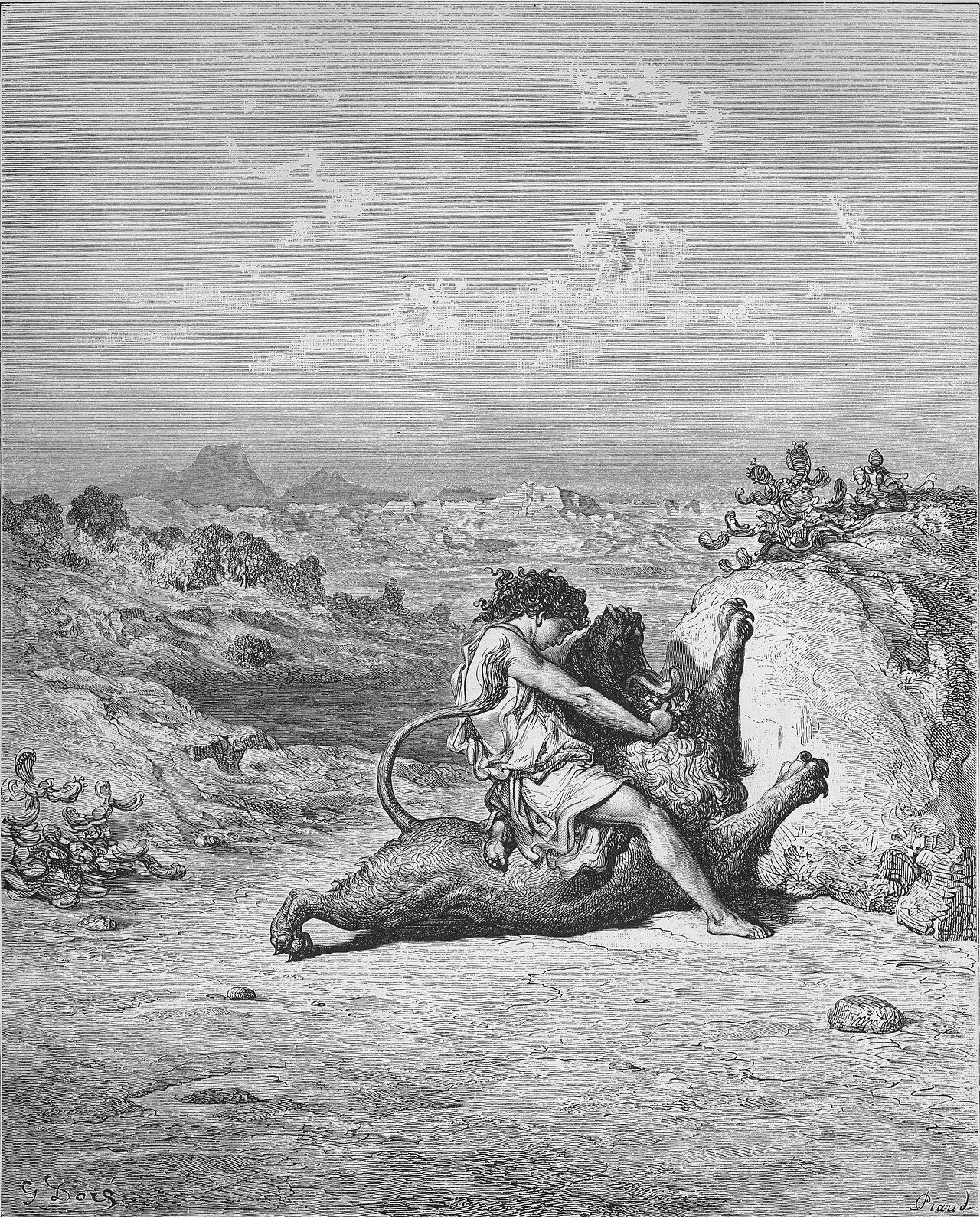
Samson Slays a Lion, Gustave Doré, Doré's English Bible (1866), public domain
Key verse
“Let me tell you a riddle,” Samson said to them. “If you can solve it for me within the seven days of the feast, I will give you thirty linen garments and thirty sets of clothes.
It stands in scene B of the chapter, verses 10 to 20.
The chapter
Chapter summary
Samson sees a Philistine woman in Timnah and tells his parents, 'Get her for me; for she pleaseth me well.' They object, not knowing it was of Jehovah, who sought an occasion against the Philistines. On the way the Spirit rushes upon him and he rends a young lion as one rends a kid, later finding bees and honey in the carcase, a Nazirite quietly touching what is dead. At his feast he wagers a riddle on it: out of the eater came forth food, and out of the strong came forth sweetness. His wife weeps it out of him in seven days; he answers the guests bitterly about plowing with his heifer, then pays the wager with spoil from Ashkelon.
Context
History · Samuel · Judges overview
Where the chapter sits
Judges 14 falls in The twelve judges (chapters 3–16). Othniel, Ehud, Shamgar, Deborah, Gideon, Tola, Jair, Jephthah, Ibzan, Elon, Abdon, Samson (and Abimelech as anti-judge). Seven oppression-deliverance cycles.
Before it: Incomplete conquest; programmatic cycle, chapters 1–2. After it: Appendix: diagnosis of Israel, chapters 17–21.
The whole shape of Judges→The world behind this chapter
Judges 14The history
A marriage was arranged between families, not between individuals, which is why Samson tells his parents to get her for me and why they object. Marrying a Philistine was not merely bad taste; the covenant forbade intermarriage with the peoples of the land precisely because it dragged Israel into their worship.
The rest of the history, and what it meant to them
Where Samson meets the lion tells you something. He is in the vineyards of Timnah, the one place a lifelong Nazirite had no business being. Lions were still present in the region into the Iron Age and are mentioned throughout the Old Testament as a real hazard to shepherds. Later he goes back and scoops honey out of the carcass, handling a dead body and feeding it to his parents without telling them, a double breach he treats as a joke.
The wedding feast ran seven days, and the thirty companions given to Samson are not friends. He arrives without a family party of his own in a Philistine town, so the bride's side supplies thirty young men, which is as much a guard as an honor. Riddling contests at feasts were a known entertainment, and the stake, thirty linen undergarments and thirty changes of festival clothes, was a small fortune, since cloth was hand-woven and clothing was capital.
The bride's tears for seven days, and the threat to burn her and her father's house, show how ordinary Philistine coercion was. She was caught between a foreign husband and thirty local men who could destroy her family.
What it meant to them
The line the first hearers had to sit with is that this was of the LORD, who was seeking an occasion against the Philistines. God works his purpose through a man behaving badly, and the text says so plainly without excusing the behavior.
Everything about Samson runs on appetite, she looks right to me, the honey tastes good, the riddle wins a bet. Hearers watching a deliverer who never once prays before acting knew they were watching something break.
Sources cited
- John H. Walton, Victor H. Matthews, and Mark W. Chavalas, The IVP Bible Background Commentary: Old Testament
- Keil and Delitzsch, Biblical Commentary on the Old Testament: Joshua, Judges, Ruth
A. A lion torn apart, honey in the carcass
1. (vv. 1-2)
a.Timnath stands in Judah's town list at Joshua 15:57 and is handed to Dan at Joshua 19:43, so the woman Samson wants lives inside his own tribe's paper border and under Philistine rule. He goes down to it and comes back up, which fixes the hill country round Zorah above the coastal plain where the town sits. His first recorded words in Scripture are get her for me to wife, and the ground he gives for the request is what his eye had done.
Judges 14:1, 2 voicesWhat preachers and commentators have said about this verse, in their own words.
Judges 14:1
“And Samson went down to Timnath,.... A city which by lot fell to the tribe of Judah, but was afterwards given to the tribe of Dan, and now in the hands of the Philistines, Jos 15:57. Judah is said to go up to it, because the place where he lived lay below it, Gen 38:13, but Samson is said to go down to it, because he lived above it.”
Judges 14:1
“Went down to Timnath - A frontier town of the Philistines, at the beginning of the lands belonging to the tribe of Judah, Jos 15:57; but afterwards given up to Dan, Jos 19:43. David took this place from the Philistines, but they again got possession of it in the reign of Ahaz, 2Ch 28:18.”
Adam Clarke· Commentary on the Bible (1810-1826)evangelical
Judges 14:2, 1 voice
Judges 14:2
“Get her for me - namely, by Paying the requisite dowry (see marginal references) and gifts to relations. Hence, the frequent mention of parents taking wives for their sons Exo 34:16; Neh 10:30, because the parents of the bridegroom conducted the negotiation, and paid the dower to the parents of the bride.”
2. (vv. 3-4)
a.The parents object on the ground of the uncircumcised Philistines, which is the same term of reproach Jonathan uses at 1 Samuel 14:6 and David at 1 Samuel 17:26. Samson's answer reads in the Hebrew she is right in mine eyes, and right in his own eyes is the sentence this book closes with at 17:6 and 21:25. Verse 4 says the parents knew not that it was of the Lord, and readers divide over what that covers: Matthew Henry takes the marriage rule as dispensed with where the aim was to strike the oppressor, while Albert Barnes reads God as turning misconduct he foresaw into an occasion rather than approving the match. The dominion named here is the forty years of 13:1, and 13:5 had said Samson would begin to deliver rather than finish.
Judges 14:3, 1 voice
Judges 14:3
“The uncircumcised Philistines - Compare 1Sa 14:6; 1Sa 17:26; 1Sa 31:4, for a similar use of the term as one of reproach. Also Act 11:3.”
Judges 14:4, 2 voices
Judges 14:4
“His father and mother very properly opposed Samson’s marriage with a Pagan woman, the daughter of the oppressors of his race. But they could not prevail, because it was the secret purpose of God by these means to “seek occasion” against the Philistines; i. e. to make the misconduct of the father of Samson’s wife, which He foresaw, the occasion of destruction to the Philistines. Compare the marginal references for similar statements.”
Judges 14:4
“It was not a thing evil in itself for him to marry a Philistine. It was forbidden because of the danger of receiving hurt by idolaters; where there was not only no danger of that kind, but an opportunity hoped for of doing that hurt to them which would be good service to Israel, the law might well be dispense with.”
Matthew Henry· Commentary on the Whole Bible (1707-1721)puritan
3. (vv. 5-6)
a.The lion meets him among the vineyards, and Numbers 6:3-4 bars a Nazarite from the vine tree and from everything made of it, which is why commentators weigh the location while the text records nothing about what he ate or drank there. This is the second of four times the Spirit of the Lord comes on Samson, after 13:25 and before 14:19 and 15:14, and those four are the greater part of the seven such comings in the book. The wording came mightily is stronger than what is said of Othniel at 3:10 and of Gideon at 6:34, and what follows it here is a killing. He had nothing in his hand, and he told neither parent.
Judges 14:6, 1 voice
Judges 14:6
“He rent him as he would have rent a kid - Now it is not intimated that he did this by his own natural strength, but by the Spirit of the Lord coming mightily upon him: so that his strength does not appear to be his own, nor to be at his command; his might was, by the will of God, attached to his hair and to his Nazarate.”
Adam Clarke· Commentary on the Bible (1810-1826)evangelical
4. (vv. 7-9)
a.Numbers 6:6 keeps a Nazarite from coming at any dead body, and 6:7 holds the ban even for his father and his mother. Samson turns aside to the carcase, takes the honey out of it in his hands, eats as he walks, and gives the rest to his parents without telling them where it came from. That silence is the second in four verses, since verse 6 also ends on what he kept from them, and the two silences together are what make the riddle possible. Adam Clarke reads the interval of verse 8 as about a year, the usual space between betrothal and wedding, by which time the flesh would be gone and the dry bones left for the bees.
Judges 14:8, 3 voices
Judges 14:8
“After a time - Probably about one year; as this was the time that generally elapsed between espousing and wedding. A swarm of bees and honey in the carcass - By length of time the flesh had been entirely consumed off the bones, and a swarm of bees had formed their combs within the region of the thorax, nor was it an improper place; nor was the thing unfrequent, if we may credit ancient writers; the carcasses of slain beasts becoming a receptacle for wild bees.”
Adam Clarke· Commentary on the Bible (1810-1826)evangelical
Judges 14:8
“IT was a singular circumstance that a man unarmed should have slain a lion in the prime of its vigor and yet, more strange that a swarm of bees should have taken possession of the dried carcass and have filled it with their honey. In that country, what with beasts, birds, insects and the dry heat, a dead body is soon cleansed from all corruption and the bones are clean and white. Still, the killing of the lion and the finding of the honey make up a remarkable story.”
Judges 14:8
“After a time - Hebrew. after days; that is, either after some days: or, rather, after a year, as that word often signifies; when the flesh of the lion, (which by its strong smell is offensive to bees) was wholly consumed, and nothing was left but the bones.”
John Wesley· Explanatory Notes upon the Old Testament (1765)evangelical
B. The riddle, the wedding week, and the plowed heifer
1. (vv. 10-11)
a.The word rendered feast here is mishteh, built on the verb to drink, and it is the ordinary word for the banquet at Genesis 21:8 and Esther 1:3. Numbers 6:3 bars a Nazarite from wine and from strong drink, and this verse puts him at the drinking feast the young men kept, while saying nothing about what he took. The thirty companions are read two ways: Albert Barnes takes their number as a mark of the standing of Samson's family, and Jamieson, Fausset and Brown take them for a watch set on a stranger by the bride's people.
Judges 14:10, 1 voice
Judges 14:10
“Made a feast ... - This was the wedding-feast, protracted in this instance seven days, in that of Tobias (Tobit 8:19) fourteen days. It was an essential part of the marriage ceremony Gen 29:22; Est 2:18; Mat 22:2-4; Rev 19:7, Rev 19:9.”
Judges 14:11, 2 voices
Judges 14:11
“Thirty companions - These were “the children of the bride-chamber” (Mat 9:15; see Jdg 14:20). From the number of them it may be inferred that Samson’s family was of some wealth and importance.”
Judges 14:11
“Samson, in some place obtained for the occasion, as he was a stranger. A large number of paranymphs, or "friends of the bridegroom," furnished, no doubt, by the bride's family, attended his party, ostensibly to honor the nuptials, but really as spies on his proceedings.”
Jamieson, Fausset & Brown· Commentary Critical and Explanatory on the Whole Bible (1871)reformed
2. (vv. 12-14)
a.The word for riddle is chidah, the same word used of the hard questions the queen of Sheba brings to Solomon at 1 Kings 10:1 and of the dark saying Ezekiel is told to speak at Ezekiel 17:2. The stake is thirty linen garments and thirty changes of raiment against the same, so a wedding game carries the price of a small fortune on each side. Adam Clarke observes that the riddle offers no rule of interpretation to anyone who was not there, since the road to the answer runs through a lion nobody saw and honey nobody was told about. Three of the seven days are spent by the end of verse 14.
Judges 14:12, 2 voices
Judges 14:12
“I will now put forth a riddle - Probably this was one part of the amusements at a marriage-feast; each in his turn proposing a riddle, to be solved by any of the rest on a particular forfeit; the proposer forfeiting, if solved, the same which the company must forfeit if they could not solve it. Thirty sheets - I have no doubt that the Arab hayk, or hake, is here meant; a dress in which the natives of the East wrap themselves, as a Scottish Highlander does in his plaid.”
Adam Clarke· Commentary on the Bible (1810-1826)evangelical
Judges 14:12
“I will now put forth a riddle--Riddles are a favorite Oriental amusement at festive entertainments of this nature, and rewards are offered to those who give the solution. Samson's riddle related to honey in the lion's carcass. The prize he offered was thirty sindinim, or shirts, and thirty changes of garments, probably woolen.”
Jamieson, Fausset & Brown· Commentary Critical and Explanatory on the Whole Bible (1871)reformed
Judges 14:14, 2 voices
Judges 14:14
“And perhaps this was not only a prodigy of valour, but also a mystery of wisdom, an utterance of prophecy. For it does not seem to have been without a purpose that, as he was going to his marriage, a roaring lion met him, which he tore asunder with his hands, in whose body, when about to enjoy the wished-for wedlock, he found a swarm of bees, and took honey from its mouth, which he gave to his father and mother to eat.”
Ambrose of Milan· written before 397· On the Holy Spirit 2, Introduction, 6-9patristic
Judges 14:14
“And he said unto there - Thus he states or proposes his riddle: - Out of the eater came forth meat, And out of the strong came forth sweetness. Instead of strong, the Syriac and Arabic have bitter. I have no doubt that the riddle was in poetry; and perhaps the two hemistichs above preserve its order. This was scarcely a fair riddle; for unless the fact to which it refers were known, there is no rule of interpretation by which it could be found out. We learn from the Scholiast, on Aristophanes, Vesp. v.”
Adam Clarke· Commentary on the Bible (1810-1826)evangelical
3. (vv. 15-17)
a.The threat is the death the Philistines carry out at 15:6, where they come up and burn her and her father with fire, so the fire she betrays her husband to escape reaches her one chapter later. She weeps the seven days and he tells her on the last of them because she lay sore upon him, and the same pressure runs again at 16:16, where Delilah pressed him daily until his soul was vexed unto death. His answer at verse 16 sets his parents and his wife on one footing, since he had told neither.
Judges 14:15, 1 voice
Judges 14:15
“Seventh day - They had doubtless spoken to her before this time, but with some remissness, supposing that they should find it out; but now their time being nigh slipped, they put her under a necessity of searching it out. To take that we have - That is, to strip us of our garments.”
John Wesley· Explanatory Notes upon the Old Testament (1765)evangelical
Judges 14:17, 1 voice
Judges 14:17
“And she wept before him the seven days, while the feast lasted,.... Those that remained of the seven days, from the fourth to this time, as Kimchi seems rightly to interpret it; though some think she began to beseech him with tears, on the first day of the feast, to impart the secret to her for her own satisfaction; and then, after the men had urged her on the fourth day to persuade her husband to it, she continued pressing him more earnestly with tears unto the seventh day.”
4. (v. 18)
a.They answer in the same two-line shape the riddle was put in, and their answer names the honey and the lion while leaving the carcase out, which is as far as the wife's information could carry them. The hour is given because it matters: before the sun went down is the last of the seven days, and the wager stood until then. The proverb Samson throws back is read two ways, with Adam Clarke taking plowed with my heifer for a charge of infidelity and tracing the same turn of phrase in Greek and Latin writers, while Keil and Delitzsch read it as the narrower charge that they worked his wife to get at him.
Judges 14:18, 2 voices
Judges 14:18
“If ye had not ploughed with my heifer - If my wife had not been unfaithful to my bed, she would not have been unfaithful to my secret; and, you being her paramours, your interest was more precious to her than that of her husband. She has betrayed me through her attachment to you. Calmet has properly remarked, in quoting the Septuagint, that to plough with one’s heifer, or to plough in another man’s ground, are delicate turns of expression used both by the Greeks and Latins, as well as the Hebrews, to point out a wife’s infidelities.”
Adam Clarke· Commentary on the Bible (1810-1826)evangelical
Judges 14:18
“If ye had not &c. - If you had not employed my wife to find it out, as men plough up the ground with an heifer, thereby discovering its hidden parts; he calls her heifer, because she was joined with him in the same yoke.”
John Wesley· Explanatory Notes upon the Old Testament (1765)evangelical
5. (vv. 19-20)
a.he went down to Ashkelon: Ashkelon is one of the five Philistine cities named at Joshua 13:3, and Jamieson, Fausset and Brown put it about twenty-four miles from Timnath, so the thirty men whose clothes pay the wager are not the thirty who won it. This is the third of the four comings of the Spirit on Samson, and as at verse 6 what follows is a killing rather than deliverance in the ordinary sense. He goes up to his father's house, and while he is away the bride is given to the friend of the bridegroom, the man who had stood beside him through the feast. That is the debt chapter 15 opens on.
Judges 14:19, 2 voices
Judges 14:19
“The Spirit of the Lord came upon him - “The spirit of fortitude from before the Lord.” - Targum. He was inspired with unusual courage, and he felt strength proportioned to his wishes. He - slew thirty men - and took their spoils - He took their hayks, their kumjas, and caftans, and gave them to the thirty persons who, by unfair means, had solved his riddle; thus they had what our version calls thirty sheets, and thirty changes of raiment. See the note on Jdg 14:12.”
Adam Clarke· Commentary on the Bible (1810-1826)evangelical
Judges 14:19
“HE SLAYS THIRTY PHILISTINES. 19, 20. went down to Ashkelon, and slew thirty men of them--This town was about twenty-four miles west by southwest from Timnah; and his selection of this place, which was dictated by the Divine Spirit, was probably owing to its bitter hostility to Israel. took their spoil--The custom of stripping a slain enemy was unknown in Hebrew warfare.”
Jamieson, Fausset & Brown· Commentary Critical and Explanatory on the Whole Bible (1871)reformed
Judges 14:20, 1 voice
Judges 14:20
“But Samson’s wife was given to his companion - This was the same kind of person who is called the friend of the bridegroom, Joh 3:29. And it is very likely that she loved this person better than she loved her husband, and went to him as soon as Samson had gone to his father’s house at Zorah. She might, however, have thought herself abandoned by him, and therefore took another; this appears to have been the persuasion of her father, Jdg 15:”
Adam Clarke· Commentary on the Bible (1810-1826)evangelical
The text of this chapter
This page carries no textual note on Judges 14. Where this site has examined a place the manuscripts differ, the examination is in the manuscripts room. Every place this site examines →
This page draws on 9 works. Open for the list.
This page draws on Adam Clarke; Albert Barnes; Ambrose of Milan, On the Holy Spirit 2, Introduction, 6-9; Charles Spurgeon, The Metropolitan Tabernacle Pulpit, Sermon No. 1703: “Hands Full of Honey” (lightly modernized text, CCEL edition) (1883); Jamieson, Fausset & Brown; John Gill; John Wesley, Explanatory Notes upon the Old Testament (1765); Keil and Delitzsch, Biblical Commentary on the Old Testament: Joshua, Judges, Ruth and Matthew Henry.
Keep studying
On this page