
Jobchapter 38
41 verses · unknown · 10th century BC · Wisdom and poetry
while the morning stars sang together and all the sons of God shouted for joy?
Introduction
unknown, Wisdom and poetry, Job Overview.
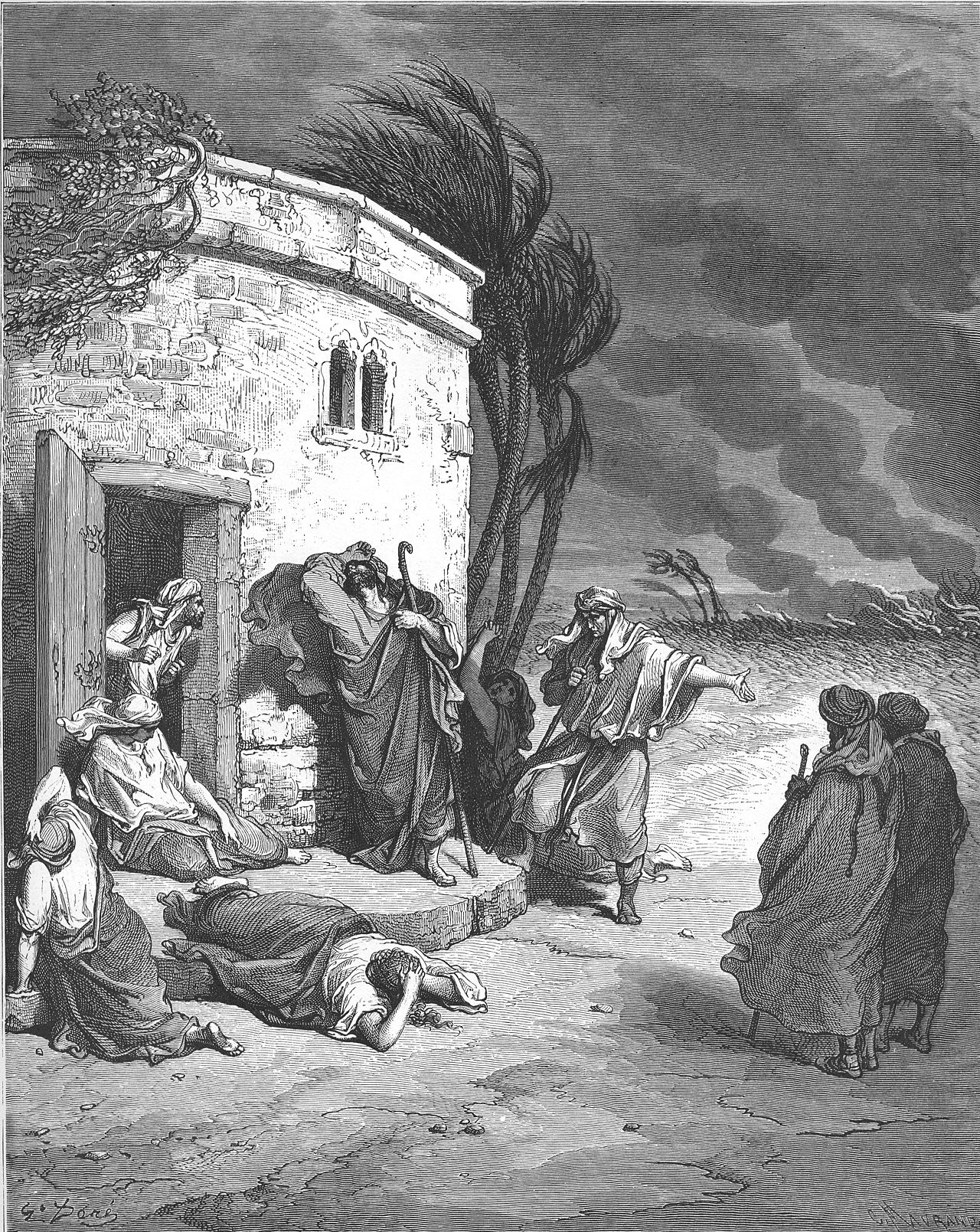
The LORD answers Job in this chapter, speaking out of the whirlwind after thirty-five chapters in which people spoke about Him. Job had asked for a hearing, and this is the reply. The first hearers had waited as long as Job for God to speak. The chapter is almost entirely questions. Listen for the order in which they move, from the foundations of the earth to the sea, the dawn, the deep, the storehouses of the weather and the stars. Then listen for the animals, whose account begins at the end of the chapter and runs through chapter 39.
Context
- Who
- Hearers who had been waiting thirty-five chapters for God to say something
- What
- The first part of the LORD's answer to Job, a series of questions about the making and running of the earth, the sea, the weather and the stars.
- Where
- The ash heap, with God speaking out of the storm.
- When
- The book sets Job in the age of the patriarchs, commonly placed about 2000 to 1800 BC, and it gives no date.
- Why
- To answer Job's demand for a hearing by showing him the order of creation that God keeps and Job cannot.
Historical context
God's opening instruction is a working man's phrase: gird up now thy loins like a man. Men wore long robes, and to run, fight, or do heavy labour you pulled the hem up through your belt. It means get ready to work, not prepare to be crushed.
Show the rest of the historical context, 3 more paragraphs
The first section is a building site. Where wast thou when I laid the foundations of the earth? Who laid the measuring line upon it? Whereupon are the foundations fastened, and who laid the corner stone? Every term is from construction, the surveyor's cord, the footings, the corner stone set first and squaring everything after it. Laying a foundation was a ceremonial occasion in the ancient world, attended and celebrated, and God says the celebration happened without Job: when the morning stars sang together and all the sons of God shouted for joy. That is the divine council again, the same assembly from chapter 1, present at creation and rejoicing over it.
Then the sea, described as a birth and a nursery. It broke forth as if out of a womb; God made the cloud its garment and thick darkness its swaddling band, and set bars and doors and said, hitherto shalt thou come, but no further. Chaotic water was the ancient world's image of everything untameable, and here it is a newborn being wrapped and put behind a door.
The rest of the chapter walks through the sky and the seasons, and much of it concerns places no human being had been: the springs of the sea and the recesses of the deep; the gates of death; the storehouses of snow and hail, reserved 'against the time of trouble, against the day of battle and war', hail as a weapon in God's arsenal, which Israel's own history had seen. Rain is sent on wilderness where no man is, to satisfy ground nobody farms. Ice and hoar frost are asked after by name. And the constellations are called by their Hebrew names, the Pleiades bound in a cluster, Orion's bands, the Mazzaroth brought out in their season, and the Bear with her young. Sky-watching was serious work in that world, and the question is whether Job can bind or loose any of it.
Significance
God never mentions the accuser, never explains the wager, and never answers the question Job asked. He asks about seventy questions of his own, and every one of them is about a world that runs without Job in it.
Show the rest of the significance, 1 more paragraph
For the first hearers the point was not that Job was too small to matter. It was that the universe is vastly larger and stranger than the tidy moral machine everyone in the argument had assumed, and that the God who runs it is not obliged to file a brief.
This chapter in Jewish lifeWhat this chapter is in Jewish life and reading.
What is done
This chapter has no place in the synagogue year. The site's own table in src/lib/hebraic/readings.ts printed parashot total 0 and haftarah uses total 0 for the book of Job, and no festival reading.
The corpus joins it to the study of the Torah portions through the Midrash arranged by them. Under the fourth verse it carries Midrash Tanchuma, Ki Tisa 12:1. Under the eighth verse it carries Midrash Tanchuma, Chukat 1:1. Under the tenth verse it carries Midrash Tanchuma Buber, Chukat 1:1. Under the tenth verse it carries Midrash Tanchuma, Pekudei 3:9. Under the twenty-second verse it carries Midrash Tanchuma, Terumah 11:1.
How it is read
Rashi and Malbim are the two commentators on this chapter whose English the corpus carries. Rashi is quoted from The Judaica Press complete Tanach with Rashi, translated by A. J. Rosenberg, which Sefaria reports as CC-BY. Malbim is quoted from Malbim's Job, trans. Jeremy I. Pfeffer. Ktav, 2003, which Sefaria reports as CC-BY.
God now answers Job, and Rashi gives two readings of the tempest in the first verse. In the first, God answers from the tempest Job had complained of in the ninth chapter. "Count your hairs and I will give you as many answers" (Rashi on Job 38:1:1). The answer points to the twenty-fifth verse, read of a shaft for every hair. In the other, God afflicted Job with a tempest and healed him with one, which Rashi assigns to Sifrei with a question mark (Rashi on Job 38:1:1). At the third verse God tells Job to rouse himself from his illness and his sufferings (Rashi on Job 38:3:1).
The second verse also carries two readings. The plain one is dark and foolish counsel. In the other, God speaks of the book's own opening, where He wrote of Job's integrity so that His name should rest on him. Job darkened that counsel with many words. Rashi links the verse to Job's reply in the forty-second chapter, and to God's answer that Abraham also did not know and yet passed ten tests. Rashi ends the note by saying that this is the reading he found (Rashi on Job 38:2:1).
Rashi glosses the questions on creation one by one. The cornerstone was laid in the middle of the sea, from which the whole world was founded (Rashi on Job 38:6:1). At the thirteenth verse God will grasp the earth by its corners like a garment and shake the wicked out of it (Rashi on Job 38:13:1). The gates of death are Gehinnom (Rashi on Job 38:17:1). Rashi reads the light parted in the twenty-fourth verse as the sun's radiance, diverging this way and that like the horns of a hind (Rashi on Job 38:24:1).
At the eleventh verse Malbim reads the laws of nature as instruments of Providence. "Though these statutes cannot be frustrated or revoked by man or Nature, they nevertheless remain under God's control and He can suspend or alter them as Providence requires" (Malbim on Job 38:11:1). Two further notes are the translator's summaries of Malbim's readings. Malbim names two cycles of light and darkness, the first being the polar day and night (Malbim on Job 38:20:1). He takes the stores of snow as the permanent snow of high mountains and the polar regions (Malbim on Job 38:22:1).
The corpus carries two further notes on this chapter without an English text, each marked linked because Sefaria holds no English version of the ref. They stand cited by ref and unquoted. One stands at Ibn Ezra on Job 38:18:1. One stands at Metzudat David on Job 38:19:1.
What the rabbis say
The corpus carries forty rabbinic locators on this chapter and the text of none, so each is cited and linked here rather than quoted. On the first verse it holds Bava Batra 16a:17 and Bereshit Rabbah 4:4. On the third verse it holds Midrash Tehillim 103:6. On the fourth verse it holds Midrash Tanchuma, Ki Tisa 12:1 and Shemot Rabbah 40:3. On the sixth verse it holds Midrash Sekhel Tov, Bereshit 31:51:4 and Otzar Midrashim, Midrash Konen ('He Established') 1:4. On the seventh verse it holds Avot DeRabbi Natan, Recension B 44:16 and Bereshit Rabbah 65:21.
On the eighth verse it holds Midrash Tanchuma, Chukat 1:1 and Pirkei DeRabbi Eliezer 5:1. On the ninth verse it holds Jerusalem Talmud Niddah 3:3:2 and Otzar Midrashim, Maaseh Beraishit & Maaseh Merkavah, Baraita of Maaseh Beraishit 5. On the tenth verse it holds Midrash Tanchuma Buber, Chukat 1:1 and Midrash Tanchuma, Pekudei 3:9. On the eleventh verse it holds Bamidbar Rabbah 18:22 and Bereshit Rabbah 23:7. On the twelfth verse it holds Bereshit Rabbah 3:6 and Jerusalem Talmud Berakhot 8:6:9. On the thirteenth verse it holds Midrash Mishlei 17:1 and Midrash Mishlei 17:7.
On the fourteenth verse it holds Ein Yaakov (Glick Edition), Sanhedrin 4:13 and Ein Yaakov, Sanhedrin 4:20. On the fifteenth verse it holds Bamidbar Rabbah 13:12. On the sixteenth verse it holds Bereshit Rabbah 5:3. On the nineteenth verse it holds Otzar Midrashim, Tractate of Emanations 1:4. On the twenty-second verse it holds Midrash Tanchuma, Terumah 11:1. On the twenty-third verse it holds Midrash Lekach Tov, Deuteronomy 32:34:1. On the twenty-fourth verse it holds Midrash Lekach Tov on Lamentations 1:1:3. On the twenty-fifth verse it holds Bava Batra 16a:19. On the twenty-sixth verse it holds Bereshit Rabbah 13:8.
On the twenty-eighth verse it holds Bereshit Rabbah 12:7. On the twenty-ninth verse it holds Midrash Tehillim 18:14. On the thirty-first verse it holds Berakhot 58b:13. On the thirty-second verse it holds Berakhot 58b:15. On the thirty-fifth verse it holds Bava Batra 25a:8. On the thirty-sixth verse it holds Bamidbar Rabbah 10:8. On the thirty-seventh verse it holds Jerusalem Talmud Berakhot 9:2:3. On the thirty-eighth verse it holds Bereshit Rabbah 1:6. On the forty-first verse it holds Midrash Shmuel 5:2. What each of them teaches is a saying of the rabbis, and is reported as theirs wherever this site quotes one. The quotations wait on a fetch that carries the text.
Sources: Rashi, Rashi on Job 38:1:1 to 38:24:1, The Judaica Press complete Tanach with Rashi, translated by A. J. Rosenberg, reported CC-BY; Malbim, Malbim on Job 38:11:1 to 38:22:1, Malbim's Job, trans. Jeremy I. Pfeffer. Ktav, 2003, reported CC-BY; Ibn Ezra, Ibn Ezra on Job 38:18:1, cited by ref because the corpus carries no English text; Metzudat David, Metzudat David on Job 38:19:1, cited by ref because the corpus carries no English text; The Sefaria corpus, scripts/data/sources/sefaria/job/38.json, the 40 Talmud and Midrash locators of this chapter; The site's own files, src/lib/hebraic/readings.ts, printing no portion, no Haftarah and no festival reading for this book.
The heads below are this chapter's scenes. The numbered points under each are its verses.
Jehovah Answers Out of the Whirlwind: Where Wast Thou?
Job 38:1-3
out of the whirlwind: The whirlwind speech opens with a question in place of an answer. “Now brace yourself like a man” calls up a wrestler or servant readying for work. Henry reads the commands as God granting Job's demand for a hearing on terms Job never expected: questions, where he wanted a verdict.
Job 38:1
“Then the Lord answered Job out of the whirlwind,.... As soon as Elihu had done speaking, who saw the tempest rising, and gave hints of it, Job 37:2; and hastened to finish his discourse. This was raised to give notice of the Lord being about to appear, and to display his majesty, and to command reverence and attention. The Targum calls it the whirlwind of distress, as it might be to Job; and a representation of the distressed and disturbed state and condition in which he was.”
2 more voices on this verseWhat preachers and commentators have said about this verse, in their own words.
Job 38:1
“Then the Lord answered Job - This speech is addressed particularly to Job, not only because he is the principal personage referred to in the book, but particularly because he had indulged in language of murmuring and complaint. God designed to bring him to a proper state of mind before he appeared openly for his vindication.”
Job 38:1
“This and the disciplinary design of trial to the godly is the great lesson of this book. He does not solve the difficulty by reference to future retribution: for this was not the immediate question; glimpses of that truth were already given in the fourteenth and nineteenth chapters, the full revelation of it being reserved for Gospel times.”
Jamieson, Fausset & Brown · Commentary Critical and Explanatory on the Whole Bible (1871)reformed
Gregory the Dialogist and Thomas Aquinas heard this question as a reproof of Elihu, who had just finished speaking. John Gill and Albert Barnes read it of Job, the man Job 38:1 names as the one the Lord answered. Gill notes that Job owns the words in chapter 42.
Job 38:2
“Who is this that involves sentences in unskilful words? As we have said also in the former part, an interrogative of this kind, in which it is said, Who is this? is the beginning of a reproof. For Eliu had spoken arrogantly. And we say not, Who is this, excepting expressly of him whom we know not. But knowledge on God's part is approval; His not knowing is rejection.”
Gregory the Dialogist · written before 604 · Morals on the Book of Job, Book XXVIIIpatristic
brace yourself like a man: The man told to brace himself is a hero ready for battle, say Jamieson, Fausset and Brown. The summons answers Job 9:35, where Job had wished for this hearing. Chrysostom saw encouragement in the form: questions are the best way to bring a dejected man to understanding.
Job 38:4-6
laid the foundations of the earth?: The “measuring line” and the “cornerstone” borrow the words of a building site. Delitzsch notes the same terms return at Isaiah 28:16 for the stone laid in Zion. Gill reads the questions as pressing one point, that a man absent from creation's laying has no standing to indict its Governor.
Job 38:4
“Where wast thou when I was laying the foundations of the earth? Tell Me, if thou hast understanding. ALLEGORICAL INTERPRETATION Behold all things are put together in historical narration, as if concerning the origin of the world. But something is immediately subjoined, which seems to be said of the creation, not of the world, but of the Church. For it is said; Or who hath laid the corner stone thereof? For by this, which was not done at the beginning of the world, it is shewn that that former expression was not used of the creation of the world.”
Gregory the Dialogist · written before 604 · Morals on the Book of Job, Book XXVIIIpatristic
2 more voices on this verse
Job 38:4
“Where wast thou when I laid the foundations of the earth?.... The earth has foundations, and such firm ones that it cannot be moved; but what are they, since it is hung in the air on nothing! No other than the power and will of God, who laid these foundations, and the Son of God, who has created and upholds all things by the word of his power, Heb 1:3. Where was Job then?”
Job 38:4
“The first man was not, much less were we. It is the honour of Christ that he was present when this was done ( Prov. viii. 1, 2 ); but we are of yesterday and know nothing.”
Matthew Henry · Commentary on the Whole Bible (1707-1721)puritan
Surely you know!: is irony. Barnes calls the clause wholly ironical, a rebuke of Job's claim that he could explain how God governs the world. Aquinas read the measurements as an answer to ancient thinkers who put the earth's place down to material necessity with no ordering plan behind it.
Job 38:5
“Who hath laid the measure of it, if thou knowest? or who hath stretched the line upon it? ALLEGORICAL INTERPRETATION Lines of measures are stretched forth in the partition of lands, in order that fairness of dimension may be observed by their very extension. But the Lord, coming to the Church in the flesh, measured out the measures of the earth with lines, because He marked out the boundaries of the Church with the subtlety of His secret judgment.”
Gregory the Dialogist · written before 604 · Morals on the Book of Job, Book XXVIIIpatristic
who laid its cornerstone: Barnes notes the Hebrew word names a column's base. Jamieson, Fausset and Brown read the foundations as made to sink, like a stone let down until it settles firm in clay. Gill presses the question further, for the earth hangs on nothing and rests on the hand of God alone.
Job 38:6
“Whereupon are the bases thereof fastened? Or who hath laid the corner stone thereof? ALLEGORICAL INTERPRETATION What else do we understand by the foundations of this earth, but the teachers of Holy Church? For columns are raised on the bases, but on the columns the weight of the whole fabric is raised. Holy teachers are then not improperly designated by the name of bases.”
Gregory the Dialogist · written before 604 · Morals on the Book of Job, Book XXVIIIpatristic
1 more voice on this verse
Job 38:6
“Whereupon are the foundations thereof fastened?.... Or the pillars of it, as Ben Gersom interprets it; see Psa 75:3; and which Aben Ezra understands of the mountains: but be they what they may, on what can they be fastened or sunk into, when the earth hangs on nothing, and there is nothing visible to support it, nothing but the mighty hand of God? or who laid the corner stone thereof? which unites, cements, and keeps the fabric together, and is the ornament and beauty of it; but who can tell what that is?”
the morning stars sang together: The phrase “sons of God” is the last of five Old Testament uses. Delitzsch and most older commentators read the company as angels at creation, and others read it with Genesis 6. Gill sets this joy against the day of his birth that Job cursed in chapter 3.
Job 38:7
“When the morning stars were praising Me together. And all the sons of God exulting for joy. For because the nature of rational spirits is believed to have been created first in time, the Angels are, not improperly, called 'morning stars.' But if this is so, whilst the earth was invisible, and in disorder, whilst darkness was over the abyss, they anticipated in their existence the coming day of the following age through the light of wisdom.”
Gregory the Dialogist · written before 604 · Morals on the Book of Job, Book XXVIIIpatristic
2 more voices on this verse
Job 38:7
“The creation morn is appropriately associated with these, it being the commencement of this world's day. The stars are figuratively said to sing God's praises, as in Ps 19:1; They are symbols of the angels, bearing the same relation to our earth, as angels do to us.”
Jamieson, Fausset & Brown · Commentary Critical and Explanatory on the Whole Bible (1871)reformed
Job 38:7
“When the morning-stars - There can be little doubt that angelic beings are intended here, though some have thought that the stars literally are referred to, and that they seemed to unite in a chorus of praise when another world was added to their number. The Vulgate renders it, astra matutina, morning-stars; the Septuagint, ὅτε ἐγενήθηναι ἄστρα hote egenēthēnai astra - “ when the stars were made:” the Chaldee, “the stars of the zephyr,” or “morning” - צפר כוכבי.”
Job 38:8-11
Who enclosed the sea behind doors: “Who enclosed the sea behind doors” pictures the ocean born like a child that “burst forth from the womb”. The words “You may come this far, but no farther” set the shoreline as a standing order. Henry reads the image as a restraint God keeps where creatures cannot see it.
Job 38:8
“Who shut up the sea with doors - Who gathered the waters together into one place, and fixed the sea its limits, so that it cannot overpass them to inundate the earth? When it brake forth, as if it had issued out of the womb? - This is a very fine metaphor. The sea is represented as a newly born infant issuing from the womb of the void and formless chaos; and the delicate circumstance of the liquor amnii, which bursts out previously to the birth of the foetus, alluded to.”
Adam Clarke · Commentary on the Bible (1810-1826)evangelical
made the clouds its garment: Albert Barnes places the scene before the sun first rose and sets it beside Genesis 1:2, with darkness over the face of the deep. Matthew Henry takes the thick darkness as far shores hidden from one another. Clarke compares the cloud to a newborn's first cloth.
Job 38:9
“When I made the cloud the garment thereof - Referring to the garment in which the new-born infant is wrapped up. This image is one of great beauty. It is that of the vast ocean just coming into being, with a cloud resting upon it and covering it. Thick darkness envelopes it, and it is swathed in mists; compare Gen 1:2,” And darkness was upon the face of the deep.” The time here referred to is that before the light of the sun arose upon the earth, before the dry land appeared, and before annuals and people had been formed.”
set in place its bars and doors: Adam Clarke traces these boundaries to the decree of Genesis 1:9, when the waters were gathered into one place and dry land appeared. The land became the bars, and rivers and bays the doors. Jamieson, Fausset and Brown add that the Greek word for shore means a broken place.
Job 38:10
“And brake up for it my decreed place - This refers to the decree, Gen 1:9: “Let the waters under the heavens be gathered together unto one place.” And set bars and doors - And let the dry land appear. This formed the bars and doors of the sea; the land being everywhere a barrier against the encroachments and inundations of the sea; and great rivers, bays, creeks, etc., the doors by which it passes into the interior of continents, etc.”
Adam Clarke · Commentary on the Bible (1810-1826)evangelical
Barnes says this is best felt on a beach. Clarke applies the verse to the tides, whose ebb and flow the moon and sun hold within their boundaries. Gregory read the doors as preachers and the bar as the Lord, holding back the proud waves of the sea.
Job 38:11
“And said, Hitherto shalt thou come - This is a most sublime expression, and its full force can be felt only by one who has stood on the shores of the ocean, and seen its mighty waves roll toward the beach as if in their pride they would sweep everything away, and how they are checked by the barrier which God has made. A voice seems to say to them that they may roll in their pride and grandeur so far, but no further.”
1 more voice on this verse
Job 38:11
“And I set a bar and doors, and said, Hitherto shall thou come, and thou shalt not proceed further, and here shall thou break thy swelling waves. ALLEGORICAL INTERPRETATION What is designated by 'doors,' but holy preachers, and what by the 'bar,' except the Lord Incarnate? For He has in truth opposed these doors as a firmer barrier against the force of the swelling sea, the more He has strengthened them by barring them Himself.”
Gregory the Dialogist · written before 604 · Morals on the Book of Job, Book XXVIIIpatristic
Jehovah: Hast Thou Entered the Treasuries of the Snow?
Job 38:12-15
have you commanded the morning: “In your days, have you commanded the morning” asks whether Job has set one day in motion. “The earth takes shape like clay under a seal” pictures the dawn stamping the world each day. Delitzsch reads “Light is withheld from the wicked” as the revealing daylight exposing what darkness covered.
Job 38:12
“Hast thou commanded the morning since thy birth, and hast thou shewn to the day-spring its place? Our Lord Jesus Christ, in that He is the Power and Wisdom of God, is born of the Father before all times, or rather, because He neither began, nor ceased to be born, let us say more truly that He was ever born. Yet we cannot say, He is ever being born, lest He should seem imperfect.”
Gregory the Dialogist · written before 604 · Morals on the Book of Job, Book XXIXpatristic
2 more voices on this verse
Job 38:12
“Passing from creation to phenomena in the existing inanimate world. Hast thou--as God daily does. commanded the morning--to rise. since thy days--since thou hast come into being. his place--It varies in its place of rising from day to day, and yet it has its place each day according to fixed laws.”
Jamieson, Fausset & Brown · Commentary Critical and Explanatory on the Whole Bible (1871)reformed
Job 38:12
“Hast thou commanded the morning - This refers to dawn or morning twilight, occasioned by the refraction of the solar rays by means of the atmosphere; so that we receive the light by degrees, which would otherwise burst at once upon our eyes, and injure, if not destroy, our sight; and by which even the body of the sun himself becomes evident several minutes before he rises above the horizon.”
Adam Clarke · Commentary on the Bible (1810-1826)evangelical
the ends of the earth: are its wings in Hebrew, Barnes notes, the edges of the land spread out. Jamieson, Fausset and Brown take the wicked as those of Job 24:13, who hate the light and work in the dark. Henry calls the light a servant of God's justice.
Job 38:13
“That it might take hold of the ends of the earth - Margin, as in Hebrew “wings.” Wings are in the Scriptures frequently given to the earth, because it seems to be spread out, and the expression refers to its extremities. The language is derived from the supposition that the earth was a plain, and had limits or bounds. The idea here is, that God causes the light of the morning suddenly to spread to the remotest parts of the world, and to reveal everything which was there.”
like clay under a seal: Barnes reports that Schultens counted twenty readings of this line. The Septuagint made it God taking clay of the earth to form a creature with speech, which Barnes calls far from the Hebrew. Clarke hears the sealing of clay, which he believed was common in the East.
Job 38:14
“The seal shall be restored as clay, and shall stand as a garment. [ALLEGORICAL INTERPRETATION] What else but 'clay' did the Lord find the people of Israel, whom He came unto when given up to the practices of the Gentiles, and toiling at bricks in Egypt? And whilst He led it forth by so many miracles to the land of promise, and filled it, when brought thither, with the knowledge of His wisdom, whilst He conferred on it so many secret mysteries by means of Prophecy, what else did He make it but a 'seal' for preserving His mystery?”
Gregory the Dialogist · written before 604 · Morals on the Book of Job, Book XXIXpatristic
1 more voice on this verse
Job 38:14
“It is turned as clay to the seal - The earth, like soft clay, is capable of modifying itself in endless ways, and assuming infinite forms. As a proof of this, see the astonishing variety of plants, flowers, and fruits, and the infinitely diversified hues, odours, tastes, consistency, and properties, of its vegetable productions. There seems to be an allusion here to the sealing of clay, which I believe has been, and is now, frequent in the East.”
Adam Clarke · Commentary on the Bible (1810-1826)evangelical
their upraised arm is broken: Jamieson, Fausset and Brown turn the line around. The light of the wicked is darkness, their working day as at Job 24:17, and the dawn puts it out. Albert Barnes also allows a second sense, that prosperity is held back from the wicked while the light blesses the righteous.
Job 38:15
“And from the wicked their light is withholden - While the light thus spreads over the earth, rendering every object beautiful and blessing the righteous, light and prosperity are withheld from the wicked; see the notes at Job 24:17. Or, the meaning may be, that when the light shines upon the world, the wicked, accustomed to perform their deeds in the night, flee from it, and retreat to their dark hiding-places. And the high arm - Of the wicked. The arm is a symbol of strength.”
Job 38:16-18
the vents of the sea: The questions move from sky to deep, asking whether Job has reached “the vents of the sea”. Clarke reads the paired “gates of death” and of “the shadow of death” as deliberate. The deep and the grave are both closed to a man who complains he cannot see God's reasons.
Job 38:16
“Hast thou entered into the depth of the sea, and hast thou walked in the lowest parts of the abyss? As if He said, As I, Who not only sought the sea, that is this world, by assuming the flesh and soul of a man, but also descended by that flesh voluntarily subjected to death, to the bottom of the pit, as if to the depths of the sea. For if the 'sea' must be understood to mean the world after the manner of Scripture language, nothing hinders the 'depths of the sea' from meaning the bars of the pit.”
Gregory the Dialogist · written before 604 · Morals on the Book of Job, Book XXIXpatristic
2 more voices on this verse
Job 38:16
“Hast thou entered into the springs of the sea? - Of these springs, inlets, or outlets of the sea, we know just as much as Job. There was prevalent among philosophers an opinion, that through a porous bottom fresh matter was constantly oozing by which the sea was supplied with new materials. But through such pores these materials might as well ooze out as ooze in. Walked in the search of the depth? - Hast thou walked from the shallow beach through the great ocean’s bed, till thou hast arrived at its profoundest depths?”
Adam Clarke · Commentary on the Bible (1810-1826)evangelical
Job 38:16
“Or canst thou give an account of the rise and original of the waters of the sea? Vapours are continually exhaled out of the sea. Dost thou know how the recruits are raised by which it is continually supplied?”
Matthew Henry · Commentary on the Whole Bible (1707-1721)puritan
the gates of the shadow of death?: Barnes places these gates at Sheol, the dark home of the dead beneath the earth, shut with gates and bars. Jamieson, Fausset and Brown hear the second question rise above the first, since a living man has never seen those gates. Death's gates lie bare before God at Job 26:6.
Job 38:17
“Have the gates of death been opened unto thee, and hast thou seen the gloomy doors? For the 'gates of death' are the adverse powers. Which the Lord descended and opened, because by dying He overcame their strength. Which are by another appellation called the 'gloomy doors,' because while they are not seen, by reason of their crafty concealment, they open to deceived minds the way of death. Which gloomy doors the Lord beholds; because He both observes and represses the crafty malice of unclean spirits.”
Gregory the Dialogist · written before 604 · Morals on the Book of Job, Book XXIXpatristic
1 more voice on this verse
Job 38:17
“Have the gates of death been opened unto thee?.... Meaning not by which death has entered into the world, and which have been the causes and occasion of it; as the sin of man, the appointment of God, and various providences, calamities and diseases; but by which men enter into the state of the dead.”
the extent of the earth?: Clarke notes that the earth was then thought to be a vast plain bordered by the sea and the heavens, its full extent unknown. Henry adds that Job had never sailed around the earth. He could tell nothing of its extent.
Job 38:18
“It is but a point to the universe? yet, small as it is, we cannot be exact in declaring the dimensions of it. Job had never sailed round the world, nor any before him; so little did men know the breadth of the earth that it was but a few ages ago that the vast continent of America was discovered, which had, time out of mind, lain hidden.”
Matthew Henry · Commentary on the Whole Bible (1707-1721)puritan
1 more voice on this verse
Job 38:18
“Hast thou considered the breadth of the earth? For whilst the Lord sought the narrowness of death, He spread abroad His faith in the nations, and extended Holy Church to numberless hearts of believers. To whom it is said by the Prophet, Enlarge the place of thy tent, and extend the curtains of thy tabernacles; spare not, lengthen thy cords, and strengthen thy stakes: for thou shalt penetrate to the right hand and to the left, and thy seed shall inherit the Gentiles.”
Gregory the Dialogist · written before 604 · Morals on the Book of Job, Book XXIXpatristic
Job 38:19-21
the way to the home of light?: Verse 21 turns openly sarcastic, “Surely you know, for you were already born”, since Job's age is nothing beside the ages the question assumes. Henry reads the irony as the chapter's method throughout, each question answerable by God alone and put to the man who has demanded answers.
Job 38:19
“Tell Me, if thou knowest all things, in what path the light dwelleth, and what is the place of darkness? that thou mayest take each of them to the bounds thereof, and understand the paths to the house thereof. Blessed Job is tried with a weighty question, in that he is examined as to the way of light and the place of darkness, whether he should bring them each to their boundaries, and should understand the paths to the house thereof. For what is understood by the word 'light' but righteousness? and what is designated by 'darkness' but iniquity?”
Gregory the Dialogist · written before 604 · Morals on the Book of Job, Book XXIXpatristic
1 more voice on this verse
Job 38:19
"What is the way (to the place wherein) light dwelleth?" The origin of light and darkness. In Ge 1:3-5, 14-18, "light" is created distinct from, and previous to, light-emitting bodies, the luminaries of heaven.
Jamieson, Fausset & Brown · Commentary Critical and Explanatory on the Whole Bible (1871)reformed
lead it back to its border?: Jamieson, Fausset and Brown take its border as the line between light and darkness, the same limit named at Job 26:10. John Gill pictures Job taking light by the hand and guiding it to its farthest bound. Adam Clarke calls the picture poetry.
Job 38:20
“Dost thou know its place so well as to be able to guide, ("take" as in Isa 36:17) it to (but UMBREIT, "reach it in") its own boundary, that is, the limit between light and darkness (Job 26:10)?”
Jamieson, Fausset & Brown · Commentary Critical and Explanatory on the Whole Bible (1871)reformed
1 more voice on this verse
Job 38:20
“Shouldest take it to the bound thereof? - Or, as Mr. Good, translates, “That thou shouldest lay hold of it in its boundary.” That thou shouldest go to the very spot where light commences, and where darkness ends; and see the house where each dwells. Here darkness and light are personified, each as a real intelligent being, having a separate existence and local dwelling. But poetry animates everything. It is the region of fictitious existence.”
Adam Clarke · Commentary on the Bible (1810-1826)evangelical
for you were already born!: Barnes allows two readings of the verse, a plain question or keen sarcasm. Clarke hears irony in rabbim, a word for multitudes. Gregory drew from it that a man who does not know his own beginning cannot know his end or the number of his days.
Job 38:21
“Didst thou know then that thou wast about to be born, and didst thou know the number of thy days? As if He were openly saying, What wonder if thou understandest not thine end, since thou dost not comprehend thy beginning? And since thou knowest not with what beginning thou camest hither, what wonder, if thou canst not tell with what end thou art taken away? If therefore it was My work to bring thee forward from secresy to sight at thy beginning, it will be Mine also to bring thee back from sight to secresy.”
Gregory the Dialogist · written before 604 · Morals on the Book of Job, Book XXIXpatristic
1 more voice on this verse
Job 38:21
“Knowest thou it, because thou wast then born? - This may either be a question, or it may be spoken ironically. According to the former mode of rendering it, it is the same as asking Job whether he had lived long enough to understand where the abode of light was, or whether he had an existence when it was created, and knew where its home was appointed. According to the latter mode, it is keen sarcasm. “Thou must know all this, for thou art so old.”
Job 38:22-24
the storehouses of snow: God names the “storehouses of snow” and hail as held “in reserve for times of trouble, for the day of war and battle”. Barnes reads the military language deliberately, the snow and hail that fall as ordinary weather also standing ready as instruments of judgment.
Job 38:22
“Hast thou entered into the treasures of snow, or hast thou seen the treasures of the hail, which I have prepared against the time of the enemy, against the day of battle and war? What else must be understood by the 'snow' or 'hail,' but the cold and hard hearts of the wicked? For as charity is designated by warmth, so also in Holy Scripture wickedness is wont to be designated by cold. For it is written, As a cistern maketh its water cold, so doth its own wickedness make cold the soul.”
Gregory the Dialogist · written before 604 · Morals on the Book of Job, Book XXIXpatristic
1 more voice on this verse
Job 38:22
“The treasures of the snow - The places where snow is formed, and the cause of that formation. See on Job 37:6 (note). Treasures of the hail - It is more easy to account for the formation of snow than of hail. Hail, however, is generally supposed to be drops of rain frozen in their passage through cold regions of the air; and the hail is always in proportion to the size of the raindrop from which it was formed.”
Adam Clarke · Commentary on the Bible (1810-1826)evangelical
the day of war and battle?: Adam Clarke reads the times of trouble from the Hebrew as a season of tightness, when frost binds the earth. John Gill finds the stored hail at work against Egypt in Exodus 9:25 and held in reserve for Revelation 16:21. Gill calls it God's artillery.
Job 38:23
“Which I have reserved against the time of trouble,.... For the punishment or affliction of men; and is explained as follows, against the day of battle and war? as his artillery and ammunition to light his enemies with. Of hail we have instances in Scripture, as employed against the Egyptians and Canaanites, Exo 9:25; and of a reserve of it in the purposes of God, and in prophecy against the day of battle with antichrist, Rev 16:21; and so Jarchi interprets it here of the war of Gog and Magog.”
the east wind scattered over the earth?: The Berean reads lightning where the older versions read light. Clarke took the line of the thunder cloud and the zigzag path of its flash. Jamieson, Fausset and Brown pair the light with the east wind, since both come from one quarter and often rise together, as at Jonah 4:8.
Job 38:24
“Light travels from the sun to the earth, ninety millions of miles, in eight minutes. which scattereth--rather, "And by what way the east wind (personified) spreads (scattereth) itself." The light and east wind are associated together, as both come from one quarter, and often arise together (Jon 4:8).”
Jamieson, Fausset & Brown · Commentary Critical and Explanatory on the Whole Bible (1871)reformed
2 more voices on this verse
Job 38:24
“By what way is the light scattered? The heat is divided over the earth. For He in truth is the way, Who says, I am the Way, the Truth, and the Life. The light is, therefore, scattered by this way, because all the Gentile world is enlightened by His presence. But He rightly said, Is scattered, because the light of preaching was not contracted or confined, but shone forth with its brightness far and wide by the voices of the Apostles.”
Gregory the Dialogist · written before 604 · Morals on the Book of Job, Book XXIXpatristic
Job 38:24
“By what way is the light parted - Who can accurately describe the cause and operation of a thunder cloud, the cause, nature, and mode of operation of the lightning itself? Is it a simple element or compound substance? What is its velocity? and why not conductible by every kind of substance, as it is known to exist in all, and, indeed, to be diffused through every portion of nature? How is it parted? How does it take its zigzag form? this is the curious, indescribable, and unknown parting. Are all the causes of positive and negative electricity found out?”
Adam Clarke · Commentary on the Bible (1810-1826)evangelical
Jehovah: Canst Thou Bind the Cluster of the Pleiades?
Job 38:25-27
Who cuts a channel for the flood: The rain falls “on a desert where no man lives”, unseen by human eye. Henry reads this as the chapter's clearest answer to any claim that God governs only for man's benefit. Gill takes the “tender grass” of an empty waste as providence for a hidden audience Job never considered.
Job 38:25
“Thus the hearts of kings are said to be in God's hand; and as the rains, those rivers of God, he turns them whithersoever he will. Every drop goes as it is directed. God has sworn that the waters of Noah shall no more return to cover the earth; and we see that he is able to make good what he has promised, for he has the rain in a water-course.”
Matthew Henry · Commentary on the Whole Bible (1707-1721)puritan
a desert where no man lives: Rain on a desert shows who sends it, say Jamieson, Fausset and Brown. Barnes agrees that no man could claim to bring rain on a barren land where no man lives. Gill says it feeds the wild animals there.
Job 38:26
“That it should rain upon the earth without man, in the desert, where no mortal dwelleth. To rain upon the earth without man in the desert, is to preach the word of God to the Gentile world. For whilst it retained no worship of the Godhead, and shewed in itself no appearance of good works, it was plainly a desert. And because there was therein no lawgiver, nor any one who could seek God in a reasonable way, there was, as it were, 'no man;' and it remained as if occupied by beasts alone, void of men.”
Gregory the Dialogist · written before 604 · Morals on the Book of Job, Book XXIXpatristic
2 more voices on this verse
Job 38:26
“Since rain fails also on places uninhabited by man, it cannot be that man guides its course. Such rain, though man cannot explain the reason for it, is not lost.”
Jamieson, Fausset & Brown · Commentary Critical and Explanatory on the Whole Bible (1871)reformed
Job 38:26
“God can make the earth fruitful without any art or pains of ours, Gen. ii. When there was not a man to till the ground, yet there went up a mist and watered it. But we cannot make it fruitful without God; it is he that gives the increase. [2.] Where there is no man to be provided for nor to take the benefit of the fruits that are produced.”
Matthew Henry · Commentary on the Whole Bible (1707-1721)puritan
make it sprout with tender grass?: Barnes pictures the parched wasteland as a thirsty traveler who cries to God and is satisfied. Clarke names the beasts, birds and insects of the desert that feed on the tender grass. Gregory read the wasteland as the Gentile world.
Job 38:27
“To satisfy the desolate and waste ground - As if it lifted an imploring voice to God, and he sent down the rain to satisfy it. The desert is thus like a thirsty pilgrim. It is parched, and thirsty, and sad, and it appeals to God, and he meets its needs, and satisfies it. Or to cause the bud of the tender herb to spring forth - In the desert. There God works alone. No man is there to cultivate the extended wilds, and yet an unseen agency is going forward.”
1 more voice on this verse
Job 38:27
“That it should fill the pathless and desolate land, and should produce green herbs. For the Gentile world, to which a way was not open for the word of God, was a long while pathless. For on the coming of our Redeemer it so received the calling of grace, as that there had not been in it before the way of Prophecy. It is also rightly called desolate; namely, as being destitute of either the wisdom of counsel, or of the fruit of good works.”
Gregory the Dialogist · written before 604 · Morals on the Book of Job, Book XXIXpatristic
Job 38:28-30
Does the rain have a father?: “Does the rain have a father” asks for a genealogy. Ice and frost are given a womb and a birth, as the sea was at verse 8. Clarke reads these figures for water in its three states as one argument that every form answers to a single unseen governor.
Job 38:28
“Who is the father of the rain? or who hath begotten the drops of dew? [ALLEGORICAL INTERPRETATION] As if He were saying, Except Myself, Who sprinkle, of My free grace, the barren earth of the human heart with drops of knowledge. For of this rain is said elsewhere, Thou wilt set apart, O God, a voluntary rain for thine inheritance. For God sets apart a voluntary rain for His inheritance, because He grants it to us, not for own deserts, but from the bounty of His own benignity.”
Gregory the Dialogist · written before 604 · Morals on the Book of Job, Book XXIXpatristic
2 more voices on this verse
Job 38:28
“Hath the rain a father? - Or, Who is the father of the rain? We have seen above one part of the apparatus by which God produces it; other causes have been mentioned on Job 36:27, etc. The drops of dew? - אגלי egley, the sphericles, the small round drops or globules. Dew is a dense moist vapor, found on the earth in spring and summer mornings, in the form of a mizzling rain. Dr. Hutton defines it, “a thin, light, insensible mist or rain, descending with a slow motion, and falling while the sun is below the horizon.”
Adam Clarke · Commentary on the Bible (1810-1826)evangelical
Job 38:28
“Can any visible origin of rain and dew be assigned by man? Dew is moisture, which was suspended in the air, but becomes condensed on reaching the--in the night--lower temperature of objects on the earth.”
Jamieson, Fausset & Brown · Commentary Critical and Explanatory on the Whole Bible (1871)reformed
From whose womb does the ice emerge?: John Gill calls the ice God's own child and cites Psalm 147:17. Here, he writes, the Lord is pictured as a mother. Thomas Aquinas sets out the pairs behind the verse, frozen rain as snow and frozen dew as frost.
Job 38:29
“Out of whose womb came the ice?.... The parent of the rain and dew is the parent of the ice also, and he only; it is therefore called "his ice", his child, his offspring, Psa 147:17. Here the Lord is represented as a mother, and so he is by Orpheus (b) called "metropator", or "mother-father"; and the hoary frost of heaven, who hath gendered it? this is of God, and by his breath; see Job 37:10. (b) Apud Clement. Stromat. l. 5. p. 608.”
the surface of the deep is frozen?: Frozen is literally taken in Hebrew, and Barnes gives the verb as yitlakadu. The waters take hold of one another and hold together. Clarke ties the frozen deep to winter by the constellations of the next verses, which rise in the winter months.
Job 38:30
“The unfrozen waters are hid under the frozen, as with a covering of stone. frozen--literally, "is taken"; the particles take hold of one another so as to cohere.”
Jamieson, Fausset & Brown · Commentary Critical and Explanatory on the Whole Bible (1871)reformed
1 more voice on this verse
Job 38:30
“The waters are hid as with a stone - Here is a reference to freezing in the winter, as we may learn from some of the constellations mentioned below, which arise above our horizon, in the winter months.”
Adam Clarke · Commentary on the Bible (1810-1826)evangelical
Job 38:31-33
bind the chains of the Pleiades: “Can you bind the chains of the Pleiades or loosen the belt of Orion” names two constellations Job named among God's wonders. Verse 32 extends the survey to “the Bear and her cubs”. Delitzsch reads the questions as asking whether Job can govern their courses and seasons, beyond seeing them.
Job 38:31
“But English Version agrees better with the Hebrew. The seven stars are closely "bound" together (see on Job 9:9). "Canst thou bind or loose the tie?" "Canst thou loose the bonds by which the constellation Orion (represented in the East as an impious giant chained to the sky) is held fast?" (See on Job 9:9).”
Jamieson, Fausset & Brown · Commentary Critical and Explanatory on the Whole Bible (1871)reformed
2 more voices on this verse
Job 38:31
“Canst thou bind the sweet influences of Pleiades? - The seven stars. On the meaning of the word used here (כימה kı̂ymâh), see the notes at Job 9:9. In regard to the meaning of the word rendered “sweet influences,” there has been considerable variety of interpretation.”
Job 38:31
“MOST of you know that singularly beautiful cluster of stars called the Pleiades—very small, but intensely bright. These are most conspicuous about the time of spring, and therefore, in poetry the vernal influences which quicken the earth and clothe it with the green grass and the many-colored flowers are connected with the Pleiades. By the sweet influences of the Pleiades we understand, then, in plain language, those benign influences which produce the spring and the summer. These, it is said, no man can restrain.”
the Bear and her cubs?: The constellations here stand for Mazzaroth, a word Albert Barnes finds nowhere else in Scripture and which the Septuagint left untranslated. Jerome made it the morning star. Jamieson, Fausset and Brown take the Bear as Ursa Major and her cubs as the three stars in its tail.
Job 38:32
“Dost thou bring forth the morning star at its time, and dost thou make the evening star to rise over the sons of earth? For the Father brought forth the morning star in his season, because, as it is written; When the fulness of the time was come, God sent His Son born of a woman, made under the Law, to redeem them that are under the Law.”
Gregory the Dialogist · written before 604 · Morals on the Book of Job, Book XXIXpatristic
1 more voice on this verse
Job 38:32
“Mazzaroth in his season? - This is generally understood to mean the signs of the zodiac. מזרות Mazzaroth, according to Parkhurst, comes from מזר mazar, to corrupt; and he supposes it to mean that pestilential wind in Arabia, called simoom, the season of which is the summer heats.”
Adam Clarke · Commentary on the Bible (1810-1826)evangelical
ConnectionsDeuteronomy 4:19, Psalms 19:1, Strong's H4216
the laws of the heavens?: John Wesley reads the laws of the heavens as the fixed order of the stars' motion and their influence on the world below. Their dominion over the earth names that influence. Albert Barnes notes that modern astronomy from Copernicus on has uncovered only a few of those laws.
Job 38:33
“Knowest thou the ordinances of heaven? - The laws or statutes by which the motions of the heavenly bodies are governed. These were wholly unknown in the time of Job, and the discovery of some of those laws - for only a few of them are yet known - was reserved to be the glory of the modern system of astronomy. The suggestion of the great principles of the system gave immortality to the name Copernicus; and the discovery of those laws in modern times has conferred immortality on the names of Brahe, Kepler, and Newton.”
Job 38:34-36
Can you command the clouds: “Who has put wisdom in the heart” turns the questions inward for the first time, wisdom as a gift placed in the heart. Henry reads the turn as preparing for the living creatures that follow, moving from sky and sea to the wisdom built into life.
Job 38:34
“Canst thou lift up thy voice to the clouds - Canst thou produce lightning and thunder, that water may be formed, and poured down upon the earth? Thunder is called קלות koloth, voices; for it is considered the voice of God: here then Job’s voice, קולך kolecha, is opposed to the voice of Jehovah!”
Adam Clarke · Commentary on the Bible (1810-1826)evangelical
send the lightning bolts on their way?: Adam Clarke sets the verse beside the pagan picture of Jupiter gripping lightning in his fist. Here the bolts go out and report back like servants. Albert Barnes observes that for all man has learned of lightning, the power to wield it still lies wholly with God.
Job 38:35
“Canst thou send lightnings? - That is, lightning is wholly under the control of God. So it is now; for after all that man has done to discover its laws, and to guard against it, yet still man has made no advances toward a power to wield it, nor is it possible that he ever should.”
given understanding to the mind?: The word rendered mind is rare in Hebrew, and Jamieson, Fausset and Brown tie it to seeing, so perception. Gregory read it as the cock that calls out the coming light. Ishodad says God put the wisdom of reason in the heart.
Job 38:36
“Who hath put wisdom in the in ward parts? - Who has given לשכוי lasechvi, to the contemplative person, understanding? Even the most sedulous attention to a subject, and the deepest contemplation, are not sufficient to investigate truth, without the inspiration of the Almighty, which alone can give understanding. But who has given man the power to conceive and understand? A power which he knows he has, but which he cannot comprehend. Man knows nothing of his own mind, nor of the mode of its operations.”
Adam Clarke · Commentary on the Bible (1810-1826)evangelical
2 more voices on this verse
Job 38:36
“Who hath placed wisdom in the inward parts of a man? or who hath given the cock understanding? 9. Who else are designated in this place by the name of the cock, but these same holy preachers, mentioned again in another way, who strive amid the darkness of this present life to announce by their preaching, as if by their notes, the approaching light?”
Gregory the Dialogist · written before 604 · Morals on the Book of Job, Book XXXpatristic
Job 38:36
“But Hebrew supports English Version. The connection is, "Who hath given thee the intelligence to comprehend in any degree the phenomena just specified?" heart--not the usual Hebrew word, but one from a root "to view"; perception.”
Jamieson, Fausset & Brown · Commentary Critical and Explanatory on the Whole Bible (1871)reformed
Job 38:37-38
the wisdom to count the clouds?: “Who has the wisdom to count the clouds” narrows the questions toward the ground, as rain works into the soil. Gill reads the image as deliberately plain after the sky's grand catalogue. Wesley marks the verse as a quiet hinge before the chapter turns to the animals.
Job 38:37
“Who can number the clouds in wisdom?.... Or has such wisdom as to be able to count them when the heavens are full of them; hence they are used to denote a great multitude, Isa 55:8; or "declare" them (t), set forth and explain the nature of them, their matter, motion, and use; none can do this perfectly or completely. Aben Ezra interprets it, who can make them as sapphire? in which he is followed by Mr. Broughton and others (u); the sapphire is a precious stone, very clear and lucid, of a sky colour.”
1 more voice on this verse
Job 38:37
“Who can number the clouds? - The word here rendered “clouds” (שׁחקים shachaqiym) is applied to the clouds as made up of “small particles” - as if they were composed of fine dust, and hence, the word number is applied to them, not as meaning that the clouds themselves were innumerable, but that no one could estimate the number of particles which enter into their formation. In wisdom - By his wisdom. Who has sufficient intelligence to do it?”
the dust hardens into a mass: Barnes notes that the Hebrew verb is used of pouring molten metal to cast it. Wet with rain, the dust flows together and hardens. Jamieson, Fausset and Brown also allow the heat hardening the earth into a mass before the rain.
Job 38:38
“When the dust was hardened into earth, and the clods were bound together. 18. For the sacred language describes, after its custom, things still future, as though already passed: observing, namely, in itself, that which is said by it; Who made the things that are to come. [Is. 45, 11] The dust is therefore hardened at that time into earth, because it is brought back to solid limbs. And the clods are bound together, doubtless, because solid bodies arise together gathered from the dust.”
Gregory the Dialogist · written before 604 · Morals on the Book of Job, Book XXXpatristic
2 more voices on this verse
Job 38:38
“When the dust groweth into hardness, and the clods cleave fast together? When the dust is attenuated, and ground, as it were, into powder; and the clods cleave together, as if glued, as in a drought for want of rain: or the bottles of heaven being unstopped and poured out; or "sprinkling the dust with this sprinkling,'' as Mr. Broughton. Or rather, pouring on the dust with pouring; that is, pouring down rain, by unstopping the bottles of heaven.”
Job 38:38
“God provides food for the inferior creatures, and it is by his providence, not by any care or pains of ours, that they are fed. The following chapter is wholly taken up with the instances of God's power and goodness about animals, and therefore some transfer to it the last three verses of this chapter, which speak of the provision made, 1.”
Matthew Henry · Commentary on the Whole Bible (1707-1721)puritan
Jehovah: Who Provideth for the Raven His Prey?
Job 38:39-41
hunt the prey for a lioness: “Who provides food for the raven” names the least likely creature for divine care, and Delitzsch notes that “its young cry out to God”. Henry reads the lion and raven as opposite ends, the fiercest hunter and the most despised scavenger, both fed by the hand Job has questioned.
Job 38:39
“Wilt thou hunt the prey for the lion?.... From meteors the Lord passes to animals, beasts, and birds, wherefore some here begin the thirty ninth chapter, which only treats of such; and he begins with the lion, the strongest among beasts, and most fierce; cruel, and voracious; and asks, who hunts his prey for him?”
2 more voices on this verse
Job 38:39
“Wilt thou hunt the prey for the lion? - The appeal here is to the instincts with which God has endowed animals, and to the fact that he had so made them that they would secure their own food. He asks Job whether he would undertake to do what the lion did by instinct in finding his food, and by his power and skill in seizing his prey. There was a wise adaptation of the lion for this purpose which man could neither originate nor explain.”
Job 38:39
“Elihu had said, God speaks to men and they do not perceive it ( ch. xxxiii. 14 ); but this they could not but perceive, and yet we have a more sure word of prophecy, 2 Pet. i. When they had all had their saying, and yet had not gained their point, then it was time for God to interpose, whose judgment is according to truth.”
Matthew Henry · Commentary on the Whole Bible (1707-1721)puritan
crouch in their dens: Adam Clarke explains the crouching of young lions. Until they are swift enough to run down their prey, they lie hidden in the thicket and surprise it. John Gill applies the same waiting to old lions whose strength has failed them.
Job 38:40
“When they couch in their dens, and lie in wait in their caves. 26. For when the holy Apostles did not at all rise up against the limbs of the devil in the voice of bold preaching, and, not being yet strengthened after the Lord's Passion with the outpouring of the Holy Spirit, did not preach their Redeemer with firm authority, they were still lying in wait, as it were, in dens against their adversaries.”
Gregory the Dialogist · written before 604 · Morals on the Book of Job, Book XXXpatristic
2 more voices on this verse
Job 38:40
“When they couch in their dens, and abide in the covert to lie in wait? Which some understand of old lions, who, for want of strength, lie couchant in their dens, or in some covert place, waiting for any prey that passes by, to seize upon it. But the same pasture and places are used by younger lions, as well as old ones; who are emblems of wicked men, cruel persecutors, and bloodthirsty tyrants, who fill their palaces and kingdoms with murder and rapine; see Psa 10:8, Nah 2:11.”
Job 38:40
“When they couch in their dens - Before they are capable of trusting themselves abroad. Abide in the covert - Before they are able to hunt down the prey by running. It is a fact that the young lions, before they have acquired sufficient strength and swiftness, lie under cover, in order to surprise those animals which they have not fleetness enough to overtake in the forest; and from this circumstance the כפירים kephirim, “young lions, or lions’ whelps,” have their name: the root is כפר caphar, to cover or hide.”
Adam Clarke · Commentary on the Bible (1810-1826)evangelical
Who provides food for the raven: Albert Barnes sets the verse beside Psalm 147:9 and Matthew 6:26. John Wesley adds that young ravens are left early by their parents, so their food must come from the care of God. Matthew Henry takes their cry as the cry of nature to the God of nature.
Job 38:41
“Who provideth for the raven his food? - The same thought is expressed in Psa 147:9, He giveth to the beast his food, And to the young ravens which cry. Compare Mat 6:26. Scbeutzer (in loc.) suggests that the reason why the raven is specified here rather than other fowls is, that it is an offensive bird, and that God means to state that no object, however regarded by man, is beneath his notice. He carefully provides for the needs of all his creatures.”
How this psalm is built
The form: A speech given in the form of questions, the best means to convince, as Chrysostom classes it.
The patterns in this chapter
| Device | What it does | Where to see it |
|---|---|---|
| The questions of the first speech | The Berean text in the store carries 33 question marks in chapter 38 and 17 in chapter 39, and the first speech of the LORD makes almost no statement between them. Adam Clarke reads the method as argument by interrogation, a series of questions easier than those Job had tried to settle. John Chrysostom holds that God speaks in questions because they are the best means to convince.Adam Clarke, Commentary on the Bible, on Job 38:3. | Job 38:2, Job 38:4, Job 38:31, Job 39:1, Job 39:19 |
How this chapter is built
1 more paragraph on the patterns
The LORD's first speech runs from Job 38:1 to 40:2, and this chapter holds most of it. The questions move outward from the foundations of the earth in verses 4 to 7 to the sea in verses 8 to 11 and the dawn in verses 12 to 15. They go on to the deep and the gates of death in verses 16 to 18, the storehouses of the weather in verses 22 to 30, and the stars in verses 31 to 33. Verses 39 to 41 turn to the lioness and the raven, and the animals carry the speech through chapter 39. Thomas Aquinas, in his Commentary on Job on verse 4, reads the order as deliberate. God questions Job about things the senses can reach, and ignorance of these shows how much less he knows of higher things.
Keep studying
Studies11
People and groups1
Words12
Subjects1
Sources for this chapter
The summary
Jamieson, Fausset & Brown, Commentary Critical and Explanatory; John Wesley, Notes on the Old Testament and Matthew Henry, Complete Commentary.
The form and classifications
John Chrysostom, Commentary on Job, on Job 38:3.
The exposition
Adam Clarke, Commentary on the Bible; Albert Barnes; Franz Delitzsch, Biblical Commentary on the Book of Job; Gregory the Dialogist; Ishodad of Merv, COMMENTARY ON JOB 38:36; Jamieson, Fausset & Brown, Commentary Critical and Explanatory on the Whole Bible; John Chrysostom, COMMENTARY ON JOB 38:3; John Gill; John Wesley, Explanatory Notes upon the Old Testament; Matthew Henry, Commentary on the Whole Bible and Thomas Aquinas, Commentary on Job.