
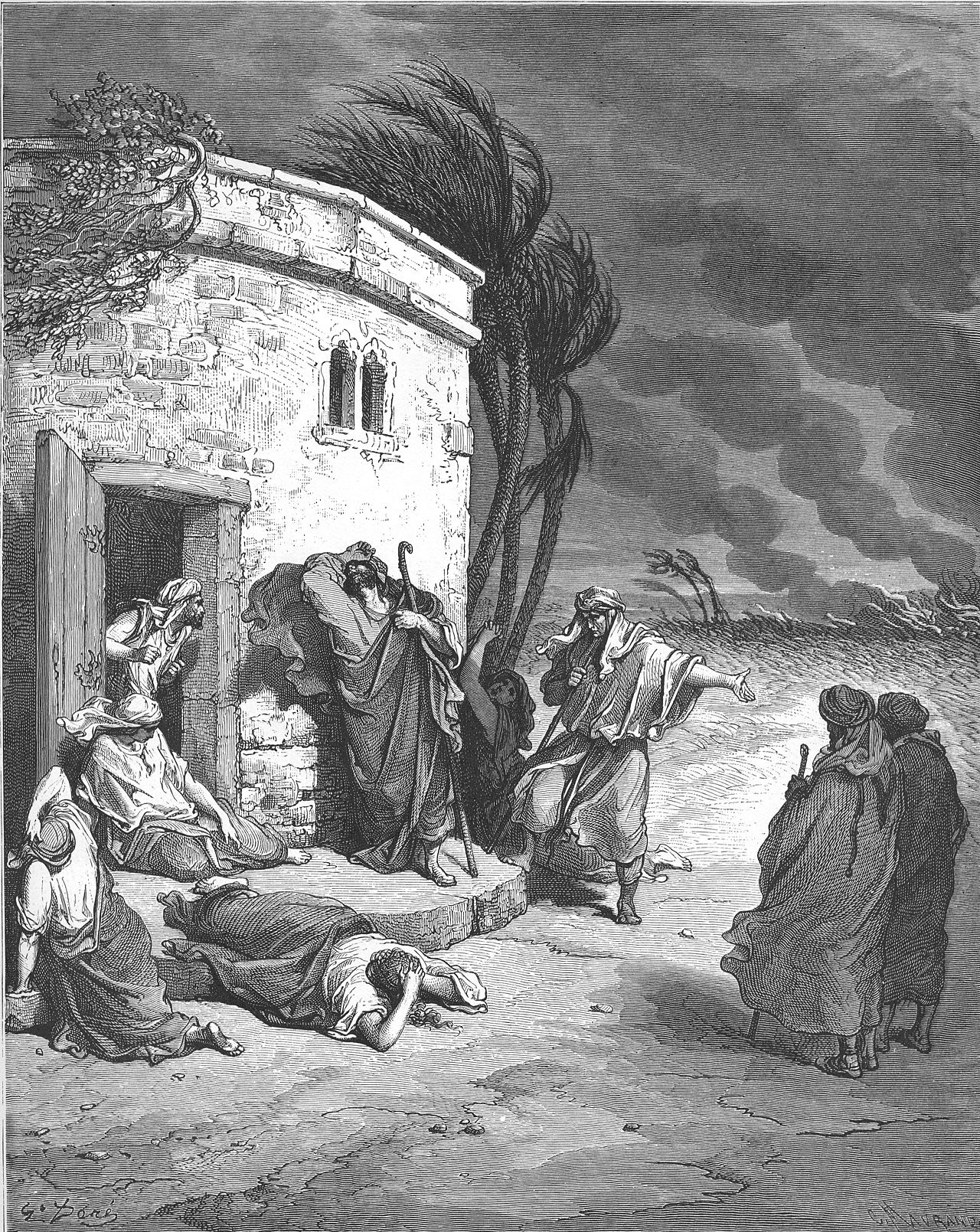
Jobchapter 24
25 verses · unknown · 10th century BC · Wisdom and poetry
From the city, men groan, and the souls of the wounded cry out, yet God charges no one with wrongdoing.
Introduction
unknown, Wisdom and poetry, Job Overview.
Job continues his reply to Eliphaz and turns to the injustice he sees in the world. Eliphaz had charged him with crimes against the poor, and Job now describes the men who truly commit them. His hearers lived under a system of loans and pledges and knew what it did to a poor household. Listen for the boundary stones, the pledged animals and the hungry hands that carry grain. Listen also for the men who work by night. The chapter opens with a question about when God will hold court.
Context
- Who
- Hearers who had worked someone else's land and gone home hungry
- What
- Job's account of the oppression of the poor and the crimes of the night, and his question why God does not set days for judgment.
- Where
- The fields, roads and towns of Job's world, described from the ash heap.
- When
- The third round of speeches, the continuation of Job's reply to Eliphaz.
- Why
- To show that injustice often goes unpunished for a time, against the friends' claim that the wicked always fall quickly.
Historical context
Job answers Eliphaz's invented charges with real ones, drawn from the world around them. He starts with boundary stones: 'some remove the landmarks'. Fields were marked by inscribed stones, and moving one stole land silently. Mesopotamian boundary markers were carved with elaborate curses against anyone who shifted them, and every legal tradition of the region treated it as a serious crime.
Show the rest of the historical context, 3 more paragraphs
Then the debt system in operation. They drive away the donkey of the fatherless and take the widow's ox for a pledge, seizing the one animal a poor household needed to plough or carry. They pluck the fatherless from the breast and take a pledge of the poor. The needy are turned out of the way and the poor of the earth hide themselves together.
The picture of the working poor is the sharpest social writing in the Old Testament. They go out to their labour like wild donkeys in the desert, rising early for prey; they reap in a field that is not theirs and gather the vintage of the wicked. They are wet with the showers of the mountains and embrace the rock for want of a shelter. They carry the sheaves and remain hungry; they make oil inside the walls of the rich and tread the winepresses, and suffer thirst.
The last section moves to night crimes, when there were no lamps in the street and no watch outside the gate: the murderer rising with the light to kill the poor, the adulterer waiting for the twilight and disguising his face, thieves digging through the mud-brick walls of houses they had marked in daylight. Morning to them, Job says, is as the shadow of death, their working day runs the other way round.
Significance
The question that opens the chapter, why, seeing times are not hidden from the Almighty, do they that know him not see his days?, is a demand for the court calendar. Job wants to know when the case will be heard.
Show the rest of the significance, 1 more paragraph
For hearers who lived at the bottom of that system, this chapter was the Bible taking their side out loud, and refusing to explain their suffering away.
This chapter in Jewish lifeWhat this chapter is in Jewish life and reading.
What is done
This chapter has no place in the synagogue year. The site's own table in src/lib/hebraic/readings.ts printed parashot total 0 and haftarah uses total 0 for the book of Job, and no festival reading.
The corpus joins it to the study of the Torah portions through the Midrash arranged by them. Under the third verse it carries Midrash Tanchuma Buber, Noach 26:1. Under the tenth verse it carries Midrash Tanchuma, Noach 18:11. Under the thirteenth verse it carries Midrash Tanchuma, Bereshit 12:3. Under the twenty-first verse it carries Bereshit Rabbati, Parashat Vayishlach 36. Under the thirty-second verse, by the corpus's numbering, it carries Midrash Tanchuma, Vayera 3:4.
How it is read
Rashi is the one commentator on this chapter whose English the corpus carries, quoted here from The Judaica Press complete Tanach with Rashi, translated by A. J. Rosenberg, which Sefaria reports as CC-BY. He calls the first verse a plaint. Why were the times of man's days kept open to the Holy One, so that He knows the day of each death? Perhaps otherwise He would delay the retribution, and death would come first (Rashi on Job 24:1:1).
Those who remove landmarks buy fields beside their neighbours' and move their fences into the neighbours' land at night (Rashi on Job 24:2:1). Rashi reads the list of wrongs as leading to the twelfth verse. He gives its purpose as "to let them know their iniquity and to furnish them with their recompense" (Rashi on Job 24:3:1).
The poor hide together in fear of them (Rashi on Job 24:4:1). The robbers lie in wait for passersby like wild donkeys used to the desert (Rashi on Job 24:5:1). The poor are made to lie naked all night, wet from the mountain streams with no refuge (Rashi on Job 24:7:1, Rashi on Job 24:8:1). The breast of the orphan is the source of his food and sustenance (Rashi on Job 24:9:1). The people and the dignitaries of the city groan because of the robbers (Rashi on Job 24:12:1).
From the thirteenth verse Rashi reads the wicked as the generation of the Flood. They rebelled because the rain rose from the earth and they needed nothing (Rashi on Job 24:13:1). The weaker among them dug under houses at night and stayed sealed in by day, unafraid of demons (Rashi on Job 24:16:1, Rashi on Job 24:17:1). When Noah and Methuselah rebuked them, they answered that they could float on papyrus boats (Rashi on Job 24:18:1). Their evil changed the world for one year from its six seasons (Rashi on Job 24:19:1).
Two notes report older sayings. Rashi reports the exposition of Rabbi Tanchum that the generation of the Flood placed their children beneath them to stop up the windows of the deep (Rashi on Job 24:20:1). He also describes their custom of two wives. One was given a potion to keep her barren and was fed and adorned, while the wife meant for children was starved in widow's garments (Rashi on Job 24:21:1).
The chapter ends with God's reckoning. The Holy One draws the mighty to retribution and grants them a reprieve (Rashi on Job 24:22:1). He gives them safety until the day of their catastrophe (Rashi on Job 24:23:1). They are then taken from the world in a fleeting second (Rashi on Job 24:24:1).
What the rabbis say
The corpus carries forty rabbinic locators on this chapter and the text of none, so each is cited and linked here rather than quoted. On the second verse it holds Bereshit Rabbah 38:6, Kohelet Rabbah 1:13:1 and Kohelet Rabbah 3:10:1. On the third verse it holds Midrash Tanchuma Buber, Noach 26:1 and Shemot Rabbah 30:13. On the fifth verse it holds Midrash Sekhel Tov, Bereshit 16:12:1. On the seventh verse it holds Pirkei DeRabbi Eliezer 42:10. On the tenth verse it holds Ein Yaakov (Glick Edition), Sanhedrin 11:122, Midrash Tanchuma, Noach 18:11 and Pirkei DeRabbi Eliezer 22:3.
On the eleventh verse it holds Bereshit Rabbah 31:2 and Jerusalem Talmud Yevamot 6:5:3. On the twelfth verse it holds Aggadat Bereshit 4:3, Eikhah Rabbah, Petichta 32 and Jerusalem Talmud Yevamot 16:3:5. On the thirteenth verse it holds Midrash Tanchuma, Bereshit 12:3, Midrash Yelamdenu, Selections from Yalkut Talmud Torah 28:1 and Pirkei DeRabbi Eliezer 22:2. On the fourteenth verse it holds Bereshit Rabbah 27:3, Bereshit Rabbah 32:1 and Ein Yaakov, Pesakhim 1:4. On the fifteenth verse it holds Bamidbar Rabbah 14:6, Bamidbar Rabbah 14:7 and Bamidbar Rabbah 9:1.
On the sixteenth verse it holds Jerusalem Talmud Maaser Sheni 5:1:9 and Sanhedrin 109a:14. On the eighteenth verse it holds Bereshit Rabbah 30:1 and Bereshit Rabbah 30:2. On the nineteenth verse it holds Ein Yaakov (Glick Edition), Shabbat 2:22 and Ein Yaakov (Glick Edition), Taanit 1:23. On the twentieth verse it holds Bereshit Rabbah 33:1 and Bereshit Rabbah 33:5. On the twenty-first verse it holds Bereshit Rabbah 23:2 and Bereshit Rabbati, Parashat Vayishlach 36. On the twenty-second verse it holds Midrash Tehillim 16:2. On the twenty-fourth verse it holds Ein Yaakov (Glick Edition), Sotah 1:9 and Ein Yaakov, Sotah 1:11.
On the twenty-fifth verse it holds Midrash Sekhel Tov, Bereshit 27:33:3. The corpus also anchors two locators past the twenty-fifth verse, which is the last verse of this chapter in the Berean Standard Bible count the site carries. Each is listed as the corpus prints it. The corpus sets Midrash Tanchuma, Vayera 3:4 at Job 24:32 and Vayikra Rabbah 5:1 at Job 24:39. Sefaria numbers by the Hebrew text, and a locator here is checked against that numbering before it is quoted. What each of them teaches is a saying of the rabbis, and is reported as theirs wherever this site quotes one. The quotations wait on a fetch that carries the text.
Sources: Rashi, Rashi on Job 24:1:1 to 24:24:1, The Judaica Press complete Tanach with Rashi, translated by A. J. Rosenberg, reported CC-BY; The Sefaria corpus, scripts/data/sources/sefaria/job/24.json, the 40 Talmud and Midrash locators of this chapter; The site's own files, src/lib/hebraic/readings.ts, printing no portion, no Haftarah and no festival reading for this book.
The heads below are this chapter's scenes. The numbered points under each are its verses.
Job: Why Are Times of Judgment Not Laid Up by the Almighty?
Job opens the list by asking why the Almighty does not "reserve times for judgment". The question takes for granted that judgment belongs to God. Delitzsch notes that the whole chapter answers this verse with evidence, a list of crimes done in plain sight with no visible consequence.
Job 24:1
“Why, seeing times are not hidden froth the Almighty - Dr. Good renders this, “Wherefore are not doomdays kept by the Almighty. So that his offenders may eye his periods?” Dr. Noyes: “Why are not times of punishment reserved by the Almighty. And why do not they, who regard him, see his judgments?” Jerome, “Times are not hidden from the Almighty; but they who know him are ignorant of his days.” The Septuagint, “But why have set times - ὧραι hōrai, escaped the notice - ἔλαθον elathon - of the Almighty, and the wicked transgressed all bounds?”
1 more voice on this verseWhat preachers and commentators have said about this verse, in their own words.
Job 24:1
“Though this is a mystery of Providence, yet there is a reason for it, and we shall shortly know why the judgment is deferred; even the wisest, and those who know God best, do not yet see it. God will exercise their faith and patience, and excite their prayers for the coming of his kingdom, for which they are to cry day and night to him, Luke xviii.”
Matthew Henry · Commentary on the Whole Bible (1707-1721)puritan
Job 24:2-4
Men move boundary stones: s", they "pasture stolen flocks", they "drive away the donkey of the fatherless", and they "take the widow’s ox in pledge". Gill notes that the fatherless and the widow were the weakest members of a household economy, the people law and custom were meant to shield.
Job 24:2
“Some remove the landmarks - Stones or posts were originally set up to ascertain the bounds of particular estates: and this was necessary in open countries, before hedges and fences were formed. Wicked and covetous men often removed the landmarks or termini, and set them in on their neighbors’ ground, that, by contracting their boundaries, they might enlarge their own. The law of Moses denounces curses on those who remove their neighbors’ landmarks. See Deu 19:14; Deu 27:17, and the note on the former place, where the subject is considered at large.”
Adam Clarke · Commentary on the Bible (1810-1826)evangelical
1 more voice on this verse
Job 24:2
“Forging or destroying deeds is now a crime equivalent to this. They dispossess them of their personal estates, under colour of justice. They violently take away flocks, pretending they are forfeited, and feed thereof; as the rich man took the poor man's ewe lamb, 2 Sam. xii.”
Matthew Henry · Commentary on the Whole Bible (1707-1721)puritan
They drive away the donkey of the fatherless: The fatherless and the widow head the list of the wronged, as they did in Eliphaz's charge against Job at Job 22:9. Barnes notes that an orphan's donkey may be his only property. A wrong done to those who cannot defend themselves weighs heavier.
Job 24:3
“They drive away the ass of the fatherless - Of the orphan, who cannot protect himself, and whose only property may consist in this useful animal. Injury done to an orphan is always regarded as a crime of special magnitude, for they are unable to protect themselves; see the notes at Job 22:9. They take the widow’s ox for a pledge - See the notes at Job 22:6. The widow was dependent on her ox to till the ground, and hence, the crime of taking it away in pledge for the payment of a debt.”
They push the needy off the road: The oppressors now take the road from the poor. Barnes says they crowd the needy from the path and deny them the use of the highway. Henry adds that the poor of the land are forced into hiding, with no other way to keep safe from them.
Job 24:4
“They turn the needy out of the way - They crowd the poor out of the path, and thus oppress and injure them. They do not allow them the advantages of the highway. The poor of the earth hide themselves together - For fear of the rich and mighty man. Driven from the society of the rich, without their patronage and friendship, they are obliged to associate together, and find in the wicked man neither protector nor friend. And yet the proud oppressor is not punished.”
3 more voices on this verse
Job 24:4
“They will mislead them if they can when they meet them on the high-way, so that the poor and needy are forced to hide themselves from them, having no other way to secure themselves from them.”
Matthew Henry · Commentary on the Whole Bible (1707-1721)puritan
Job 24:4
“They have turned the needy out of the way; and have oppressed together the meek of the earth. For by the term of 'poverty,' humility is very often denoted, and very often they that appear gentle and humble, if they have not learnt to maintain discretion, fall by the examples of other men.”
Gregory the Dialogist · written before 604 · Morals on the Book of Job, Book XVIpatristic
Job 24:4
“They turn the needy out of the way - They will not permit them to go by the accustomed paths; they oblige them to take circuitous routes. When the Marquis of H. was made ranger of Richmond Park, he thought it his duty to shut up a pathway which had existed for a long time; and those who presumed, after this shutting up, to break the fence, and take that path as formerly, were prosecuted.”
Adam Clarke · Commentary on the Bible (1810-1826)evangelical
Job 24:5-8
like wild donkeys in the desert: The poor now appear "like wild donkeys in the desert", who "go to work foraging for food" while "the wasteland is food for their children". They "glean the vineyards of the wicked". Watson notes that the poor do the labor that feeds their oppressors and own none of the harvest.
Job 24:5
“So Ishmael is called a "wild ass-man"; These Bedouin robbers, with the unbridled wildness of the ass of the desert, go forth thither. Robbery is their lawless "work." The desert, which yields no food to other men, yields food for the robber and his children by the plunder of caravans. rising betimes--In the East travelling is begun very early, before the heat comes on.”
Jamieson, Fausset & Brown · Commentary Critical and Explanatory on the Whole Bible (1871)reformed
1 more voice on this verse
Job 24:5
“Behold, as wild asses in the desert - In regard to the wild ass, see the notes at Job 6:5. Schultens, Good, Noyes, and Wemyss, understand this, not as referring to the haughty tyrants themselves, but to the oppressed and needy wretches whom they had driven from society, and compelled to seek a precarious subsistence, like the wild ass, in the desert. They suppose that the meaning is, that these outcasts go to their daily toil seeking roots and vegetables in the desert for a subsistence, like wild animals.”
glean the vineyards of the wicked: Readers divide over who gathers here. Henry takes the robbers of verse 2 as reaping other men's fields as freely as their own. Jamieson, Fausset and Brown take the poor of verse 5 as the gleaners, working vineyards that belong only to the wicked.
Job 24:6
They reap every one his corn in the field - This is perfectly characteristic. These wandering hordes often make sudden irruptions, and carry off the harvest of grain, olives, vines, etc., and plunge with it into the wilderness, where none can follow them. The Chaldee gives the same sense: “They reap in a field that is not their own, and cut off the vineyard of the wicked.”
Adam Clarke · Commentary on the Bible (1810-1826)evangelical
1 more voice on this verse
Job 24:6
“If we translate "belonging to the wicked," then it will imply that the wicked alone have vineyards, the "pious poor" (Job 24:4) have none. "Gather" in Hebrew, is "gather late." As the first clause refers to the early harvest of corn, so the second to the vintage late in autumn.”
Jamieson, Fausset & Brown · Commentary Critical and Explanatory on the Whole Bible (1871)reformed
they spend the night naked: Barnes notes that desert nights are often intensely cold though the days are hot, so the loss of a cloak meant real suffering. Jamieson, Fausset and Brown hear an echo of Job 22:6, where Eliphaz accused Job of stripping the naked. Here the stripping is done by others.
Job 24:7
“They cause the naked to lodge without clothing - They strip others of their clothing, and leave them destitute. That they have no covering in the cold - All travelers tell us, that though the day is intensely hot in the deserts of Arabia, yet the nights are often intensely cold. Hence, the sufferings of those who are plundered, and who have nothing to defend themselves from the cold air of the night.”
1 more voice on this verse
Job 24:7
“UMBREIT understands it of the Bedouin robbers, who are quite regardless of the comforts of life, "They pass the night naked, and uncovered," &c. But the allusion to Job 22:6, makes the English Version preferable (see on Job 24:10). Frost is not uncommon at night in those regions (Ge 31:40).”
Jamieson, Fausset & Brown · Commentary Critical and Explanatory on the Whole Bible (1871)reformed
they huddle against the rocks for want of shelter: Stripped of clothing in verse 7, the poor now take the mountain rains without cover. Wesley pictures rain running down the rocks into the caves where they fled, and a cleft in the rock as their only shelter. Barnes notes how suddenly such showers pour from the hills.
Job 24:8
“They are wet with the showers of the mountains - That is, the poor persons, or the travelers whom they have robbed. Hills collect the clouds, and showers seem to pour down from the mountains. These showers often collect and pour down so suddenly that there is scarcely time to seek a shelter. And embrace the rock for want of a shelter - Take refuge beneath a projecting rock. The robbers drive them away from their homes, or plunder them of their tents, and leave them to find a shelter from the storm, or at night, beneath a rock.”
3 more voices on this verse
Job 24:8
“Wet - With the rain-water, which runs down the rocks or mountains into the caves, to which they fled for shelter. Rock - Are glad when they can find a cleft of a rock in which they may have some protection against the weather.”
John Wesley · Explanatory Notes upon the Old Testament (1765)evangelical
Job 24:8
“They are wet with the showers of the mountains, and embrace the stones for want of a garment. 'The showers of the mountains' are the words of the learned. Of which same 'mountains' it is delivered by the voice of Holy Church; I lifted up mine eyes unto the hills: and so those persons, 'the showers of the mountains wet,' in that the streams of the holy fathers fill them to the full.”
Gregory the Dialogist · written before 604 · Morals on the Book of Job, Book XVIpatristic
Job 24:8
“They are wet with the showers of the mountains - Mr. Good thinks that torrents, not showers, is the proper translation of the original זרם zerem; but I think showers of the mountain strictly proper. I have seen many of these in mountainous countries, where the tails of water-spouts have been intercepted and broken, and the outpouring of them would be incredible to those who have never witnessed similar phenomena.”
Adam Clarke · Commentary on the Bible (1810-1826)evangelical
Job 24:9-12
The fatherless infant is snatched from the breast: The wrongs press further: "The fatherless infant is snatched from the breast". The line "yet God charges no one with wrongdoing" restates the problem of verse 1 in its starkest form. Barnes notes that this line is the hinge of the list, the evidence gathered to press that question.
Job 24:9
“They pluck the fatherless from the breast,.... Either on purpose to starve it, which must be extremely barbarous; or to sell it to be brought up a slave; or by obliging the mother to wean it before the due time, that she might be the better able to do work for them they obliged her to.”
1 more voice on this verse
Job 24:9
“They pluck the fatherless from the breast - That is, they steal away unprotected children, and sell them, or make slaves of them for their own use. If this is the correct interpretation, then there existed at that time, what has existed since, so much to the disgrace of mankind, the custom of kidnapping children, and bearing them away to be sold as slaves. Slavery existed in early ages; and it must have been in some such way that slaves were procured.”
They carry the sheaves, but still go hungry: Barnes sets the hungry who carry the sheaves beside the ox of Deuteronomy 25:4, left unmuzzled while it trod the grain. The poor get less than the ox. Jamieson, Fausset and Brown see the naked here as stripped of clothing taken in pledge.
Job 24:10
“They cause him to go naked - These cruel, hard-hearted oppressors seize the cloth made for the family wear, or the wool and flax out of which such clothes should be made. And they take away the sheaf - Seize the grain as soon as it is reaped, that they may pay themselves the exorbitant rent at which they have leased out their land: and thus the sheaf - the thraves and ricks, by which they should have been supported, are taken away from the hungry.”
Adam Clarke · Commentary on the Bible (1810-1826)evangelical
1 more voice on this verse
Job 24:10
“In Job 24:7 a like sin is alluded to: but there he implies open robbery of garments in the desert; here, the more refined robbery in civilized life, under the name of a "pledge." Having stripped the poor, they make them besides labor in their harvest-fields and do not allow them to satisfy their hunger with any of the very corn which they carry to the heap.”
Jamieson, Fausset & Brown · Commentary Critical and Explanatory on the Whole Bible (1871)reformed
they tread the winepresses, but go thirsty: The poor who carry the sheaves in verse 10 also crush the olives and tread the grapes of the wicked. Jamieson, Fausset and Brown place the work within the walls of the oppressor's vineyards. Henry calls this worse than muzzling the ox.
Job 24:11
“Which made oil within their walls - Or rather, they compel them to express oil within their walls. The word יצהירו yatshı̂yrû, rendered “made oil,” is from צחר tsachar, to shine, to give light; and hence, the derivatives of the word are used to denote light, and then oil, and thence the word comes to denote to press out oil for the purpose of light. Oil was obtained for this purpose from olives by pressing them, and the idea here is, that the poor were compelled to engage in this service for others without compensation.”
1 more voice on this verse
Job 24:11
“Which--"They," the poor, "press the oil within their wall"; namely, not only in the open fields (Job 24:10), but also in the wall-enclosed vineyards and olive gardens of the oppressor (Isa 5:5). Yet they are not allowed to quench their "thirst" with the grapes and olives.”
Jamieson, Fausset & Brown · Commentary Critical and Explanatory on the Whole Bible (1871)reformed
yet God charges no one with wrongdoing: Clarke marks a turn here from the poor of the fields to the poor of the city. The wounded cry out there too. Jamieson, Fausset and Brown take the last clause as the point of the whole list: God charges no one and punishes no one.
Job 24:12
“Groan - Under grievous oppressions. Soul - The life or blood of those who are wounded to death, as this word properly signifies, crieth aloud to God for vengeance.”
John Wesley · Explanatory Notes upon the Old Testament (1765)evangelical
Job: They Rebel Against the Light
Job 24:13-17
those who rebel against the light: A second group joins the list, "those who rebel against the light". The murderer rises when "daylight is gone", and housebreakers "dig through houses" and "shut themselves in" by day. Clarke notes the reversal these men live by, since for them "deep darkness is their morning" and daylight threatens exposure.
Job 24:13
“They are rebellious against the light. They know not the ways thereof, nor have returned by the paths thereof. LITERAL INTERPRETATION Very often wicked people at once know the right things that they ought to follow, and yet neglect to follow what they know; and so they are 'rebellious against the light,' in that following their desires, they contemn the good that they know. They then that do wrong not from ignorance, but pride, present the shield of their exaltation against the darts of truth, that they may not be stricken in heart to their good.”
Gregory the Dialogist · written before 604 · Morals on the Book of Job, Book XVIpatristic
1 more voice on this verse
Job 24:13
“They are of those that rebel against the light - That is, they hate the light: compare Joh 3:20. It is unpleasant to them, and they perform their deeds in the night. Job here commences a reference to another class of wicked persons - those who perform their deeds in the darkness of the night; and he shows that the same thing is true of them as of those who commit crimes in open day, that God does not interpose directly to punish them. They are suffered to live in prosperity.”
the murderer rises to kill the poor and needy: The rebels against the light of verse 13 begin with the murderer. Jamieson, Fausset and Brown place his work at early dawn, while it is still dark and travellers and labourers set out, as at Psalm 10:8. By night the same man turns thief.
Job 24:14
“The murderer rising with the light - Perhaps the words should be read as Mr. Good has done: - With the daylight ariseth the murderer; Poor and needy, he sheddeth blood. This description is suitable to a highwayman; one who robs in daylight, and who has been impelled by poverty and distress to use this most unlawful and perilous mode to get bread; and for fear of being discovered or taken, commits murder, and thus adds crime to crime.”
Adam Clarke · Commentary on the Bible (1810-1826)evangelical
The eye of the adulterer watches for twilight: The adulterer joins the murderer among those who hide from the light. Barnes compares Proverbs 7:8-9, where a man goes the way to her house at twilight, and reads the covered face as a mask. Henry notes that even bold sinners hide their sin.
Job 24:15
“The eye also of the adulterer waiteth for the twilight, saying, No eye shall see me. And disguiseth his face. There is nothing to hinder but that this may be understood even after the latter, seeing that he who desires to commit adultery, seeks out the dark. But whereas it is a sentence uttered against Heretics, it is meet that this thing which is declared be understood in a mystical sense. Thus Paul says, For we are not as many that adulterate the word of God. For the adulterer seeks not offspring, but pleasure in the act of carnal copulation.”
Gregory the Dialogist · written before 604 · Morals on the Book of Job, Book XVIpatristic
1 more voice on this verse
Job 24:15
“The eye also of the adulterer waiteth for the twilight; - compare the description in Pro 7:8-9, “He went the way to her house; in the twilight, in the evening, in the black and dark night.” And disguiseth his face - Margin, “setteth his face in secret.” The meaning is, that he put a mask on his face, lest he should be recognized. So Juvenal, Sat. viii. 144, as quoted by Noyes: - si nocturnus adulter Tempora Santonico velas adoperta cucullo.”
In the dark they dig through houses: Barnes takes the housebreaker here as a third class of sinner after the murderer and the adulterer. Jamieson, Fausset and Brown note that eastern houses were built of sun-dried mud brick, so thieves dug through the walls, as at Matthew 6:19. By day they seal themselves in.
Job 24:16
“In the dark they dig through houses - Thieves in Bengal very frequently dig through the mud wall and under the clay floors of houses, and, entering unperceived, plunder them while the inhabitants are asleep. Mr. Good’s version of this paragraph I shall lay before the reader: - Job 24:15 For the dark too watcheth the eye of the adulterer; Exclaiming, No eye shall behold me. Then putteth he the muffler on his face; Job 24:16 He wormeth into houses amidst the darkness.”
Adam Clarke · Commentary on the Bible (1810-1826)evangelical
deep darkness is their morning: The men of verses 13 to 16 invert the day. Barnes says they dread the light as other men dread the deepest darkness, for morning would expose their deeds. Maurer, cited by Jamieson, Fausset and Brown, reads the terrors as those of the morning light.
Job 24:17
“For the morning is to them even as the shadow of death - They dread the light as one does usually the deepest darkness. The morning or light would reveal their deeds of wickedness, and they therefore avoid it. As the shadow of death - As the deepest darkness; see the notes at Job 3:5. If one know them - If they are recognized. Or, more probably, this means “they,” that is, each one of them, “are familiar with the terrors of the shadow of death,” or with the deepest darkness.”
1 more voice on this verse
Job 24:17
“Rather, "They know well (are familiar with) the terrors of," &c. [UMBREIT]. Or, as MAURER, "They know the terrors of (this) darkness," namely, of morning, the light, which is as terrible to them as darkness ("the shadow of death") is to other men.”
Jamieson, Fausset & Brown · Commentary Critical and Explanatory on the Whole Bible (1871)reformed
Job 24:18-21
They are but foam on the surface of the water: "As drought and heat consume the melting snow, so Sheol steals those who have sinned", the swift retribution the friends have preached. Readers divide over whether Job speaks this as his own concession that judgment is only delayed, or sets the friends' creed inside his speech.
Job 24:18
“He is swift as the waters - Literally, Light is he on the face of the waters: and cursed shall be their portion on the earth, which Mr. Good translates: - Miserable is this man on the waters: Deeply miserable the lot of those on dry land. He beholdeth not the way of the vineyards - These no longer flourish or bring forth fruit. The labor of the vintage fails.”
Adam Clarke · Commentary on the Bible (1810-1826)evangelical
so Sheol steals those who have sinned: Drought and heat consume melting snow without a trace, and Sheol takes the sinful as quickly. Jamieson, Fausset and Brown compare the streams of Job 6:16-18. Barnes notes that the verb for steals means to seize by force.
Job 24:19
“Drought and heat consume the snow-waters - Margin, “violently take;” see the notes at Job 6:17. The word rendered “consume,” and in the margin “violently take” (יגזלו yı̂gâzelû), means properly to strip off, as skin from the flesh; and then to pluck or tear away by force; to strip, to spoil, to rob. The meaning here is, that the heat seems to seize and carry away the snow waters - to bear them off, as a plunderer does spoil. There is much poetic beauty in this image.”
1 more voice on this verse
Job 24:19
Arabian image; melted snow, as contrasted with the living fountain, quickly dries up in the sunburnt sand, not leaving a trace behind (Job 6:16-18). The Hebrew is terse and elliptical to express the swift and utter destruction of the godless; (so) "the grave--they have sinned!"
Jamieson, Fausset & Brown · Commentary Critical and Explanatory on the Whole Bible (1871)reformed
The womb forgets them: The womb that bore them forgets them, and the worm feeds on them. Jamieson, Fausset and Brown note that a mother is the last to forget, as at Isaiah 49:15, and Clarke reads womb as mercy itself. Henry hears an ordinary death, remembered no more like any other.
Job 24:20
“The womb shall forget him - The mother that bare him shall have no affection for him, nor be afflicted at his death. But the word רחם rechem signifies compassion, mercy. Mercy shall be unmindful of him. How dreadful such a state! When mercy itself forgets the sinner, his perdition slumbereth not. The worm shall feed sweetly on him - The Chaldee has, “The cruel, who have neglected to commiserate the poor, shall be sweet to the worms.” He shall be brought into a state of the greatest degradation, and shall be no more remembered.”
Adam Clarke · Commentary on the Bible (1810-1826)evangelical
They prey on the barren and childless: Jamieson, Fausset and Brown read verses 18 to 21 as the friends' doctrine, with this verse naming the wrong that earns the cursed portion. The barren and childless had no sons to guard them, and the widow no husband. Henry sets the childless beside the fatherless.
Job 24:21
“He evil entreateth the barren - The woman who has no children to comfort or support her. He increases her calamity by acts of cruelty and oppression. To be without children, as is well known, was regarded, in the patriarchal ages, as a great calamity. And doeth not good to the widow - See the notes at Job 24:3. Notwithstanding all this, he is permitted to live in prosperity, and to die without any visible tokens of the divine displeasure.”
1 more voice on this verse
Job 24:21
“The reason given by the friends why the sinner deserves such a fate. barren--without sons, who might have protected her. widow--without a husband to support her.”
Jamieson, Fausset & Brown · Commentary Critical and Explanatory on the Whole Bible (1871)reformed
Job 24:22-25
by His power, God drags away the mighty: The chapter closes with God, who "drags away the mighty" and gives them "a sense of security". Readers differ on whether Job grants judgment comes late or quotes the friends' creed to overturn it. He then dares them: "who can prove me a liar and reduce my words to nothing?"
Job 24:22
“He took away the mighty in his might. Since in the might of his wickedness the mighty he severally takes away, whilst by the craftiness of his error he carries off the great ones of this world. In opposition to whom it is said by Paul, God hast chosen the weak things of the world to confound the things that are mighty.”
Gregory the Dialogist · written before 604 · Morals on the Book of Job, Book XVIIpatristic
1 more voice on this verse
Job 24:22
“He draweth also the mighty - Calmet gives the following version of the original: “He draws with him guards for his defense; he raises himself up, and does not feel assured of his life.” In the midst even of his guards he is afraid; and dares not put confidence in any person. This is an admirable delineation of the inquietudes and terrors of a tyrant.”
Adam Clarke · Commentary on the Bible (1810-1826)evangelical
His eyes are on their ways: The mighty whom God drags away in verse 22 are given a sense of security for a while. His eyes watch their ways all the same. Jamieson, Fausset and Brown hear Job's wonder at this, and Wesley reads the watching eyes as a promise of punishment in due time.
Job 24:23
“Though it be given him to be in safety - That is, God gives him safety. The name God is often understood, or not expressed. The meaning is, that God gives this wicked man, or oppressor, safety. He is permitted to live a life of security and tranquility. Whereon he resteth - Or, rather, “And he is sustained, or upheld” - (וישׁען veyshâ‛an). The meaning is, that he is sustained or upheld by God.”
1 more voice on this verse
Job 24:23
“God hath given unto him room for repentance, and he abuseth it in pride. Whosoever commits sin and lives, such a person Divine Appointment for this reason bears with in iniquity, that it may withhold him from iniquity. But he that is borne with for a longer time, and yet is not withholden from iniquity, is vouchsafed indeed the benefit of the patience Above, yet with the chains of his guilt is by that very benefit binding himself the tighter.”
Gregory the Dialogist · written before 604 · Morals on the Book of Job, Book XVIIpatristic
They are exalted for a moment: Barnes takes the rise of the wicked as Job's own proposition against the friends. Henry says Job owns that the wicked are miserable at last, and he denies what the friends assert. Their end comes as quietly as grain cut at harvest.
Job 24:24
“Join "for a while" with "are gone," not as English Version. Translate: "A moment--and they are no more! They are brought low, as all (others) gather up their feet to die" (so the Hebrew of "are taken out of the way").”
Jamieson, Fausset & Brown · Commentary Critical and Explanatory on the Whole Bible (1871)reformed
1 more voice on this verse
Job 24:24
“They are exalted for a little while, but they shall not hold on. The glory of bad men, whilst it is for the most part extended into a multitude of years, is by the minds of the weak reckoned to be long and as it were stable; but when an instantaneous end cuts it off, surely it proves to its face that it was short, because the end by putting a limit makes it known that that which was capable of passing away was little.”
Gregory the Dialogist · written before 604 · Morals on the Book of Job, Book XVIIpatristic
who can prove me a liar: The dare closes the reply that began in chapter 23. Barnes reads it as an appeal to facts: the wicked of this chapter prosper, and whoever denies it must prove it. Henry names two ways to reduce the words to nothing: prove them false, or prove them beside the purpose.
Job 24:25
“And if it be not so now, who will make me a liar? - A challenge to anyone to prove the contrary to what he had said. Job had now attacked their main position, and had appealed to facts in defense of what he held. He maintained that, as a matter of fact, the wicked were prospered, that they often lived to old age, and that they then died a peaceful death, without any direct demonstration of the divine displeasure. He boldly appeals, now, to anyone to deny this, or to prove the contrary. The appeal was decisive.”
Keep studying
Sources for this chapter
The summary
Jamieson, Fausset & Brown, Commentary Critical and Explanatory; John Wesley, Notes on the Old Testament and Matthew Henry, Complete Commentary.
The exposition
A. B. Davidson, The Book of Job, Cambridge Bible; Adam Clarke, Commentary on the Bible; Albert Barnes; Franz Delitzsch, Biblical Commentary on the Book of Job; Jamieson, Fausset & Brown, Commentary Critical and Explanatory on the Whole Bible; John Gill, Exposition of the Old Testament; John Wesley, Explanatory Notes upon the Old Testament; Matthew Henry, Commentary on the Whole Bible and R. A. Watson, The Book of Job, Expositor's Bible.