
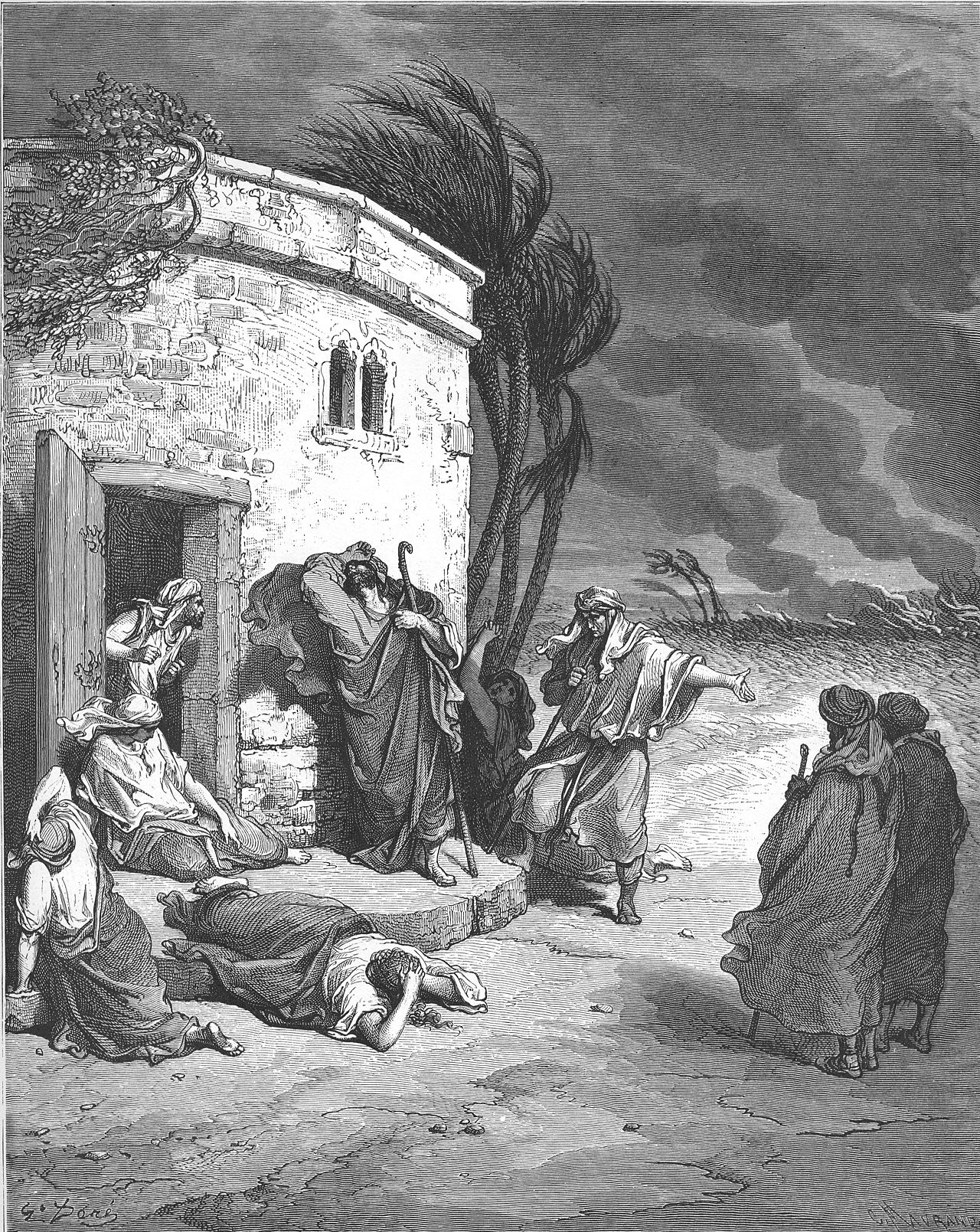
Jobchapter 16
22 verses · unknown · 10th century BC · Wisdom and poetry
My friends are my scoffers as my eyes pour out tears to God.
Introduction
unknown, Wisdom and poetry, Job Overview.
Job answers Eliphaz, and this speech runs on through chapter 17. He speaks as a man mocked in public by the people who came to comfort him. His hearers knew the gestures of scorn in a small town, the shaken head and the blow to the cheek, and what it meant to sit in sackcloth. Listen for the pictures of attack, as Job describes himself as a target. Listen then for a sudden turn toward heaven in the middle of the darkest lines. There Job looks for someone to speak for him before God.
Context
- Who
- Hearers who knew what public contempt looked like in a small town
- What
- Job's reply to Eliphaz, a complaint that God and men have attacked him and an appeal to a witness in heaven.
- Where
- The ash heap outside Job's town, before the three friends.
- When
- The second round of speeches, in Job's first reply of that round.
- Why
- To show Job holding to his innocence and looking past his accusers to God for a hearing.
Historical context
Job calls them miserable comforters and says he could string words together too, if their souls were where his soul is, shaking his head at them. Head-shaking, gaping with the mouth, and striking a man on the cheek were all recognised gestures of public scorn in that world, done in front of witnesses so that everyone saw a man's standing collapse.
Show the rest of the historical context, 3 more paragraphs
The middle section uses the imagery of an ambush and an execution. God has taken him by the neck and shaken him to pieces, set him up as a mark for the arrow, and his archers surround him and split his kidneys, the innermost part of the body, the seat of the deepest feeling in Hebrew usage. He is describing not just pain but being singled out as a target.
The mourning details are exact. He has sewn sackcloth on his skin, not draped, sewn, the sign of grief that has become permanent, and defiled his horn in the dust. A horn was the standard symbol of a man's strength and honour, taken from the lifted horn of a bull; pushing it into the dirt is the picture of a strong man's dignity ground into the ground where he sits.
Then, in the middle of the darkest speech so far, comes a flash of something else: 'my witness is in heaven, and my record is on high'. Job appeals past his friends and past his own experience to a witness in the heavenly court who knows the truth of him. He asks that his blood not be covered, the ancient conviction that unavenged blood cries from the ground until someone answers for it.
Significance
Job's instinct here is remarkable and the book means it to be. Attacked by God, as he sees it, he appeals to God, 'that one might plead for a man with God, as a man pleadeth for his neighbour'.
Show the rest of the significance, 1 more paragraph
For hearers, that is the second time the need for a mediator has surfaced, and it is louder than the first. The book keeps raising a hand it cannot yet fill.
This chapter in Jewish lifeWhat this chapter is in Jewish life and reading.
What is done
The site's table of the synagogue year lists no reading from this chapter. That table in src/lib/hebraic/readings.ts printed parashot total 0, haftarah uses total 0 and no festival reading for Job.
The corpus meets the chapter in other settings. Under the eleventh verse it files Tractate Soferim 4:9 and 5:5 and Tractate Sefer Torah 4:8 and 5:7, beside Jerusalem Talmud Sotah 5:6:2. Under the thirteenth it files Chullin 43a:6. Shemot Rabbah stands at 21:7 under the eleventh verse and at 22:3 under the seventeenth.
How it is read
Malbim, in Malbim's Job, translated by Jeremy I. Pfeffer (Ktav, 2003), which Sefaria reports as CC-BY, heads the chapter "The Ninth Oration - Job’s Second Reply to Eliphaz" (Malbim on Job 16:1:1). He then says what Job holds back. Job does not answer Eliphaz at once on the prosperity of the wicked, nor Bildad on the same issue. He prefers "to wait until all three of his companions have addressed the subject", and he answers them all together in chapter 21 (Malbim on Job 16:1:2). A reader of this chapter looks to chapter 21 for Job's reply on that question.
Rashi, quoted here from The Judaica Press complete Tanach with Rashi, translated by A. J. Rosenberg, which Sefaria reports as CC-BY, reads the opening as Job turning the friends' method back on them. "I know how to chide as you do" (Rashi on Job 16:4:1). Were he in their place, the movement of his lips in complaint would stop (Rashi on Job 16:5:1). He reads the shriveling of Job's body as a witness raised to accuse him of iniquity (Rashi on Job 16:8:1).
Two notes name those who wound Job. At the ninth verse Rashi says briefly, "Satan is the adversary" (Rashi on Job 16:9:1). At the eleventh he says that the Holy One, blessed be He, delivered Job to a fool, "a scorner, a mocker, to be scornful of me" (Rashi on Job 16:11:1). The next verse keeps that fool as the one who crumbled him to pieces (Rashi on Job 16:12:1). The archers of the thirteenth verse are the one who shoots his arrows, a sense Rashi takes from Genesis 21:20 (Rashi on Job 16:13:1).
Several notes are word studies that reach into the Mishnah. The scab of the fifteenth verse is a dry wound that forms a crust, and Rashi sets it beside the language of Rosh Hashanah 27b on a shofar scraped thin (Rashi on Job 16:15:1). The shriveling of the sixteenth he compares with Chullin 3:3 and with Lamentations 1:20 (Rashi on Job 16:16:1). The pouring out of the twentieth is the dripping of tears (Rashi on Job 16:20:1).
The close of the chapter is Job's claim to a clean record and a hearing. His prayer is pure because he neither cursed his friend nor thought evil against him (Rashi on Job 16:17:1). He asks that no place on earth absorb his cry, so that it rises to heaven (Rashi on Job 16:18:1).
The witness in heaven Rashi names in six words. "My Creator, Who knows my ways" (Rashi on Job 16:19:1). At the twenty-first verse Job wishes for a place where a man could reason with God. Rashi reads the verse as likening "the contention of man with his Maker, and the contention of man with his fellow" (Rashi on Job 16:21:1). The numbered years of the last verse are the limited days of his life (Rashi on Job 16:22:1).
The corpus carries three further notes on this chapter without an English text, each marked linked because Sefaria holds no English version of the ref. They stand cited and unquoted at Ibn Ezra on Job 16:2:1, and at Metzudat David on Job 16:2:1 and 16:14:1.
What the rabbis say
The corpus carries twenty-one rabbinic locators on this chapter and the text of none, so each is cited and linked here by ref alone. On the second verse it holds Pesikta Rabbati 29:1.
The eleventh verse, where Rashi hears God deliver Job to a fool, draws nine of the twenty-one. The corpus holds Bereshit Rabbah 57:4, Shemot Rabbah 21:7, Jerusalem Talmud Sotah 5:6:2, Midrash Lekach Tov, Numbers 22:32:1 and Yalkut Shimoni on Torah 102:5. Tractate Sefer Torah 4:8 and 5:7 and Tractate Soferim 4:9 and 5:5 stand with them.
The thirteenth verse, the archers, draws six. The corpus holds Bereshit Rabbah 30:8, Chullin 43a:6, Ein Yaakov, Khullin 3:2, Esther Rabbah 6:3, Midrash Sekhel Tov, Bereshit 49:23:1 and Pesikta Rabbati 31:1.
The rest fall one to a verse. On the fourteenth the corpus holds a passage of Otzar Midrashim from the Midrashim of Rabbi Akiba, The Small Letters and their Purposes, at 27. On the fifteenth it holds Pesikta DeRav Kahana 16:6, and on the seventeenth Shemot Rabbah 22:3. On the eighteenth it holds Midrash Tehillim 26:2, and on the nineteenth Midrash Sekhel Tov, Bereshit 49:27:2. What each of them teaches is a saying of the rabbis, and is reported as theirs wherever this site quotes one. The quotations wait on a fetch that carries the text.
Sources: Rashi, Rashi on Job 16:3:1 to 16:22:1, The Judaica Press complete Tanach with Rashi, translated by A. J. Rosenberg, reported CC-BY; Malbim, Malbim on Job 16:1:1 and 16:1:2, Malbim's Job, trans. Jeremy I. Pfeffer, Ktav, 2003, reported CC-BY; Ibn Ezra, Ibn Ezra on Job 16:2:1, cited by ref because the corpus carries no English text; Metzudat David, Metzudat David on Job 16:2:1 and 16:14:1, cited by ref because the corpus carries no English text; The Sefaria corpus, scripts/data/sources/sefaria/job/16.json, the 21 Talmud and Midrash locators of this chapter; The site's own files, src/lib/hebraic/readings.ts, printing no portion, no Haftarah and no festival reading for this book.
The heads below are this chapter's scenes. The numbered points under each are its verses.
Job: Miserable Comforters Are Ye All
Job 16:1-5
Then Job answered: Job opens his reply by naming the friends outright, "miserable comforters are you all", the book's only use of the phrase and his plainest verdict. He chooses the harder path instead, "I would encourage you with my mouth", naming the comfort he needed and did not receive.
Job 16:1
“Then Job answered and said. As soon as Eliphaz had done speaking, Job stood up, and made the following reply.”
1 more voice on this verseWhat preachers and commentators have said about this verse, in their own words.
Job 16:1
“Since Eliphaz speaks so, as if the matter were of extraordinary importance, and talks as if his speech derived from the wisdom of the ancestors, Job also resumes the argument he had used at the beginning. Is what you say not evident, he says? Therefore, since you speak superficially and utter what comes to your mind without checking your words, do not be annoyed with me if I express the thoughts of my mind.”
John Chrysostom · written before 407 · Commentary on Job 16:1-2patristic
miserable comforters are you all: Job answers the claim of 15:11, where Eliphaz had called his speeches the consolations of God. Barnes points back to 13:4 and notes that the friends came to condole with him and have only irritated him. Their comfort adds to the trouble.
Job 16:2
“I have heard many such things - These sayings of the ancients are not strange to me; but they do not apply to my case: ye see me in affliction; ye should endeavor to console me. This ye do not; and yet ye pretend to do it! Miserable comforters are ye all.”
Adam Clarke · Commentary on the Bible (1810-1826)evangelical
long-winded speeches?: Job throws the charge of 15:2 back at Eliphaz: it is the friends' speeches that are long-winded. Barnes notes that the Hebrew reads words of wind. Jamieson, Fausset and Brown read the second question as asking what Job has said to provoke them.
Job 16:3
“He retorts upon Eliphaz his reproach (Job 15:2). emboldeneth--literally, "What wearies you so that ye contradict?" that is, What have I said to provoke you? &c. [SCHUTTENS].”
Jamieson, Fausset & Brown · Commentary Critical and Explanatory on the Whole Bible (1871)reformed
shake my head at you: Barnes reads it as a claim that it is easy to heap up old proverbs against a man in pain. Henry calls it an easy thing to trample on those who are down. Jamieson, Fausset and Brown explain that to shake the head was a gesture of scorn.
Job 16:4
“I also could speak - It is probably better to render some of these permissives or potential verbs literally in the future tense, as in the Hebrew: I also Will speak. Mr. Good has adopted this mode. If your soul were in my soul’s stead - If you were in my place, I also could quote many wise sayings that might tend to show that you were hypocrites and wicked men; but would this be fair?”
Adam Clarke · Commentary on the Bible (1810-1826)evangelical
the consolation of my lips would bring relief: Job says what his mouth and lips would do if the friends sat where he sits: encourage them and bring relief. Henry says true consolation strengthens faith and patience. Jamieson, Fausset and Brown, after Umbreit, read the verse as irony, lip comfort of the kind the friends offer.
Job 16:5
“Opposed to strengthening with the heart, that is, with real consolation. Translate, "I also (like you) could strengthen with the mouth," that is, with heartless talk: "And the moving of my lips (mere lip comfort) could console (in the same fashion as you do)" [UMBREIT]. "Hearty counsel" (Pr 27:9) is the opposite.”
Jamieson, Fausset & Brown · Commentary Critical and Explanatory on the Whole Bible (1871)reformed
Job 16:6-8
Even if I speak, my pain is not relieved: Speech brings no relief and silence brings none: "if I hold back, how will it go away". His body is the witness, "my frailty rises up and testifies against me". Barnes notes that the friends took wasting illness as proof of hidden sin, which chapter 1 denies.
Job 16:6
“Though I speak - But it will be of no avail thus to speak; for reprehensions of your conduct will not serve to mitigate my sufferings.”
Adam Clarke · Commentary on the Bible (1810-1826)evangelical
2 more voices on this verse
Job 16:6
“Sometimes giving vent to grief gives ease; but, " Though I speak " (says Job), " my grief is not assuaged, my spirit is never the lighter for the pouring out of my complaint; nay, what I speak is so misconstrued as to be turned to the aggravation of my grief." 2.”
Matthew Henry · Commentary on the Whole Bible (1707-1721)puritan
Job 16:6
“Though I speak, my grief is not assuaged - “But for me, it makes now no difference whether I speak or am silent. My sufferings continue. If I attempt to vindicate myself before people, I am reproached; and equally so if I am silent. If I maintain my cause before God, it avails me nothing, for my sufferings continue. If I am silent, and submit without a complaint, they are the same. Neither silence, nor argument, nor entreaty, avail me before God or man. I am doomed to suffering.” What am I eased? - Margin. “Goeth from me.””
You have devastated all my family: Job speaks of God, then turns and speaks to Him. Barnes reads the first line as God having exhausted his strength. Jamieson, Fausset and Brown take the devastated family as witnesses who could testify to his innocence.
Job 16:7
“But now he hath made me weary - That is, God has exhausted my strength. This verse introduces a new description of his sufferings; and he begins with a statement of the woes that God had brought on him. The first was, that he had taken away all his strength. All my company - The word rendered “company” (עדה ‛êdâh) means properly an assembly that comes together by appointment, or at stated times; but here it is evidently used in the sense of the little community of which Job was the head and father.”
my frailty rises up and testifies against me: Jamieson, Fausset and Brown say the friends took his wasted body as proof of guilt. They trace the Hebrew verb for bound to a root meaning to draw together. Henry adds that the same witness could show his complaint has cause.
Job 16:8
But another "witness" arises against him, namely, his "leanness" or wretched state of body, construed by his friends into a proof of his guilt. The radical meaning of the Hebrew is "to draw together," whence flow the double meaning "to bind" or "fetter," and in Syriac, "to wrinkle." leanness--meaning also "lie"; implying it was a "false witness."
Jamieson, Fausset & Brown · Commentary Critical and Explanatory on the Whole Bible (1871)reformed
1 more voice on this verse
Job 16:8
“Thou hast filled me with wrinkles - If Job’s disease were the elephantiasis, in which the whole skin is wrinkled as the skin of the elephant, from which this species of leprosy has taken its name, these words would apply most forcibly to it; but the whole passage, through its obscurity, has been variously rendered. Calmet unites it with the preceding, and Houbigant is not very different.”
Adam Clarke · Commentary on the Bible (1810-1826)evangelical
Job 16:9-11
His anger has torn me and opposed me: Job pictures God as a beast of prey who "gnashes His teeth at me", and "My adversary pierces me with His eyes" like a hunter. Delitzsch reads this as honest but partial sight, since the court of chapters 1 and 2 is hidden from Job.
Job 16:9
“He teareth me in his wrath - The language here is all taken from the ferocity of wild beasts; and the idea is, that his enemy had come upon him as a lion seizes upon its prey. Rosenmuller, Reiske, and some others suppose that this refers to God. Cocceius refers it to Satan. Schultens, Dr. Good, and some others, to Eliphaz, as the leading man among his adversaries. I have no doubt that this is the true reference.”
1 more voice on this verse
Job 16:9
“So God is represented (Job 10:16). who hateth me--rather, "and pursues me hard." Job would not ascribe "hatred" to God (Ps 50:22). mine enemy--rather, "he sharpens, &c., as an enemy" (Ps 7:12).”
Jamieson, Fausset & Brown · Commentary Critical and Explanatory on the Whole Bible (1871)reformed
strike my cheeks with contempt: The friends open their mouths against Job just as God opposed him in verse 9, as Jamieson, Fausset and Brown observe. Barnes notes the shift to all the friends together. Henry, with many ancient writers, sees Christ here, struck on the cheek.
Job 16:10
“They have gaped upon me - Changing the form from the singular to the plural, and including “all” his pretended friends. Such a change in the number is not uncommon. His mind seems to have passed from the particular instance which he was contemplating, to “all” his friends, and he suddenly felt that “all” had treated him alike. The meaning is, that, like wild beasts, they open their mouth to devour me. They have gathered themselves together - They have entered into a conspiracy, and have “agreed” to oppose me.”
1 more voice on this verse
Job 16:10
“Herein Job was a type of Christ, as many of the ancients make him: these very expressions are used in the predictions of his sufferings, Ps. xxii. 13 , They gaped upon me with their mouths; and ( Mic. v. 1 ), They shall smite the Judge of Israel with a rod upon the cheek, which was literally fulfilled, Matt. xxvi.”
Matthew Henry · Commentary on the Whole Bible (1707-1721)puritan
God has delivered me to unjust men: Barnes and Jamieson, Fausset and Brown take the unjust men to be the professed friends themselves. Barnes pictures a captive in their hands. Henry sees Christ here too, delivered into wicked hands by the counsel of God in Acts 2.
Job 16:11
God hath delivered me - Margin “shut me up.” The meaning is, that God had committed him to their hands as a prisoner or captive. They had power over him to do as they pleased. To the ungodly - Into the hands of wicked people - meaning undoubtedly his professed friends. And turned me over - The word used here (from ירט yârat) means to throw head long, to precipitate, to cast down. Here it means, “he has thrown me headlong into the hands of the wicked.”
Job: Even Now, Behold, My Witness Is in Heaven
Job 16:12-14
I was at ease, but He shattered me: Job's settled life becomes a target: "He seized me by the neck and crushed me" and "He has set me up as His target". Henry notes that Job never doubts God's power here, only His purpose, though Job will call Him his witness at 16:19.
Job 16:12
“I was at ease - I was in a state of happiness and security. The word used here (שׁלו shâlêv) means sometimes to be “at ease” in an improper sense; that is, to be in a state of “carnal security,” or living unconcerned in sin (Eze 23:42; compare Pro 1:32); but here it is used in the sense of comfort. He had everything desirable around him. But he hath broken me asunder - He has crushed me. He hath also taken, me by my neck - Perhaps as an animal does his prey.”
His archers surround me: The target image of verse 12 continues. Jamieson, Fausset and Brown take the archers as the three friends, whose words wound like arrows, while Gill also names Satan or Job's diseases. Barnes notes that the Hebrew word means many or mighty ones and is used nowhere else for archers.
Job 16:13
“His archers compass me round about,.... Satan and his principalities and powers casting their fiery darts at him; or rather, his friends shooting their arrows, even bitter words, reproaches, and calumnies; or the various diseases of his body, his boils and ulcers, which were so many arrows shot into him, in every part of him all around, and gave him exquisite pain and anguish; besides the arrows of the Almighty, or that painful sensation he had of the wrath of God.”
1 more voice on this verse
Job 16:13
“His archers - He does not come alone to shoot at me; he has employed a company of bowmen, who also direct “their” arrows against me. The word used here רב rab means properly “much, large,” great; and is applied to that which is powerful or mighty. It is nowhere else used in the sense of “archers,” and might be rendered “his many;” that is, his bands, hosts, or armies. But as all the ancient versions render it “arrows,” or “archers,” probably that sense is to be retained.”
He breaks me with wound upon wound: Gill and Henry connect each wound to the first chapter, where one messenger came on the heels of another. Barnes explains that each blow breaks Job before he can recover. The mighty warrior is God Himself.
Job 16:14
“He breaketh me - He crushes me. With breach upon breach - He renews and repeats the attack, and thus completely overwhelms me. One blow follows another in such quick succession, that he does not give me time to recover. He runneth upon me like a giant - With great and irresistible force - as some strong and mighty warrior whom his adversary cannot resist. The Hebrew is גבור gı̂bbôr - “a mighty one.” Septuagint, “The mighty - δυνάμενοι dunamenoi - run upon me.” Vulgate, “gigas” - a giant.”
1 more voice on this verse
Job 16:14
“He breaketh me with breach upon breach,.... Upon his substance, his family, and the health of his body, which came thick and fast, one after another; referring to the report of those things brought by one messenger upon the back of another, see Eze 7:26; he runneth upon me like a giant; with great fury and fierceness, with great strength and courage, with great speed and swiftness, causing great terror and distress; he not being able to resist him, any more than a dwarf a giant, and no more, nor so much, a match for him; see Isa 42:13.”
Job 16:15-17
I have sewn sackcloth over my skin: In "I have sewn sackcloth over my skin" mourning is stitched on. "I have buried my horn in the dust" grinds his strength and dignity into the ground. Clarke notes that sackcloth sewn to the skin pictures a grief too settled to lay aside as ordinary mourning was.
Job 16:15
“I have sewed sackcloth - I have put on the badges of humiliation and grief; see the notes at Isa 3:24. This was the usual emblem of mourning. In order more deeply to express it, or to make it a “permanent” memorial of sorrow, it would seem that it was “sewed” around the body - as we “sew” crape on the hat. And defiled my horn in the dust - The word rendered “defiled” (from עלל ‛âlal) has, according to Gesenius, the notion of “repetition,” derived from the use of the Arabic word.”
1 more voice on this verse
Job 16:15
“I have not only put on sackcloth, but sewed it on, as being resolved to continue my humiliation, as long as my affliction continues. Defiled my horn - I have willingly parted with all my wealth, and power, and glory (as the horn often signifies in scripture,) and been content to lie in the dust.”
John Wesley · Explanatory Notes upon the Old Testament (1765)evangelical
My face is red with weeping: Jamieson, Fausset and Brown, after Umbreit and Noyes, read the face as red and flushed, and take the shadows as the darkening many tears bring. Clarke reads the shadows as death's shadow already cast over Job. Henry sees in these tears a type of Christ, the man of sorrows.
Job 16:16
“My face is foul with weeping - Wemyss, “swelled.” Noyes, “red.” Good, “tarnished.” Luther, “ist geschwollen” - is swelled. So Jerome. The Septuagint, strangely enough, ἡ γαστήρ μον συνκέκαυται, κ. τ. λ. hē gastēr mou sunkekautai, etc. “my belly is burned with weeping.” The Hebrew word (חמר châmar) means to boil up, to ferment, to foam. Hence, it means to be red, and the word is often used in this sense in Arabic - from the idea of becoming heated or inflamed.”
1 more voice on this verse
Job 16:16
“In this also he was a type of Christ, who was a man of sorrows, and much in tears, and pronounced those blessed that mourn, for they shall be comforted. Job's Comfort in Conscious Integrity. 17 Not for any injustice in mine hands: also my prayer is pure.”
Matthew Henry · Commentary on the Whole Bible (1707-1721)puritan
my prayer is pure: Job answers the charge of 15:4 that he had cast off the fear of God, as Wesley observes. The claim faces both men and God. Henry adds that prayer cannot be pure while injustice stains the hands, so the two claims stand together.
Job 16:18-19
O earth, do not cover my blood: Job asks that his case stay open after death. While the friends accuse him on the ground, "my witness is in heaven, and my advocate is on high". Delitzsch reads this as the second rung of a ladder, after the arbiter at 9:33 and before the redeemer of 19:25.
Job 16:18
“O earth, cover not thou my blood - This is evidently an allusion to the murder of Abel, and the verse has been understood in two different ways: 1. Job here calls for justice against his destroyers. His blood is his life, which he considers as taken away by violence, and therefore calls for vengeance. Let my blood cry against my murderers, as the blood of Abel cried against Cain.”
Adam Clarke · Commentary on the Bible (1810-1826)evangelical
my witness is in heaven: Job turns from friends who testify against him to a witness on high who knows his innocence. Barnes calls this returning confidence in God, the trust Job comes back to after his most passionate words. Henry names it Job's triumph.
Job 16:19
“My witness is in heaven - That is, I can appeal to God for my sincerity. He is my witness; and he will bear record for me. This is an evidence of returning confidence in God - to which Job always returns even after the most passionate and irreverent expressions. Such is his real trust in God, that though he is betrayed at times into expressions of impatience and irreverence, yet he is sure to return to calmer views, and to show that he has true confidence in the Most High.”
1 more voice on this verse
Job 16:19
“Also now--Even now, when I am so greatly misunderstood on earth, God in heaven is sensible of my innocence. record--Hebrew, "in the high places"; Hebrew, "my witness." Amidst all his impatience, Job still trusts in God.”
Jamieson, Fausset & Brown · Commentary Critical and Explanatory on the Whole Bible (1871)reformed
Job 16:20-21
My friends are my scoffers: The wish "that a man might plead with God as he pleads with his neighbor" asks for an advocate. Gill notes that this stays in a human register, short of the witness of verse 19 and the redeemer of chapter 19.
Job 16:20
“My friends scorn me - Margin “are my scorners.” That is, his friends had him in derision and mocked him, and he could only appeal with tears to God. Mine eye poureth out tears unto God - Despised and mocked by his friends, he made his appeal to one who he knew would regard him with compassion. This shows that the heart of Job was substantially right.”
1 more voice on this verse
Job 16:20
“Hebrew, "are my scorners"; more forcibly, "my mockers--my friends!" A heart-cutting paradox [UMBREIT]. God alone remains to whom he can look for attestation of his innocence; plaintively with tearful eye, he supplicates for this.”
Jamieson, Fausset & Brown · Commentary Critical and Explanatory on the Whole Bible (1871)reformed
plead with God as he pleads with his neighbor!: Job wants to plead his cause before God the way one man pleads with his neighbor, a wish Barnes traces through his speeches. Jamieson, Fausset and Brown, after Umbreit, hear Job asking God to support him against God. Henry allows a gospel sense: Christ pleads for man.
Job 16:21
“Oh that one might plead for a man - A more correct rendering of this would be, “Oh that it might be for a man to contend with God;” that is, in a judicial controversy. It is the expression of an earnest desire to carry his cause at once before God, and to be permitted to argue it there. This desire Job had often expressed; see Job 13:3, note; Job 13:18-22, notes. On the grammatical construction of the passage, see Rosenmuller. As a man pleadeth for his neighbour - Hebrew “the son of man;” that is, the offspring of man.”
1 more voice on this verse
Job 16:21
“The language of this wish is like that in Isa. l. 7, 8 , I know that I shall not be ashamed, for he is near that justifies me. Some give a gospel sense of this verse, and the original will very well bear it; and he will plead (that is, there is one that will plead) for man with God, even the Son of man for his friend, or neighbour.”
Matthew Henry · Commentary on the Whole Bible (1707-1721)puritan
when only a few years are past: The chapter closes on the plainest fact, "I will go the way of no return". Barnes notes that it belongs to Job's range of moods, the confidence of 16:19 and this mortality side by side. Wesley reads it as pressing Job's plea for a hearing before death closes the case.
Job 16:22
“When a few years are come - I prefer Mr. Good’s version: - “But the years numbered to me are come. And I must go the way whence I shall not return.” Job could not, in his present circumstances, expect a few years of longer life; from his own conviction he was expecting death every hour. The next verse, the first of the following chapter, should come in here: My breath is corrupt, etc. - He felt himself as in the arms of death: he saw the grave as already digged which was to receive his dead body.”
Adam Clarke · Commentary on the Bible (1810-1826)evangelical
Keep studying
Studies1
People and groups1
Sources for this chapter
The summary
Jamieson, Fausset & Brown, Commentary Critical and Explanatory; John Wesley, Notes on the Old Testament and Matthew Henry, Complete Commentary.
The context
Gregory the Great, Morals on the Book of Job and Matthew Henry, Commentary on the Whole Bible.
The exposition
Adam Clarke, Commentary on the Bible; Albert Barnes; Franz Delitzsch, Biblical Commentary on the Book of Job; Jamieson, Fausset & Brown, Commentary Critical and Explanatory on the Whole Bible; John Gill, Exposition of the Old Testament; John Wesley, Explanatory Notes upon the Old Testament and Matthew Henry, Commentary on the Whole Bible.