
Estherchapter 5
14 verses · KJVEsther book hub →
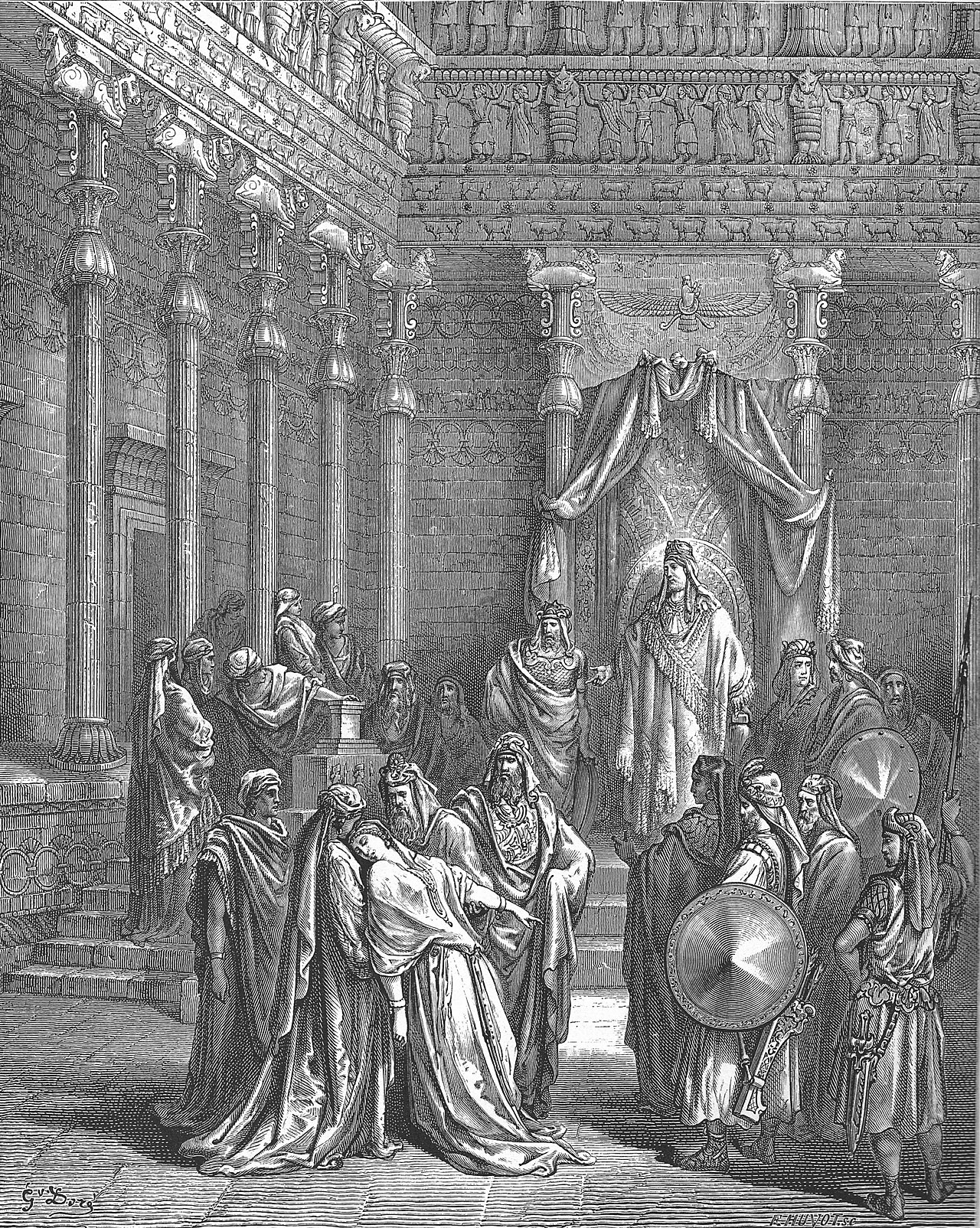
Esther Before the King, Gustave Doré, Doré's English Bible (1866), public domain
Key verse
And Esther answered, If it seem good unto the king, let the king and Haman come this day unto the banquet that I have prepared for him.
It stands in scene A of the chapter, verses 1 to 8.
The chapter
Chapter summary
On the third day Esther puts on her royal apparel and stands in the inner court; the king holds out the golden sceptre and offers her to the half of the kingdom. Her request is only that he and Haman come to a banquet she has prepared. And there, asked again, she asks them back a second time on the morrow. Haman goes out 'joyful and glad of heart' until he sees Mordecai in the king's gate, who neither stands up nor moves. At home he recounts his riches, his many sons, and his private invitations, then undoes it all: 'yet all this availeth me nothing, so long as I see Mordecai the Jew sitting at the king's gate.' Zeresh advises a gallows fifty cubits high, and he builds it.
Context
History · Mordecai · Esther overview
Where the chapter sits
Esther 5 falls in The reversal (chapters 5–7). Esther's two banquets; Haman's gallows and the night the king cannot sleep; Mordecai honoured; Haman hanged on his own gallows.
Before it: The queen and the plot, chapters 1–4. After it: The deliverance and Purim, chapters 8–10.
The whole shape of Esther→The world behind this chapter
Esther 5The history
Everything in the opening scene is protocol. Esther puts on her royal clothing, the visible sign of her office, and stands in the inner court where the king can see her from the throne room. The sceptre is extended, and touching its tip is the accepted gesture of receiving mercy. Only then may she speak.
The rest of the history, and what it meant to them
The king's offer of half the kingdom was a stock royal flourish, not a real transfer of territory; Persian kings were known for extravagant promises made at table. Esther does not take it. She asks for a private meal, then asks for a second one, stretching out an evening in a court where timing was everything.
A Persian 'banquet of wine' was the drinking stage that followed the food, the relaxed hour when business got done. Serving it twice, with the king and only one guest, gave Esther what she needed: a setting in which the king was at ease, Haman was flattered into the open, and one more night could pass before she spoke.
The stake Haman erects is usually pictured as a gallows for hanging, but Persian executions of this kind were impalements, the body raised on a tall pole for public display. Darius's own inscription at Behistun boasts of impaling rebel leaders. Fifty cubits is around seventy-five feet, likely counting the height of the mound or house it stood on; the point is that all Susa was meant to see it.
What it meant to them
Hearers would have followed the two men and enjoyed the contrast. Haman goes home 'joyful and with a glad heart', counts his money, his sons, and his invitations, and then admits that all of it is worth nothing while one man refuses to stand up. That is what the chapter says pride is: never enough, and permanently unsafe.
Meanwhile the queen risks her life and then does something that must have looked like cowardice, she serves dinner and says nothing. The night she buys is the night the story turns.
Sources cited
- Herodotus, The Histories
- Edwin M. Yamauchi, Persia and the Bible
- Flavius Josephus, The Antiquities of the Jews (Whiston translation)
A. The golden sceptre held out, and a banquet prepared
1. (vv. 1-3)
a.put on her royal apparel: The three days of fasting commanded at 4:16 end here, and Esther's approach is exactly the law Mordecai described in the chapter before: uncalled, into the inner court, her life resting on whether the king holds out the sceptre. He does, and she draws near and touches its top before either speaks a further word. The king's offer, to the half of the kingdom, repeats a formula of royal generosity that the commentators read as courtly idiom rather than a literal grant, since he repeats the same words again at 7:2 without ever meaning to divide his kingdom.
Esther 5:1, 3 voicesWhat preachers and commentators have said about this verse, in their own words.
Esther 5:1
“Over against the gate - This is the usual situation of the throne in the “throne-room” of an Oriental palace. The monarch, from his raised position, can see into the court through the doorway opposite to him, which is kept open.”
Esther 5:1
“In such a situation the Persian king was seated. The seat he occupied was not a throne, according to our ideas of one, but simply a chair, and so high that it required a footstool. It was made of gold, or, at least, inlaid with that metal, and covered with splendid tapestry, and no one save the king might sit down on it under pain of death.”
Jamieson, Fausset & Brown· Commentary Critical and Explanatory on the Whole Bible (1871)reformed
Esther 5:1
“When the heart is enlarged in communion with God it will be emboldened in doing and suffering for him. Some think that the three days' fast was only one whole day and two whole nights, in all which time they did not take any food at all, and that this is called three days, as Christ's lying in the grave so long is.”
Matthew Henry· Commentary on the Whole Bible (1707-1721)puritan
Esther 5:2, 3 voices
Esther 5:2
“She obtained favor in his sight - The Septuagint represents “the king as being at first greatly enraged when he saw Esther, because she had dared to appear before him unveiled, and she, perceiving this, was so terrified that she fainted away; on which the king, touched with tenderness, sprung from his throne, took her up in his arms, laid the golden scepter on her neck, and spoke to her in the most endearing manner.” This is more circumstantial than the Hebrew, but is not contrary to it.”
Adam Clarke· Commentary on the Bible (1810-1826)evangelical
Esther 5:2
“On the Khorsabad reliefs the rod is painted red, doubtless to represent gold; proving that "the golden sceptre" was a simple wand of that precious metal, commonly held in the right hand, with one end resting on the ground, and that whether the king was sitting or walking. "The gold sceptre" has received little alteration or modification since ancient times [GOSS].”
Jamieson, Fausset & Brown· Commentary Critical and Explanatory on the Whole Bible (1871)reformed
Esther 5:2
“Held out - In testimony that he pardoned her presumption, and was ready to grant her petition. Touched - In token of her thankful acceptance of the king's favour, and of her reverence and submission.”
John Wesley· Explanatory Notes upon the Old Testament (1765)evangelical
Esther 5:3, 3 voices
Esther 5:3
“It shall be even given thee ... - Xerxes, on another occasion, when pleased with one of his wives, offered to grant her any request whatever, without limitation. Compare the margin reference.”
Esther 5:3
“It shall be given - God in his providence often prevents the fears and outdoes the hopes of his servants. To the half of the kingdom - A proverbial expression: that is, nothing in reason shall be denied.”
John Wesley· Explanatory Notes upon the Old Testament (1765)evangelical
Esther 5:3
“She had a law against her; we have a promise, many a promise, in favour of us: Ask, and it shall be given you. She had no friend to introduce her, or intercede for her, while on the contrary he that was then the king's favourite was her enemy; but we have an advocate with the Father, in whom he is well pleased. Let us therefore come boldly to the throne of grace.”
Matthew Henry· Commentary on the Whole Bible (1707-1721)puritan
2. (vv. 4-5)
a.let the king and Haman come this day unto the banquet that I have prepared for him: Esther's petition is not the request itself but an invitation: she answers the king's offer of half the kingdom with a banquet, the first of two delays before she names her cause. The commentators read the caution as prudence born of the danger she has just walked through rather than indecision. A woman who has staked her life on one audience does not spend it on a first impulse.
Esther 5:4, 2 voices
Esther 5:4
“And Esther answered, if it seem good unto the king,.... She humbly submits it to his pleasure, suggesting it would be exceeding grateful to her, could it be granted: let the king and Haman come this day unto the banquet that I have prepared for him; for the king; and supposing it would be acceptable to him, and the rather engage him to come to it, she invited his favourite; and chiefly, that she might have an opportunity of accusing him before the king to his face, and when alone.”
Esther 5:4
“Let the king and Haman come this day unto the banquet - It was necessary to invite Haman to prevent his suspicion, and that he might not take any hasty step which might have prevented the execution of the great design.”
Adam Clarke· Commentary on the Bible (1810-1826)evangelical
3. (vv. 6-8)
a.at the banquet of wine: the king repeats his offer in full, and Esther defers a second time, asking only for another banquet the next day. The delay is read two ways that need not compete: it is sound statecraft, giving her time to judge Haman's temper and the king's mood, and it is also the room the story needs, since this evening's postponement is what leaves the king with unfinished business the very night that follows.
Esther 5:6, 1 voice
Esther 5:6
“The banquet of wine - After the meats were removed, it was customary in Persia to continue the banquet for a considerable time with fruits and wine. During this part of the feast, the king renewed his offer.”
Esther 5:7, 1 voice
Esther 5:7
“Perhaps her heart failed her now when she was going to make her request, and she desired to take some further time for prayer, that God would give her a mouth and wisdom. The putting of it off thus, it is likely, she knew would be well taken as an expression of the great reverence she had for the king, and her unwillingness to be too pressing upon him.”
Matthew Henry· Commentary on the Whole Bible (1707-1721)puritan
Esther 5:8, 1 voice
Esther 5:8
“I will do to-morrow - She saw she was gaining on the king’s affections; but she was not yet sufficiently confident; and therefore wished another interview, that she might ingratiate herself more fully in the king’s favor, and thus secure the success of her design. But Providence disposed of things thus, to give time for the important event mentioned in the succeeding chapter.”
Adam Clarke· Commentary on the Bible (1810-1826)evangelical
B. All this avails me nothing: a gallows fifty cubits high
1. (v. 9)
a.full of indignation against Mordecai: Haman leaves the banquet joyful, the height of his fortune within reach, and the sight of one man who will not stand nor move undoes it in a moment. Mordecai does nothing at all; he simply keeps sitting, and the stillness accomplishes what no insult could.
Esther 5:9, 1 voice
Esther 5:9
“He stood not up, nor moved for him - This was undoubtedly a serious breach of Persian etiquette, and may well have angered Haman.”
2. (vv. 10-12)
a.Nevertheless Haman refrained himself: Haman restrains himself in the street and empties his heart at home, counting his riches, his many sons, and every mark of promotion above the king's own princes and servants. He closes with the one honor that outranks the rest in his own eyes, being the queen's sole guest besides the king, twice running. The list reads as a man reciting his own greatness in order to persuade himself it is enough.
Esther 5:10, 2 voices
Esther 5:10
“Nevertheless Haman refrained himself,.... From showing any outward resentment to Mordecai, from laying hands upon him or taking revenge on him, as being too much below him to avenge himself on a single person, when the whole body of the people Mordecai belonged to would shortly feel the power of his hand for such insolent treatment of him: and when he came home, he sent and called for his friends, and Zeresh his wife; who, the Targum says, was the daughter of Tatnai, the governor on the other side the river, Ezr 5:3.”
Esther 5:10
“What a struggle had he in his own bosom between his anger, which required Mordecai's death immediately ( O that I had of his flesh! 31 ), and his malice, which had determined to wait for the general massacre! Thus thorns and snares are in the way of the froward.”
Matthew Henry· Commentary on the Whole Bible (1707-1721)puritan
Esther 5:11, 1 voice
Esther 5:11
“The multitude of his children - Herodotus tells us that, next to prowess in arms, it was regarded as the greatest proof of manly excellence in Persia to be the father of many sons.” Haman had ten sons (see the margin reference).”
Esther 5:12, 2 voices
Esther 5:12
“Am I - Thus he makes that matter of glorying which was the occasion of his utter ruin. So ignorant are the wisest men, and subject to fatal mistakes, rejoicing when they have most cause of fear, and sorrowing for those things which tend to joy and comfort.”
John Wesley· Explanatory Notes upon the Old Testament (1765)evangelical
Esther 5:12
“Note, Self-admirers and self-flatterers are really self-deceivers. Haman pleased himself with the fancy that the queen, by this repeated invitation, designed to honour him, whereas really she designed to accuse him, and, in calling him to the banquet, did but call him to the bar.”
Matthew Henry· Commentary on the Whole Bible (1707-1721)puritan
3. (v. 13)
a.so long as I see Mordecai the Jew sitting at the king’s gate: Yet all this availeth me nothing, so long as I see Mordecai the Jew sitting at the king's gate: one verse holds the whole anatomy of resentment, where every honor Haman owns is cancelled by the one man who withholds the single thing he cannot buy. Wealth, promotion and a queen's favor cannot outweigh one unbending posture at a gate he cannot avoid passing.
Esther 5:13, 1 voice
Esther 5:13
“Yet all this availeth me nothing - Pride will ever render its possessor unhappy. He has such a high opinion of his own worth, that he conceives himself defrauded by every one who does not pay him all the respect and homage which he conceives to be his due. The soul was made for God, and nothing but God can fill it and make it happy. Angels could not be happy in glory, when they had cast off their allegiance to their Maker.”
Adam Clarke· Commentary on the Bible (1810-1826)evangelical
4. (v. 14)
a.Let a gallows be made of fifty cubits high: Zeresh and Haman's friends supply the instrument: a gallows fifty cubits high, built that same night, so the morning needs only the king's word. Haman builds the reversal engine with his own hands before the narrator turns it against him, and the chapter ends with the means of his fall already standing in his own courtyard.
Esther 5:14, 1 voice
Esther 5:14
“Let a gallows be made of fifty cubits high - The word עץ ets, which we translate gallows, signifies simply wood, a tree, or pole; and this was to be seventy-five feet high, that he might suffer the greater ignominy, and be a more public spectacle. I believe impaling is here also meant. See the note, Est 2:23 (note).”
Adam Clarke· Commentary on the Bible (1810-1826)evangelical
The text of this chapter
This page carries no textual note on Esther 5. Where this site has examined a place the manuscripts differ, the examination is in the manuscripts room. Every place this site examines →
This page draws on 9 works. Open for the list.
This page draws on Adam Clarke; Albert Barnes, Notes, Explanatory and Practical, on the Old and New Testaments (1832-1869); Jamieson Fausset and Brown, Commentary Critical and Explanatory on the Whole Bible; Jamieson, Fausset & Brown, Commentary Critical and Explanatory on the Whole Bible (1871); John Gill; John Wesley; Keil, The Books of Ezra, Nehemiah, and Esther; Matthew Henry and W. F. Adeney, Ezra, Nehemiah and Esther (Expositor's Bible).
Keep studying
On this page