
Esther 5:3
in Esther 5“What is it, Queen Esther?” the king inquired. “What is your request? Even up to half the kingdom, it will be given to you.”
BSB
The same verse in ASV and KJV ▾
ASV
Then said the king unto her, What wilt thou, queen Esther? and what is thy request? it shall be given thee even to the half of the kingdom.
KJV
Then said the king unto her, What wilt thou, queen Esther? and what is thy request? it shall be even given thee to the half of the kingdom.
⋯
This verse in Esther 5
Commentary
9 notes on this verseA commentator
Albert Barnes1798–1870
Notes, Explanatory and Practical, on the Old and New Testaments (1832-1869)
It shall be even given thee ... - Xerxes, on another occasion, when pleased with one of his wives, offered to grant her any request whatever, without limitation. Compare the margin reference.
This site's exposition
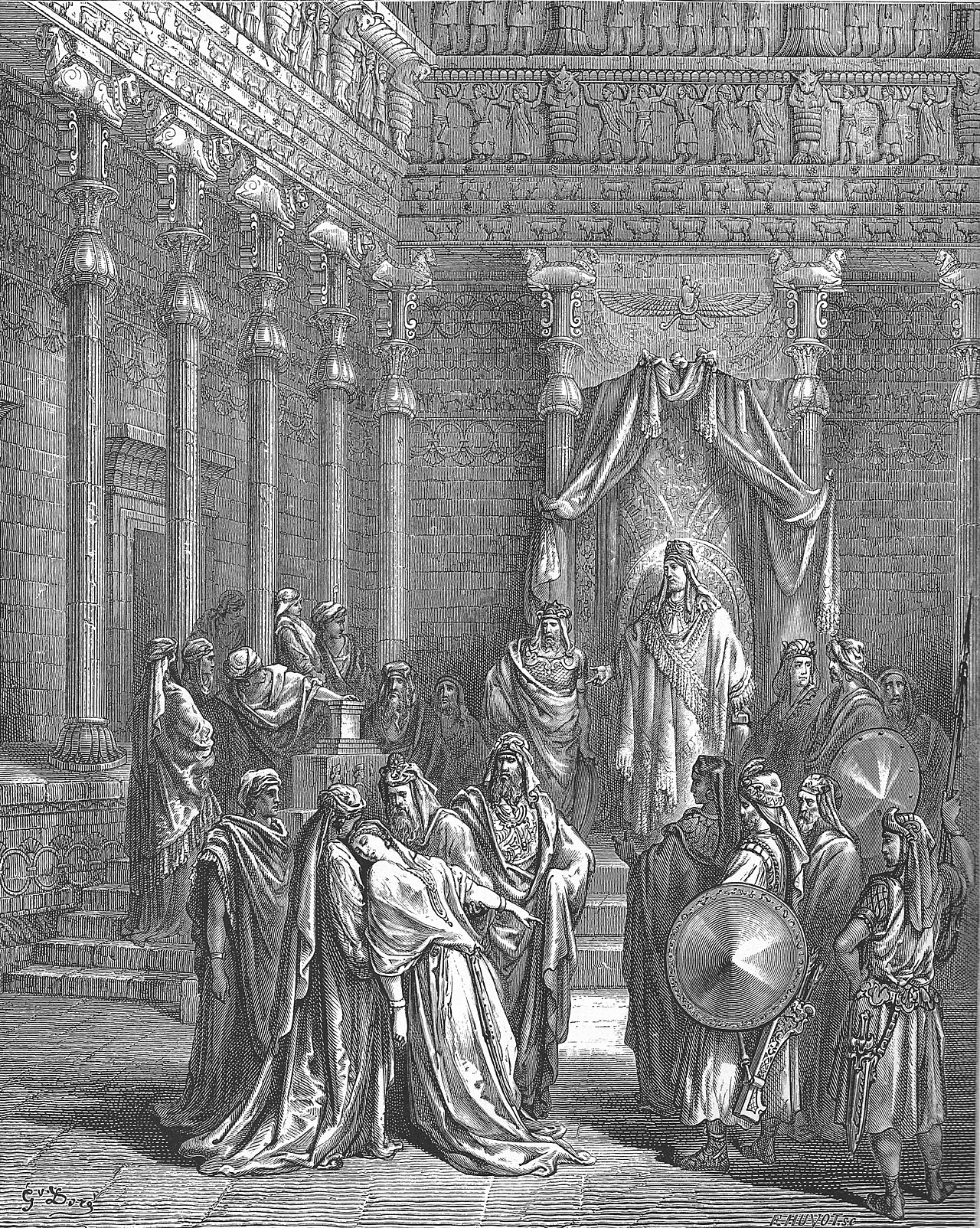
Esther put on her royal attire
on Esther 5:1-3
The three days of fasting commanded at 4:16 end here. Esther goes uncalled into the inner court, her life resting on whether the king extends the scepter. The king's offer, "Even up to half the kingdom," is read as courtly idiom, since he repeats the same words at 7:2.
This site's exposition
“What is it, Queen Esther?” the king
The offer follows a Persian custom, which Jamieson, Fausset and Brown trace to royal favorites given whole cities for their bread, wine and clothing. Barnes records that Xerxes once offered one of his wives any request at all. The king saw that Esther had come with a request.
The record, by era
The Medieval Church2 voices
And with regard to her petition, the king answered that he would listen to it, as it is said in the gospel as well, "Ask, and it will be given you; seek and you will find; knock, and the door will be opened for you." …
And the king himself pledges that he will agree to her request, just as he says in the Gospel: "Ask and it shall be given to you; seek and you shall find; knock and it shall be opened to you" (Matthew 7). And likewise: "Seek …
The Puritans and the Awakening3 voices
It shall be given - God in his providence often prevents the fears and outdoes the hopes of his servants. To the half of the kingdom - A proverbial expression: that is, nothing in reason shall be denied.
She had a law against her; we have a promise, many a promise, in favour of us: Ask, and it shall be given you. She had no friend to introduce her, or intercede for her, while on the contrary he that was then the king's favourite was her enemy; but we have an advocate with the Father, in whom he is well pleased. Let us therefore come boldly to the throne of grace.
Then said the king unto her, what wilt thou, Queen Esther?....
1 more voice on this verse
The Nineteenth Century1 voice
A commentator
Jamieson, Fausset & Brown1802–1910
Commentary Critical and Explanatory on the Whole Bible (1871)
proposed
it shall be even given thee to the half of the kingdom--This mode of speaking originated in the Persian custom of appropriating for the maintenance of great men, or royal favorites, one city for his bread, another for his wine, a third for his clothes, &c., so that the phrase denoted great liberality.
quarantine:debris (2026-07-29) — starts-lowercase
How the passage was read
What the Jewish commentators add
Up until half the empire. A thing that is in the middle and at the halfway mark of the empire; that is, the Beis Hamikdosh, which they started to build in the days of Koresh, and he reneged and commanded to discontinue the work. 3 See Maseches Megillah 15b.
1 more on this passage, in their own words ▾
Let his majesty and Haman attend. Our Rabbis listed many reasons for the matter. 4 Ibid. What did Esther see [i.e., what motivated her] to invite Haman?
This section is reception history: how the passage was read and kept in the Jewish tradition. Where a reading parts from an essential of the Christian faith, the section says so at that point.
Texts and citation data: Sefaria; each excerpt follows its version’s licence. 5 further sources are cited on this chapter that carry no English text this site may quote or only restate the verse.
The words behind it
14 Hebrew wordsEvery Hebrew word of this verse in the order it stands, with what it means and the door to its own study. The last column counts the times a word stands in the whole Bible: the rarer the word, the more the places it appears belong together.
| Hebrew | Sound | Meaning | Word study | In the Bible |
|---|---|---|---|---|
| וַיֹּ֤אמֶר | vaiyomer | and he said | H559 → | 5305 times |
| לָהּ֙ | lah | to her | ||
| הַמֶּ֔לֶךְ | hamelekh | the king | H4428 → | 2525 times |
| מַה־ | mah- | what? | H4100 → | 752 times |
| לָּ֖ךְ | lakh | [is] to you | ||
| אֶסְתֵּ֣ר | ʾester | O Esther | H635 → | 55 times |
| הַמַּלְכָּ֑ה | hamalkah | the queen | H4436 → | 35 times |
| וּמַה־ | umah- | and what? | H4100 → | 752 times |
| בַּקָּשָׁתֵ֛ךְ | bakashatekh | [is] request your | H1246 → | 8 times |
| עַד־ | ʾad- | up to | H5704 → | 1261 times |
| חֲצִ֥י | chatzi | <the> half of | H2677 → | 125 times |
| הַמַּלְכ֖וּת | hamalkhut | the kingdom | H4438 → | 91 times |
| וְיִנָּ֥תֵֽן | veyinaten | so it may be given | H5414 → | 2011 times |
| לָֽךְ׃ | lakh | to you |
וַיֹּ֤אמֶרand he said
vaiyomerH559 →5305 times
לָהּ֙to her
lah
הַמֶּ֔לֶךְthe king
hamelekhH4428 →2525 times
מַה־what?
mah-H4100 →752 times
לָּ֖ךְ[is] to you
lakh
אֶסְתֵּ֣רO Esther
ʾesterH635 →55 times
הַמַּלְכָּ֑הthe queen
hamalkahH4436 →35 times
וּמַה־and what?
umah-H4100 →752 times
בַּקָּשָׁתֵ֛ךְ[is] request your
bakashatekhH1246 →8 times
עַד־up to
ʾad-H5704 →1261 times
חֲצִ֥י<the> half of
chatziH2677 →125 times
הַמַּלְכ֖וּתthe kingdom
hamalkhutH4438 →91 times
וְיִנָּ֥תֵֽןso it may be given
veyinatenH5414 →2011 times
לָֽךְ׃to you
lakh
A shaded row is a word that stands 400 times or fewer in the Bible.
The walk
8 stopsEach card is a verse this one points to, and under it the verses that one points to in turn. Where several paths arrive at the same place, that place is listed first: the text keeps returning to it.
Through
Mark 6:23And he swore to her, “Whatever you ask of me, I will give you, up to half my kingdom!”
it leads to
- Esther 7:2
and as they drank their wine on that second day, the king asked once more, “Queen Esther, what is your petition? It will be given to you. What is your request? Even up to…
Reached by 3 separate paths from here.
- Esther 7:2
Through
1 Kings 3:5One night at Gibeon the LORD appeared to Solomon in a dream, and God said, “Ask, and I will give it to you!”
it leads to
- 1 Kings 9:2
the LORD appeared to him a second time, as He had appeared to him at Gibeon.
- James 1:5–6
Now if any of you lacks wisdom, he should ask God, who gives generously to all without finding fault, and it will be given to him.
- 2 Chronicles 1:7–12
That night God appeared to Solomon and said, “Ask, and I will give it to you!”
- Numbers 12:6
He said, “Hear now My words: If there is a prophet among you, I, the LORD, will reveal Myself to him in a vision; I will speak to him in a dream.
- John 14:13–14
And I will do whatever you ask in My name, so that the Father may be glorified in the Son.
- 1 Kings 9:2
Through
Esther 9:12who said to Queen Esther, “In the citadel of Susa the Jews have killed and destroyed five hundred men, including Haman’s ten sons. What have they done in the rest of the royal provinces?…
it leads to
- Esther 5:6
And as they drank their wine, the king said to Esther, “What is your petition? It will be given to you. What is your request? Even up to half the kingdom, it will be…
Reached by 3 separate paths from here.
- Esther 5:6
Through
Esther 5:6And as they drank their wine, the king said to Esther, “What is your petition? It will be given to you. What is your request? Even up to half the kingdom, it will be…
it leads to
- Esther 9:12
who said to Queen Esther, “In the citadel of Susa the Jews have killed and destroyed five hundred men, including Haman’s ten sons. What have they done in the rest of the royal provinces?…
Reached by 2 separate paths from here.
- Esther 9:12
Where this verse is studied
On this page
About Esther
Who and where
1 name in this verse with a page on the site.
This page draws on 9 works. Open the list of works
This page draws on Albert Barnes, Notes, Explanatory and Practical, on the Old and New Testaments (1832-1869); Jamieson Fausset and Brown, Commentary Critical and Explanatory on the Whole Bible; Jamieson, Fausset & Brown, Commentary Critical and Explanatory on the Whole Bible; John Gill, Exposition of the Old Testament (1748-1763); John Wesley, Explanatory Notes upon the Old Testament; Keil, The Books of Ezra, Nehemiah, and Esther; Matthew Henry, Commentary on the Whole Bible; Rabanus Maurus, EXPLANATION ON THE BOOK OF ESTHER 8 and Rabanus Maurus, Commentary on Esther.