
Esther 5:4
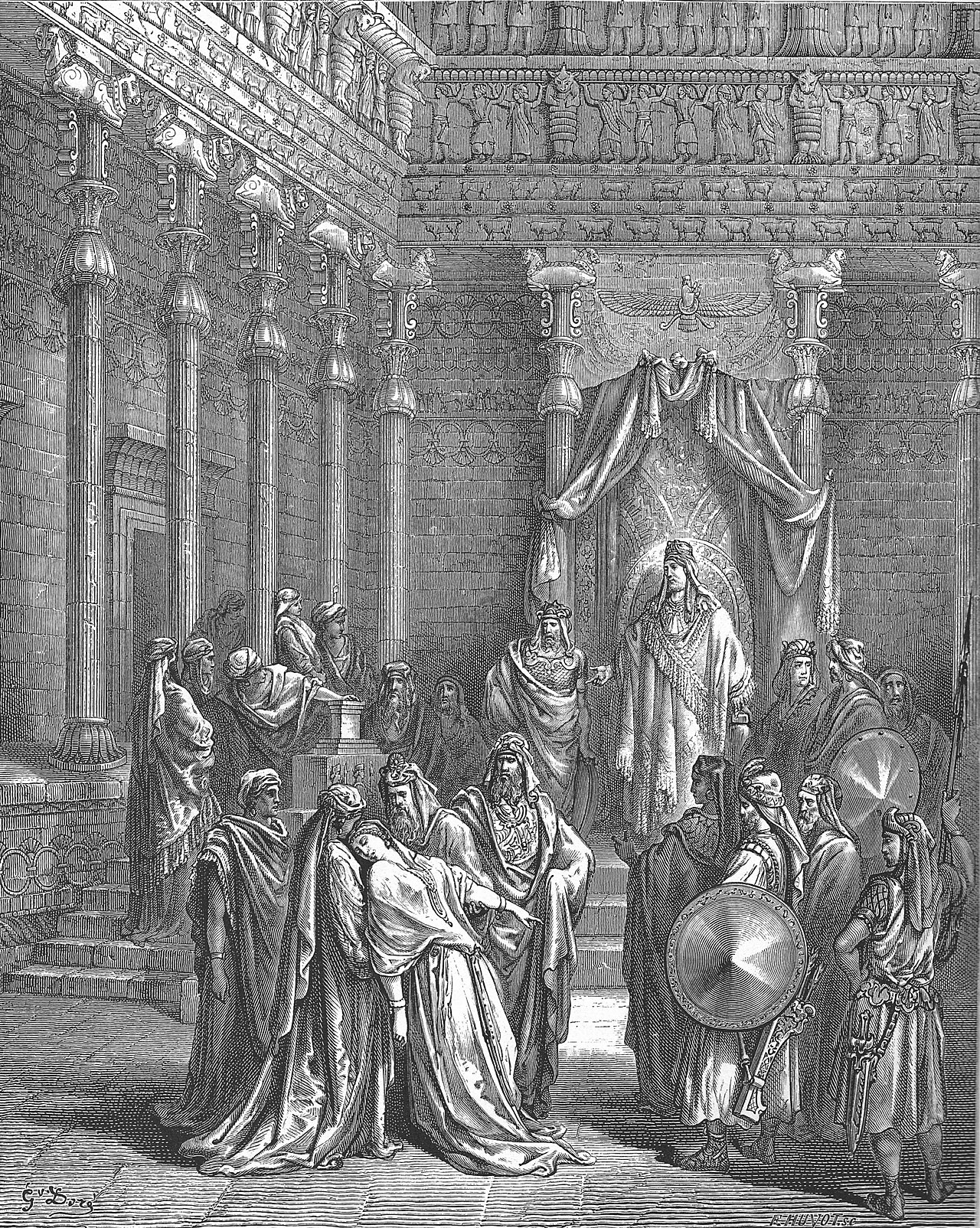
in Esther 5“If it pleases the king,” Esther replied, “may the king and Haman come today to the banquet I have prepared for the king.”
BSB
The same verse in ASV and KJV ▾
ASV
And Esther said, If it seem good unto the king, let the king and Haman come this day unto the banquet that I have prepared for him.
KJV
And Esther answered, If it seem good unto the king, let the king and Haman come this day unto the banquet that I have prepared for him.
⋯
This verse in Esther 5
Commentary
4 notes on this verseAnd Esther answered, if it seem good unto the king,.... She humbly submits it to his pleasure, suggesting it would be exceeding grateful to her, could it be granted: let the king and Haman come this day unto the banquet that I have prepared for him; for the king; and supposing it would be acceptable to him, and the rather engage him to come to it, she invited his favourite; and chiefly, that she might have an opportunity of accusing him before the king to his face, and when alone.
This site's exposition
let the king and Haman come this day unto the banquet that I have prepared for him
on Esther 5:4-5
Esther's petition is not the request itself but an invitation: she answers the king's offer of half the kingdom with a banquet, the first of two delays before she names her cause. The commentators read the caution as prudence born of the danger she has just walked through rather than indecision. A woman who has staked her life on one audience does not spend it on a first impulse.
The record, by era
The Puritans and the Awakening1 voice
on Esther 5:4-5
(5.) She hoped at the banquet of wine to have a fairer and more favourable opportunity of presenting her petition. Wisdom is profitable to direct how to manage some men that are hard to deal with, and to take them by the right handle.
The Nineteenth Century1 voice
Let the king and Haman come this day unto the banquet - It was necessary to invite Haman to prevent his suspicion, and that he might not take any hasty step which might have prevented the execution of the great design.
How the passage was read
What the Jewish commentators add
Let his majesty and Haman attend. Our Rabbis listed many reasons for the matter. 4 Ibid. What did Esther see [i.e., what motivated her] to invite Haman?
1 more on this passage, in their own words ▾
Up until half the empire. A thing that is in the middle and at the halfway mark of the empire; that is, the Beis Hamikdosh, which they started to build in the days of Koresh, and he reneged and commanded to discontinue the work. 3 See Maseches Megillah 15b.
This section is reception history: how the passage was read and kept in the Jewish tradition. Where a reading parts from an essential of the Christian faith, the section says so at that point.
Texts and citation data: Sefaria; each excerpt follows its version’s licence. 5 further sources are cited on this chapter that carry no English text this site may quote or only restate the verse.
The words behind it
15 Hebrew wordsEvery Hebrew word of this verse in the order it stands, with what it means and the door to its own study. The last column counts the times a word stands in the whole Bible: the rarer the word, the more the places it appears belong together.
| Hebrew | Sound | Meaning | Word study | In the Bible |
|---|---|---|---|---|
| וַתֹּ֣אמֶר | vatomer | and she said | H559 → | 5305 times |
| אֶסְתֵּ֔ר | ʾester | Esther | H635 → | 55 times |
| אִם־ | ʾim- | if | H518 → | 1069 times |
| עַל־ | ʾal- | [is] on | H5921 → | 5755 times |
| הַמֶּ֖לֶךְ | hamelekh | the king | H4428 → | 2525 times |
| ט֑וֹב | tov | good | H2896 → | 538 times |
| יָב֨וֹא | yavo' | let him come | H935 → | 2568 times |
| הַמֶּ֤לֶךְ | hamelekh | the king | H4428 → | 2525 times |
| וְהָמָן֙ | vehaman | and Haman | H2001 → | 54 times |
| הַיּ֔וֹם | haiyom | this day | H3117 → | 2304 times |
| אֶל־ | ʾel- | to | H413 → | 5510 times |
| הַמִּשְׁתֶּ֖ה | hamishteh | the feast | H4960 → | 46 times |
| אֲשֶׁר־ | ʾasher- | which | H834 → | 5497 times |
| עָשִׂ֥יתִי | ʾasiti | I have made | H6213 → | 2628 times |
| לֽוֹ׃ | lo | for him |
וַתֹּ֣אמֶרand she said
vatomerH559 →5305 times
אֶסְתֵּ֔רEsther
ʾesterH635 →55 times
אִם־if
ʾim-H518 →1069 times
עַל־[is] on
ʾal-H5921 →5755 times
הַמֶּ֖לֶךְthe king
hamelekhH4428 →2525 times
ט֑וֹבgood
tovH2896 →538 times
יָב֨וֹאlet him come
yavo'H935 →2568 times
הַמֶּ֤לֶךְthe king
hamelekhH4428 →2525 times
וְהָמָן֙and Haman
vehamanH2001 →54 times
הַיּ֔וֹםthis day
haiyomH3117 →2304 times
אֶל־to
ʾel-H413 →5510 times
הַמִּשְׁתֶּ֖הthe feast
hamishtehH4960 →46 times
אֲשֶׁר־which
ʾasher-H834 →5497 times
עָשִׂ֥יתִיI have made
ʾasitiH6213 →2628 times
לֽוֹ׃for him
lo
A shaded row is a word that stands 400 times or fewer in the Bible.
The walk
8 stopsEach card is a verse this one points to, and under it the verses that one points to in turn. Where several paths arrive at the same place, that place is listed first: the text keeps returning to it.
Through
Proverbs 29:11A fool vents all his anger, but a wise man holds it back.
it leads to
- Proverbs 19:11
A man’s insight gives him patience, and his virtue is to overlook an offense.
- Proverbs 12:16
A fool’s anger is known at once, but a prudent man overlooks an insult.
- Micah 7:5
Do not rely on a friend; do not trust in a companion. Seal the doors of your mouth from her who lies in your arms.
- Proverbs 19:11
Through
1 Corinthians 14:20Brothers, stop thinking like children. In regard to evil be infants, but in your thinking be mature.
it leads to
- 1 Peter 2:2
Like newborn babies, crave pure spiritual milk, so that by it you may grow up in your salvation,
- 1 Corinthians 13:11
When I was a child, I talked like a child, I thought like a child, I reasoned like a child. When I became a man, I set aside childish ways.
- Romans 16:19
Everyone has heard about your obedience, so I rejoice over you. But I want you to be wise about what is good and innocent about what is evil.
- Matthew 18:3
“Truly I tell you,” He said, “unless you change and become like little children, you will never enter the kingdom of heaven.
- 1 Peter 2:2
Through
Psalms 112:5It is well with the man who is generous and lends freely, whose affairs are guided by justice.
it leads to
- Psalms 37:21
The wicked borrow and do not repay, but the righteous are gracious and giving.
- Psalms 37:21
Where this verse is studied
On this page
Studies1
What the record shows
1 entry◈The YHWH acrostics in Esthercontested
E. W. Bullinger (The Companion Bible, Appendix 60) finds the initial and final letters of four phrases spelling YHWH, forwards and backwards, in Esther — a book that never names God. The letters are where he says they are; the selection of which four phrases, out of thousands, is what fails. It is acrostic-adjacent rather than gematria proper, and it is not demonstrable.
The case against it
The letters are where Bullinger says they are; the selection is what fails. Esther offers thousands of windows of four consecutive words, and the four that yield יהוה were chosen out of that pool after the fact, with the searcher free to accept either initial or final letters and either reading direction. How often four consecutive Hebrew words happen to begin or end with yod, he, vav, he is exactly the quantity a control test would measure, and no one has measured it. Note also that it is acrostic-adjacent rather than gematria proper - no letter-values are involved. Classify as a speculative observation, charming and unprovable, and say so (E. W. Bullinger, The Companion Bible, Appendix 60, public domain).
About Esther
Who and where
1 name in this verse with a page on the site.
This page draws on Adam Clarke, Commentary on the Bible; John Gill, Exposition of the Old Testament (1748-1763) and Matthew Henry, Commentary on the Whole Bible.