
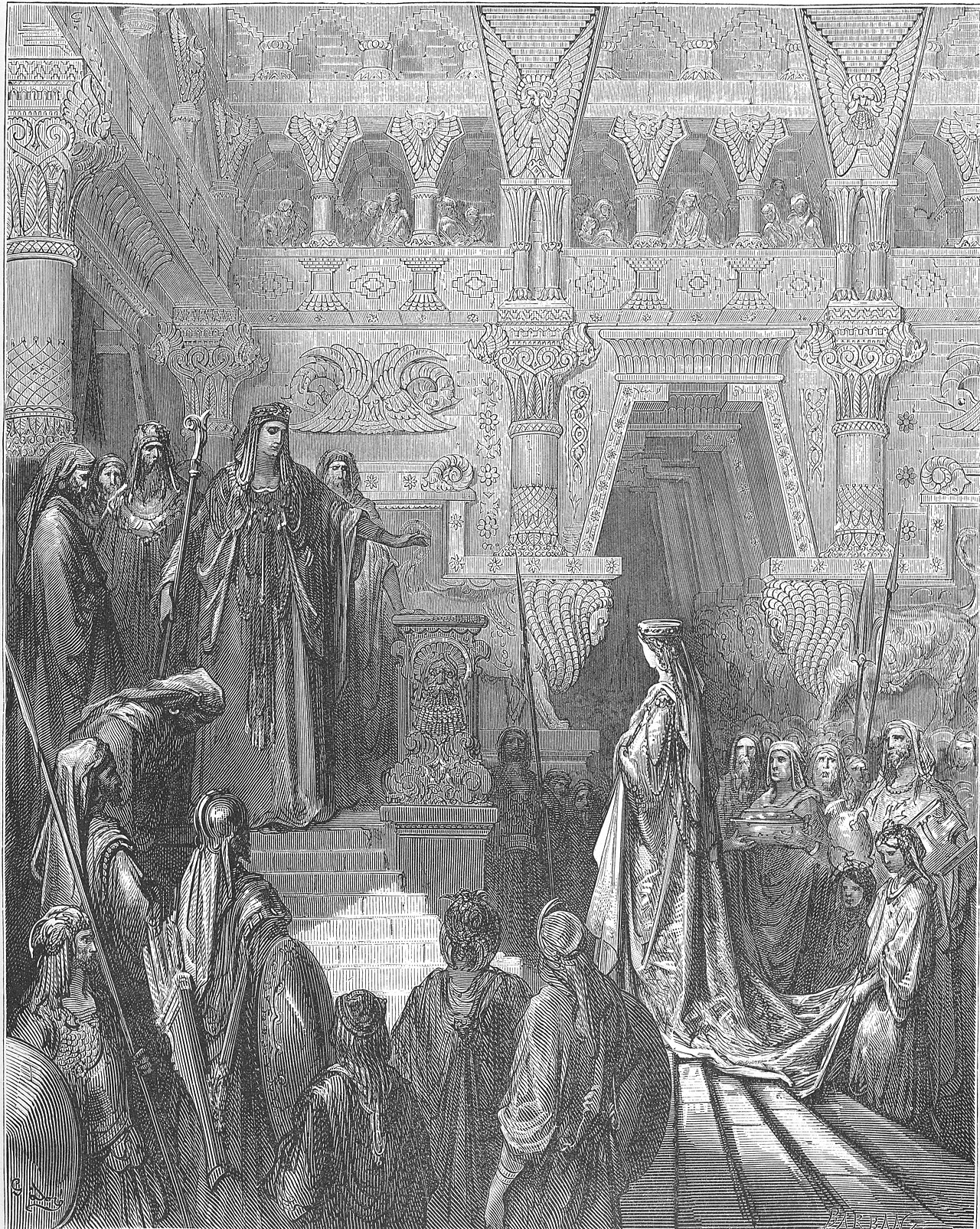
1 Kingschapter 10
29 verses · Jeremiah, by tradition · 6th century BC · History
And Solomon gathered together chariots and horsemen: and he had a thousand and four hundred chariots, and twelve thousand horsemen, whom he bestowed in the cities for chariots, and with the king at Jerusalem.
Introduction
Jeremiah, by tradition, History, 1 Kings Overview.
The historian writes this chapter for a people living under empires, who remembered a time when the nations came to them. It records a state visit from a distant queen and a list of the king's wealth. Its first hearers knew the incense road that ran north from Arabia and the worth of gold, ivory and horses. Listen for what the visitor says about the God of Israel. Then weigh the list of gold, chariots and horses against the law of the king that the hearers also knew. The chapter shows the reign at its brightest.
Context
- Who
- Israelites who had never seen their nation courted by the world
- What
- The visit of the queen of Sheba to test Solomon's wisdom, her blessing of the LORD, and a record of the king's gold, throne, fleet, chariots and horse trade.
- Where
- The court in Jerusalem, reached by caravan from Sheba in southern Arabia, with fleets from Ezion-geber and a horse trade with Egypt and Kue.
- When
- Late in Solomon's reign, about 945 BC on the standard chronology, before the turning of chapter 11.
- Why
- To show the nations drawn to Israel by the wisdom the LORD gave its king, and to set down the full measure of Solomon's wealth.
Historical context
The chapter belongs to Solomon at his height and to the queen of Sheba, a reigning monarch who travels to test him.
Show the rest of the historical context, 4 more paragraphs
The time is about 945 BC, late in the reign and before the turning recorded in the next chapter.
The place is the court in Jerusalem, and the roads and sea lanes that reach it. Sheba lay in what is now Yemen, at the far end of the incense road, and camel caravans carried frankincense and myrrh fifteen hundred miles north to the markets of Egypt, Syria and Mesopotamia.
The occasion is a state visit with trade behind it. That road ran past Israel's new Red Sea port, so the queen arrives as a trading power meeting a competitor who has just put ships in her waters.
A first hearer knew the customs the scene runs on. Testing a foreign king with hard questions was recognised diplomacy, and riddling contests between courts appear across the literature of the region as a measure of a court's competence. He knew a hundred and twenty talents of gold with spices was a state-level payment rather than a gift. He knew what an ivory throne overlaid with gold meant, and carved ivory furniture inlays from this period have since been excavated at Samaria and at Assyrian sites. He also knew where the money came from. Chariot horses out of Egypt and out of Kue, in what is now southern Turkey, were bought at a fixed price and resold north to the kings of the Hittites and of Aram.
Significance
The queen's speech is the point of the chapter for the first hearers. A foreign monarch says the half was not told her, and then blesses the God of Israel for setting this king on the throne to do judgment and justice.
Show the rest of the significance, 1 more paragraph
That was what Israel among the nations was for, a people so visibly governed that outsiders came to look and went home speaking of their God. The next chapter shows how quickly it can go the other way.
This chapter in Jewish lifeWhat this chapter is in Jewish life and reading.
How it is read
Rashi is quoted here from the Metsudah Tanach series of Lakewood, New Jersey, which Sefaria reports as CC-BY. The thing that took the queen of Sheba's breath away is read in two ways, and the corpus carries both. Rashi takes the last item in her list as a covered way Solomon had built from his house up to the temple, and reads the verse as her seeing him go up by it. The translation sets the Targum beside him, which takes the same words as the offerings Solomon brought in the house (Rashi on I Kings 10:5:1). On the same word later in the chapter, where the almug wood is worked, Rashi compares the reading in Chronicles and settles on a paved way (Rashi on I Kings 10:12:1).
What Solomon gave the queen in return is narrowed sharply. Rashi says the giving of the text refers only to the teaching of wisdom (Rashi on I Kings 10:13:1). That is the classical Jewish answer to a verse Christian readers have often filled in for themselves, and it is the plain reading the corpus carries.
The gold figure is the place a reader sees the classical method working in the open. Rashi adds up the named sources of Solomon's gold and reaches six hundred and sixty. Then he writes that he does not know where the remaining six came from. He goes on to test the total against the figures in Chronicles and proposes a way of squaring them. Thirty of Hiram's talents were counted with the gold from Ophir, since Hiram's servants sailed there with Solomon's (Rashi on I Kings 10:14:1). The commentator states the gap before he offers the repair.
The rest of the wealth is read as craft and as value. The traders who brought the extra gold Rashi takes as merchants visiting the land on business. The translation notes Metzudat Zion with a second sense of the word, of retailers who look the land over to find where to trade (Rashi on I Kings 10:15:1). The large shields he describes as body shields wrapping a man on three sides, and he ties the picture to the last verse of the fifth psalm (Rashi on I Kings 10:16:1). The beaten gold is soft and easy to spread (Rashi on I Kings 10:17:1). The overlay of the throne sparkles like pearls (Rashi on I Kings 10:18:1). The throne itself is read from its steps and its round top, where the king sits (Rashi on I Kings 10:19:1). The silver is explained by its worth rather than by its absence, since silver counted for nothing in those days (Rashi on I Kings 10:21:1). The ships of Tarshish he gives from the Targum as ships of Africa (Rashi on I Kings 10:22:1). Eleven further notes stand in the corpus without an English text and are cited and unquoted. Metzudat David stands at Metzudat David on I Kings 10:2:1, 10:3:1, 10:7:1, 10:9:1, 10:20:1 and 10:24:1. Malbim stands at 10:4:1, 10:6:1, 10:8:1 and 10:23:1, and Radak at Radak on I Kings 10:1:1.
What the rabbis say
The corpus carries forty rabbinic locators on this chapter and the text of none, so each is cited and linked here rather than quoted. The queen's coming draws three on the first verse. The corpus holds Kohelet Rabbah 2:8:1, Midrash Mishlei 1:1 and Shemot Rabbah 27:4. Her hard questions draw Shir HaShirim Rabbah 8:13:1 on the second. Her word about the happiness of Solomon's servants draws three on the eighth, at Kohelet Rabbah 1:1:2, Midrash Tehillim 72:1 and Otzar Midrashim, Baraita of Rabbi Pinchas Ben Yair 1:21. Her blessing of the LORD draws Midrash Mishlei 14:3 on the ninth.
Her gifts and the almug wood carry the next set. On the tenth verse the corpus holds Jerusalem Talmud Yoma 4:4:5 and Shir HaShirim Rabbah 4:12:2. On the eleventh it holds Yoma 44b:17 and Bamidbar Rabbah 13:14, and on the twelfth Pesikta Rabbati 33:1.
The gold of the house draws the heaviest weight in the chapter. On the sixteenth verse the corpus holds Chullin 30b:14 with Ein Yaakov, Khullin 2:2, Sifra, Tzav, Section 5 3, and a passage of Otzar Midrashim on the canopies of Elijah at 4. On the seventeenth it holds Yoma 39b:8, Kohelet Rabbah 2:6:1 and Ein Yaakov (Glick Edition), Yoma 4:3. On the eighteenth it holds Esther Rabbah 1:12, Kohelet Rabbah 2:4:1, Midrash Lekach Tov, Leviticus 1:1:1 and Midrash Tehillim 45:6.
The throne draws four on the nineteenth verse, which is the seat the tradition returns to most often. The corpus holds Devarim Rabbah 5:6, Pesikta DeRav Kahana 1:7, and Midrash Tanchuma at Vaetchanan 1:1 with the Buber recension at the same place. The vessels of gold draw four on the twenty-first, at Ein Yaakov, Sanhedrin 2:13, the Glick Edition at Sanhedrin 2:11, Esther Rabbah 2:10 and Jerusalem Talmud Sanhedrin 2:6:6.
The trade closes the chapter. On the twenty-fifth verse the corpus holds Pirkei DeRabbi Eliezer 11:14, and on the twenty-sixth Shir HaShirim Rabbah 1:1:10. On the twenty-seventh, where silver is made as common as stones, it holds Aggadat Bereshit 76:2, Bamidbar Rabbah 10:3, Devarim Rabbah 1:5 and Ein Yaakov (Glick Edition), Pesakhim 4:5. On the twenty-ninth, the horses brought out of Egypt, it holds Sanhedrin 21b:17 and Ein Yaakov (Glick Edition), Sanhedrin 2:12. That last verse is where the law about a king multiplying horses meets the account, and the tradition reads the two together. What each of them teaches is a saying of the rabbis, and this site reports it as theirs. The quotations wait on a fetch that carries the text.
Sources: Rashi, Rashi on I Kings 10:5:1 to 10:25:1, the Metsudah Tanach series, Lakewood, N.J, reported CC-BY; Metzudat David, Metzudat David on I Kings 10:2:1 to 10:24:1, cited by ref because Sefaria holds no English version; Malbim, Malbim on I Kings 10:4:1, 10:6:1, 10:8:1 and 10:23:1, cited by ref because Sefaria holds no English version; Radak, Radak on I Kings 10:1:1, cited by ref because Sefaria holds no English version; Metzudat Zion, noted at Rashi on I Kings 10:15:1 by the Metsudah translation; Targum Jonathan, cited by Rashi at Rashi on I Kings 10:5:1 and 10:22:1; The Sefaria corpus on disk, scripts/data/sources/sefaria/1-kings/10.json, fetched 2026-09-19, the forty Midrash and Talmud locators cited above, 2026.
The heads below are this chapter's scenes. The numbered points under each are its verses.
The queen of Sheba: there was no more spirit in her
1 Kings 10:1-3
she came to prove him with hard questions: The queen of Sheba travels from southern Arabia to test Solomon's wisdom with hard questions, and Jesus names her the queen of the south at Matt 12:42 and Luke 11:31, rising in judgment against a generation that refuses one greater than Solomon. Solomon answers every question she brings; there is not any thing hid from the king which he told her not. Her hard questions were likely riddles and matters of state as much as philosophy, the kind ancient Near Eastern courts traded to test a ruler's mind.
1 Kings 10:1
“And when the queen of Sheba heard of the fame of Solomon,.... Josephus (u) calls her a queen of Egypt and Ethiopia; but Sheba was in the southern part of Arabia Felix; her name with the Ethiopians is Maqueda (w), and with the Arabic geographer (x) Belequis.”
1 more voice on this verseWhat preachers and commentators have said about this verse, in their own words.
1 Kings 10:1
“Therefore does our Saviour mention her enquiries after God, by Solomon, as an aggravation of the stupidity of those who enquire not after God by our Lord Jesus Christ, though he, having lain in his bosom, was much better able to instruct them.”
Matthew Henry · Commentary on the Whole Bible (1707-1721)puritan
Adam Clarke places the queen of Sheba among the Sabaeans of southern Arabia, a people rich in spices and gold. Bede links her to the Ethiopian queens of Acts 8:27. Charles Spurgeon preached on her opening her whole heart to the king.
Adam Clarke sets her questions among the riddles and fables prized in the East, the kind Samson put to his wedding guests at Judges 14:12 to 14. Matthew Henry reads them as questions asked to learn. Solomon made plain what she had thought too difficult to explain.
1 Kings 10:3
“Solomon told her all her questions - Riddles, problems, fables, apologues, etc., formed the principal part of the wisdom of the East; indeed they use and delight in them to the present day. See the case of Samson and his friends, Jdg 14:12 (note), Jdg 14:14 (note), and the notes there.”
Adam Clarke · Commentary on the Bible (1810-1826)evangelical
1 Kings 10:4-7
the house that he had built: She has already heard the fame; now she sees a whole working court, the table, the servants seated, the ministers attending, the cupbearers' array, and the ascent by which Solomon went up to the house of the Lord, and it leaves her with no more spirit in her, an idiom for astonishment past words. Her own verdict follows at verse 7, the half was not told me, admitting that report, however true, could not carry what sight did. Order, not oratory, is what finally overwhelms her, an entire household running in wisdom.
1 Kings 10:4
“And when the queen of Sheba had seen all Solomon's wisdom,.... Which she perceived by his answers to things relative to all sorts of science, natural, civil, and divine: and the house that he had built; the singular for the plural, "house for houses"; the house of the Lord, his own house, that for Pharaoh's daughter, and the house of the forest of Lebanon; in all which there appeared not only surprising grandeur and magnificence, but exquisite art and skill; there was a great display of his wisdom in the form and contrivance of them.”
The Hebrew word here can mean his ascent or his burnt offerings, and the Berean takes the second. Adam Clarke thought a stairway an odd sight to list. Ishodad of Merv held that Solomon dressed his servants by rank, so each class of attendants could be known by its attire.
1 Kings 10:5
“And the meat of his table - Compare 1Ki 4:22-23. The scene here described receives very apt illustration from the Assyrian banquet scenes, where we have numerous guests sitting, dressed handsomely in fringed robes, with armlets upon their arms, and bracelets round their wrists, attendants standing behind them, and magnificent drinking-cups, evidently of a costly metal, in the hands of the guests, which are filled from a great wine-bowl at one end of the chamber.”
John Gill hears relief in her words. The queen had thought the report of Solomon's wisdom overstated, and now she found it true. Caesarius of Arles pressed the same test on monks whose good name had spread, that the life should match the report.
1 Kings 10:6
“Those who, through grace, are brought to experience the delights of communion with God will say that the one-half was not told them of the pleasures of Wisdom's ways and the advantages of her gates. Glorified saints, much more, will say that it was a true report which they heard of the happiness of heaven, but that the thousandth part was not told them, 1 Cor. ii.”
Matthew Henry · Commentary on the Whole Bible (1707-1721)puritan
Matthew Henry carries her words over to the life of faith. Those who come to know God find that half was never told them of the pleasures of wisdom's ways. The saints in glory will say the same of heaven, with 1 Corinthians 2:9 behind them.
1 Kings 10:8-10
stand continually before thee: The queen praises Solomon's own household staff as happy men before she blesses the Lord who set him on Israel's throne, and her confession at verse 9 names covenant love, because the Lord loved Israel for ever, as the reason for Solomon's kingship, not dynastic succession alone. Her gift of a hundred and twenty talents of gold with spices in great store is itself unmatched; the narrator says no such abundance of spices came again. A foreign queen becomes the text's clearest outside witness to Israel's God, blessing him by name in a scene the Chronicler retells at 2 Chr 9 without changing its substance.
1 Kings 10:8
“Note, It is a great advantage to be in good families, and to have opportunity of frequent converse with those that are wise, and good, and communicative. Many have this happiness who know not how to value it. With much more reason may we say this of Christ's servants, Blessed are those that dwell in his house, they will be still praising him.”
Matthew Henry · Commentary on the Whole Bible (1707-1721)puritan
Albert Barnes reads her blessing as owning the LORD as the God of Israel and its land, a confession below those of Hiram and Cyrus. Jamieson, Fausset and Brown report the Jewish tradition that the queen was converted, and note that no offering of hers is recorded. Matthew Henry notes she credits his reign to justice.
1 Kings 10:9
“To this she attributes his prosperity, not to his wisdom, for bread is not always to the wise ( Eccl. ix. 11 ), but whoso doeth judgment and justice, it shall be well with him, Jer. xxii. Thus giving of thanks must be made for kings, for good kings, for such kings; they are what God makes them to be.”
Matthew Henry · Commentary on the Whole Bible (1707-1721)puritan
2 more voices on this verse
1 Kings 10:9
“Blessed be the Lord thy God - This acknowledgment of Yahweh falls below the confessions of Hiram 2Ch 2:12 and Cyrus Ezr 1:3. It does not imply more than an admission of His power as a local deity; namely, that He is the God of the Jews and of their country.”
1 Kings 10:9
“Blessed be the Lord thy God--(See on 1Ki 5:7). It is quite possible, as Jewish writers say, that this queen was converted, through Solomon's influence, to the worship of the true God. But there is no record of her making any gift or offering in the temple.”
Jamieson, Fausset & Brown · Commentary Critical and Explanatory on the Whole Bible (1871)reformed
John Gill notes that the sum matches the gold Hiram sent at 9:14, and he and Albert Barnes read the gift as Psalm 72:15, where gold of Sheba is given to the king. Matthew Henry sees the gold and spices of the Magi at Matthew 2:11 foreshadowed here. Ephrem the Syrian reads the queen as the church.
1 Kings 10:10
“And she gave the king one hundred and twenty talents of gold,.... The same sum that Hiram sent him; see Gill on 1Ki 9:14 this fulfilled the prophecy, so far as it respected Solomon, Psa 72:15. and of spices very great store, and precious stones; see 1Ki 10:2 there came no more such abundance of spices as these which the queen of Sheba gave to King Solomon; that is, into Judea.”
1 more voice on this verse
1 Kings 10:10
“The present of gold and spices which the wise men of the east brought to Christ was signified by this, Matt. ii. Thus she paid for the wisdom she had learned and did not think she bought it dearly. Let those that are taught of God give him their hearts, and the present will be more acceptable than this of gold and spices.”
Matthew Henry · Commentary on the Whole Bible (1707-1721)puritan
1 Kings 10:11-13
great plenty of almug trees: Hiram's navy, the same one that ferries gold from Ophir, also brings back almug wood, a timber rare enough that the narrator can say there came no such almug trees since. Solomon uses it for pillars in the house of the Lord and his own house, and for harps and psalteries, the same wood serving both worship and music. The chapter closes the queen's visit with Solomon's royal bounty added on top of her own requests, and she returns to her own country, an ending the Gospels never dwell on because their point in citing her is her rising in judgment, not her going home.
1 Kings 10:11
“The navy of Hiram - i. e., Solomon’s navy in the Red Sea, which was chiefly manned by subjects of Hiram. (see the marginal reference). Almug-trees - Probably the sandal-wood tree (pterocarpus santalinus). The wood is very heavy, hard, and fine grained, and of a beautiful garnet color, which, according to the rabbinical writers, was the color of the algum. One of the names of the red sandal-wood, in its own native country (India) is “valguka,” a word of which “algum” is a natural corruption.”
The Hebrew word for steps ordinarily means a prop, and Albert Barnes takes it as a railing for the house of the LORD and the king's palace. The Berean renders it steps, as at 2 Chronicles 9:11. Barnes describes the lyre as a triangular harp with ten strings.
1 Kings 10:12
“Pillars - The Hebrew word signifies ordinarily a “prop” (margin). It is generally supposed to mean in this place a “railing,” or “balustrade,” a sense which connects and harmonises the present passage with the parallel passage in Chronicles (marginal reference), where Solomon is said to have made of the almug-wood “stairs” for the temple and for his own house. Harps - The Jewish harp כנור kı̂nnôr was of a triangular shape, and had ordinarily ten strings.”
Adam Clarke held that this verse belongs straight after verse 10, closing the visit of the queen of Sheba before the account of Solomon's gold. He also records the tradition that she bore Solomon a son, Menilek, who ruled her country after her and brought the Jewish faith there. Scripture itself says nothing of it.
1 Kings 10:13
“All her desire whatsoever she asked - Some imagine she desired progeny from the wise king of Israel; and all the traditions concerning her state that she had a son by Solomon called Menilek, who was brought up at the Israelitish court, succeeded his mother in the kingdom of Saba, and introduced among his subjects the Jewish religion. See at the end of the chapter, 1Ki 10:29 (note).”
Adam Clarke · Commentary on the Bible (1810-1826)evangelical
Six hundred sixty-six talents; silver as stones in Jerusalem
1 Kings 10:14-15
six hundred threescore and six talents: The weight of gold that came to Solomon in one year is six hundred threescore and six talents, a number some modern teachers set beside the six hundred sixty six of Rev 13:18, a connection worth naming as theirs and not the text's own comment. That annual total does not even count the separate streams the next verse lists, the merchantmen, the spice traders, the kings of Arabia, and the country's own governors, each bringing tribute on top of the temple-metal weight. Kings states the number and moves on; the moral weight falls later when the same gold sits beside the wives who turn the king's heart at 11:1-8.
1 Kings 10:14
“Now the weight of gold that came to Solomon in one year was six hundred and sixty and six talents of gold. From Ophir and Tarshish, and wherever he traded; which was of our money, according to Berewood (k), 2,997,000 pounds; or as another learned man (l), who makes it equal to 5,138,520 ducats of gold. (k) De Ponder. & Pret. c. 5. (l) Scheuchzer. Physic. Sacr. vol. 3. p. 580.”
John Wesley reads the Hebrew behind merchants as searchers, either traders who hunt out goods or officers who inspect them for the king's revenue. Albert Barnes reads the Arabian kings as kings of the mixed peoples of Jeremiah 25:24, on the desert border. The word for governors was later a Persian title, Barnes notes.
1 Kings 10:15
“Besides that he had of the merchantmen, and of the traffic of the spice merchants,.... What they paid him as a duty or custom for the importation of their goods: and of all the kings of Arabia; who were subject to him, and paid him a yearly tribute, or at least made presents, see 1Ki 4:21. and of the governors of the country; who were viceroys or deputy governors of countries conquered by his father, and who collected tribute from the people, and paid it to him.”
1 more voice on this verse
1 Kings 10:15
“There is no mention in the original of “spice merchants.” Two classes of traders are spoken of; but both expressions are general. Kings of Arabia - Rather, “kings of the mingled people” (compare Jer 25:24). These were probably tribes half Jewish, half Arabian, on the borders of the western desert. They are regarded as Arabs by the author of Chronicles (marginal reference). Governors - The word used here is thought to be of Aryan origin. It appears to have been a title given by the Persians to petty governors, inferior to the great satraps of provinces.”
1 Kings 10:16-17
two hundred targets of beaten gold: Solomon turns bullion into display, two hundred large shields at six hundred shekels of gold apiece and three hundred smaller shields at three pounds each, housed together in the house of the forest of Lebanon named at 7:2 as an armory of cedar pillars. The targets outfit a ceremonial guard rather than a battlefield, gold too soft for war use, and 14:26-27 later records Shishak stripping them and Rehoboam replacing them with brass, a fall told in as few words as the making. The building that held state administration in chapter 7 now holds Solomon's gold armor, glory concentrated in one room.
1 Kings 10:16
“And King Solomon made two hundred targets of beaten gold,.... Which were a larger sort of shields, which covered the whole body; and these were made of gold beaten with the hammer, or drawn into plates, being melted like wax; so the Poeni or Carthaginians made shields of gold (m): six hundred shekels of gold went to one target; which is to be understood not of the weight, but of the price or value of them, which amounted to four hundred and fifty pounds of our money; so Brerewood (n). (m) Plin. Nat. Hist. l. 35. 3. (n) Ut supra.”
the house of the forest of Lebanon: Albert Barnes hangs these gold shields with those David took from Hadadezer at 2 Samuel 8:7, around the outer walls of a house joined to the House of the Forest of Lebanon. Song of Songs 4:4 pictures such a tower hung with shields. Isaiah 22:8 later names the House of the Forest as an armory.
1 Kings 10:17
“These shields, together with the 500 taken by David from Hadadezer 2Sa 8:7 were hung round the outer walls of a building, reckoned as belonging to the “house of the Forest of Lebanon,” but separate from it, and called sometimes “the Tower of David” Son 4:4, or from its use “the armoury” Son 4:4; Isa 22:8. The practice of hanging shields outside walls for ornamentation seems to have existed at Tyre Eze 27:10-11, Rome, Athens, and elsewhere. Traces of it are thought to be found in the Assyrian sculptures.”
1 Kings 10:18-20
a great throne of ivory: The throne combines two costly materials, ivory carved and then overlaid with gold, six steps up with a rounded back, armrests flanked by lions, and twelve more lions ranged two by two on the steps. The text's own comment, there was not the like made in any kingdom, matches its later claim that Solomon exceeded all the kings of the earth for riches and wisdom at verse 23. Twelve lions on a throne built for David's son reads to the commentators as royal imagery reaching toward Judah's lion of Gen 49:9, named as their reading rather than the text's own statement.
1 Kings 10:18
“Moreover, the king made a great throne of ivory,.... To sit on and judge his people; and ivory being white, may denote the purity, justice, and equity with which he judged; the white throne in Rev 20:11 may be an allusion to this; the ivory he had from Tarshish, 1Ki 10:22. and overlaid it with the best gold; for the greater splendour and majesty of it; not that he covered it all over, for then the ivory would not be seen, but interlined it, or studded it with it, whereby it appeared the more beautiful and magnificent.”
3 more voices on this verse
1 Kings 10:18
“It is, on the whole, probable that the substance of the throne was wood, and that the ivory, cut into thin slabs, and probably carved in patterns, was applied externally as a veneer. This is found to have been the practice in Assyria. The gold was probably not placed over the ivory, but covered other parts of the throne.”
1 Kings 10:18
“The ascent to it was by six steps, on each of which stood lions, in place of a railing--while a lion, probably of gilt metal, stood at each side, which, we may suppose from the analogy of other Oriental thrones, supported a canopy. A golden footstool is mentioned (2Ch 9:18) as attached to this throne, whose magnificence is described as unrivalled.”
Jamieson, Fausset & Brown · Commentary Critical and Explanatory on the Whole Bible (1871)reformed
1 Kings 10:18
“He rolled it, flowered it, or inlaid it, with gold. The stays or arms of this stately chair were supported by the images of lions in gold; so were the steps and paces by which he went up to it, to be a memorandum to him of that courage and resolution wherewith he ought to execute judgment, not fearing the face of man. The righteous, in that post, is bold as a lion.”
Matthew Henry · Commentary on the Whole Bible (1707-1721)puritan
Albert Barnes compares the thrones in the carvings of Egypt and Assyria, which had armrests and lions but lacked steps and had a flat back. The Hebrew for armrests is hands, as Adam Clarke notes. Bonaventure read the six steps of the throne as six stages by which the soul climbs toward God.
1 Kings 10:19
“Representations of thrones are frequent in the Egyptian and Assyrian sculptures. They have no steps up to them, but frequently stand upon square bases. The back appears to be flat at the top, not rounded. Assyrian thrones have “stays” or arms on either side, and they stand generally upon lion’s feet. They are always accompanied by a footstool. Lions stood beside the stays - The arms of Assyrian thrones are occasionally supported by figures of animals. The throne of Rameses II at Medinet Abou has a sphinx at the side and a lion below the sphinx.”
John Gill reads the lions as a sign of royal power, noting that the Egyptians set lions beneath the throne of Horus. Gill knew of no earlier throne of ivory. Albert Barnes finds this throne grander than any pictured in the carvings of Assyria or Egypt.
1 Kings 10:20
“And twelve lions stood there on the one side and on the other upon the six steps,.... There was a lion on each side of every step, a symbol of royal power, as before observed; so the Egyptians placed lions under the throne of Orus (r): there was not the like made in any kingdom; for the matter and form of it, for its grandeur and magnificence; there was none at least at that time, whatever has been since; for this is the first throne of ivory we read of. (r) Hori Apoll. Hieroglyph, l. 1. c. 17.”
1 more voice on this verse
1 Kings 10:20
“Solomon’s throne, as described, is certainly grander than any of which we have a representation, either in Assyria or Egypt. Much more, then, would it transcend the thrones in inferior kingdoms.”
1 Kings 10:21-22
it was nothing accounted of: Silver disappears from daily use because gold has made it common; the narrator states plainly that silver was nothing accounted of in Solomon's days, the same verdict repeated almost word for word at verse 27 over the whole city. The navy of Tharshish, sailing with Hiram's fleet once every three years, brings gold, silver, ivory, apes and peacocks, a cargo list reaching past the Mediterranean trade routes toward India or east Africa by the commentators' reckoning. The Hebrew words for apes and peacocks are themselves loanwords, taken by the older commentators as evidence of the voyage's distant origin.
1 Kings 10:21
“He made it circulate among his subjects, so that the kingdom was as rich as the king; for he had no separate interests of his own to consult, but sought the welfare of his people. Those princes are not governed by Solomon's maxims who think it policy to keep their subjects poor. Solomon was herein a type of Christ, who is not only rich himself, but enriches all that are his.”
Matthew Henry · Commentary on the Whole Bible (1707-1721)puritan
Jamieson, Fausset and Brown and Albert Barnes place Tarshish at Tartessus in Spain, whose silver mines explain why silver was accounted as nothing in verse 21. Barnes keeps this fleet apart from the Ophir fleet of 9:26. John Wesley leaves the site open between Spain and the Indies.
1 Kings 10:22
“A navy of Tharshish - For probable conjectures concerning this place, and the three years’ voyage, see at the end of this, 1Ki 10:29 (note) and the preceding chapter, 1 Kings 9 (note). Apes - קפים kophim; probably a species of monkey rather than ape.”
Adam Clarke · Commentary on the Bible (1810-1826)evangelical
1 more voice on this verse
1 Kings 10:22
“For Tharshish was the name of a place upon the sea, famous for its traffick with merchants, and it was a place very remote from Judea, as appears from the three years usually spent in that voyage. But whether it was Spain, where in those times there was abundance of gold and silver, as Strabo and others affirm; or, some place in the Indies, it is needless to determine.”
John Wesley · Explanatory Notes upon the Old Testament (1765)evangelical
1 Kings 10:23-25
exceeded all the kings of the earth: The chapter's own summary, Solomon exceeded all the kings of the earth for riches and for wisdom, is repeated in substance for the whole earth seeking him in the next verse, and it is this scene Jesus draws on when he says a greater than Solomon is here. Every visitor brings a present year by year, vessels of silver and gold, garments, armour, spices, horses and mules, a tribute list that folds Solomon's fame into ordinary annual traffic rather than one royal visit. The wisdom God put in his heart, the same gift asked for at 3:9, is what the whole earth is said to be seeking, not his wealth alone.
1 Kings 10:23
“So King Solomon exceeded all the kings of the earth for riches and for wisdom. In which he was an eminent type of Christ; see Eph 3:8.”
2 more voices on this verse
1 Kings 10:23
“See the marginal references. By “all the earth” we are, of course, only to understand the kings or people of neighboring nations.”
1 Kings 10:23
“The more moderate our desires are towards earthly things the better qualified we are for the enjoyment of them and the more likely to have them. See, in Solomon's greatness, the performance of God's promise ( ch. iii. 13 ), and let it encourage us to seek first the righteousness of God's kingdom.”
Matthew Henry · Commentary on the Whole Bible (1707-1721)puritan
John Wesley reads the whole world through 2 Chronicles 9:23, which names all the kings of the earth, and limits it to the nearer lands. Bonaventure took the scene as a picture of the beauty of wisdom, which moves all who see it to wonder. John Gill calls the wisdom God's own gift.
1 Kings 10:24
“All the earth - That is, all the kings of the earth, (as it is expressed 2 Chron. ix, 23,) namely of those parts of the earth.”
John Wesley · Explanatory Notes upon the Old Testament (1765)evangelical
Albert Barnes reads the present as tribute and compares Egyptian and Assyrian carvings of subject kings bringing fixed amounts of gold and silver with the best goods of their lands. John Gill adds the Eastern custom of never visiting a great king empty handed. Adam Clarke notes that weapons were seldom made in Judea.
1 Kings 10:25
“And they brought every man his present,.... To recommend them, and introduce them into his presence: vessels of silver, and vessels of gold, and garments, and armour, and spices, and horses, and mules, a rate year by year; everyone brought according to the commodities of his country; and they did yearly, out of great respect to him, and in veneration of him for his wisdom, and for the advantages they received by his wise counsels and instructions; besides, it was the custom of the eastern countries not to pay a visit, especially to great personages, without carrying a present.”
1 more voice on this verse
1 Kings 10:25
“His present - i. e., his tribute (1Ki 4:21 note). A statement illustrated by Egyptian and Assyrian sculptures on slabs and obelisks. Tribute-bearers from the subject kings, bring not only the fixed rate of bullion, but a tribute in kind besides, consisting of the most precious products of their respective countries.”
Chariots and horses brought up out of Egypt
1 Kings 10:26-27
gathered together chariots and horsemen: Fourteen hundred chariots and twelve thousand horsemen, some kept in garrison cities and some at Jerusalem, begin the military buildup that the next two verses show breaking the law of the king outright. Silver made as common as stones and cedar as common as sycamore trees repeats verse 21's verdict on gold and extends it to the whole city, the same abundance language used earlier of Solomon's wisdom now used of his wealth. The commentators read the buildup as ordinary royal policy for the age; the text itself offers no praise or blame here, only scale.
1 Kings 10:26
“See 1Ki 4:26 note. Until the time of Solomon, war-chariots had not been in use among the Jews, except to a very small extent 1Ch 18:4. Hence, it was necessary for him to put himself on an equality in this respect with neighboring powers. Cities for chariots - They were probably fortresses upon the borders of his territory, in which he maintained the standing army necessary for the support of his dominion.”
Albert Barnes calls silver as common as stones a strong hyperbole for the riches of Jerusalem under the king. The same spending drained the rest of the land, and Barnes traces to it the revolt of chapter 12. Matthew Henry notes that plenty made silver cheap.
1 Kings 10:27
“Such is the nature of worldly wealth, plenty of it makes it the less valuable; much more should the enjoyment of spiritual riches lessen our esteem of all earthly possessions. If gold in abundance would make silver to seem so despicable, shall not wisdom, and grace, and the foretastes of heaven, which are far better than gold, make earthly wealth seem much more despicable?”
Matthew Henry · Commentary on the Whole Bible (1707-1721)puritan
1 Kings 10:28-29
horses brought out of Egypt: Deut 17:16 forbids Israel's king three things by name, multiplying horses, wives, and silver and gold, and forbids returning to Egypt to get them; this verse records Solomon doing exactly that, horses out of Egypt at a fixed price, and chapter 11 will record the other two clauses broken in turn. The narrator never cites Deuteronomy or comments on the violation; the law and the deed simply stand side by side for the reader to hold together, the same method 1 Sam 8 used for the manner of the king. Egypt's horses and chariots reach north as far as the Hittites and Syria through Solomon's own merchants, so the trade the law forbade the king becomes an export business for the kingdom.
1 Kings 10:28
“Horses brought out of Egypt - It is thought that the first people who used horses in war were the Egyptians; and it is well known that the nations who knew the use of this creature in battle had greatly the advantage of those who did not. God had absolutely prohibited horses to be imported or used; but in many things Solomon paid little attention to the Divine command. And linen yarn - The original word, מקוה mikveh, is hard to be understood, if it be not indeed a corruption.”
Adam Clarke · Commentary on the Bible (1810-1826)evangelical
1 more voice on this verse
1 Kings 10:28
“The custom to be paid to the king of Egypt for exported chariots and horses out of Egypt was very high, but (as bishop Patrick understands it) Solomon, having married his daughter, got him to compound for the customs, so that he could bring them up cheaper than his neighbours, which obliged them to buy them of him, which he was wise enough no doubt to make his advantage of.”
Matthew Henry · Commentary on the Whole Bible (1707-1721)puritan
six hundred shekels of silver: Albert Barnes takes the six hundred shekels as the price of a chariot with its harness and horses, and the horse at a hundred and fifty as a cavalry horse. John Wesley reads the sums as the value of the cargo and the king's duty on it. Adam Clarke says Solomon's royal merchants ran the trade.
1 Kings 10:29
“Taking the shekel at about three shillings of our money, six hundred silver shekels would be equal to about 90; and 150 shekels to 22 British pounds and 10 shillings. “Average” price seems to be in each case intended; and we may account for the comparatively high price of the chariot by supposing that by “chariot” is intended the entire equipage, including car, harness, and trained horses, of which there would be two at least, if not three. The “horses” mentioned separately from the chariots are not chariot-horses, but chargers for the cavalry.”
1 more voice on this verse
1 Kings 10:29
“Chariot - This is not to be understood of the chariots and horses themselves, but for the lading of chariots and horses, which consisting of fine linen and silk, were of great value: and the king's custom, together with the charges of the journey, amounted to these sums.”
John Wesley · Explanatory Notes upon the Old Testament (1765)evangelical
How this psalm is built
The form: A royal visit narrative followed by a revenue and trade record of the kingdom at its height, as Keil and Delitzsch classes it.
The patterns in this chapter
| Device | What it does | Where to see it |
|---|---|---|
| The half was not told me | The queen comes to prove Solomon with hard questions at verse 1 and gives her verdict at verses 6 and 7. She had heard a true report in her own land, and the sight exceeded it. Adam Clarke reads the idiom at verse 5, that there was no more spirit in her, as astonishment past words. Her speech at verse 9 then blesses the LORD by name.Adam Clarke, Commentary on the Bible, 1832, on 1 Kings 10:5. | 1 Kings 10:1, 1 Kings 10:5, 1 Kings 10:7, 1 Kings 10:9 |
| There came no such | The chapter measures by saying a thing has no equal. No such abundance of spices ever came again at verse 10, no such almug trees came or were seen at verse 12, and there was not the like made in any kingdom at verse 20. Keil and Delitzsch read the repeated formula as the narrator's way of marking a high-water mark he will not need to mark twice.Keil and Delitzsch, Biblical Commentary on the Old Testament: The Books of the Kings, 1861 to 1875, on 1 Kings 10:12. | 1 Kings 10:10, 1 Kings 10:12, 1 Kings 10:20 |
| Silver was nothing accounted of | Verse 21 says silver was nothing accounted of in the days of Solomon, because gold had made it common. Verse 27 says the same of the whole city, with silver as stones and cedars as sycamores. The two verdicts frame the wealth section, and the second extends the first from the palace to Jerusalem.Keil and Delitzsch, Biblical Commentary on the Old Testament: The Books of the Kings, 1861 to 1875, on 1 Kings 10:27. | 1 Kings 10:21, 1 Kings 10:27 |
| The tribute list | Verse 25 counts what every visitor brought year by year: vessels of silver and vessels of gold, garments, armour, spices, horses and mules. Verse 22 counts what the navy of Tharshish brought every three years: gold, silver, ivory, apes and peacocks. The two lists turn Solomon's fame into ordinary annual traffic.Albert Barnes, Notes on the Old Testament, 1832 to 1869, on 1 Kings 10:22. | 1 Kings 10:22, 1 Kings 10:25 |
| The law and the deed, side by side | Deuteronomy 17:16 forbids Israel's king to multiply horses or to send to Egypt for them. Verses 28 and 29 record Solomon's horses brought out of Egypt at a fixed price and resold north to the kings of the Hittites and of Syria. Keil and Delitzsch note that the narrator cites no law and passes no comment, the same method used for the manner of the king at 1 Samuel 8:11 to 18.Keil and Delitzsch, Biblical Commentary on the Old Testament: The Books of the Kings, 1861 to 1875, on 1 Kings 10:28. | 1 Kings 10:26, 1 Kings 10:28, Deuteronomy 17:16 |
The debated concept
10 more paragraphs on the patterns
The first question is the six hundred threescore and six talents of verse 14. Some modern teachers set the figure beside the number at Revelation 13:18. Adam Clarke and Keil and Delitzsch read the verse as an annual revenue total and nothing more, and the connection is named here as a modern reading rather than as the text's own comment. The narrator states the number and moves on.
The second question is what the chapter thinks of the wealth. Keil and Delitzsch and Jamieson, Fausset and Brown read the chariot and horse buildup of verses 26 to 29 as ordinary royal policy for the age. They observe that the text offers no praise or blame at that point. Matthew Henry reads the same verses against Deuteronomy 17:16 and hears the law broken in plain sight. Both readings agree on what the verses say, and they differ on whether the narrator is judging. The page states both and lets the law and the deed stand side by side, which is what the text does.
The third is where Tharshish and Ophir lay. The older commentators report identifications reaching toward India and toward east Africa, and none of them settles it. John Gill and Albert Barnes both carry the question open.
The New Testament's use
The queen of Sheba is the chapter's one New Testament citation, and Jesus makes it twice. At Matthew 12:42 and Luke 11:31 He calls her the queen of the south, and says she came from the uttermost parts of the earth to hear Solomon's wisdom. A greater than Solomon is here, He says in the same breath. The Gospels use her arrival rather than her departure, and the point in both places is judgment on a generation that would not hear.
The chapter's own summary at verse 24 says the whole earth sought Solomon to hear his wisdom, which is the background Jesus draws on.
The divine connection
The queen's blessing at verse 9 is the clearest outside witness in the book. A foreign monarch names covenant love as the reason for Solomon's throne, saying the LORD loved Israel for ever and set him king to do judgment and justice. Jamieson, Fausset and Brown and John Gill both read her speech as the point of the scene.
That is what Israel among the nations was for. Deuteronomy 4:6 to 8 set out the pattern, a people governed so visibly that outsiders come to look and go home speaking of their God. This chapter is the one place in Kings where it happens.
The gift is named as God's. Verse 24 says the whole earth sought to hear the wisdom that God had put in Solomon's heart, which is the answer to the request at 1 Kings 3:9 stated in full. The chapter that shows the gift at its height is the chapter before the one that shows the heart it was given to turning away.
Keep studying
Sources for this chapter
The summary
Jamieson, Fausset & Brown, Commentary Critical and Explanatory; John Wesley, Notes on the Old Testament and Matthew Henry, Complete Commentary.
The form and classifications
F. W. Farrar, The First Book of Kings, The Expositor's Bible, 1893, on 1 Kings 10:4; Keil and Delitzsch, Biblical Commentary on the Old Testament: The Books of the Kings, 1861 to 1875, on 1 Kings 10:1 and Matthew Henry, Commentary on the Whole Bible, 1710, on 1 Kings 10:24.
The exposition
Adam Clarke, Commentary on the Bible; Albert Barnes; Bede, Commentary on Acts 8:27; Bonaventure; Caesarius of Arles, SERMON 236.3; Charles Spurgeon, The Metropolitan Tabernacle Pulpit, Sermon No. 2779: “Heart-communing” (lightly modernized text, CCEL edition); Ephrem the Syrian, SYRIAC FRAGMENT ON 1 KINGS 10:10; F. W. Farrar, The First Book of Kings (Expositor's Bible); Ishodad of Merv, BOOKS OF SESSIONS 1 KINGS 10:5; Jamieson Fausset and Brown, Commentary Critical and Explanatory on the Whole Bible; Jamieson, Fausset & Brown, Commentary Critical and Explanatory on the Whole Bible; John Gill; John Wesley, Explanatory Notes upon the Old Testament; Keil, The Books of the Kings and Matthew Henry, Commentary on the Whole Bible.