
1 Kings 10:19
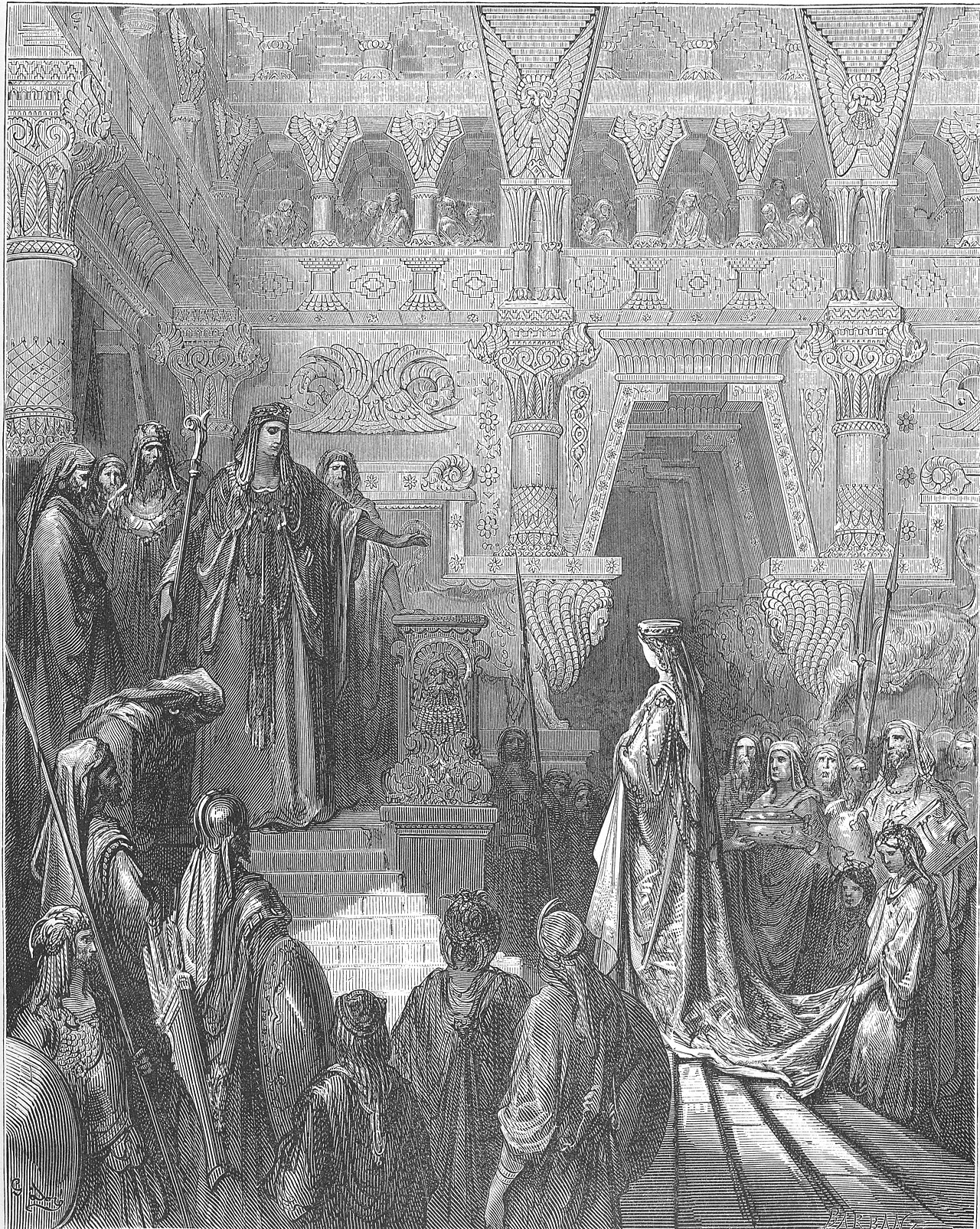
in 1 Kings 10The throne had six steps, and its back had a rounded top. There were armrests on both sides of the seat, with a lion standing beside each armrest.
BSB
The same verse in ASV and KJV ▾
ASV
There were six steps to the throne, and the top of the throne was round behind; and there were stays on either side by the place of the seat, and two lions standing beside the stays.
KJV
The throne had six steps, and the top of the throne was round behind: and there were stays on either side on the place of the seat, and two lions stood beside the stays.
⋯
This verse in 1 Kings 10
Commentary
11 notes on this verseA commentator
Albert Barnes1798–1870
Notes, Explanatory and Practical, on the Old and New Testaments (1832-1869)
Representations of thrones are frequent in the Egyptian and Assyrian sculptures. They have no steps up to them, but frequently stand upon square bases. The back appears to be flat at the top, not rounded. Assyrian thrones have “stays” or arms on either side, and they stand generally upon lion’s feet. They are always accompanied by a footstool. Lions stood beside the stays - The arms of Assyrian thrones are occasionally supported by figures of animals. The throne of Rameses II at Medinet Abou has a sphinx at the side and a lion below the sphinx.
This site's exposition
a great throne of ivory
on 1 Kings 10:18-20
The throne combines two costly materials, ivory carved and then overlaid with gold, six steps up with a rounded back, armrests flanked by lions, and twelve more lions ranged two by two on the steps. The text's own comment, there was not the like made in any kingdom, matches its later claim that Solomon exceeded all the kings of the earth for riches and wisdom at verse 23. Twelve lions on a throne built for David's son reads to the commentators as royal imagery reaching toward Judah's lion of Gen 49:9, named as their reading rather than the text's own statement.
This site's exposition
its back had a rounded top
Albert Barnes compares the thrones in the carvings of Egypt and Assyria, which had armrests and lions but lacked steps and had a flat back. The Hebrew for armrests is hands, as Adam Clarke notes. Bonaventure read the six steps of the throne as six stages by which the soul climbs toward God.
The record, by era
The Medieval Church4 voices
A commentator
BonaventureItinerarium Mentis in Deum, Chapter 1 · Written in the 13th century.
proposed
Just as God completed the whole world in six days and rested on the seventh, so the lesser world may be led in most orderly fashion through six stages of successive illuminations to the repose of contemplation. As a figure of this, one ascended by …
A commentator
BonaventureItinerarium Mentis in Deum, Chapter 7 · Written in the 13th century.
proposed
These six considerations having therefore been traversed, as if they were the six steps of the throne of the true Solomon, by which one arrives at peace, where the true peaceful one rests in a peaceful mind as in an interior Jerusalem; and as if …
A commentator
BonaventureCollationes de Septem Donis, Collation 9 · Written in the 13th century.
proposed
The seventh and last column of wisdom is simplicity in intention. Concerning this it is said that "King Solomon made a great throne of ivory," and he made in it "six steps." The other columns are round about, but this one is the most principal …
There are seven orders arranged by degrees up to the priesthood, in which is the standing of the orders, because it belongs to the priesthood to consecrate the Sacrament of the body of Christ, in which is the fullness of all graces; whence the other …
The Puritans and the Awakening1 voice
He rolled it, flowered it, or inlaid it, with gold. The stays or arms of this stately chair were supported by the images of lions in gold; so were the steps and paces by which he went up to it, to be a memorandum to him of that courage and resolution wherewith he ought to execute judgment, not fearing the face of man. The righteous, in that post, is bold as a lion.
3 more voices on this verse
The Puritans and the Awakening1 voice
The throne had six steps,....
The Nineteenth Century2 voices
A commentator
Jamieson, Fausset & Brown1802–1910
Commentary Critical and Explanatory on the Whole Bible (1871)
The ascent to it was by six steps, on each of which stood lions, in place of a railing--while a lion, probably of gilt metal, stood at each side, which, we may suppose from the analogy of other Oriental thrones, supported a canopy. A golden footstool is mentioned (2Ch 9:18) as attached to this throne, whose magnificence is described as unrivalled.
The throne was round behind: and there were stays on either side - This description seems to indicate that the throne was in the form of one of our ancient round-topped, two-armed chairs. This throne or chair of state was raised on a platform, the ascent to which consisted of six steps. What we call stays is in the Hebrew ידת yadoth, hands, which serves to confirm the conjecture above.
The words behind it
18 Hebrew wordsEvery Hebrew word of this verse in the order it stands, with what it means and the door to its own study. The last column counts the times a word stands in the whole Bible: the rarer the word, the more the places it appears belong together.
| Hebrew | Sound | Meaning | Word study | In the Bible |
|---|---|---|---|---|
| שֵׁ֧שׁ | shesh | six | H8337 → | 216 times |
| מַעֲל֣וֹת | maalot | steps | H4609 → | |
| לַכִּסֵּ֗ה | lakiseh | [belonged] to the throne | H3678 → | 135 times |
| וְרֹאשׁ־ | verosh- | and a top | H7218 → | 599 times |
| עָגֹ֤ל | ʾagol | round | H5696 → | 6 times |
| לַכִּסֵּה֙ | lakiseh | [belonged] to the throne | H3678 → | 135 times |
| מֵאַֽחֲרָ֔יו | meacharav | <from> behind it | H310 → | 715 times |
| וְיָדֹ֛ת | veyadot | and hands | H3027 → | 1618 times |
| מִזֶּ֥ה | mizeh | from this | H2088 → | 1180 times |
| וּמִזֶּ֖ה | umizeh | and from this | H2088 → | 1180 times |
| אֶל־ | ʾel- | [were] to | H413 → | 5510 times |
| מְק֣וֹם | mekom | [the] place of | H4725 → | 401 times |
| הַשָּׁ֑בֶת | hashavet | the sitting | H7675 → | |
| וּשְׁנַ֣יִם | ushenayim | and two | H8147 → | 768 times |
| אֲרָי֔וֹת | ʾarayot | lions | H738 → | 80 times |
| עֹמְדִ֖ים | ʾomedim | [were] standing | H5975 → | 521 times |
| אֵ֥צֶל | ʾetzel | beside | H681 → | 61 times |
| הַיָּדֽוֹת׃ | haiyadot | the hands | H3027 → | 1618 times |
שֵׁ֧שׁsix
sheshH8337 →216 times
מַעֲל֣וֹתsteps
maalotH4609 →
לַכִּסֵּ֗ה[belonged] to the throne
lakisehH3678 →135 times
וְרֹאשׁ־and a top
verosh-H7218 →599 times
עָגֹ֤לround
ʾagolH5696 →6 times
לַכִּסֵּה֙[belonged] to the throne
lakisehH3678 →135 times
מֵאַֽחֲרָ֔יו<from> behind it
meacharavH310 →715 times
וְיָדֹ֛תand hands
veyadotH3027 →1618 times
מִזֶּ֥הfrom this
mizehH2088 →1180 times
וּמִזֶּ֖הand from this
umizehH2088 →1180 times
אֶל־[were] to
ʾel-H413 →5510 times
מְק֣וֹם[the] place of
mekomH4725 →401 times
הַשָּׁ֑בֶתthe sitting
hashavetH7675 →
וּשְׁנַ֣יִםand two
ushenayimH8147 →768 times
אֲרָי֔וֹתlions
ʾarayotH738 →80 times
עֹמְדִ֖ים[were] standing
ʾomedimH5975 →521 times
אֵ֥צֶלbeside
ʾetzelH681 →61 times
הַיָּדֽוֹת׃the hands
haiyadotH3027 →1618 times
A shaded row is a word that stands 400 times or fewer in the Bible.
Where this verse is studied
On this page
Studies1
About 1 Kings
This page draws on 10 works. Open the list of works
This page draws on Adam Clarke, Commentary on the Bible; Albert Barnes, Notes, Explanatory and Practical, on the Old and New Testaments (1832-1869); Bonaventure, Itinerarium Mentis in Deum, Chapter 1; Bonaventure, Itinerarium Mentis in Deum, Chapter 7; Bonaventure, Collationes de Septem Donis, Collation 9; Bonaventure, Breviloquium, Part 6; Jamieson, Fausset & Brown, Commentary Critical and Explanatory on the Whole Bible; John Gill, Exposition of the Old Testament; John Gill, Exposition of the Old Testament (1748-1763) and Matthew Henry, Commentary on the Whole Bible.