
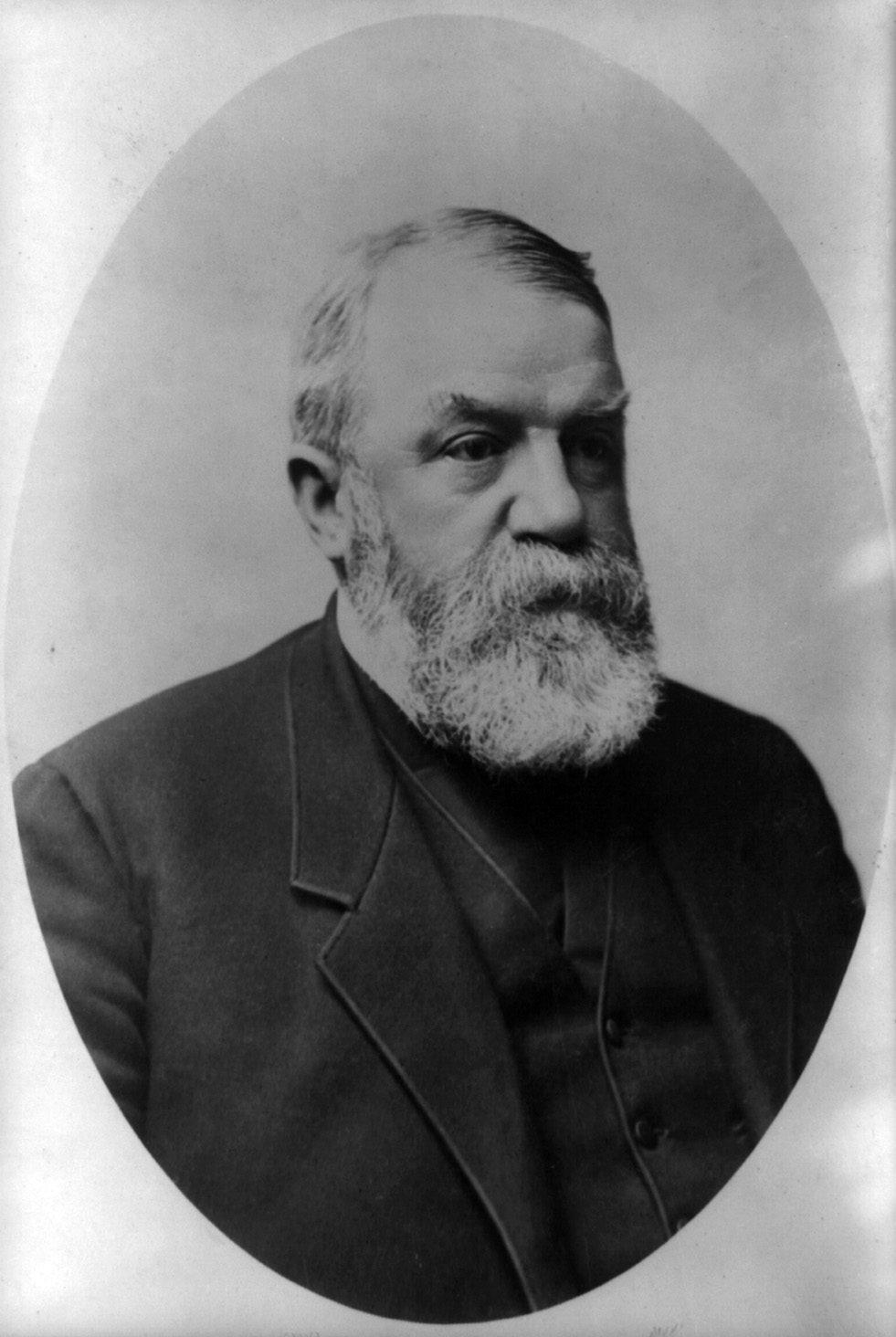
Royalty Photo, Dwight L. Moody, 1900. Public domain.
Boston, Chicago and Britain, to 1899 · Person · Featured Study
Dwight L. Moody
A Chicago shoe salesman who became a lay evangelist, he preached across Britain and America and founded schools at Northfield.
A church committee in Boston turned away an eighteen-year-old shoe clerk who could not say what Christ had done for him.
For God so loved the world that He gave His one and only Son, that everyone who believes in Him shall not perish but have eternal life.
For God so loved the world that He gave His one and only Son, that everyone who believes in Him shall not perish but have eternal life.
- Born
- 5 February 1837 at Northfield, Massachusetts
- Died
- 22 December 1899 at Northfield
- Family
- father: Edwin Moody; mother: Betsy Holton Moody; wife: Emma C. Revell
- Places
- Northfield, Boston, Chicago, New York, London
Summary
Dwight L. Moody grew up poor in western Massachusetts and was won to Christ by his Sunday school teacher while he worked for an uncle in Boston. In Chicago he left a good living to give all his time to mission work. From 1873 he and Ira Sankey held meetings across Britain, and he spent his last years building schools.
- An English preacher's week of sermons on one verse changed what he preached about the love of God.
- He married Emma C. Revell in 1862, and she became his ablest helper.
- He was never a clergyman, and the Church of England's clergy at Newcastle refused his mission for that reason.
God So Loved the World
John 3:16 changed his preaching, and 2 Corinthians 12 gave him words for what he would not tell.
He heard that verse as the text of seven sermons in a row in his church at Chicago. He spoke of his filling in New York as Paul spoke of an experience he kept to himself for fourteen years.
The question of this life is what changed in a Chicago mission worker that made the same sermons bear fruit.
I know a man in Christ who fourteen years ago was caught up to the third heaven. Whether it was in the body or out of it I do not know, but God knows.Moody compared his own silence about New York to Paul's here.
The Life in Order
The dates come from the church minutes and school records that W. R. Moody printed.
He was thirty-six when he sailed for Britain.
- 5 February 1837Born at NorthfieldW. R. Moody
- About 1841His father's sudden deathW. R. Moody
- May 1855First examined for church membershipW. R. Moody
- 12 March 1856Received into the Mount Vernon ChurchW. R. Moody
- Autumn 1856Removal to ChicagoW. R. Moody
- 1862Married Emma C. RevellW. R. Moody
- 24 December 1871The North Side Tabernacle dedicatedW. R. Moody
- 17 June 1873Landed at Liverpool with SankeyW. R. Moody
- 3 November 1879Classes began at Northfield SeminaryW. R. Moody
- 4 May 1881First boys at Mount HermonW. R. Moody
- Autumn 1889Chicago Bible Institute openedW. R. Moody
- December 1899His death at NorthfieldW. R. Moody
Each step of the life stands with its witness.
24 December 1871, 17 June 1873, 3 November 1879, 4 May 1881, Autumn 1889, December 1899
From Northfield to Northfield
W. R. Moody's life of 1900 is the witness for each paragraph.
Dwight Lyman Moody was born at Northfield, Massachusetts, on February 5, 1837. His father, a bricklayer, died when Dwight was four, leaving seven children and debts, and twins were born after his death. The creditors took even the kindling wood from the shed. His mother kept the family together.
At seventeen he went to Boston to sell shoes in his uncle's store. The uncle made him promise to go to church and Sunday school, and he went to the Mount Vernon Church. His Sunday school teacher, Edward Kimball, walked into the shoe store, found him in the back wrapping up shoes, and told him plainly that Christ loved him. Moody was converted there. The church board thought him too ignorant of doctrine and made him wait until March 1856 for membership.
He moved to Chicago in 1856 and turned out to be very good at selling shoes, and he set out to make a hundred thousand dollars. Instead he started renting pews and filling them with young men off the street, then began a Sunday school in North Market Hall, a public hall over a city market. Within a few years he had over a thousand children coming. In 1860 he gave up business altogether and lived on almost nothing.
He worked for the YMCA and served with the Christian Commission among Union soldiers during the Civil War. He built a church that the Great Chicago Fire of 1871 burned to the ground along with his house. The turning point came around that fire. Two women in his congregation had been telling him for months that he needed power from the Spirit. In New York, soon after the fire, he had an experience he would never describe in detail. He said only that God filled him, and that he afterward preached the same sermons and saw entirely different results.
In 1873 he sailed for Britain with the singer Ira Sankey. The three men who had invited them had died, and they learned it only on reaching Liverpool. The two-year campaign that followed filled halls in York, Newcastle, Edinburgh, Glasgow, Dublin, and London, where 285 meetings in four months counted 2,530,000 attendances. Moody preached; Sankey sang solos at the organ, which was itself controversial.
He came home famous and used it to build Northfield Seminary for young women (1879), Mount Hermon School for boys (1881), and the Chicago Evangelization Society. He founded the Northfield summer conferences, and the first students' conference, at Mount Hermon in July 1886, gave the Student Volunteer Movement its start. He was never ordained.
He collapsed while preaching in Kansas City in November 1899, went home to Northfield, and died there on December 22, 1899, at sixty-two. That morning he was heard to say, "Earth recedes; Heaven opens before me."
Seven Sermons on One Verse
A young English preacher stayed a week in Moody's church, and Moody told the story for the rest of his life.
Moody had met Henry Moorehouse in Dublin and thought the beardless young man could not preach. He answered his letters coldly and left town on the Thursday he came.
His wife told him on his return that the Englishman had preached twice from the third chapter of John. She said he told the worst sinners that God loved them, and that he backed up everything he said with the Bible.
Moorehouse took the same verse every night for a week. Moody said he went through the Bible from Genesis to Revelation to show that in all ages God loved the world.
In Their Own Words
Four sayings, as his son printed them in 1900.
D.L. Moody (1837 to 1899)
his account of Henry Moorehouse's sermons, as W. R. Moody prints it, page 139
I never knew that God loved us so much
“I never knew up to that time that God loved us so much. This heart of mine began to thaw out; I could not keep back the tears. It was like news from a far country: I just drank it in.”
Evangelical
About this saying1 paragraph
Moody told how Moorehouse's week of sermons on John 3:16 thawed him while he led his church at Chicago.
D.L. Moody
his account of 1871, as W. R. Moody prints it, page 149
Stay His hand
“I can only say that God revealed Himself to me, and I had such an experience of His love that I had to ask Him to stay His hand. I went to preaching again. The sermons were not different; I did not present any new truths, and yet hundreds were converted.”
Evangelical
About this saying1 paragraph
This is the most he would say of the day in New York in 1871.
D.L. Moody
words to a meeting in Britain, as W. R. Moody prints them, page 132
Plain Dwight L. Moody
“I'm not the ‘Reverend’ Mr. Moody at all. I'm plain Dwight L. Moody, a Sabbath-school worker.”
Evangelical
About this saying1 paragraph
While he preached in Britain, he corrected a chairman who had introduced him with a clergyman's title.
D.L. Moody
the autobiographical leaf, as W. R. Moody prints it, the leaf before the title page
Born of the Spirit
“I was born of the flesh in 1837. I was born of the Spirit in 1856. That which is born of the flesh may die. That which is born of the Spirit will live forever.”
Evangelical
About this saying1 paragraph
His son set these words in facsimile before the title page of his life of 1900.
The People Around Him
His family, his teacher, his partner and the preachers who shaped him.
A teacher, a wife and a boy preacher each turned his course.
| Person | Tie to Moody | The witness |
|---|---|---|
| Betsy Holton Moody | His mother refused to give her children to strangers. | W. R. Moody |
| Samuel Holton | His mother's brother, who gave him his first place in trade. | W. R. Moody |
| Edward Kimball | His Sunday school teacher at the Mount Vernon Church. | W. R. Moody |
| Emma C. Revell | His wife, who saved his portrait from the fire. | W. R. Moody |
| Henry Moorehouse | The boy preacher from England. | W. R. Moody |
| Ira D. Sankey | The singer of the British campaigns. | W. R. Moody |
| William Pennefather | A London clergyman who had urged him to come over and help. | W. R. Moody |
| W. R. Moody | His son, who wrote his life. | W. R. Moody |
William Pennefather, W. R. Moody
The Places of His Life
He was born and died at Northfield and did his work between Chicago and London.
His work ran from a Boston shoe store to the Agricultural Hall in London.
| Place | What the witnesses say | The witness |
|---|---|---|
| Northfield, Massachusetts | His family's town for two hundred years, and his home at the end. | W. R. Moody |
| The Holton store, Boston | Kimball spoke to him in the back of it. | W. R. Moody |
| North Market Hall, Chicago | A dingy hall over a market, crowded with street children. | W. R. Moody |
| Farwell Hall, Chicago | The Young Men's Christian Association building, lost in the fire. | W. R. Moody |
| New York | The city of his filling in 1871. | W. R. Moody |
| Agricultural Hall, London | Sixty meetings there counted 720,000 attendances. | W. R. Moody |
| Mount Hermon | The boys' school, where the students met in 1886. | W. R. Moody |
| Kansas City | The city of his last meetings. | W. R. Moody |
Mount Hermon, Kansas City
Working From the Cross
He described his conversion as a change in the reason he worked.
Moody used to say that before his conversion he worked towards the Cross, and afterwards from it. He had worked to be saved, and now he worked because he was saved.
His son writes that from then on, for nearly fifty years, he found his greatest joy in the service of his God.
How the Key Verse Was Taught
Cyril of Alexandria, Matthew Henry and Jamieson, Fausset and Brown read John 3:16.
Cyril of Alexandria (died 444)
Commentary on the Gospel of John, Book 2
Cyril of Alexandria read in it the Son who is God by nature, given in the Father's love.
“He desireth to show openly herein, that He is God by Nature, since one must needs deem that He Who came forth from God the Father, is surely God also, not having the honour from without, as we have, but being in truth what He is believed to be. With exceeding skill does He say this, having joined therewith the love of God the Father to us, well and opportunely coming to discourse thereon. For He shames the unbelieving Nicodemus, yea rather, He shows that he is ungodly also.”
on John 3:16Patristic
Matthew Henry (1662 to 1714)
Commentary on the Whole Bible
Matthew Henry drew from it the duty to believe and to accept the gift.
“Salvation has been of the Jews, but now Christ is known as salvation to the ends of the earth, a common salvation. Here is the great gospel duty, and that is to believe in Jesus Christ (Whom God has thus given, given for us, given to us ), to accept the gift, and answer the intention of the giver.”
on John 3:16Puritan
Jamieson, Fausset & Brown (1802 to 1910)
Commentary Critical and Explanatory on the Whole Bible
Jamieson, Fausset and Brown set Christ beside the bronze serpent, given for every perishing sinner.
“Yet was the warrant in both cases to expect a cure equally rational and well grounded. As the serpent was God's ordinance for the cure of every bitten Israelite, so is Christ for the salvation of every perishing sinner--the one however a purely arbitrary ordinance, the other divinely adapted to man's complicated maladies.”
on John 3:14 to 16Reformed
What the Witnesses Leave Open
The records differ on the year of his conversion and on his view of the student volunteers.
When he was convertedEdward Kimball; the Mount Vernon Church minutes; Moody himself
Kimball's account gives the shop and no date. The church's minute of May 1855 says he was first awakened on the 16th of May. Moody's own leaf says he was born of the Spirit in 1856.
The minute of March 1856 records his reception into the church, which may be the year he meant.
Whether he backed the student volunteersW. R. Moody
Nearly a hundred students at the conference of 1886 pledged themselves to foreign missions. His son writes that the Volunteer Movement did not at first receive his endorsement, because he thought its pressure on the young unwise.
Books to Read Next
The Life of Dwight L. Moody
W. R. Moody · 1900
His son printed the church minutes, the letters and Moody's own tellings.
Read it free at the Internet ArchiveWhat Moody Left
Moody left two schools at Northfield, a Bible institute in Chicago, and the summer conferences that sent students to the mission field.
Sources
Scripture is the Berean Standard Bible.
- The Holy Bible, Berean Standard Bible (read 2026)
- W. R. Moody, The Life of Dwight L. Moody (New York: Fleming H. Revell, 1900)
- Cyril of Alexandria, Commentary on the Gospel of John, book 2.
- Matthew Henry, Commentary on the Whole Bible (1710), on John 3:16.
- Jamieson, Fausset and Brown, Commentary Critical and Explanatory on the Whole Bible (1871), on John 3:14 to 16.