
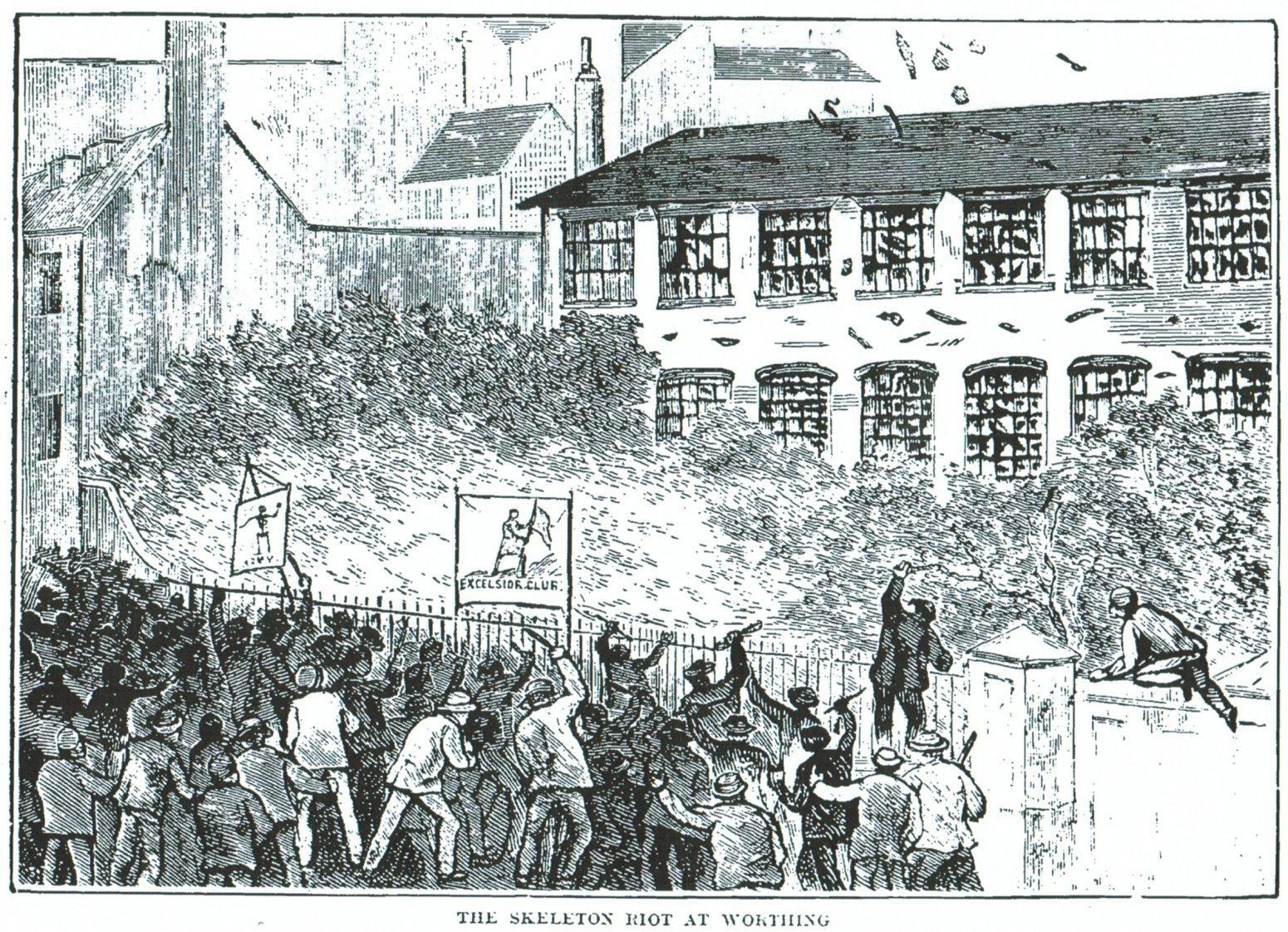
Unknown engraver, The Skeleton Riot at Worthing, 1884. Public domain.
From Exeter to Worthing, in the 1880s · Story · Featured Study
The Skeleton Army Riots
English towns from Exeter to Worthing saw organised bands attack the Salvation Army's marches, and the courts had to rule on who broke the peace.
- Where
- Exeter, Weston-super-Mare, Worthing, Hastings, Potton
- Who
- William Booth, William Beatty, Mr Justice Field, Charles Jeffries
- When
- From the early 1880s into the 1890s (probable)
The band at Honiton ran its own paper, The Skeleton, as a rival to the Army's War Cry.
The apostles left the Sanhedrin, rejoicing that they had been counted worthy of suffering disgrace for the Name.
Summary
The bands called themselves Skeleton Armies, and they rose against the Army from the early 1880s. Nigel Bovey, an Army officer and editor of The War Cry, counts 67 towns in thirteen years. A court's judgment is the firmest record of the fight.
- West Sussex Record Office says the crowd at Worthing grew to 4,000 people.
- Against the Army's "Blood and Fire" the bands cried "Blood and Thunder", and against "Soup", "Soap" and "Salvation" they set "Beef", "Beer" and "Bacca".
- One band leader at Whitechapel, Charles Jeffries, rose to be a Commissioner of the Army.
The Texts of Reproach
Jesus and Paul told believers to expect insult and persecution.
This study asks who attacked the Army's processions in English towns and what the courts did about it. It also asks how far the Army's own record of those years can be trusted. It gives the counts of those assaulted in one year, the story from Exeter to Worthing and the case of Beatty v. Gillbanks from the Law Reports. It then gives the Army's answers to the violence, the words of four who lived through it, and what each writer names as the cause.
Blessed are you when people insult you, persecute you, and falsely say all kinds of evil against you because of Me.
Jesus's blessing covers insult as well as blows, and the bands gave the marchers both.
Matthew 5:11BSB
Indeed, all who desire to live godly lives in Christ Jesus will be persecuted,
Paul's warning fits people assaulted for marching and preaching, and the Army's count measures what it cost them.
The Army's Count for 1882
Five books over four decades print a count of those assaulted in one year.
Every total here comes from the Army, and the totals run from 642 to 699.
| Writer and year | People assaulted | Women among them | Buildings attacked |
|---|---|---|---|
| Fidelis, 1884 | 669 | 251 | Fifty-six |
| Booth-Tucker, 1892 | 669 | 251 | Fifty-six |
| Railton, 1912 | 699 | 251 | Not given |
| Begbie, 1920 | 669 | 251 | Fifty-six |
| Bramwell Booth, 1925 | 642 | More than one-third | Sixty |
The first book prints the 669 as 391 men, 251 women and twenty-three children, which add to 665. The men and women alone add to the 642 of the last book, which counts the children apart. The likeliest reading of the arithmetic, which is an inference, is that all these totals are one count copied.
The Army's words for the count are "to our knowledge". Three of the books add that eighty-six of its people were imprisoned, fifteen of them women.
From Exeter to Worthing
The bands copied the Army's flags, uniforms and songs, and they rose in town after town.
Nigel Bovey dates the first Skeleton Army to Exeter in 1881. He says that the bands had no central command and that men in Whitechapel, Exeter and Honiton each called themselves general. The railway, he says, carried people to the next town's disturbance.
West Sussex Record Office records banners of skeletons, rats and coffins. The trouble at Worthing came in 1884, after the Army complained of a nearby store selling alcohol. More than 1,000 people went to the Army's barracks, its landlord's home, the town hall and the police station.
On 17 August the two sides clashed. When the Salvationists had returned to their barracks, the landlord, George Head, turned a revolver on the rioters and injured several of them. Worthing later published a notice threatening a criminal sentence and hard labour for anyone subscribing to the Skeleton Army.
The deaths that are reported3 paragraphs
The BBC reported in 2020 that Susannah Beaty, newly married, was struck by a thrown rock and kicked by a mob at Hastings in 1889 and died later in hospital. It calls her the Army's first martyr.
West Sussex Record Office writes that a woman at Shoreham was "reportedly killed" by a stone, and it gives no source.
Both deaths stand as reports, and the number who died is unknown.
The bands were still marching at Potton in Bedfordshire in 1890. The War Cry described them there in uniform with drum, flutes and rattles under a flag of coffin, skull and cross-bones. It claimed that the Army answered by "showing unruffled love".
Beatty v. Gillbanks
The Law Reports give the whole case, from the march to the judgment.
The justices found a band at Weston-super-Mare "called the Skeleton Army" that paraded the streets against the Army. When the two met, they found, "a free fight, great uproar, blows, tumult, stone throwing, and disorder" followed.
On 23 March 1882 the Army marched with a mob of over 2,000 around it, and a general fight broke out at the Railway Parade. Two justices then posted a notice against assembling to the disturbance of the peace.
On Sunday 26 March Captain William Beatty led the procession out again. A police sergeant told him to disperse, and he marched on some twenty yards and was arrested. William Mullins and Thomas Bowden took the lead and were arrested too.
The justices found that the three had meant "to force their way through the streets". They bound them to keep the peace for twelve months, with three months in prison on default. Harold Begbie, Booth's biographer, later wrote that a Salvationist "was sentenced to three months' imprisonment". The order was a bond, with prison only on default.
Mr Justice Field and Mr Justice Cave, in the Queen's Bench Division, set the order aside. Field wrote that the finding meant "a man may be convicted for doing a lawful act" if he knows that it may provoke another to an unlawful one. He added that no authority supported it.
How the Army Answered
Its answers were a letter to the government, a pause in the marches and a welcome to those who came to disturb.
In October, five months before the case, William Booth, the Army's General, wrote to the Home Secretary about Stamford. The Home Secretary had advised its Mayor about the Army, and Booth replied that no one from the Army had yet been sent there. He argued that the violence came from roughs who had been assured they could act with impunity.
George Scott Railton, a Commissioner of the Army, writes that at one time in that year there would be 1,500 police on extra duty to protect the Army. He names no town. The Army disliked this, he says, and it "gave up our marches entirely for a few weeks". The pause let the police gain control before it began again.
On New Year's Eve, three months before the case, Charles Jeffries came with about thirty of the Whitechapel band to disturb the watchnight service of the Whitechapel Corps. It is said, Bovey reports, that Jeffries and then the others went forward and knelt at the penitent form.
How the Key Verse Was Taught
Three writers, from Polycarp in the second century to Gregory, who died in 604, on suffering for the Name.
Polycarp of Smyrna (died 155)
Epistle to the Philippians 8
A letter of the second century sets Christ's own endurance before believers as their pattern.
“Let us then continually persevere in our hope, and the earnest of our righteousness, which is Jesus Christ, ‘who bore our sins in His own body on the tree,’ ‘who did no sin, neither was guile found in His mouth,’ but endured all things for us, that we might live in Him. Let us then be imitators of His patience; and if we suffer for His name's sake, let us glorify Him. For He has set us this example in Himself, and we have believed that such is the case.”
on Acts 5:41Patristic
John Chrysostom (died 407)
Homily on Acts 14
A homily of the fourth century finds the power of God in the apostles' boldness after the flogging.
“‘And they departed from the presence of the council, rejoicing that they were counted worthy to suffer shame for the name of Christ.’ What miracles so wonderful as this? Nowhere is the like of this recorded of the old saints: for Jeremiah indeed was scourged for the word of God, and they threatened Elijah, and the rest: but in this case, even by this very thing, and not only by their miracles, these showed forth the power of God. He does not say, that they were not pained, but that though pained they rejoiced. How does this appear? From their boldness afterwards: they were so instant still, even after their beatings, in preaching the word.”
on Acts 5:41Patristic
Gregory the Dialogist (died 604)
Forty Gospel Homilies, Homily 30
A later homily credits the Holy Spirit with the change in Peter and goes on to the other men the Spirit filled.
“And they went rejoicing from the presence of the council, because they were counted worthy to suffer insults for the name of Jesus. Behold, Peter rejoices in beatings, who before was afraid at mere words. And he who previously feared when questioned by the voice of a servant girl, after the coming of the Holy Spirit, though beaten, tramples down the powers of rulers. It is fitting to raise the eyes of faith to the power of this craftsman, and to consider here and there the Fathers of the new and old testament. Behold, with these same eyes of faith opened, I gaze upon David, Amos, Daniel, Peter, Paul, Matthew, and I wish to consider what kind of craftsman this Holy Spirit is, but in my very consideration I fall short. For he fills a boy who plays the harp, and makes him a psalmist. He fills a herdsman shepherd picking sycamore figs, and makes him a prophet. He fills an abstinent boy, and makes him a judge of elders. He fills a fisherman, and makes him a preacher. He fills a persecutor, and makes him a teacher of the Gentiles. He fills a tax collector, and makes him an evangelist. O what a craftsman this Spirit is! There is no delay in learning whatever he wills. As soon as he touches the mind, he teaches, and merely to have touched is to have taught. For as soon as he illuminates the human soul, he transforms it; he suddenly takes away what it was, and suddenly produces what it was not.”
on Acts 5:41Patristic
In Their Own Words
The judge, the General, his Commissioner and his son on who caused the violence and what it brought.
William Ventris Field (1813 to 1907)
Beatty v. Gillbanks, Law Reports, 9 Queen's Bench Division, page 314
Caused by other people
“the disturbances were caused by other people antagonistic to the appellants, and that no acts of violence were committed by them.”
English law
About this saying1 paragraph
The judgment of 1882 rests on this finding about who did the violence.
William Booth (1829 to 1912)
Letter to the Home Secretary, October 1881, in Harold Begbie, The Life of General William Booth, volume 1, page 481
Where the authorities made it plain
“There has never been a breach of the peace where the authorities have made it plainly understood that assault upon us will be treated as assaults upon any other people.”
Methodist
About this saying1 paragraph
Booth's letter of 1881 lays the question of order on those in authority.
George Scott Railton (1849 to 1913)
The Authoritative Life of General William Booth, page 90
What the opposition brought
“But how marvellously God helped The General by means of those very oppositions! They brought us into close touch with bodies of young fellows, many of whom have since become leaders amongst us.”
Salvation Army
About this saying1 paragraph
Railton's life of Booth, of 1912, counts the fight a gain to the Army's ranks.
Bramwell Booth (1856 to 1929)
Echoes and Memories, Disturbers of the Peace, chapter 4
Less from the saloons than the parsonages
“Yet the most persistent and unrelenting opposition that The Salvation Army had to encounter in what we sometimes call the lawless years came less from the drinking saloons than from the parsonages.”
Salvation Army
About this saying1 paragraph
This charge of 1925 is one party's word against the clergy.
Who Raised the Mobs, and Who Kept the Peace
The Army's writers blame the drink trade, a Worthing historian points to the old festivals, and the witnesses differ on the police.
Did the drink trade raise the mobs?2 paragraphs
Bramwell Booth wrote that the Skeleton Army was "marshalled from the beer-houses". Begbie names the Mayor of Basingstoke, "a brewer", who said he could not protect the Army. Bovey, asked for the causes, answers "success" and says that the brewing industry rebelled.
Booth, Begbie and Bovey all wrote from the Army's side.
Did the old festivals defend themselves?2 paragraphs
Chris Hare, a historian from Worthing, told the BBC that the revolts were the "final violent expression" of working-class festivals such as Bonfire Night and May Day.
The complaint about alcohol that set off the trouble at Worthing points the other way.
Should the Army have stayed indoors?1 paragraph
Bovey reports a third view from magistrates, police and businessmen in the secular press, that people liked the Army's work and "wished they did it quietly within their halls". He gives it as their view.
Whom did the police protect?1 paragraph
Begbie has the police arresting the Salvationists, and Bovey says they "tended to arrest the Salvationists", against Railton's picture of them as the Army's guards. Bramwell Booth prints the Home Secretary's advice that the processions, "not being illegal in themselves", should still be stopped where riot threatened, and he prints it to condemn it.
How far can the Army's press be trusted?1 paragraph
The Army's own press is a partial witness. Bovey says of The War Cry's reports of the time that they gave victories and little detail, and that "if we are being harsh, we might even say that is propaganda".
Books to Read Next
The Authoritative Life of General William Booth
George Scott Railton · 1912
Railton wrote this life as a Commissioner of the Army in the year Booth died.
Read Railton free at the Internet ArchiveThe Life of General William Booth, volume 1
Harold Begbie · 1920
Begbie gathers the Army's troubles of those years in a chapter headed Hostility, Suspicion, Opposition.
Read Begbie free at the Internet ArchiveEchoes and Memories
Bramwell Booth · 1925
This chapter on the disturbers of the peace gives the riots as the General's son remembered them.
Read Bramwell Booth free at the Internet ArchiveWhat the Riots Left
The riots left a precedent in English law, since Bovey says that Beatty v. Gillbanks still stands.
Sources
Scripture is the Berean Standard Bible.
- The Holy Bible, Berean Standard Bible (read 2026)
- Beatty v. Gillbanks, Law Reports, 9 Queen's Bench Division, pages 308 to 315 (1882)
- Fidelis (Agnes Maule Machar), Red-Cross Knights of the Salvation Army (Toronto: Williamson, 1884)
- F. de L. Booth-Tucker, The Life of Catherine Booth, volume 2 (1892)
- George Scott Railton, The Authoritative Life of General William Booth (1912), pages 83 to 84 and 89 to 90.
- Harold Begbie, The Life of General William Booth, volume 1, chapter 29, and volume 2, chapter 1 (1920)
- Bramwell Booth, Echoes and Memories (1925), chapter 4, Disturbers of the Peace.
- Interview with Nigel Bovey on Blood on the Flag, Salvationist (Canada), August 2015, and his comment of 25 October 2020 on the West Sussex Record Office blog.
- A. Hartley, Beef, Beer and Bacca versus Soup, Soap and Salvation, West Sussex Record Office blog, 3 January 2020.
- B. Bell, BBC News, 17 October 2020.
- Bedfordshire Archives, The Skeleton Army in Potton, quoting The War Cry.
- Captain Charles Smith, From Skeleton to Salvationist, The War Cry (undated)
Keep Studying
People and groups6
Trials of life1