
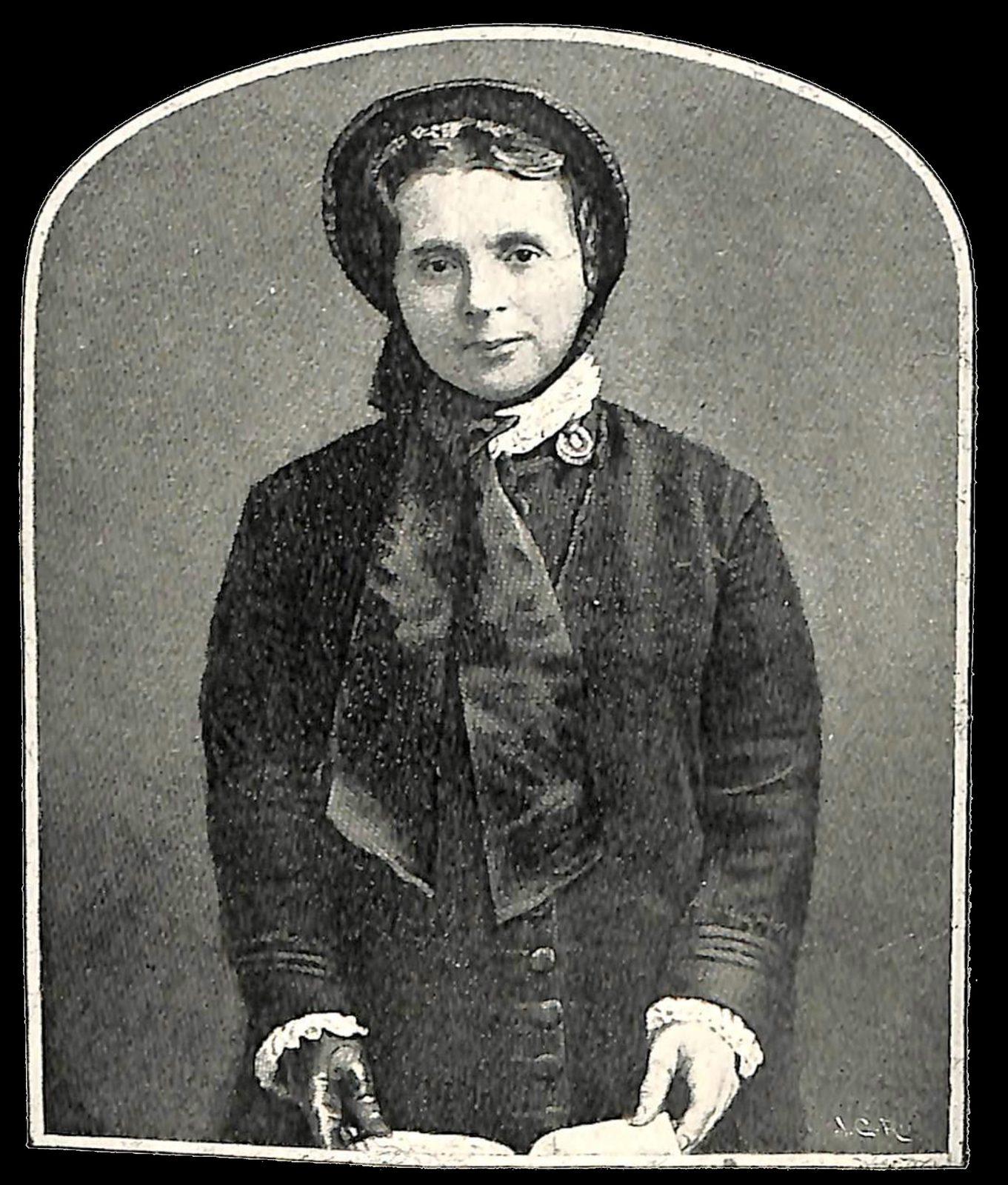
Unknown photographer, Catherine Booth, 1899. Public domain.
Gateshead and London, to 1890 · Person · Featured Study
Catherine Booth
She built The Salvation Army beside William Booth from 1865 until her death in 1890.
A timid minister's wife answered a pamphlet against women preachers, and within months she walked to the front of her husband's chapel.
‘In the last days, God says, I will pour out My Spirit on all people. Your sons and daughters will prophesy, your young men will see visions, your old men will dream dreams.
- Born
- 17 January 1829 at Ashbourne in Derbyshire
- Died
- 4 October 1890
- Family
- husband: William Booth; eldest son: William Bramwell Booth; daughter: Emma Moss Booth
- Places
- Ashbourne, Boston, Gateshead, London, Clacton-on-Sea
Summary
Catherine Booth grew up in Derbyshire and Lincolnshire. She married a young minister of the Methodist New Connexion. At Gateshead she wrote a defence of the right of women to preach. Months later she began to preach herself. The Army she built with her husband sent women out as officers.
- Her pamphlet answered a minister who had attacked Phoebe Palmer, an American preacher.
- Thirty-six thousand came to her funeral service at Olympia in October 1890.
- Her last address was given at the City Temple in London in 1888.
Your Daughters Shall Prophesy
Peter's sermon at Pentecost and Joel's promise carry her argument.
Female Ministry argues from these two verses that daughters receive the Spirit as sons do, and may use the gift in public.
The question of this life is how a woman she herself called timid and bashful came to preach, and what she taught when she did.
And afterward, I will pour out My Spirit on all people. Your sons and daughters will prophesy, your old men will dream dreams, your young men will see visions.Joel's promise names daughters beside sons.
The Life in Order
Most dates come from Booth-Tucker's life of 1892 and Railton's table.
She was thirty-one when she first spoke from a pulpit.
- 17 January 1829Born at AshbourneBooth-Tucker
- 1834Removal of the family to Boston in LincolnshireBooth-Tucker
- 1844Her conversionRailton
- 16 June 1855Married William BoothRailton
- 8 March 1856Birth of BramwellRailton
- December 1859Rees's attack on Mrs. Palmer reached herBooth-Tucker
- 8 January 1860Birth of EmmaBooth-Tucker
- Whit Sunday 1860First address, at Bethesda in GatesheadBooth-Tucker
- 1878Practical Christianity printed, and the first corps flag givenRailton
- 21 June 1888Last public addressRailton
- 4 October 1890Her deathRailton
Each step of the life stands with its witness.
8 January 1860, Whit Sunday 1860, 1878, 21 June 1888, 4 October 1890
From Ashbourne to Clacton
Booth-Tucker tells the life from her letters and her own addresses.
Catherine Mumford read the Bible through eight times before she was twelve and married William Booth at twenty-six.
When a minister attacked the American evangelist Phoebe Palmer for preaching, Catherine answered him in print with Female Ministry, a careful argument from Scripture that God had never barred a woman from the pulpit.
A few months later, sitting in her husband's chapel, she stood up and spoke herself.
Her meetings in London's West End drew officers into the work in the East End, where the Booths' Christian Mission became the Salvation Army in 1878. She designed the bonnet its women wore.
Her addresses went into print as books, among them Godliness in 1880 and Popular Christianity in 1887. In 1888 Sir James Paget found that she had cancer and advised an operation.
She died of cancer two years later, and tens of thousands filed past her coffin.
The First Address
She told the story of that Sunday in a meeting twenty years later.
Weeks after Emma's birth, lying ill, she had promised God that she would obey if He called her again. On a Sunday that spring her husband planned an open-air service on Windmill Hills, and the weather drove it into the chapel.
About a thousand people were present, she said. She was sitting in the minister's pew with her eldest boy when she felt the Holy Spirit come upon her.
She walked down the aisle and confessed that she had been disobeying God. Her husband asked her to preach that night, and she did.
Her servant, who was at the meeting, went home and danced round the kitchen table, Booth-Tucker writes.
In Their Own Words
Four sayings, from a letter of 1859 to an address of 1883.
Catherine Booth (1829 to 1890)
letter to her mother, December 1859, as F. de L. Booth-Tucker prints it, volume 1, page 243
He shall not go unanswered
“That subject would warm me up anywhere and before anybody. William is always pestering me to begin giving lectures, and certainly this would be a good subject to start with. I am determined that he shall not go unanswered.”
Salvation Army
About this saying1 paragraph
She wrote this to her mother in December 1859, after she read Rees's pamphlet.
Catherine Booth
her account of her first address, as F. de L. Booth-Tucker prints it, volume 1, page 255
A fool for Christ
“This is just the point. I have never yet been willing to be a fool for Christ. Now I will be one!”
Salvation Army
About this saying1 paragraph
She said this to herself in the pew at Bethesda in 1860, as she told it twenty years later.
Catherine Booth
her account of her first address, as F. de L. Booth-Tucker prints it, volume 1, page 255
I want to say a word
“He stepped down and asked me, 'What is the matter, my dear?' I replied, 'I want to say a word.' He was so taken by surprise that he could only say, 'My dear wife wishes to speak,' and sat down.”
Salvation Army
About this saying1 paragraph
The same account of that day in 1860 goes on to the front of the chapel.
Catherine Booth
Papers on Aggressive Christianity (1891), page 13
Compel them to come in
“I will have guests, and if you can't get them in by civil measures, use military measures. Go and compel them to come in. It seems to me that we want more of this determined aggressive spirit.”
Salvation Army
About this saying1 paragraph
In an address on the parable of the great supper, printed in Aggressive Christianity in 1883, she urged the churches to go out after the people.
The People Around Her
The witnesses name her household, her opponent and the preachers she met.
A pamphlet against Phoebe Palmer drew her into print.
| Person | Tie to Catherine Booth | The witness |
|---|---|---|
| Mrs. Mumford | Her mother taught her to read from the Bible as a small child. | Booth-Tucker |
| William Booth | He had long urged her to speak, and he sat down to let her. | Booth-Tucker |
| Arthur Augustus Rees | An Independent minister of Sunderland, once a clergyman, wrote the pamphlet she answered. | Booth-Tucker |
| Phoebe Palmer | Her meetings at Newcastle drew Rees's attack. | Booth-Tucker |
| Emma Moss Booth | A daughter, born days after the pamphlet appeared. | Booth-Tucker |
| Joseph Parker | He lent her his pulpit in 1888. | Booth-Tucker |
| F. de L. Booth-Tucker | He wrote her life in two volumes in 1892. | Railton |
The Places of Her Life
She grew up in the Midlands and Lincolnshire and did her work in the north and in London.
Her first address was in a chapel on the Tyne, and her last in the City of London.
| Place | What the witnesses say | The witness |
|---|---|---|
| Ashbourne, Derbyshire | Her birthplace. | Booth-Tucker |
| Boston, Lincolnshire | Her childhood home from the age of five. | Booth-Tucker |
| Bethesda Chapel, Gateshead | Its members grew from thirty-nine to three hundred in the Booths' years there. | Booth-Tucker |
| The City Temple, London | Joseph Parker's church. | Booth-Tucker |
| Clacton-on-Sea | A quiet watering-place in Essex, her home in her last illness. | Booth-Tucker |
| Abney Park Cemetery | Her grave. | Railton |
What Her Pamphlet Argues
Her pamphlet answers from Scripture the texts used against women preaching.
She quotes the prophet directly: "But God says, by His prophet Joel, they shall use it, just in the same sense as the sons use it."
On 1 Timothy 2:12 she quotes the Rev. J. H. Robinson, who held that Paul forbids only such teaching as is domineering. She quotes Mrs. Palmer that the terms preach and prophesy mean one and the same thing in Scripture.
How the Key Verse Was Taught
Ambrose, Matthew Henry and Catherine Booth read the Spirit poured on all flesh.
Ambrose of Milan (died 397)
On the Holy Spirit, Book 1
Ambrose of Milan weighed the words of My Spirit as a measure given to each.
“‘I will pour out of My Spirit’: He said not Spirit, but ‘of My Spirit,’ for we are not able to receive the fulness of the Holy Spirit, but we receive as much as our Master divides to us of His own according to His will.”
on Acts 2:17Patristic
Matthew Henry (1662 to 1714)
Commentary on the Whole Bible
Matthew Henry read the last days as the whole age of the gospel.
“It refers to the last days, the times of the gospel, which are called the last days because the dispensation of God's kingdom among men, which the gospel sets up, is the last dispensation of divine grace, and we are to look for no other than the continuation of this to the end of time.”
on Acts 2:17 to 21Puritan
Catherine Booth (1829 to 1890)
Female Ministry, in Papers on Practical Religion, page 134
Catherine Booth drew from the verse a woman's place in the pulpit.
“Why should woman be confined exclusively to the kitchen and the distaff, any more than man to the field and workshop?”
Salvation Army
What the Witnesses Leave Open
Booth-Tucker's life of her and Railton's life of her husband differ on two dates.
When Female Ministry appearedGeorge Scott Railton; F. de L. Booth-Tucker
Railton's table of events puts the pamphlet in 1859. Booth-Tucker says Rees's pamphlet reached her in December 1859, and that Emma was born on 8 January 1860 within a few days of the reply's publication.
Read together, the two place it in the last days of 1859 or the first days of 1860.
The year of her birthGeorge Scott Railton; F. de L. Booth-Tucker
Railton's table gives 17 January 1827. Booth-Tucker gives the same day in 1829, and her marriage at twenty-six in June 1855 agrees with his year.
Books to Read Next
The Life of Catherine Booth, Volume 1
F. de L. Booth-Tucker · 1892
He prints her letters and her own account of her first address.
Read volume 1 free at the Internet ArchiveThe Life of Catherine Booth, Volume 2
F. de L. Booth-Tucker · 1892
The second volume carries the Army years, her illness and her funeral.
Read volume 2 free at the Internet ArchiveThe Authoritative Life of General William Booth
George Scott Railton · 1912
It has a table of events dating her books and her addresses.
Read it free at Project GutenbergWhat Catherine Booth Left
She left a defence of women preaching, volumes of printed addresses, and an Army whose women stood in its pulpits.
Sources
Scripture is the Berean Standard Bible.
- The Holy Bible, Berean Standard Bible (read 2026)
- F. de L. Booth-Tucker, The Life of Catherine Booth, the Mother of the Salvation Army, volumes 1 and 2 (London, 1892)
- George Scott Railton, The Authoritative Life of General William Booth (1912)
- Catherine Booth, Female Ministry; or, Woman's Right to Preach the Gospel, in Papers on Practical Religion (London: International Headquarters, fourth edition, dated 1891 by the Internet Archive)
- Catherine Booth, Aggressive Christianity (Boston, 1883), and Papers on Aggressive Christianity (London, 1891)
- Ambrose of Milan, On the Holy Spirit, book 1.
- Matthew Henry, Commentary on the Whole Bible (1710), on Acts 2:17.
Keep Studying
People and groups5
Doctrines1