
AD 1705 to 1719 · Story · Featured Study
The Danish-Halle Mission, 1706
A king's missionaries from Halle reached India in 1706 and wrote home of all they met.
The two missionaries sat on the ground among the children of a Tamil school and traced their first letters in the sand.
- When
- 29 November 1705 to 23 February 1719
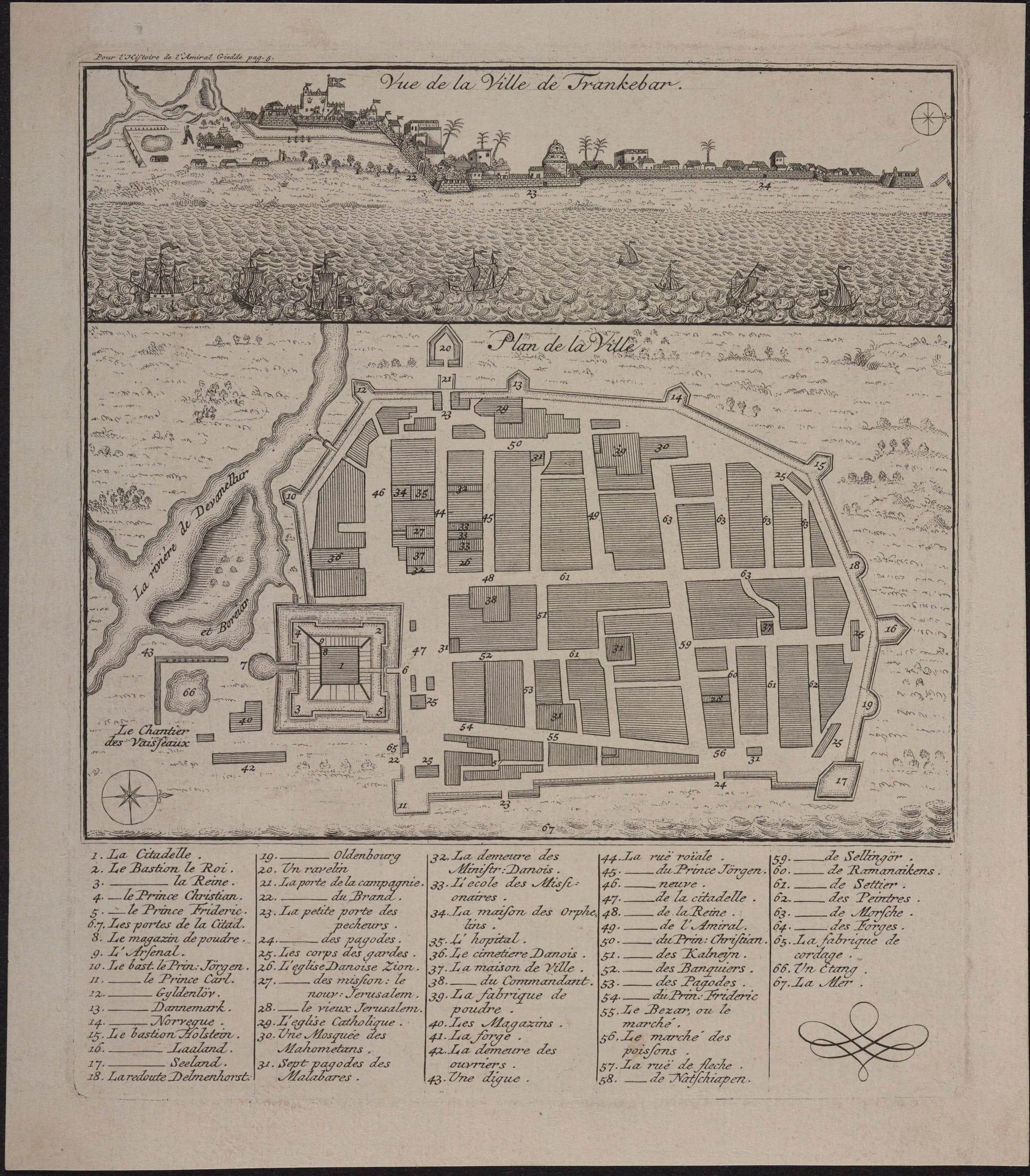
A view and plan of Tranquebar, 1746. Public domain.
For no one can lay a foundation other than the one already laid, which is Jesus Christ.
Summary
King Frederick IV of Denmark sent Bartholomäus Ziegenbalg and Heinrich Plütschau to his colony of Tranquebar on the Coromandel Coast of India in 1705. Ziegenbalg worked there for the rest of his life, and Plütschau for five years.
- The King paid each of the two a yearly salary of 200 Six-dollars.
- The world in general, writes J. Ferd. Fenger, the mission's historian, was indifferent to the plan or called it chimerical and useless.
- Ziegenbalg was born at Pulsnitz in Saxony on St John's Day, 24 June 1683.
The Six Aids of a Translator
Ziegenbalg named six aids to his translating, and he set a verse of Scripture beside each one.
Fenger prints the list from Ziegenbalg's own papers, in the order he gave it, after the Bibles and commentaries he kept at hand.
Prayer and obedience come first
Open my eyes that I may see wondrous things from Your law.
His first aid was hearty prayer to God, and he gave this verse for it.
Psalm 119:18BSB
If anyone desires to do His will, he will know whether My teaching is from God or whether I speak on My own.
His second aid was obedience, so that a truth became life to the translator before he wrote it down.
John 7:17BSB
If, then, I do not know the meaning of someone’s language, I am a foreigner to the speaker, and he is a foreigner to me.
His third aid was knowing the manner in which the Holy Spirit speaks in the Scriptures.
Then the reading and the rule of faith
And this is what we speak, not in words taught us by human wisdom, but in words taught by the Spirit, expressing spiritual truths in spiritual words.
His fourth aid was a diligent comparison with other writers who explain the text.
Above all, you must understand that no prophecy of Scripture comes from one’s own interpretation.
His fifth aid was careful attention to the context.
2 Peter 1:20BSB
We have different gifts according to the grace given us. If one’s gift is prophecy, let him use it in proportion to his faith;
His sixth aid was the analogy of faith, so that nothing went down against the articles of faith.
Romans 12:6BSB
1 Corinthians 2:13, 2 Peter 1:20, Romans 12:6
The Story From Copenhagen to the New Church
It moves from the King's order to a prison cell, a printing press and a grave.
The King's Declaration of 17 November 1705 appointed Ziegenbalg to instruct “the heathens who dwell within Our territory” in the doctrine of the Augsburg Confession. Lütkens had asked his former colleagues at Berlin, and they asked Francke at Halle for the men.
The two embarked at Copenhagen on 29 November 1705 in the Princess Sophia Hedwig.
Where can I go to escape Your Spirit? Where can I flee from Your presence?The missionaries' journal says they remembered this psalm among the sandbanks off Ceylon.
On landing, the officials left them in the burning heat until the evening, first outside the gates and then in the market place.
The first baptism followed ten months later, of five slaves. That summer the missionaries built their own church and named it New Jerusalem.
Then He said to His disciples, “The harvest is plentiful, but the workers are few.Plütschau set this verse before the Society for Promoting Christian Knowledge in London in 1712, when he asked for more men.
Ziegenbalg was arrested on 19 November 1708 and kept four months in the castle prison. He went back to his translation as soon as he was free.
The same Society sent a press, a printer and paper from London. The ship was taken by the French, the printer died, and the press reached Tranquebar in August 1712.
The Gospels and Acts came off the mission press in 1714 and the other books in 1715. His Old Testament got no further than the book of Ruth.
through glory and dishonor, slander and praise; viewed as imposters, yet genuine;Plütschau called its first words the motto of a true missionary in his speech of 1712.
Ziegenbalg sailed for Europe on the last day of October 1714 and was back at Madras in August 1716.
On 9 February 1717 the new commandant laid the foundation stone of a new church, and Ziegenbalg preached on 1 Corinthians 3:11.
He died on 23 February 1719 and was buried the next day in the New Jerusalem Church.
I have fought the good fight, I have finished the race, I have kept the faith.Fenger records that these words of Paul were spoken to Ziegenbalg as he was dying.
2 Corinthians 6:8, 2 Timothy 4:7
The People of the Story
Eight people stand in the record, each with his part and the witness who gives it.
A king, his chaplain and a professor sent the men, and a commandant opposed them.
| Person | His part | The record |
|---|---|---|
| Frederick IV of Denmark | He sent the two men, and the cause of the heathen lay near his heart even when he was Crown Prince. | Fenger |
| Franz Julius Lütkens | The son of a miller, he became the King's court preacher at Copenhagen in 1704 and found the men. | Fenger |
| August Hermann Francke | He was professor of divinity and of Greek and the Oriental languages at Halle. | Hough; Fenger |
| Bartholomäus Ziegenbalg | He married Maria Dorothea Salzmann at Halle on his one journey back to Europe. | Fenger |
| Heinrich Plütschau | He came from Wesenberg in Mecklenburg and died about 1746 as pastor of Beyenflieth in Holstein. | Fenger |
| Attrup | The colony's secretary dared to take the newcomers in on the evening they landed. | Fenger |
| John Sigismund Hassius | He governed the colony as commandant until the Company recalled him. | Fenger |
| J. E. Gründler | He studied at Halle, landed on 20 July 1709 and died on 19 March 1720. | Fenger |
John Sigismund Hassius, J. E. Gründler
Who Tells the Story
The missionaries' own letters, the mission's own history and an English chaplain's history tell it.
The missionaries' journal and letters were printed in English at London as Propagation of the Gospel in the East. They are the mission speaking of itself, and the commandant's charges against it are known from Fenger's report of his letters.
Fenger wrote his History of the Tranquebar Mission from the original papers, and the mission's own press at Tranquebar printed it in English in 1863. James Hough, a chaplain of the East India Company, read the Tranquebar registers for his history of 1845.
Where the Witnesses Differ
Four facts of the first years stand in two forms in the witnesses.
The landing, the first baptism, the church and the prison each have witnesses who disagree.
| The fact | One form | The other form |
|---|---|---|
| The landing | The journal, Fenger and Hough give 9 July. | Pietas Hallensis, Part III, gives June. |
| The first baptism | Hough found 12 May in the registers. | Niecamp and other writers gave 5 May, as Hough reports. |
| The church of New Jerusalem | Hough says the building was finished on 14 August. | Fenger says it was consecrated on 4 August. |
| The prison | Fenger and Hough give four months. | Vedder gives three months. |
How the Key Verse Was Taught
Three writers, of the fourth, the eighteenth and the nineteenth centuries, read the verse.
John Chrysostom (died 407)
Homilies on First Corinthians, Homily VIII, on 1 Corinthians 3:11
John Chrysostom preached on the verse at Antioch in the fourth century.
“Upon this then let us build, and as a foundation let us cleave to it, as a branch to a vine; and let there be no interval between us and Christ. For if there be any interval, immediately we perish.”
Patristic
John Wesley (1703 to 1791)
Explanatory Notes upon the New Testament, on 1 Corinthians 3:11
John Wesley read the verse in 1755 as the ground of the whole church, its doctrines, duties and blessings.
“Who, in his person and offices, is the firm, immovable Rock of Ages, every way sufficient to bear all the weight that God himself, or the sinner, when he believes, can lay upon him.”
Evangelical
Jamieson, Fausset & Brown (1802 to 1910)
Commentary Critical and Explanatory on the Whole Bible, on 1 Corinthians 3:11
Jamieson, Fausset and Brown set down the plain sense of the verse in their commentary of 1871.
“A man can not lay any other, since the only one recognized by God has been already laid.”
Evangelical
In Their Own Words
Ziegenbalg writes of the Tamil people and their books, of his prison and of his finished translation.
Bartholomäus Ziegenbalg (1683 to 1719)
a letter from Tranquebar, quoted in J. Ferd. Fenger, History of the Tranquebar Mission, chapter III, page 25
The Malabarians and their books
“Most Christians in Europe … suppose the Malabarians to be a very barbarous people, but this arises from the Europeans who have been amongst them not understanding their language, so that they have not been able to read their books, but have drawn their conclusions from outward appearances.”
Lutheran
About this saying1 paragraph
Ziegenbalg wrote this in his early years at Tranquebar, after he had learned to read the palm-leaf books.
Bartholomäus Ziegenbalg
a letter from Tranquebar, quoted in J. Ferd. Fenger, History of the Tranquebar Mission, chapter III, page 32
Read to me a hundred times
“I choose such books as I should wish to imitate both in speaking and writing. I have had such authors read to me a hundred times, that there might not be a word or an expression which I did not know and could not imitate.”
Lutheran
About this saying1 paragraph
Ziegenbalg wrote this in 1709, three years after he landed.
Bartholomäus Ziegenbalg
his letter from prison to the Commandant and Council, quoted in J. Ferd. Fenger, History of the Tranquebar Mission, chapter IV, page 42
Praying for you
“Meanwhile though you have forbidden me many things which I have requested of you, you have not been able to prevent me from praying for you, neither will you be able to forbid it for the future.”
Lutheran
About this saying1 paragraph
Ziegenbalg ended his letter of 1708 or 1709 with a promise to the men who had shut him up.
Bartholomäus Ziegenbalg
his words on finishing the New Testament, quoted in J. Ferd. Fenger, History of the Tranquebar Mission, chapter VII, page 80
A treasure in India
“All the books of the New Testament are now translated; this is a treasure in India, which surpasses all other Indian treasures.”
Lutheran
About this saying1 paragraph
The translation from the Greek had taken him from October 1708 to the spring of 1711.
Bartholomäus Ziegenbalg, Bartholomäus Ziegenbalg
Where Historians Disagree
Two questions of the mission stand here with the writers who answer them.
Were they the first Protestant missionaries?2 paragraphs
Hough called theirs “the first Protestant Mission on the Continent of India” in 1845, and Thomson called it “the earliest Protestant Mission to the East Indies” in 1870. The New Schaff-Herzog names Ziegenbalg the first German Protestant missionary to India.
Against that reading, Hutton held in 1909 that the National Missionary College at Copenhagen sent its men “as State officials”. He held that the Moravians were the first Protestant church to undertake the conversion of the heathen. Carey's Enquiry of 1792 sets Eliot of New England, in 1632, before Ziegenbalg.
Heterodox Pietists, or true ministers?2 paragraphs
The commandant Hassius accused the missionaries of pietistic heterodoxy in a letter of 20 October 1707, and in 1708 a public disputation at Wittenberg treated them as false apostles.
Against that charge, the King's Declaration bound them to the Augsburg Confession, and Bishop Bornemann of Zealand ordained them before they sailed, as Fenger records.
Books to Read Next
Three free books tell the story, and the first two are the mission's own.
Propagation of the Gospel in the East
Bartholomäus Ziegenbalg and Heinrich Plütschau · 1718
It holds the voyage and the landing as the two men wrote them down.
Read it free onlineHistory of the Tranquebar Mission
J. Ferd. Fenger · 1863
It carries the King's Declaration, the six aids and the deathbed from the papers.
Read it free onlineThe History of Christianity in India, second portion, volume 1
James Hough · 1845
It gives the register dates and weighs the claim to be first.
Read it free onlineWhat the Mission Left
The mission outlived Ziegenbalg, and a plan of Tranquebar printed in 1746 marks its church of New Jerusalem and its school. In 1792 William Carey named Ziegenbalg among those who went before.
Sources
Scripture is the Berean Standard Bible.
- The Holy Bible, Berean Standard Bible (read 2026)
- Bartholomäus Ziegenbalg and Heinrich Plütschau, Propagation of the Gospel in the East (London: Joseph Downing, 1718), Part I pages 2 to 18, Part III pages 213 to 214.
- J. Ferd. Fenger, History of the Tranquebar Mission, worked out from the original papers, English translation (Tranquebar: Evangelical Lutheran Mission Press, 1863), chapters II to IX and the appendix.
- James Hough, The History of Christianity in India, second portion, volume 1 (London: Seeley, 1845), pages 107 to 195.
- August Hermann Francke, Pietas Hallensis, Part III (London, 1716)
- Andrew Thomson, Great Missionaries (London: T. Nelson, 1870), page 190.
- The New Schaff-Herzog Encyclopedia of Religious Knowledge, volume XII (New York: Funk and Wagnalls, 1912), Ziegenbalg.
- Henry C. Vedder, Christian Epoch-Makers (Philadelphia: American Baptist Publication Society, 1908), chapter XII.
- J. E. Hutton, A History of the Moravian Church (London, 1909), Book Two.
- William Carey, An Enquiry into the Obligations of Christians to Use Means for the Conversion of the Heathens (Leicester: Ann Ireland, 1792), page 36.
- John Chrysostom, Homilies on First Corinthians, Homily VIII, in A Select Library of the Nicene and Post-Nicene Fathers, first series, volume XII (Edinburgh: T. and T. Clark, 1889)
- John Wesley, Explanatory Notes upon the New Testament (London, 1755), on 1 Corinthians 3:11.
- Robert Jamieson, A. R. Fausset and David Brown, Commentary Critical and Explanatory on the Whole Bible (1871), on 1 Corinthians 3:11.
Keep Studying
People and groups8
Subjects1