
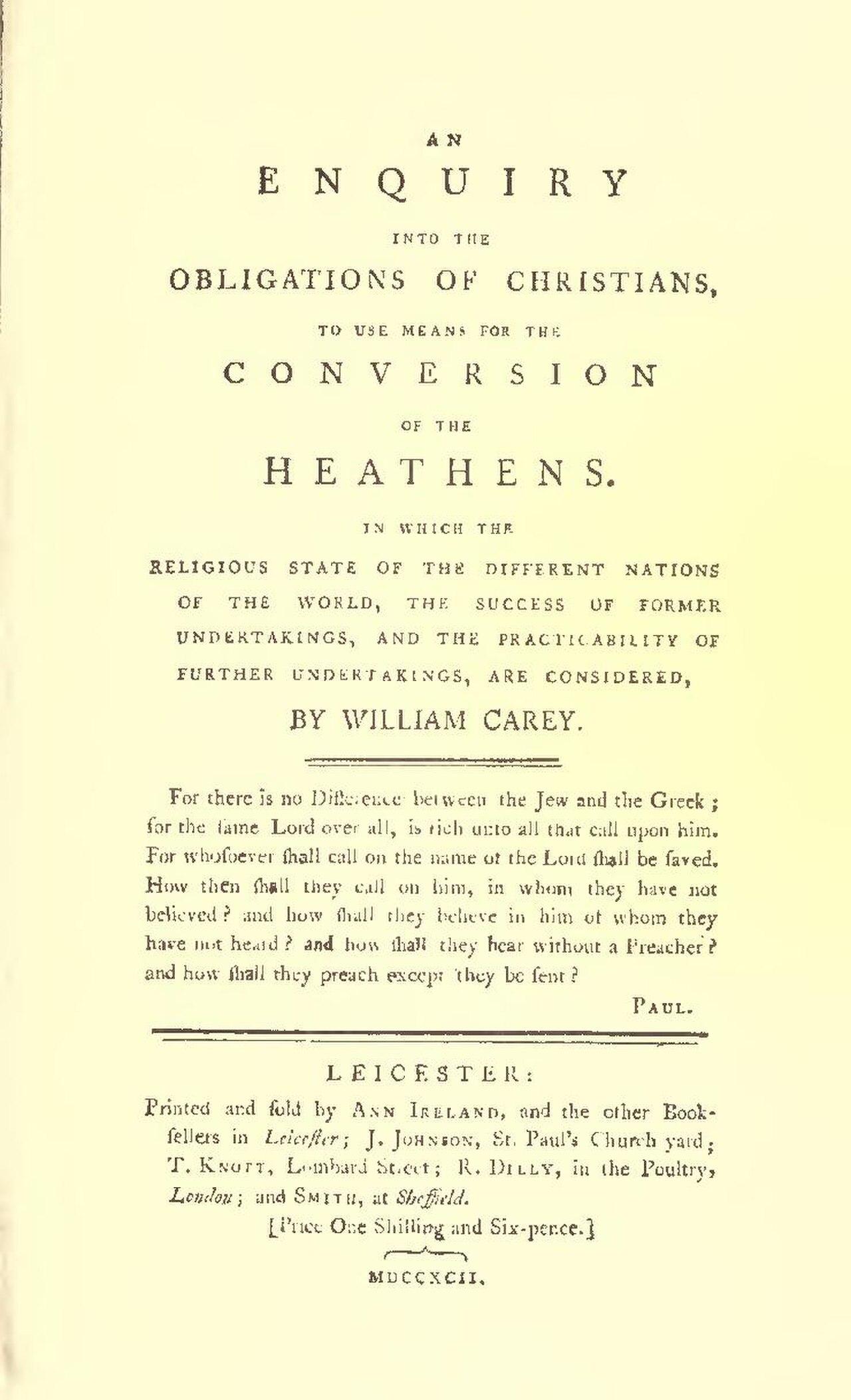
William Carey, An Enquiry into the Obligations of Christians, 1792. Public domain.
Scotland to Kettering · Subject · Featured Study
From Edwards to Carey
A Scottish agreement to pray, published by Jonathan Edwards at Boston, came to stand behind William Carey's Enquiry and his mission.
A copy of a New England pastor's book on prayer came from Scotland to a friend of Andrew Fuller in April 1784.
This is what the LORD of Hosts says: “Peoples will yet come—the residents of many cities— and the residents of one city will go to another, saying: ‘Let us go at once to plead before the LORD and to seek the LORD of Hosts. I myself am going.’ And many peoples and strong nations will come to seek the LORD of Hosts in Jerusalem and to plead before the LORD.”
This is what the LORD of Hosts says: “Peoples will yet come—the residents of many cities— and the residents of one city will go to another, saying: ‘Let us go at once to plead before the LORD and to seek the LORD of Hosts. I myself am going.’ And many peoples and strong nations will come to seek the LORD of Hosts in Jerusalem and to plead before the LORD.”
- Books
- Zechariah, Isaiah, Matthew
- Hold in memory
- Zechariah 8:21, Isaiah 54:2
Summary
Jonathan Edwards wrote the Humble Attempt in 1747. He wrote it to spread a concert of prayer begun in Scotland. Baptist ministers in the English Midlands took up its call to pray at set times. Within eight years one of them, William Carey, had moved them to form a society for missions.
- In October 1744 ministers in Scotland agreed to pray together for revival.
- The Nottingham association began monthly meetings of prayer.
- Carey asked in his Enquiry what Christians owe to the nations.
- The society was formed at Kettering on 2 October 1792.
The Verses Behind the Call to Pray and Go
Edwards opened his book on Zechariah 8, and Carey grounded his on the commission and on Isaiah 54.
Edwards set a prophecy of united prayer at the head of his book. Carey began from the command to teach all nations and preached from Isaiah's word about the tent.
Carey
Therefore go and make disciples of all nations, baptizing them in the name of the Father, and of the Son, and of the Holy Spirit,
Carey opens the Enquiry by asking whether this commission still binds the church.
How then can they call on the One in whom they have not believed? And how can they believe in the One of whom they have not heard? And how can they hear without someone to preach? And how can they preach unless they are sent? As it is written: “How beautiful are the feet of those who bring good news!”
Carey's title page prints these questions about hearing, preaching and being sent.
“Enlarge the site of your tent, stretch out the curtains of your dwellings, do not hold back. Lengthen your ropes and drive your stakes in deep.
Carey preached from this verse at Nottingham in May, as the society's narrative records.
Isaiah 54:2BSB
From the Concert of 1744 to Kettering
The dated steps run from the Scottish agreement to the society's first resolutions.
The call to pray went from Scotland to Edwards and on to the English Midlands over forty-eight years.
- The Scottish concert of prayer beginsOctober 1744Edwards, An Humble Attempt, page 14
- Edwards publishes the Humble Attempt at Boston1747The book's title page
- A copy reaches a friend of Fuller from Dr. Erskine23 April 1784Ryland, The Work of Faith, the Labour of Love, and the Patience of Hope, page 86
- The Nottingham association begins the monthly prayer meetings3 June 1784Ryland, The Work of Faith, the Labour of Love, and the Patience of Hope, page 86
- Carey asks his question at Clipstone1791Periodical Accounts, volume I, 1800, page 2
- Carey preaches at Nottingham from Isaiah 5431 May 1792Periodical Accounts, volume I, 1800, pages 2 and 3
- The society is formed at Kettering2 October 1792Periodical Accounts, volume I, 1800, page 3
A timeline of dated steps, each row naming the record that fixes its date.
The era of the Great Awakenings holds the wider story of the revivals behind Edwards's book.
The Concert of Prayer and Edwards's Humble Attempt
Scottish ministers agreed on set times of prayer, and Edwards wrote to spread the agreement.
Edwards tells how a number of ministers in Scotland, in October 1744, agreed to pray for an outpouring of the Holy Spirit and the revival of true religion. They proposed to keep the practice for two years.
They set apart some time on Saturday evening and on the Sabbath morning each week. They kept the first Tuesday of each quarter more solemnly, in private praying societies, in public meetings or alone.
A memorial from Scotland then asked that the concert continue for seven years. Edwards wrote the Humble Attempt as minister at Northampton to press the memorial on readers in New England.
The Call Reaches the Baptists of Northamptonshire
The monthly prayer meetings led to Carey's question, his book and the society.
John Ryland, Fuller's biographer, writes that the meetings of prayer on the first Monday of every month were first set on foot at the Nottingham Baptist Association on 3 June 1784. He traces the proposal to a copy of the Humble Attempt that Dr. Erskine sent from Scotland to a friend of Fuller in April of that year.
Ryland adds that the Warwickshire Association recommended the meetings in 1786 and the Western Association in 1790.
When Carey printed his Enquiry, he pointed his readers in a footnote to Edwards on prayer, lately reprinted by Mr. Sutcliffe. He judged that the monthly meetings had been heard, though the prayers were feeble.
The society's own narrative of 1800 places the next step at a ministers' meeting at Clipstone in 1791, after sermons by Sutcliff and Fuller. There Carey asked whether it was not their duty to attempt something toward spreading the gospel among the nations.
The ministers asked Carey to write out his thoughts, and the Enquiry followed some months after the sermons were printed. At Nottingham he pressed two points from Isaiah 54, that they should expect great things and attempt great things.
At Kettering the ministers agreed the first resolutions unanimously after the public services of the day. The second resolution named the body The Particular Baptist Society for Propagating the Gospel amongst the Heathen.
In Their Own Words
Jonathan Edwards (1703 to 1758)
An Humble Attempt to Promote Explicit Agreement and Visible Union of God's People in Extraordinary Prayer, part I, page 15
Edwards told what the Scottish ministers prayed for.
“to deliver all Nations from their great and manifold spiritual Calamities and Miseries, and bless them with the unspeakable Benefits of the Kingdom of our glorious Redeemer, and fill the whole Earth with his Glory.”
Congregationalist
About this saying1 paragraph
Edwards gives the end of the concert of 1744 in the first part of the Humble Attempt.
William Carey (1761 to 1834)
His question at the ministers' meeting at Clipstone, 1791, in Periodical Accounts Relative to the Baptist Missionary Society, volume I, number I, page 2
Carey put his question to the ministers at Clipstone.
“Whether it were not practicable, and our bounden duty, to attempt somewhat toward spreading the gospel in the heathen world?”
Particular Baptist
About this saying1 paragraph
Carey asked this in 1791, a year before he printed his Enquiry.
William Carey
An Enquiry into the Obligations of Christians to Use Means for the Conversion of the Heathens, section V, page 79
Carey trusted that the monthly meetings had not been in vain.
“I trust our monthly prayer-meetings for the success of the gospel have not been in vain.”
Particular Baptist
About this saying1 paragraph
Carey wrote this near the close of the Enquiry of 1792, on page 79 of the Leicester printing.
What Moved the Baptists in 1792
Ryland traces the prayer meetings to Edwards's book, and the society's narrative begins with Carey's own mind.
Ryland's footnote of 1818 makes Edwards's book the root of the prayer meetings, and Carey's own footnote in the Enquiry sends the reader to it.
The narrative printed by the society in 1800 begins instead with the workings of Carey's mind over nine or ten years. It names his book, his sermon at Nottingham and the ministers' meetings, and does not mention Edwards's call to prayer.
Books to Read Next
An Humble Attempt
Jonathan Edwards · 1747
Edwards tells the Scottish concert and argues for joining it.
Free at the Internet ArchiveAn Enquiry into the Obligations of Christians
William Carey · 1792
Carey surveys the nations and proposes a society to send preachers.
Free at the Internet ArchivePeriodical Accounts, volume I
The Baptist Missionary Society · 1800
The society printed the story of its own beginning in this first number.
Free scan of volume IThe Life and Death of the Rev. Andrew Fuller
John Ryland · 1818
Ryland dates the prayer meetings in his notes and traces them to Edwards.
Free at the Internet ArchiveWhat the Concert Handed On
A Scottish agreement to pray was carried across the Atlantic in a New England book and back again. Within eight years of the first monthly meeting in the Midlands, its readers had founded a Baptist missionary society.
Sources
Scripture is the Berean Standard Bible.
- The Holy Bible, Berean Standard Bible (read 2026)
- Jonathan Edwards, An Humble Attempt to Promote Explicit Agreement and Visible Union of God's People in Extraordinary Prayer (Boston: D. Henchman, 1747), title page, page 1, pages 14 to 15 and 23 to 24.
- John Ryland, The Work of Faith, the Labour of Love, and the Patience of Hope, Illustrated in the Life and Death of the Rev. Andrew Fuller (Charlestown: Samuel Etheridge, 1818), page 86, the editor's footnote.
- William Carey, An Enquiry into the Obligations of Christians to Use Means for the Conversion of the Heathens (Leicester: Ann Ireland, 1792), title page, section I, page 12 and page 79.
- Periodical Accounts Relative to a Society Formed among the Particular Baptists for Propagating the Gospel among the Heathen, volume I (1800), number I, the narrative of the first establishment of the society, pages 1 to 3.
Keep Studying
Studies1
Go further2
Doctrines1
Church history6
Values1