
AD 1666 to 1705 · Story · Featured Study
Spener and the Pia Desideria
A pastor's preface of 1675 set out six proposals for the Lutheran church, and a faculty of that church charged him with error twenty years later.
Kurtz reports that Carpzov called the mild and peace-loving Spener a storm of the church.
- When
- 1666 to 5 February 1705
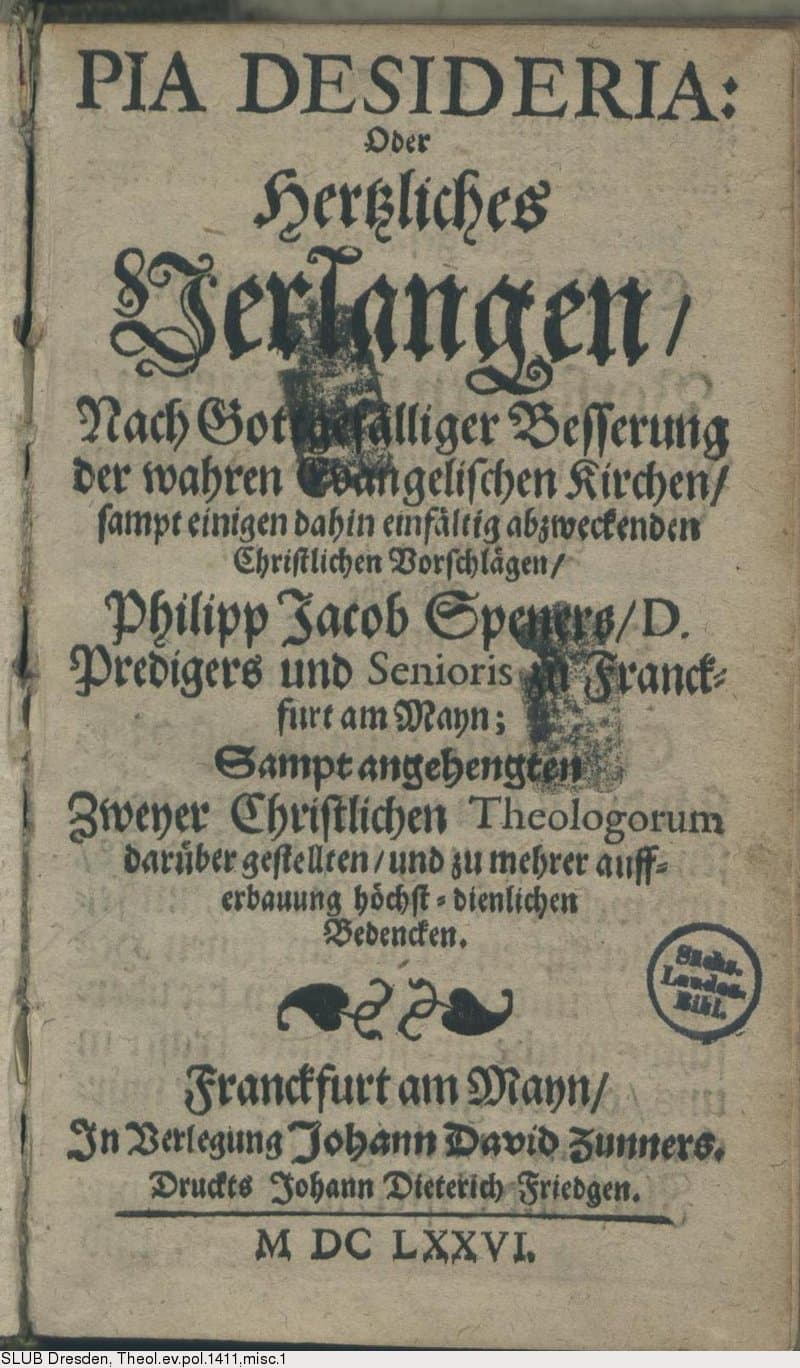
The title page of the Pia Desideria, 1676. Public domain.
Let the word of Christ richly dwell within you as you teach and admonish one another with all wisdom, and as you sing psalms, hymns, and spiritual songs with gratitude in your hearts to God.
Summary
Philipp Jakob Spener was a Lutheran pastor. His Pia Desideria asked his church for three things. They were more of the Bible among its people, a faith lived in practice and better-trained ministers.
- Kurtz says Spener also wrote a treatise on the spiritual priesthood. It brought back a doctrine that was almost forgotten.
- Mirbt says Spener alone exchanged some fifty treatises with his opponents from 1691 to 1698.
- Kurtz says that when Spener died, his opponents argued over whether he could be thought of as in glory.
The Verses Spener Gave His Proposals
He grounded the priesthood in 1 Peter 2 and the life of love in Romans 13.
Both verses stand among the texts he gives his second and third proposals.
But you are a chosen people, a royal priesthood, a holy nation, a people for God’s own possession, to proclaim the virtues of Him who called you out of darkness into His marvelous light.Spener cites this verse to show that every believer shares in the spiritual priesthood.
The commandments “Do not commit adultery,” “Do not murder,” “Do not steal,” “Do not covet,” and any other commandments, are summed up in this one decree: “Love your neighbor as yourself.”Spener quotes this verse under his third proposal, for in love all the commandments consist.
The Six Proposals
Each proposal stands in Spener's German and in MannaFest's English.
The proposals move from the Bible in the people's hands to the preaching of the inner man.
| Proposal | In Spener's words | In MannaFest's English |
|---|---|---|
| 1 | das wort GOttes reichlicher unter uns zu bringen | to bring the word of God more richly among us |
| 2 | die auffrichtung und fleissige übung des Geistlichen Priesterthums | the setting up and diligent exercise of the spiritual priesthood |
| 3 | in der praxi bestehe | that Christianity stands in practice |
| 4 | wie man wegen der Religions-strittigkeiten | how to bear oneself in disputes of religion, with prayer and good example |
| 5 | in den Schulen und auff Universitäten | ministers trained in the schools and universities |
| 6 | dem innern oder neuen menschen | preaching that reaches the inner or new man |
The Story From Frankfurt to Berlin
The story runs from Alsace to Frankfurt, Dresden and Berlin, with quarrels at Leipzig and Wittenberg on the way.
Spener was born at Rappoltsweiler in Upper Alsace in January 1635.
He was called to Frankfurt as senior in 1666. From 1670 he held meetings in his own house, as Mirbt and Kurtz both say. Mirbt adds that they met twice a week, and he calls them the collegia pietatis.
What then shall we say, brothers? When you come together, everyone has a psalm or a teaching, a revelation, a tongue, or an interpretation. All of these must be done to build up the church.Spener's first proposal cites 1 Corinthians 14 for meetings where each member brings a word, and verse 26 is MannaFest's choice within that chapter.
His preface to a new printing of Arndt's Postil appeared at Frankfurt in 1675, and the next year it was printed alone as the Pia Desideria.
Its first part surveys the faults of each estate of the church, beginning with the civil estate.
All Scripture is God-breathed and is useful for instruction, for conviction, for correction, and for training in righteousness,Spener cites 2 Timothy 3 in his first proposal for the use of the whole of Scripture, and verse 16 is MannaFest's choice within that chapter.
Its second part reads Romans 11 and Hosea 3 as a promise of better times for the church on earth.
Mirbt adds that these times were “to begin when Israel should have become converted and papal Rome should have fallen.”
And so all Israel will be saved, as it is written: “The Deliverer will come from Zion; He will remove godlessness from Jacob.Spener sets this verse first among his proofs and calls it Paul's heartfelt prophecy.
Its third part sets out the six proposals for the church's reform.
A new commandment I give you: Love one another. As I have loved you, so you also must love one another. By this everyone will know that you are My disciples, if you love one another.”The new commandment stands behind his third proposal, that Christianity is a matter of practice.
Spener went to Dresden as first chaplain in the summer of 1686. At Leipzig, Francke and Anton founded the collegium philobiblicum on 18 July 1686, and an edict of 10 March 1690 forbade such meetings.
Kurtz says Spener was expelled from Dresden, and Richard that the Elector wrote his dismissal after Brandenburg proposed the move. In 1691 he became provost of St Nicholas in Berlin.
In 1695 the Wittenberg faculty charged him in print, and he died at Berlin on 5 February 1705.
For the Israelites must live many days without king or prince, without sacrifice or sacred pillar, and without ephod or idol.Spener adds this verse as one of the places in the prophets that point the same way when they are rightly searched.
Romans 11:26, John 13:34 to 35, Hosea 3:4
The People of the Story
Seven people, each with his part and the witness who records it.
Arndt, Francke and Spener's godson stand beside three opponents at Leipzig, Wittenberg and Lübeck.
| Person | His part | The record |
|---|---|---|
| Philipp Jakob Spener | He wrote the Pia Desideria and led the meetings at Frankfurt. | Mirbt; Kurtz; Richard |
| Johann Arndt | His Postil was the book Spener's preface first stood in. | The VD17 catalogue |
| August Hermann Francke | With Paul Anton and J. K. Schade he had to leave Leipzig in 1690. | Kurtz |
| Johann Deutschmann | Kurtz puts him at the head of the Wittenberg faculty, and Mirbt names him the author of its charges. | Kurtz; Mirbt |
| Carpzov | Kurtz names J. B. Carpzov at the head of the Leipzig faculty that charged Francke and his friends with despising public worship. | Kurtz; Mirbt |
| August Pfeiffer | He wrote against Spener from Lübeck. | Mirbt |
| Nikolaus Ludwig von Zinzendorf | Spener dedicated him, his godson of four, to the kingdom of God in May 1704. | Mirbt |
Who Tells the Story
Spener's own book and four accounts written two centuries later tell the story.
A Frankfurt printing of his book from 1706 stands in the Bavarian State Library.
His life comes from Carl Mirbt's article in the New Schaff-Herzog Encyclopedia, from J. H. Kurtz's Church History in its English of 1890, and from M. E. Richard's life of 1897. The fourth source is the eleventh edition of the Britannica, of 1911.
What the Record Leaves Unsaid
The sources disagree on the day of his birth and give no reason.
The Britannica and Richard give 13 January 1635 for his birth and Mirbt gives the 23rd, and none of them says why the days differ.
In Their Own Words
Spener speaks in three passages of his German, each with MannaFest's English in its fold, and in one saying Kurtz reports in English.
Philipp Jakob Spener (1635 to 1705)
Pia Desideria (1675), the first proposal, in the printing of Frankfurt, 1706, page 94
The word more richly among us
“Daß man dahin bedacht wäre / das wort GOttes reichlicher unter uns zu bringen. Wir wissen / daß wir von natur nichts gutes an uns haben / sondern soll etwas an uns seyn / so muß es von GOtt in uns gewürcket werden / und darzu ist das wort das kräfftige mittel”
Lutheran
About this saying1 paragraph
Here Spener gives the reason for his first proposal of 1675. In MannaFest's English: that care be taken to bring the word of God more richly among us. We know that by nature we have nothing good in us. If anything is to be in us, God must work it there, and for that the word is the strong means.
Philipp Jakob Spener
Pia Desideria (1675), the second part, in the printing of Frankfurt, 1706, page 72
A better state for the church
“Sehen wir die heilige Schrifft an / so haben wir nicht zu zweifflen / daß GOtt noch einigen bessern zustand seiner Kirchen hier auff Erden versprochen hat.”
Lutheran
About this saying1 paragraph
This is the sentence on which the second part of the book of 1675 turns. In MannaFest's English: if we look at Holy Scripture, we have no cause to doubt that God has yet promised his church some better state here on earth.
Philipp Jakob Spener
Pia Desideria (1675), the sixth proposal, in the printing of Frankfurt, 1706, page 151
The inner man
“Das vornehmste aber achte ich dieses zu seyn / weil ja unser gantzes Christenthum bestehet in dem innern oder neuen menschen / dessen Seele der glaube ...”
Lutheran
About this saying1 paragraph
Here Spener names what he held in 1675 to be the chief thing in preaching. In MannaFest's English: the chief thing I take to be this, since our whole Christianity consists in the inner or new man, whose soul is faith.
An attributed saying
The saying1 paragraph
Attributed to Spener by Kurtz, who names no source. Kurtz's Church History gives it in its English of 1890. “Had I the power to call any one from the dead for the good of the church, it would be J. V. Andrea.”
Philipp Jakob Spener, An attributed saying
Where Historians Disagree
Three questions of Spener's work, with the writers who answer them.
A renewal of the Lutheran church, or a departure from it?2 paragraphs
Kurtz held that Spener saw “a pressing need of a new and wider reformation” and found the Lutheran church its fittest field, and every proposal is addressed to that church and its ministers.
Against that reading, the Wittenberg faculty charged him in 1695 with error against the church's teaching, and Kurtz himself judged that Halle Pietism after its founders grew narrow.
How many errors did Wittenberg charge?1 paragraph
The Britannica and Kurtz give 264. Mirbt gives 283 and names the faculty's work, the Christlutherische Vorstellung of 1695.
Did he teach a coming age of the church on earth?1 paragraph
Pfeiffer charged him with chiliasm over his book of 1692 on the hope of better times. Against the charge, the Pia Desideria grants that Luther and several other Lutheran teachers held Paul's promise already fulfilled in the Jews converted since the apostles' time.
Books to Read Next
Three free books, the first of them his own.
Pia Desideria
Philipp Jakob Spener · 1706 printing
It is the book itself, in German, with the six proposals in its third part.
Read it free onlinePhilip Jacob Spener and His Work
M. E. Richard · 1897
It tells his life in English, from Alsace to Berlin.
Read it free onlineChurch History, volume 3
J. H. Kurtz, translated by John Macpherson · 1890
It weighs Pietism and its opponents in two long sections.
Read it free onlineWhat Spener Left
A preface written for another man's sermons left a movement that, in Mirbt's words, “divided Lutheran Germany into two camps.”
Sources
Scripture is the Berean Standard Bible.
- The Holy Bible, Berean Standard Bible (read 2026)
- Philipp Jakob Spener, Pia Desideria: Oder Hertzliches Verlangen (first printed with Arndt's Postil, Frankfurt, 1675; alone, Frankfurt, 1676), in the printing of Frankfurt, 1706, pages 8, 35, 72, 94 to 113, 126 and 151.
- VD17, the catalogue of German prints of the seventeenth century: 12:633789B (Arndt's Postilla, Frankfurt: Zunner, 1675) and 23:000599T (Pia Desideria, Frankfurt: Zunner, printed by Fritgen, 1676)
- Carl Mirbt, Pietism, in The New Schaff-Herzog Encyclopedia of Religious Knowledge, volume 9 (New York: Funk and Wagnalls, 1911), pages 53 to 55.
- J. H. Kurtz, Church History, volume 3, translated by John Macpherson (London: Hodder and Stoughton, 1890), sections 159 and 167, pages 41 to 45 and 105.
- M. E. Richard, Philip Jacob Spener and His Work (Philadelphia: Lutheran Publication Society, 1897), pages 7 to 8, 59, 73 and 89.
- The Encyclopaedia Britannica, eleventh edition (Cambridge, 1911), volume 25, Spener.
Keep Studying
Studies4
People and groups7
Doctrines1
Subjects1
Church history2