
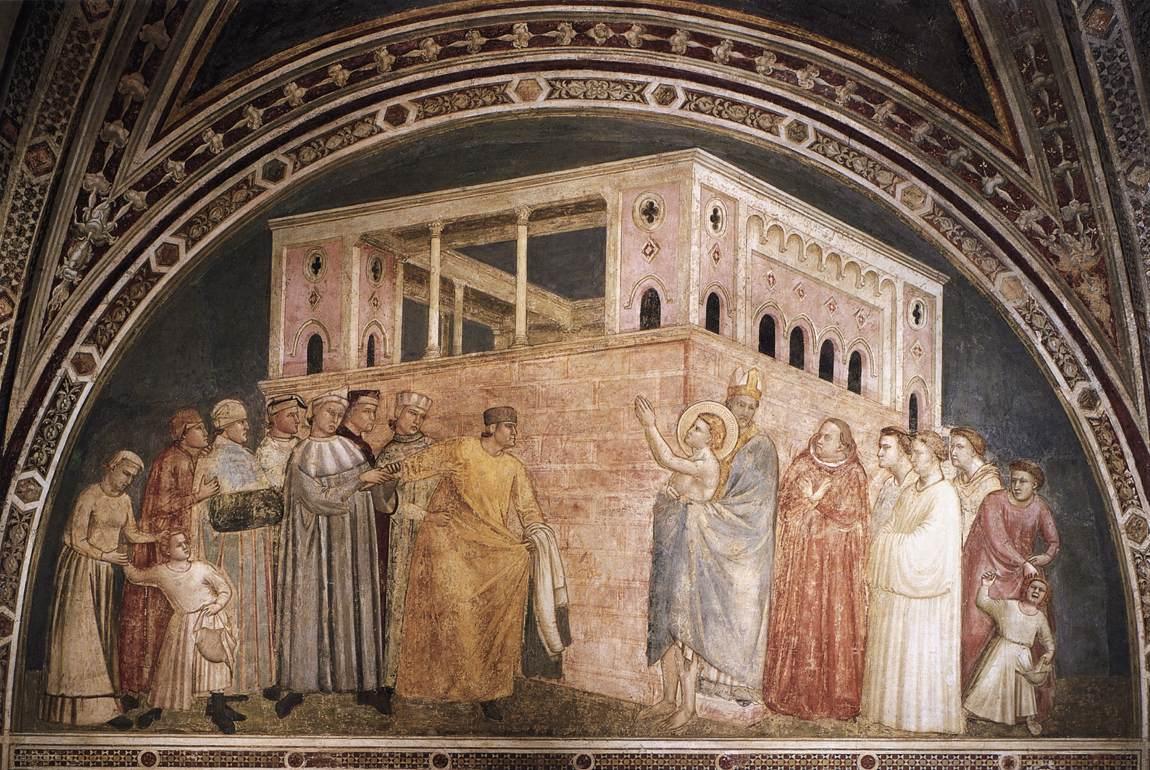
Giotto, The Renunciation of Worldly Goods, about 1325. Public domain.
Assisi, 1182 to 1226 · Person · Featured Study
Francis of Assisi
He founded the order of the Friars Minor and wrote the Canticle of the Sun in his own Italian.
- The name means
- Francesco; Schaff says his baptismal name was Giovanni and that his father seems to have named him with reference to France
- Born
- 1182, at Assisi, by Schaff's dating (probable)
- Died
- 3 October 1226, at the Portiuncula below Assisi (probable)
- Family
- father: Pietro Bernardone
- Places
- Assisi, San Damiano, the Portiuncula, Rome, Egypt, Greccio, La Verna
Before the bishop of Assisi he took off his clothes and gave them back to his father.
Do not carry any gold or silver or copper in your belts.
Summary
Francis was the son of Pietro Bernardone, a rich cloth dealer of Assisi. In 1208 he gave up his father's goods. In 1209 he took the words of Matthew 10 as the rule of his life, and he died near Assisi on 3 October 1226.
- In his Testament, written just before he died, he tells how the Lord led him among lepers.
- Bonaventure says he preached Christ to the sultan, and Philip Schaff dates that voyage to 1219.
- The day after he died, Elias of Cortona wrote that the body bore the five wounds of Christ, and Schaff weighs the case.
The Gospel He Heard
Matthew 10 sent the Twelve out without gold or silver, and Matthew 19 told a rich young man to sell what he had.
Bonaventure writes that Francis heard at Mass the Gospel in which Christ sent His disciples out with neither gold nor silver nor money in their purses. Francis said, "this is what I long for with my whole heart", and he laid down his shoes, his staff and his purse.
The question of this life is how much of it rests on his own writings and how much on the Lives written after his death. His Testament and the Canticle of the Sun are his own, and the stories of the leper, the bishop and the sultan come from Bonaventure.
Jesus told him, “If you want to be perfect, go, sell your possessions and give to the poor, and you will have treasure in heaven. Then come, follow Me.”Schaff names this verse among the three passages the first brothers took as their Rule.
The Life in Order
Schaff gives most of the years, and Bonaventure and Robinson give the rest.
The years from his turning to his death number about eighteen.
- 1182BirthSchaff, section 70
- No date givenThe leperBonaventure, chapter 1
- No date givenThe crucifixBonaventure, chapter 2, section 1
- 1208The break with his fatherSchaff, on the year
- 1209The Gospel of the TwelveBonaventure, chapter 3
- 1210The first RuleTestament, page 83
- 1212ClareSchaff, on Clara of Sciffi
- 1219The sultanBonaventure, chapter 9
- 29 November 1223The later RuleRobinson, on the bull
- Three years before his deathGreccioBonaventure, chapter 10
- 1224La VernaSchaff, on the stigmata
- 1225The CanticleRobinson, page 151
- 1226Testament writtenRobinson, page 79
- 3 October 1226DeathSchaff, with Brother Leo
- 1228CanonizationSchaff, section 70, note 824
Each step of the life stands with its witness.
1212, 1219, 29 November 1223, Three years before his death, 1224, 1225, 1226, 3 October 1226 and 1 more
From Assisi to the Portiuncula
In his Testament he gives the turn of his life, and Bonaventure and Schaff give the rest.
Schaff writes that Francis studied Latin, had money to spend and spent it in gaieties. He fought for Assisi against Perugia and was taken prisoner.
In his Testament he wrote that while he was in sin it seemed very bitter to see lepers, and the Lord led him among them. Bonaventure tells that he met a leper on the plain below Assisi, got down from his horse and kissed the man's hand.
At the old church of San Damiano he prayed before a crucifix. Bonaventure writes that a voice from the cross told him three times to go and repair the house of Christ, which was falling into ruin. He set out to repair the church building.
He took goods from his father to pay for the work, and his father brought him before the bishop to give up all claim to his inheritance. Francis stripped before them all and returned every garment to his father. The bishop covered him with his own cloak.
Schaff dates his hearing of Matthew 10 at Mass to 1209. Companions joined him, and in 1210 he took them to Rome, where Innocent III received them.
In 1212 Clare of Assisi left her father's house, and Francis received her vows. The chapel was given to her and the sisters who followed her.
In 1219 he went to Egypt and Syria. Bonaventure tells that he was brought before the sultan and preached Christ to him, and that he offered to walk into a fire to show which faith was true. The sultan refused, "for that he feared a revolt of his people".
At Greccio he kept Christmas with a manger, hay, an ox and an ass. In 1224, on the mountain of La Verna, the account says the marks of the five wounds of Christ came on his body.
Ill, he made the Canticle of the Sun in a hut near that chapel toward the close of 1225. He wrote his Testament in the summer of 1226 and died at the Portiuncula on 3 October. Gregory IX made him a saint two years later.
Read Renewal in the Western Church, on Benedict, Cluny and the friars
The Lives Behind the Life
His own writings are few, and most of the stories come from Lives written after his death.
Paschal Robinson's edition of 1906 gathers the writings held to be his: the Admonitions, the Rules, the letters, the Testament and the Canticle of the Sun. Robinson notes that Gregory IX cited the Testament in his bull of 28 September 1230. He writes that the bull shows the Testament was published only a few days before Francis died.
The leper on the plain, the voice from the crucifix and the fire offered before the sultan come from the Life by Bonaventure. Schaff calls it "legendary" and says that on the stigmata Bonaventure "is seeking to establish the fact against doubts".
Two sayings often given to Francis are not in Robinson's edition. The prayer that begins "Lord, make me an instrument of your peace" first appeared without a name in a French magazine in December 1912 and was first given to him in 1927. The line "Preach the gospel at all times" is not in his writings either.
In Their Own Words
Three passages from his writings and one reply that Bonaventure gives.
Francis of Assisi (died 1226)
The Testament (1226), in Paschal Robinson, The Writings of Saint Francis of Assisi (Philadelphia, 1906), page 83
The form of the holy Gospel
“And when the Lord gave me some brothers, no one showed me what I ought to do, but the Most High Himself revealed to me that I should live according to the form of the holy Gospel.”
Catholic
About this saying1 paragraph
In the same Testament of 1226 he told how the first brothers came and how the Rule was written.
The Lord led me among lepers1 quotation, 1 paragraph
He wrote this at the opening of his Testament in 1226, looking back on the start of his conversion.
Most high, omnipotent, good Lord1 quotation, 1 paragraph
Robinson renders the song of 1225 into a literal English line by line.
Our sister, the bodily death1 quotation, 1 paragraph
Robinson reports the tradition that he added this strophe of the Canticle in 1226, when he knew that death was near.
Our Father, Which art in heaven1 quotation, 1 paragraph
Bonaventure gives these words to Francis at his break with his father, in 1208 by Schaff's date.
The People Around Him
The sources name his father, the bishop, his first companions, Clare and two popes.
His break with his father opened the life the others joined.
| Person | Tie to Francis | The witness |
|---|---|---|
| Pietro Bernardone | His father, a rich cloth dealer, who brought him before the bishop. | Schaff; Bonaventure, chapter 2 |
| The bishop of Assisi | The renunciation took place before him. | Bonaventure, chapter 2, section 4 |
| Bernardo di Quintavallo and Egidio | They were among the first companions to join him. | Schaff |
| Clare of Assisi | Francis received her vows in 1212, and she lived at San Damiano. | Schaff; Bonaventure, chapter 4 |
| Innocent III | He confirmed the short Rule Francis had written, the Testament says. | Robinson, page 83 |
| Elias of Cortona | As vicar of the order he announced the stigmata after the death. | Schaff |
| Gregory IX | He cited the Testament in his bull Quo elongati. | Robinson, page 79 |
Bonaventure calls Clare "the first plant" among the women who followed Francis.
The Places of His Life
His life ran from Assisi to Rome and Egypt and back to the Portiuncula.
Almost every place of his life lies within a day's walk of Assisi.
| Place | What the sources say | The witness |
|---|---|---|
| Assisi | His home town, where he was born and died. | Schaff |
| San Damiano | The old church he rebuilt, later the house of Clare and her sisters. | Bonaventure; Schaff |
| The Portiuncula | The abbot of Mount Subasio gave him the chapel. | Schaff, on Santa Maria degli Angeli |
| Rome | The seat of the popes who approved his Rule. | Testament; Robinson |
| Egypt and Syria | The farthest point of his preaching tours. | Schaff, on the tours |
| Greccio | A town of Italy where the hay and the animals were brought. | Bonaventure, chapter 10, section 7 |
| La Verna | A mountain, where the account sets the vision of the seraph. | Schaff, on the vision |
What His Rule Asked
In his Testament he asks the brothers to work, to beg only when unpaid, and to take no buildings beyond what poverty allows.
In the Testament, those who came gave to the poor all they had and were content with one patched tunic, a cord and breeches. Francis wrote, "I worked with my hands", and he wished all the brothers to work at some honest labour.
When no wage was paid, they were to go to "the table of the Lord, begging alms from door to door". He told the brothers to receive no churches or dwellings built for them unless these kept the holy poverty of the Rule.
Schaff writes that living was more important to Francis than sermons or learning. Francis sought, in Schaff's words, "to give the Gospel to the common people".
How the Key Verse Was Taught
Jerome and Albert Barnes read the charge to take no gold or silver.
Jerome (died 420)
Catena Aurea by Aquinas
Jerome's reading of the verse comes down in the Catena Aurea of Thomas Aquinas.
“For if they preach without receiving reward for it, the possession of gold and silver and wealth was unnecessary. For had they had such, they would have been thought to be preaching, not for the sake of men's salvation, but their own gain. As He had cut off riches, which are meant by gold and silver, He now almost cuts off necessaries of life; that the Apostles, teachers of the true religion, who taught men that all things are directed by God's providence, might show themselves to be without thought for the morrow.”
on Matthew 10:9 to 10Patristic
Albert Barnes (1798 to 1870)
Notes, Explanatory and Practical, on the Old and New Testaments (1832-1869)
Albert Barnes read the verse as a charge not to provide money for travel.
“This prohibition of gold, silver, and brass is designed to prevent their providing money for their journey. Pieces of money of ‘small value’ were made of brass.”
on Matthew 10:9Evangelical
What the Sources Leave Open
Readers differ on the stigmata, on the hands in the Canticle and on whether he wrote one testament or several.
The marks of the stigmataElias of Cortona; Gregory IX; Sabatier; Hausrath, as Schaff reports him; Schaff
The day after the death, Elias of Cortona wrote to the order that he had seen on the body "five wounds which were truly the stigmata of Christ". Gregory IX in 1237 called on the whole Church to accept them.
Schaff names three views. The Catholic view holds them a miracle, and Sabatier held them the product of a highly wrought mind. A third view, which Schaff gives to Hausrath, holds that Francis made them with his own fingers.
Against them Schaff sets the silence of Gregory IX's bull of canonization in 1228. He also writes that "the historical attestation is such that an effort is required to deny them".
Whose hands are in the CanticleRobinson; Renan, as Robinson reports him; Sabatier
Robinson reports a tradition that Fra Pacifico had a hand in shaping the Canticle, and he says a whole literature has grown around the question. Renan held that no Italian original survives. Robinson answers, with Sabatier, that the Italian text stands in the Assisi manuscript 338 and in the Mazarin Library.
One testament or severalSabatier; Robinson
Sabatier held that Francis made his will anew at the end of each of his crises. Robinson answers that the early Lives know only the one Testament, and that every passage quoted from "the Testament" can be found in it, with two exceptions.
Books to Read Next
The Writings of Saint Francis of Assisi
Paschal Robinson, translator · 1906
Robinson gives the Testament, the Rules and the Canticle with notes on each text.
Read Robinson free at the Internet ArchiveThe Life of Saint Francis
Bonaventure, translated by E. Gurney Salter · 1904
Salter's English of 1904 is the edition quoted for the Gospel at Mass, the bishop and the sultan.
Read Bonaventure free at the Internet ArchiveHistory of the Christian Church, volume 5
Philip Schaff · 1907
Section 70 sets out the dates of the life and weighs the stigmata.
Read Schaff free at CCELWhat Francis Left
Francis left a short Rule, a Testament and the one song of his in Italian that has come down.
Sources
Scripture is the Berean Standard Bible.
- The Holy Bible, Berean Standard Bible (read 2026)
- Francis of Assisi, The Testament, in Paschal Robinson, The Writings of Saint Francis of Assisi (Philadelphia: The Dolphin Press, 1906), pages 79 to 86, with Robinson's introduction to it.
- Francis of Assisi, The Canticle of the Sun, in Paschal Robinson, The Writings of Saint Francis of Assisi (Philadelphia: The Dolphin Press, 1906), pages 150 to 153, with Robinson's introduction to it.
- Paschal Robinson, The Writings of Saint Francis of Assisi (Philadelphia: The Dolphin Press, 1906), the contents and the notes on the Rule of 1223.
- Bonaventure, The Life of Saint Francis, translated by E. Gurney Salter, Temple Classics (London: J. M. Dent, 1904), chapters 1, 2, 3, 4, 9 and 10.
- Philip Schaff, History of the Christian Church, volume 5 (1907), section 70, St. Francis d'Assisi, with its notes.
- C. Renoux, The Origin of the Peace Prayer of St. Francis, Franciscan Archive (cited only)
- Jerome, on Matthew 10:9, in Thomas Aquinas, Catena Aurea.
- Albert Barnes, Notes, Explanatory and Practical, on the New Testament, on Matthew 10:9.
Keep Studying
People and groups6
Go further1
Church history2