
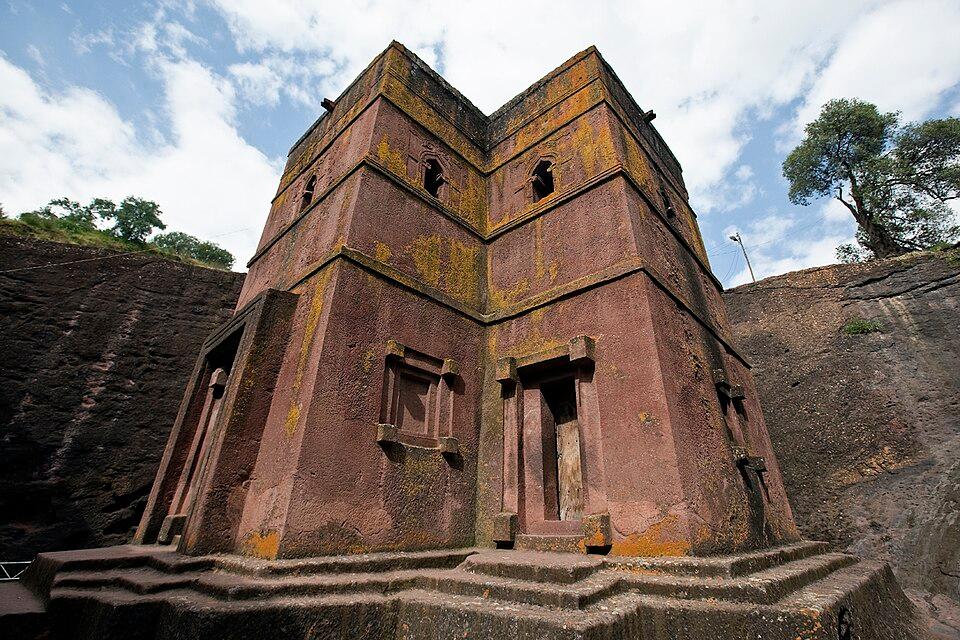
Hulivili, Bete Giyorgis, Lalibela, 2009. CC BY 2.0.
The first century to 2026 · Subject · Featured Study
The Church in Africa
The church stood in Egypt, Carthage and Ethiopia in its first centuries and grew through African prophets in the last one.
- Books
- Acts, Mark, 1 Peter
- Hold in memory
- Acts 8:27, 1 Peter 4:16
Eusebius traces the churches of Alexandria to Mark, who wrote the second Gospel.
So he started out, and on his way he met an Ethiopian eunuch, a court official in charge of the entire treasury of Candace, queen of the Ethiopians. He had gone to Jerusalem to worship,
Summary
Africa had Christians from the first days of the church. People from North Africa were in the crowd at Pentecost. A court official from Ethiopia was baptized on the road south. Perpetua died for her faith at Carthage, and a bishop served at Axum. In the last century African preachers took the gospel to many new peoples in their own lands.
- Perpetua was about twenty-two when she was condemned to death, about the year 202.
- Athanasius made Frumentius bishop and sent him back to Axum.
- Simon Kimbangu, a Baptist, led a prophet movement in the Congo.
- In 2026 Open Doors ranks Nigeria seventh among the lands where Christians suffer most.
Africa in the New Testament
Luke names Egypt and Libya at Pentecost and a man from Ethiopia on the Gaza road, and Mark names a man of Cyrene.
The New Testament places Africans at the cross, at Pentecost and on the road south from Jerusalem. Perpetua's answer at Carthage takes up the name Peter told believers to bear.
Africans in the Gospels and Acts
Now Simon of Cyrene, the father of Alexander and Rufus, was passing by on his way in from the country, and the soldiers forced him to carry the cross of Jesus.
Mark names Simon of Cyrene, a city of North Africa, as the man made to carry the cross.
Mark 15:21BSB
Phrygia and Pamphylia, Egypt and the parts of Libya near Cyrene; visitors from Rome,
Luke counts Jews and converts from North Africa among the crowd that heard the apostles at Pentecost.
Acts 2:10BSB
Perpetua's trial
But if you suffer as a Christian, do not be ashamed, but glorify God that you bear that name.
Peter tells those who suffer as Christians to praise God for that name, the name Perpetua claimed at her trial.
1 Peter 4:16BSB
1 Peter 4:16
From Alexandria to Nigeria
The dated steps run from the tradition of Mark at Alexandria to the World Watch List that ranks Nigeria seventh.
The line runs from the first churches in Egypt and Carthage to the revivals of the last century and the World Watch List.
- Mark founds the churches of Alexandria, by the tradition Eusebius recordsThe first centuryEusebius, Church History 2.16.1
- Perpetua and her companions are condemnedAbout 202The translator's notice, Ante-Nicene Fathers, volume 3
- Athanasius makes Frumentius bishop of AxumIn the time of AthanasiusAthanasius, Apology to Constantius 29 and 31
- William Wade Harris reaches the Ivory CoastEarly 1914Gaston Joseph, La Côte d'Ivoire (1917), pages 155 to 157
- Simon Kimbangu's movement begins in the Lower CongoMay 1921Lerrigo, The International Review of Missions (1922), page 270
- Revival breaks out in Rwanda1933Emma Wild-Wood, Christian History 153 (2024), pages 38 to 39
- Nigeria stands seventh on the World Watch List2026Open Doors, the table of ranks
A timeline of dated steps, each row naming the record that fixes its date.
The era page of the church under fire holds the wider story of the twentieth century.
Alexandria, Carthage and Axum
Three writers left a record of the early church in Africa.
Eusebius passes on the report that Mark went first to Egypt, preached his Gospel there and founded its first churches.
The Passion of Perpetua and Felicitas tells of new converts who were seized while they still waited to be baptized. Its English translator gives the common view that they died at Carthage.
Perpetua, about twenty-two years old and nursing an infant son, wrote the first part of the account in her own hand. She would not sacrifice for the emperors, and the judge Hilarianus sent the prisoners to the wild beasts.
Socrates tells of Frumentius, a young man of Tyre who ruled a kingdom for its boy king and sought out its Christian traders. Frumentius later went to Alexandria to ask for a bishop, and Athanasius chose him.
Athanasius calls him bishop of Auxumis and keeps a letter the emperor wrote to its two princes about him. His English editor places Auxume in Abyssinia, the old name of Ethiopia.
The Prophets and the East African Revival
Harris preached in West Africa and Kimbangu in the Congo, and revival spread from Rwanda and Uganda.
Gaston Joseph, a French officer, wrote in 1917 that William Wade Harris of Liberia reached the Ivory Coast early in 1914. Joseph records that Harris baptized whole crowds and had their fetishes burned, until the officer at Lahou sent him away.
E. W. Thompson of the Wesleyan mission wrote that Harris's converts ran into tens of thousands, though he preached through interpreters.
P. H. J. Lerrigo, who reached the Congo in August 1921, reports that Simon Kimbangu belonged to the English Baptist church at Wathen. Lerrigo dates the start of the Prophet Movement to the May before.
Emma Wild-Wood traces the East African Revival to early signs in the Anglican Church of Uganda in the 1920s. She writes that revival broke out in Rwanda in 1933 and reached Kenya in 1937 and Tanzania in 1939.
John V. Taylor writes that the movement spread for over twenty years without becoming a sect, though sects were many in the region.
In Their Own Words
Perpetua of Carthage (182 to 203)
The Passion of Perpetua and Felicity, her own narrative, chapter 2, section 2
Perpetua answered the Roman judge.
“I am a Christian.”
Early church martyr
About this saying1 paragraph
Perpetua wrote this of her hearing before Hilarianus, about the year 202, in the part of the Passion that is her own account.
Socrates Scholasticus (died 439)
Church History, 1.19
Socrates tells what Frumentius did as bishop.
“Accordingly this was done; Frumentius invested with episcopal authority, returned to India and became there a preacher of the Gospel, and built several churches, being aided also by divine grace”
Patristic
About this saying1 paragraph
Socrates, whose history runs to the year 439, took this from Rufinus, who heard it from Edesius, Frumentius's companion.
P. H. J. Lerrigo
The Prophet Movement in Congo, The International Review of Missions 11, p. 270
Lerrigo found the Prophet Movement in full swing.
“The movement began in May 1921, and at the time of the writer’s arrival in Congo (August), was in full swing.”
American Baptist missionary and writer
About this saying1 paragraph
Lerrigo wrote this after his journey through the Lower Congo in 1921.
Where the Records Differ
Two writers give different starts for the East African Revival, and the story of Harris comes from the man who sent him away.
Taylor starts the outbreak with Blasio Kigozi of Ruanda, who prayed alone for a week in 1935 and came back in the Spirit's power.
Wild-Wood puts the outbreak in Rwanda two years earlier and traces it back to Simeoni Nsibambi, who met Joe Church of the mission in 1929.
Joseph served the colony that sent Harris away, and he calls the prophet's power over the fetish priests hypnosis.
MannaFest's Wesleyan-Pentecostal tradition sees the gospel's power in the burned fetishes and the crowds who were baptized.
Books to Read Next
The Passion of the Holy Martyrs Perpetua and Felicitas
Perpetua and an unnamed editor, translated by R. E. Wallis · 1885
Perpetua tells her own imprisonment, and an editor tells her death.
Free at the Christian Classics Ethereal LibraryLa Côte d'Ivoire: le pays, les habitants
Gaston Joseph · 1917
Joseph describes the colony, its land and its peoples, in French.
Free at the Internet ArchiveThe Growth of the Church in Buganda
John V. Taylor · 1958
Taylor studies the church of Uganda and the beginnings of the revival among its people.
At the Internet ArchiveWhat the African Church Carried
Africa had churches at Alexandria and Carthage and a bishop at Axum within four hundred years of Christ. In the last century its own prophets and revival leaders took the faith to new peoples in the west, the centre and the east.
Sources
Scripture is the Berean Standard Bible.
- The Holy Bible, Berean Standard Bible (read 2026)
- Eusebius, Church History 2.16.1, translated by Arthur Cushman McGiffert, Nicene and Post-Nicene Fathers, second series, volume 1 (New York, 1890)
- The Passion of the Holy Martyrs Perpetua and Felicitas, translated by R. E. Wallis, with the translator's introductory notice, Ante-Nicene Fathers, volume 3 (Buffalo, 1885), chapter 1, sections 1 and 2.
- Socrates Scholasticus, Church History 1.19, translated by A. C. Zenos, Nicene and Post-Nicene Fathers, second series, volume 2 (New York, 1890), with its note 220 on Rufinus 1.9.
- Athanasius, Apology to Constantius 29 and 31, and Archibald Robertson's prolegomena, Nicene and Post-Nicene Fathers, second series, volume 4 (New York, 1892)
- Gaston Joseph, La Côte d'Ivoire: le pays, les habitants (Paris: Émile Larose, 1917), pages 155 to 157.
- E. W. Thompson, The Ivory Coast: A Study in Modern Missionary Method, The International Review of Missions 17 (1928), pages 632 to 633.
- P. H. J. Lerrigo, The Prophet Movement in Congo, The International Review of Missions 11 (1922), pages 270 to 271.
- John V. Taylor, The Growth of the Church in Buganda (London: SCM, 1958), pages 99 to 100.
- Emma Wild-Wood, The Twentieth-Century East African Revival, Christian History 153, Global Outpouring (Christian History Institute, 2024), pages 38 to 39.
- Open Doors, World Watch List 2026, the table of scores and ranks (reporting period 1 October 2024 to 30 September 2025), in the Swiss edition Weltverfolgungsindex 2026.
Keep Studying
Studies1
Subjects1
Church history8
Trials of life1