
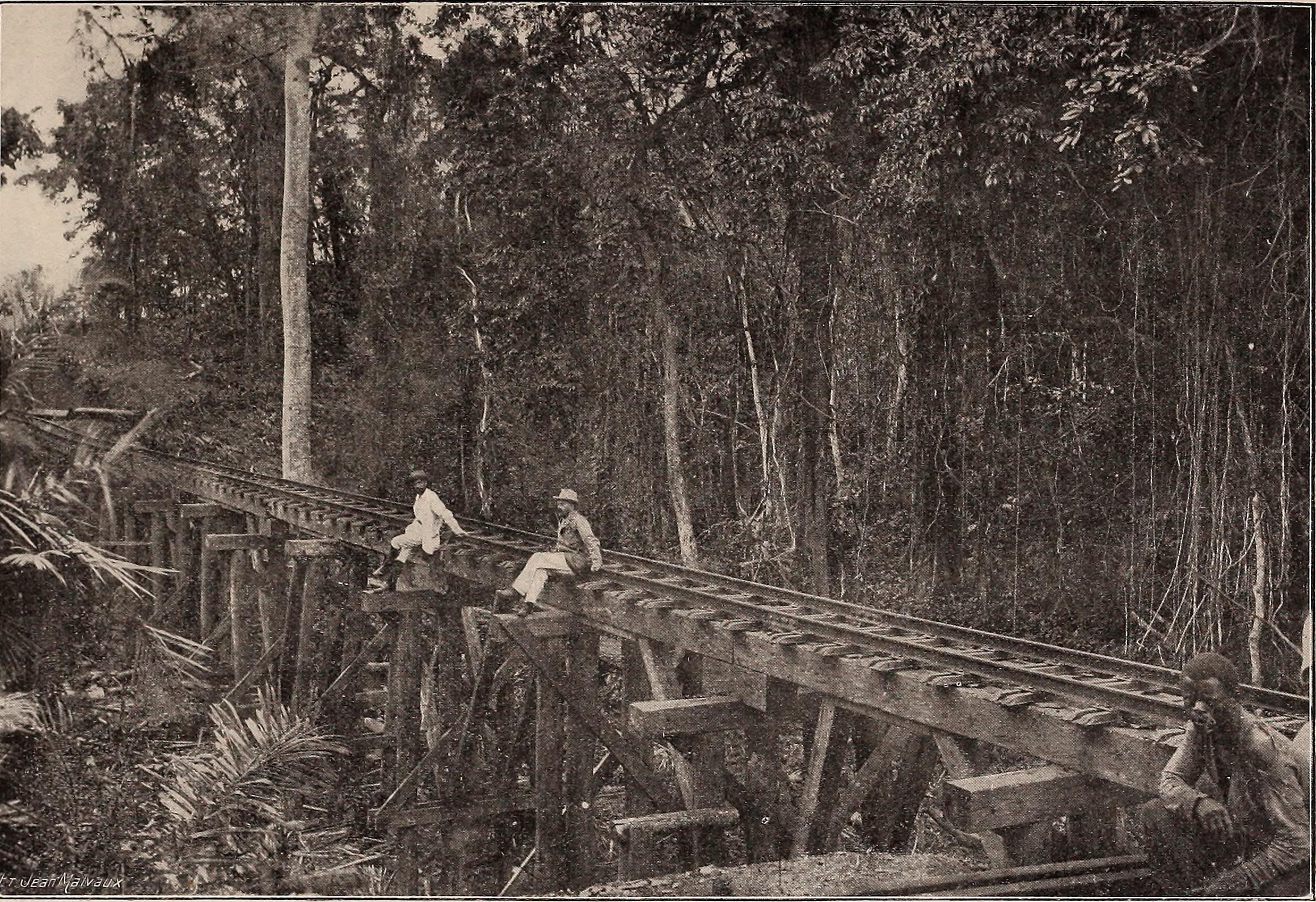
The railway from Matadi to Stanley Pool, a plate from Louis Goffin (1907), no known copyright restrictions
Nkamba and Thysville in the Belgian Congo · Story · Featured Study
Simon Kimbangu, 1921
A Baptist church member in the Lower Congo was reported as a healer in April and sentenced to death in October.
- Where
- Nkamba, Thysville, Wathen, Elisabethville
- Who
- Simon Kimbangu, R. L. Jennings, Léon Morel, A. de Rossi
- When
- April 1921 to October 1951
A hymn's chorus, as the missionary Bowskill recorded it, ran, “Our leaders are in prison, and our Teachers (missionaries) put them there.”
“Caesar’s,” they answered. So Jesus told them, “Give to Caesar what is Caesar’s, and to God what is God’s.”
Summary
People left their work and crowded the trains to reach Simon Kimbangu at Nkamba. He died in prison at Elisabethville thirty years later.
- King Albert changed the death sentence to forced labour for life that November.
- W. B. Frame, who warned against the movement, wrote that no missionary at his stations saw an extraordinary healing.
- The Kimbanguist church tells of the dead raised.
- The Belgian state recognized his church in December 1959.
- The World Council of Churches took it in during 1969, and one scholar says it put it out in June 2021 on grounds of doctrine.
The Verses the Witnesses Tie to Him
G. Thomas, a Baptist missionary who sat through the trial, recorded his answer on the taxes from Matthew 22:21.
Thomas gave his deposition on 30 October. It is the one record of those days that ties verses to him in the court room.
So they took away the stone. Then Jesus lifted His eyes upward and said, “Father, I thank You that You have heard Me.
J.-L. Vellut, editor of the documents, identifies this as the verse behind his answer on why he thought he had prophetic power.
John 11:41BSB
At that time Jesus declared, “I praise You, Father, Lord of heaven and earth, because You have hidden these things from the wise and learned, and revealed them to little children.
Raymond Buell, writing from what missionaries told him, gives this verse for the same answer.
If anyone does not welcome you, shake the dust off your feet when you leave that town, as a testimony against them.”
A missionary heard him use this at the Wathen chapel on 11 September, two days before he reached Thysville.
Luke 9:5BSB
they will pick up snakes with their hands, and if they drink any deadly poison, it will not harm them; they will lay their hands on the sick, and they will be made well.”
A Baptist missionary told a magistrate in 1925 that all the movement's instruction came down to a few verses of this chapter.
Mark 16:18BSB
Matthew 11:25, Luke 9:5, Mark 16:18
April 1921 to January 1922
R. L. Jennings, a Baptist missionary, dates most of these days in his diary, and the Kimbanguist church keeps its own calendar beside it.
About nine months passed from the first report of miracles to the prison at Elisabethville.
| When | Where | What happened | Who wrote it down |
|---|---|---|---|
| 4 April | The Lower Congo | A report reached Jennings of a man who had done miracles | R. L. Jennings's diary |
| 6 April | Ngombe-Kinsuka | The church's date for the first healing, and its foundation day | The church's calendar |
| 11 May | Nkamba | The administrator Léon Morel came and slept there | Jennings's diary |
| 18 and 19 May | Nkamba | Jennings and Hillard watched and saw no miracle | Jennings's diary |
| 6 June | Nkamba | Soldiers came, a boy was killed, and Kimbangu walked away | Jennings's diary; J. S. Bowskill's notes |
| 11 September | Wathen | He stood outside the chapel with a crowd and shouted | Bowskill's notes |
| 13 September | Thysville | He arrived with over a hundred prisoners under escort | Jennings's diary |
| 1 to 3 October | Thysville | The council of war tried him and sentenced him to death | Jennings's diary |
| By 20 November | Belgium | King Albert commuted the sentence, and the news reached Jennings on 29 November | A paper of 20 November, in Vellut's note; Jennings's diary |
| 13 January 1922 | Elisabethville | He arrived by train to begin his sentence | The police commissioner |
13 September, 1 to 3 October, By 20 November, 13 January 1922
From Nkamba to the Council of War
A church member who had been passed over as a teacher drew crowds that frightened the colony.
He was born most likely in September 1889 at Nkamba, near the Ngombe-Lutete station of the Baptist Missionary Society. W. B. Frame, writing in the year of the trial, says he had been a church member since 1915, and Jennings's church roll gives about 1913.
He wanted to be a teacher, and Jennings's notes say that the post went to his step-brother.
The call is told in several ways. A Baptist named Budimbu told Lerrigo that a stranger in a dream brought him a Bible and told him to preach, and that he refused. The church's account has him hear the voice of Christ in 1918 and go off to work at Léopoldville before he came back.
The first healing is a sick child in Budimbu's telling, a dying woman named Nkiantondo by the church's oral tradition, and a convalescent woman in a later deposition of the missionary Bowskill, a hostile inquirer.
Frame wrote that people came from as far as Boma and Kinshasa in crowded trains, at times with extra cars. Jennings recalled in 1936 that workmen on the plantations and the railway threw up their work and pay.
Buell wrote in 1928 that there was no organized strike. He says the government feared an attempt to shut the railway on which the colony relied.
The administrator's visit1 paragraph
Morel's report of 17 May compared the crowds at Nkamba with Lourdes and spoke of religious fanaticism. The church's account says he chose five sick people, two of them paralytics, and that the prophet healed them without touching them. Frame says Morel saw no miracle.
When the soldiers came, Frame says, the crowd was threatening and the administrator told his men to fire in the air. The order was not obeyed, and two soldiers were stabbed. Jennings's diary of 7 June has a woman wounded and her boy killed. Bowskill says that Kimbangu saw himself unguarded and walked away, and the church still commemorates his escape.
Commandant A. de Rossi presided at the council of war. He wrote on 13 September that he stopped the prisoners' singing at Thysville. He told Jennings to warn his catechists of the machine guns next time.
Vellut records that the missionaries asked to help in his defence and that de Rossi refused them. Chômé, who wrote in Kimbangu's defence, says that the accused had no defender. He says the prosecutor asked for forced labour for life and the court gave death.
Jennings says the judge seized on the words ntantu ambi in a seized typescript, read as abominable enemy. Buell reports that officials later found the court's translations full of errors.
L'Avenir colonial belge, a hostile paper, reported on 16 October that he trembled in court and that a doctor called it simulation. It says he received twelve strokes of the whip. Jennings and Thomas sat in that court and said nothing of it, and Vellut heads the passage a parody of justice.
The plea and the commutation2 paragraphs
The missionaries Phillips and Clark wrote on 5 October asking for the King's clemency. Van den Broeck, deputy prosecutor at Boma, told the Minister of the Colonies on 12 October that the legal basis looked fragile. He said an execution would make him a martyr.
The missionary voice was divided. The Bolenge conference resolved that the authorities had to take severe measures, and the Society in London still called a life sentence too severe.
The thirty years2 paragraphs
Jennings heard that a commandant struck him with a stick as he boarded the train that December, and that he had no coat. Vellut says he was struck again before all the prisoners at Elisabethville.
Little is known of the years that followed. A hostile editor printed words of repentance in 1926, and Vellut marks them as lent to him. His body was buried at Nkamba in a mausoleum on 3 April 1960.
What Each Witness Saw of the Healings
One doctor's report survives in a missionary's typescript, and each witness is named with his side.
The church's history tells of a girl named Dina, three days dead, called back to life in the name of Jesus, as its tradition has it.
The nearest thing to a case note is Nsona at Sona Bata, typed by Frederickson, an American Baptist missionary there. Dr Ostrom's report describes her on 24 April, before she went to Nkamba, unable to straighten her arms or stand. On 3 May, after Nkamba, Frederickson found that she could straighten her feet and arms and walk with a cane.
Frederickson also wrote that a man who said he was healed still had his fistula running. Up to then, she wrote, the mission had seen no case it could pronounce healed, though she felt that some must have been. Budimbu told the American Baptist visitor Lerrigo of a boy with sleeping sickness who was commanded to be well and died after they carried him home.
The missionary Hillard told a magistrate in 1925 that Kimbangu laid hands on the sick before him without result. He said he believed the man sincere.
Frederickson also reports the limit Kimbangu set himself, that if the sick were not healed it was God's palaver and not his.
The Numbers and Who Gave Them
Most of these figures have no counter behind them, and the largest come from those with most at stake.
The figures for those relegated differ by ten times.
| What it counts | Figure | Who gave it |
|---|---|---|
| The crowd on Morel's first visit | 700 to 800 | Buell (1928), from unnamed sources |
| Pilgrims at Nkamba each day | 2,000 to 5,000 | Chômé (1968), with no counter named |
| Those relegated up to 1959 | 3,700 | The administration, in translation from Chômé |
| Those relegated up to 1959 | 37,000 | Circles close to Kimbanguism, in translation from Chômé |
| Names struck from the Wathen roll | 900 of 1,300 | H. J. Casebow (1958), the mission's memory |
| Members of the church | 5 million in 2002 and 17 million in 2017 | The church's own claims, as Pobee and Mokoko Gampiot report them |
The Church and Its Doctrine
The man's trial and what his church later taught are two separate matters, and the second is measured by the confession of the Trinity.
The church's catechism of 1963 calls him the witness of Jesus Christ. It says that through him the church knows that Christ by his death and resurrection saved mankind without distinction of races.
Mokoko Gampiot, a scholar writing as an insider of the church, reports what believers hold. They hold him to be the incarnation of the Holy Spirit and his three sons to be the persons of the Trinity. He says that the belief in Kimbangu as the Holy Spirit appears nowhere in its written texts.
Jean-Claude Loba Mkole writes in the Dictionary of African Christian Biography that the official church teaches the same of the three sons. The reporters differ on what the church officially holds.
The Christian confession is one God in three persons, and the other churches measured the teaching by that. The president of the Ecumenical Council of Congo-Brazzaville called it heresy in 2000, and the Church of Christ in Congo broke with it in March 2002.
The Catholic bishops of the Congo wrote on 3 July 2004 that in divinizing his three sons it had renounced the Holy Trinity. They wrote that it was no longer a Christian church and that its baptism was invalid. His profile of 2023 gives doctrinal grounds for the World Council's decision of June 2021.
And I will ask the Father, and He will give you another Advocate to be with you forever—
Believers read the promised Advocate of this passage as Kimbangu, as one scholar of the church reports.
John 14:16BSB
Therefore go and make disciples of all nations, baptizing them in the name of the Father, and of the Son, and of the Holy Spirit,
The bishops of the Congo denied Kimbanguist baptism on the ground of this verse.
How the Key Verse Was Taught
Two writers of the fourth century and one of the eighteenth on what is owed to Caesar and to God.
Hilary of Poitiers (died 367)
Catena Aurea by Aquinas
Hilary kept the coin for Caesar and the conscience for God.
“It behoves us also to render unto God the things that are His, namely, body, soul, and will. For Cæsar's coin is in the gold, in which His image was pourtrayed, that is, God's coin, on which the Divine image is stamped; give therefore your money to Cæsar, but preserve a conscience void of offence for God.”
on Matthew 22:21Patristic
John Chrysostom (died 407)
Homily on the Gospel of Matthew 70
Chrysostom marked the word render, for a debt already owed.
“He stopped not, however, at the rebuke, although it was enough merely to have convicted them of their purpose, and to have put them to shame for their wickedness; but He stops not at this, but in another way closes their mouths; for, ‘Shew me,’ saith He, ‘the tribute money.’ And when they had shown it, as He ever doth, by their tongue He brings out the decision, and causes them to decide, that it is lawful; which was a clear and plain victory. So that when He asks, not from ignorance doth He ask, but because it is His will to cause them to be bound by their own answers. For when, on being asked, ‘Whose is the image?’ they said, ‘Caesar's;’ He saith, ‘Render unto Caesar the things that are Caesar's.’ For this is not to give but to render, and this He shows both by the image, and by the superscription.”
on Matthew 22:19 to 21Patristic
John Wesley (1703 to 1791)
Explanatory Notes upon the New Testament
Wesley made the coin a standing rule of who governs a nation.
“And indeed this is a standing rule. The current coin of every nation shows who is the supreme governor of it. Render therefore, ye Pharisees, to Caesar the things which ye yourselves acknowledge to be Ciaesar's: and, ye Herodians, while ye are zealous for Caesar, see that ye render to God the things that are God's.”
on Matthew 22:21Evangelical
In Their Own Words
Each saying comes through a missionary or through the church's own record.
Simon Kimbangu (died 1951)
P. H. J. Lerrigo, The Prophet Movement in Congo, International Review of Missions, volume 11 (London: Humphrey Milford, Oxford University Press, 1922), page 271
The sick child
“So the next day I went and found the sick child as he had said. The people were gathered around weeping and wailing. I pushed them aside and prayed a long time for the child. Then I laid my hands upon it, and immediately I shook with great violence.”
Kimbanguist
About this saying1 paragraph
Budimbu, a Baptist who knew him, told this to Lerrigo as he had it from Kimbangu's own lips, and Lerrigo printed it in 1922.
Simon Kimbangu
The trial record as the church holds it, in Aurélien Mokoko Gampiot, Kimbanguism: An African Understanding of the Bible, (2017)
Jesus Christ is the Savior
“No, Jesus Christ is the Savior. I have received from him the mission of proclaiming the news of eternal salvation to my people.”
Kimbanguist
About this saying1 paragraph
Mokoko Gampiot prints this in 2017 as his answer to de Rossi on whether he was the Savior.
W. B. Frame
Congo Mission News 37, in J.-L. Vellut, ed., Simon Kimbangu 1921, October 1921
Deep pathos
“There was deep pathos in seeing the mother leading or carrying the blind child, friends carrying their sick and dying, or even dead, in the hope of the help of the prophet. It spoke to us who looked on of what must have been in the days of the Son of Man.”
Baptist missionary in the Lower Congo
About this saying1 paragraph
Frame wrote this for his fellow missionaries in October 1921.
J. S. Bowskill
Notes of 1921, in J.-L. Vellut, ed., Simon Kimbangu 1921, volume I (2) (2010)
God hates the shedding of blood
“The Prophet heard he was coming and urged the crowds in his town to make no resistance. ‘God hates the shedding of blood’ was his cry.”
Baptist missionary in the Lower Congo
About this saying1 paragraph
J. S. Bowskill, a Baptist missionary who was not at Nkamba that day, wrote this in his notes of 1921 on the coming of the soldiers.
G. Thomas
Deposition of 30 October 1921, in J.-L. Vellut, ed., Simon Kimbangu 1921, volume I (2) (2010)
Render unto Caesar
“Kimbangu denied at his trial that he had taught his followers not to pay taxes, citing the teaching of Jesus, ‘Render unto Cæsar, etc.’ When asked why he should think he had prophetic power, he quoted again ‘Father, I thank thee, etc.’”
Baptist missionary
About this saying1 paragraph
Thomas gave this account in 1921 to the conference of Protestant missions, as a missionary of the society Kimbangu belonged to.
P. H. J. Lerrigo
The Prophet Movement in Congo, The International Review of Missions 11, quoting a woman deported, (1922)
For the sake of the Gospel
“Do not weep for me. I am not seeing any trouble because I am being sent away. It is for the sake of the Gospel.”
American Baptist missionary and writer
About this saying1 paragraph
Lerrigo gives her words in 1922 as an example of those punished who, he writes, pose as martyrs.
What the Witnesses Dispute
The dates, the taxes and the story of his last days are each told in more than one way.
The court as Buell summarizes it held that he stirred his followers against authority, and Buell says the anti-European preaching came from his minor prophets. On the taxes, Thomas records his denial, Chômé writes that he seems never to have forbidden them, and Frame saw no sign of a conspiracy.
Against his denial stands the saying that the white man shall become black and the black man white. The church's record gives it as the reason for the sentence, and that record has him answer that it was not meant literally.
On the beginning, the church keeps 6 April. Chômé gives 18 March and credits Lerrigo, and Lerrigo gives no such date.
On the arrest, Buell and the church give 12 September, and Chômé gives the fifteenth. Jennings's diary and de Rossi's minute have him at Thysville on the evening of the thirteenth. The church and Bowskill say he gave himself up, and the officials wrote of a capture.
On the first hearing, the church's history gives 29 September, and Jennings, who sat in the court, gives 1 October. On his death, Chômé gives 10 October 1951, and Loba Mkole and the church give 12 October.
On his last days, Chômé reports that a priest, François Senkoto, said he was received as a Catholic on his deathbed. Mokoko Gampiot reports the same claim by the Jesuit Van Wing, who had worked against the movement from its first months. His sons deny it, and neither writer cites a register.
Books to Read Next
Simon Kimbangu 1921: de la prédication à la déportation. Les Sources
J.-L. Vellut, editor · 2010
Vellut prints the diaries, depositions and minutes of the case with his notes, in English and French.
Read Vellut free at the Internet ArchiveThe Prophet Movement in Congo
P. H. J. Lerrigo · 1922
Lerrigo gives the account of an American Baptist visitor who reached the Congo in the August before the trial.
Read Lerrigo free at the Internet ArchiveKimbanguism: An African Understanding of the Bible
Aurélien Mokoko Gampiot · 2017
This book gives an insider's account of the church's history and teaching in English.
Read Mokoko Gampiot free at the Internet ArchiveWhat Kimbangu Left
His trial left a question about colonial justice. His believers' teaching on the Trinity was judged by the Christian confession, and neither settles the other.
Sources
Scripture is the Berean Standard Bible.
- The Holy Bible, Berean Standard Bible (read 2026)
- J.-L. Vellut, ed., Simon Kimbangu 1921: de la prédication à la déportation. Les Sources, volume I (2), Fontes Historiae Africanae (Brussels: Académie royale des sciences d'outre-mer, 2010), which prints the diary and memoir of R. L. Jennings, the depositions of G. Thomas, J. S. Bowskill and Hillard, the notes of W. B. Frame and H. J. Casebow, the minutes of Morel and de Rossi, M. Frederickson's typescript of Dr Ostrom's report, Van den Broeck's letter and the extract from L'Avenir colonial belge of 16 October 1921.
- P. H. J. Lerrigo, The Prophet Movement in Congo, The International Review of Missions 11 (1922), pages 270 to 277.
- Raymond Leslie Buell, The Native Problem in Africa, volume II (New York: Macmillan, 1928), pages 601 to 607.
- Jules Chômé, Kimbangu (Simon), Biographie Belge d'Outre-Mer, tome VI (1968), columns 576 to 579.
- Aurélien Mokoko Gampiot, Kimbanguism: An African Understanding of the Bible, translated by Cécile Coquet-Mokoko (University Park: Penn State University Press, 2017)
- Jean-Claude Loba Mkole, Kimbangu, Simon, Dictionary of African Christian Biography (received 2016)
- Aurélien Mokoko Gampiot, Kimbanguist Church, World Religions and Spirituality Project (30 April 2023)
- John S. Pobee, African Instituted (Independent) Churches, Dictionary of the Ecumenical Movement, revised edition (2002)
Keep Studying
People and groups5
Doctrines2
Subjects1
Trials of life1