
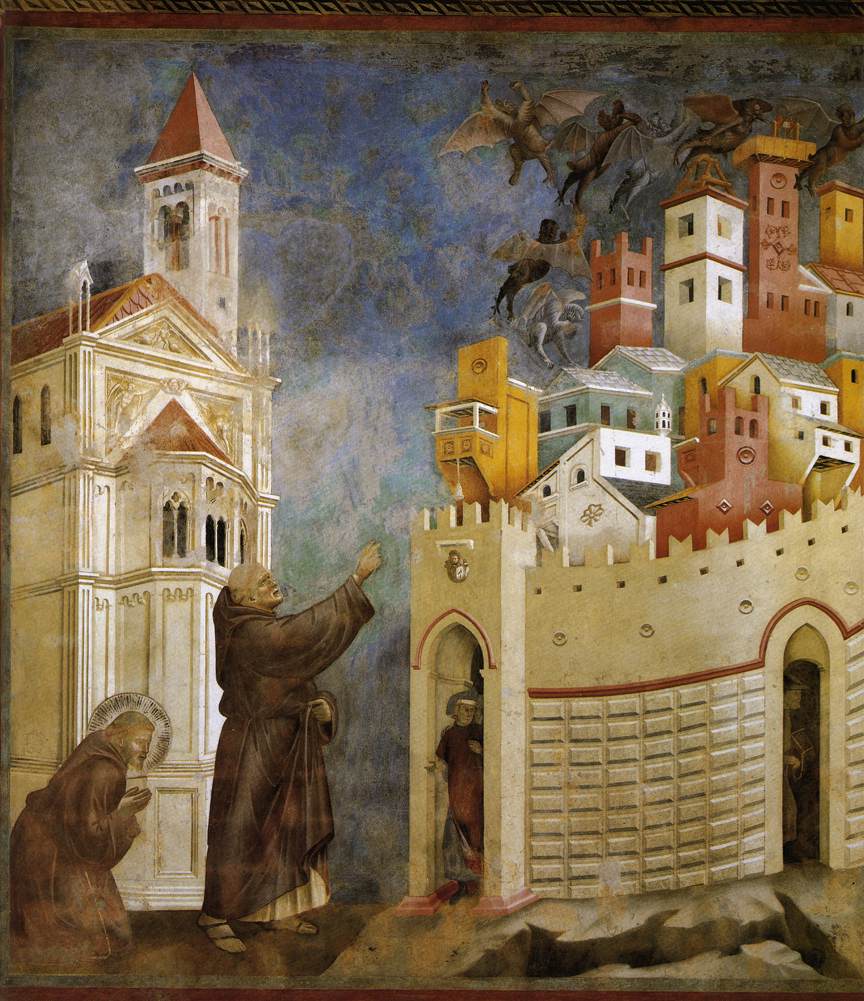
Giotto, Exorcism of the Demons at Arezzo, 1297 to 1299. Public domain.
1210 to 1256 · The churches · Featured Study
The Friars and the Towns
Two orders of brothers who begged their bread and were licensed by the popes of the thirteenth century to preach.
The church historian David Schaff wrote in 1907 that the friars joined to lonely contemplation “itinerancy in the marts and on the thoroughfares.”
The words of the LORD are flawless, like silver refined in a furnace, like gold purified sevenfold.
- Began
- 1210, when Innocent III received Francis and his companions (probable)
- Bodies
- The Friars Minor, The Order of Preachers
Summary
The friars were the two great begging orders of the 1200s, the Franciscans and the Dominicans. They left the cloister to preach to the common people in the towns. By one estimate the Franciscans alone numbered tens of thousands by 1300.
- Honorius III approved Dominic's order in 1216 and confirmed Francis's Rule in 1223.
- Dominic's friars were named the Order of Preachers.
- Francis's Rule put each preacher under his bishop and the head of his order.
- Parish priests and the masters of Paris fought the friars, and in 1256 the pope took the friars' side.
The Texts Behind the Rule of the Preachers
Robinson's notes set two verses under the chapter on preachers.
Paschal Robinson's English of the Rule, printed in 1906, sets two references beneath chapter 9. The chapter asks that a friar's words be “fire-tried and pure,” and that he preach to the people with “brevity of speech” for their good. The first note points to a psalm that praises the purity of the words of the Lord. The second points to Paul's line on the word the Lord carries out on the earth, which the Rule reads as a word made short.
For the Lord will carry out His sentence on the earth thoroughly and decisively.”Robinson's note cites it for the Rule's reason, “because the Lord made His word short upon earth.”
The Friars' Branch of the Family of Churches
The branch runs from the papal approvals of the two orders to a monk at Erfurt and a preacher in the fields.
The begging orders grew inside the Roman church and reached Luther and Wesley.
1210 to 1223
- The Roman Catholic Church
- Francis received by Innocent III
- The Order of Preachers
- The Friars Minor under the Rule of 1223
1505
1739
Each date is read from Schaff's history, the Catholic Encyclopedia or Wesley's Journal.
Philip Schaff wrote in his volume on the German Reformation that the Augustinians “belonged to the mendicant monks, like the Dominicans, Franciscans and Carmelites.” He added, “They laid great stress on preaching.”
How the Friars Began: Two Founders and Two Approvals
The orders' own Rule and a Protestant history tell the start.
David Schaff's volume on the Middle Ages is a Protestant history printed by Scribner in 1907. It says Francis and some companions went to Rome in 1210 and “were received by Innocent III.”
Schaff's note gives 1209 as the date usually printed and says Sabatier argued for 1210.
Schaff writes that Honorius III approved the organization of the Spaniard Dominic in 1216.
Francis died on 3 October 1226, by Schaff's account.
The Work They Restored: Preaching to the Common People
Schaff names what the friars took to the towns, and the Rule says what a preacher must say.
Schaff wrote that the friars “preached to the common people” and “relieved poverty.”
Francis's Rule tells the preacher to announce “vices and virtues, punishment and glory.” It forbids him to preach in a diocese whose bishop opposes it.
How then can they call on the One in whom they have not believed? And how can they believe in the One of whom they have not heard? And how can they hear without someone to preach?Paul's question about hearing without a preacher states the need the begging orders went out to meet.
The Two Orders in Their Own Records
Each order's name and its first approval, read from the record.
Both orders took their charge from a pope and their name from their work.
| Order | Its record | What the record says |
|---|---|---|
| The Friars Minor | The Rule of 1223, chapter 9 | No friar may preach to the people until the minister general has examined and approved him. |
| The Friars Minor | The Rule of 1223, its first clause, as Schaff gives it | “Brother Francis promises obedience and reverence to the lord pope, Honorius, and his successors.” |
| The Order of Preachers | Its Latin name, Ordo praedicatorum | Its members were called fratres praedicatores, brothers who preach. |
| The Order of Preachers | Where it took root, by Schaff's account | “The order took quick root in large cities, Paris, Bologna, and Rome.” |
The Friars and Their Counts
Each count is the Catholic Encyclopedia's, with the year it gives.
The Franciscans grew to tens of thousands within a century, and both orders were smaller by 1910.
| Order | The count | Who counted, and for when |
|---|---|---|
| The Friars Minor | About 3,000 friars present | The Catholic Encyclopedia (1909), for the general chapter of 1221 |
| The Friars Minor | 60,000 to 90,000 friars at most | The Catholic Encyclopedia (1909), its estimate for about 1300 |
| The Order of Preachers | Close on 12,000 | The census under Benedict XII, for 1337, as the Catholic Encyclopedia (1911) gives it |
| The Friars Minor | 16,894 Franciscans in 1,413 convents | The Catholic Encyclopedia (1909), for 4 October 1908 |
| The Order of Preachers | Very nearly 4,472 religious | The Catholic Encyclopedia (1911), for 1910 |
Where the Friars Went
Each place stands with the year its record gives.
The friars' work runs from Bologna and Assisi to Erfurt and a field outside Bristol.
| Year | Place | What happened there |
|---|---|---|
| 1221 | Bologna | Dominic died there on 6 August, lying on ashes. |
| 1297 to 1299 | Assisi | Giotto painted the life of Francis in the Upper Church, the town of Arezzo among its scenes. |
| 1505 | Erfurt | Luther entered the Augustinian convent on 17 July. |
| 1739 | Bristol | Wesley preached in the open air to about three thousand people. |
In Their Own Words
Francis of Assisi (died 1226)
The Rule of 1223, chapter 9, Of Preachers
Of preachers, 1223
“The brothers must not preach in the diocese of any bishop when their doing so may be opposed by him. And let no one of the brothers dare to preach in any way to the people, unless he has been examined and approved by the minister general of this brotherhood, and the office of preaching conceded to him by the latter. I also warn and exhort the same brothers that in the preaching they do their words be fire-tried and pure for the utility and edification of the people, announcing to them vices and virtues, punishment and glory, with brevity of speech because the Lord made His word short upon earth.”
Catholic
About this saying1 paragraph
Chapter 9 of the Rule of 1223 stands on page 71 of Robinson's book of 1906.
John Wesley (1703 to 1791)
The Journal of the Rev. John Wesley, Monday 2 April 1739
In the highways, 1739
“At four in the afternoon I submitted to be more vile, and proclaimed in the highways the glad tidings of salvation, speaking from a little eminence in a ground adjoining to the city, to about three thousand people.”
Evangelical
About this saying1 paragraph
Curnock prints the entry for Monday 2 April 1739 on pages 172 and 173 of his second volume.
John Wesley
The Journal of the Rev. John Wesley, Saturday 31 March 1739
In the fields, 1739
“In the evening I reached Bristol, and met Mr. Whitefield there. I could scarce reconcile myself at first to this strange way of preaching in the fields, of which he set me an example on Sunday; having been all my life (till very lately) so tenacious of every point relating to decency and order, that I should have thought the saving of souls almost a sin if it had not been done in a church.”
Evangelical
About this saying1 paragraph
Two days before that entry Wesley reached Bristol and met Whitefield, and he wrote down his doubt about preaching outside a church. Curnock prints it on page 167.
The Quarrel With the Parish Clergy and the Masters of Paris
The charges came from the clergy whose parishes the friars entered, and the pope answered them.
Schaff writes that the friars “intruded themselves into every parish and incurred the bitter hostility of the secular clergy whose rights they usurped.”
At Paris, where both orders had gained entrance to the university, William of St. Amour led the opposition. Schaff says his pen “compared the mendicants to the Pharisees and Scribes.”
Alexander IV ordered William's treatise burnt by a bull dated 5 October 1256.
Books to Read Next
The Writings of Saint Francis of Assisi
Paschal Robinson, translator · 1906
It gives both of Francis's Rules and his Testament in English.
Free at the Internet ArchiveHistory of the Christian Church, volume V, part I
David S. Schaff · 1907
Schaff tells the start of both orders and the fight at Paris in his chapter on the begging orders.
Free at the Internet ArchiveThe Journal of the Rev. John Wesley, volume II
Nehemiah Curnock, editor · 1909
It holds Wesley's first days of preaching in the open air.
Free at the Internet ArchiveWhat the Friars Handed On
The friars handed on the preacher who goes to the people where they live and work.
Sources
Scripture is the Berean Standard Bible.
- The Holy Bible, Berean Standard Bible (read 2026)
- David S. Schaff, History of the Christian Church, volume V, part I, The Middle Ages, 1049 to 1294 (New York: Scribner, 1907), pages 379, 383 to 388, 397, 400, 404 and 420 to 422.
- Philip Schaff, History of the Christian Church, volume VI, The German Reformation, second edition revised (New York: Scribner, copyright 1888, printing of 1904), pages 112 and 114.
- Paschal Robinson, The Writings of Saint Francis of Assisi (Philadelphia: The Dolphin Press, 1906), the Rule of 1223, chapter 9, page 71, with its notes.
- The Journal of the Rev. John Wesley, standard edition, edited by Nehemiah Curnock, volume II (London: Charles H. Kelly, 1909), pages 167 and 172 to 173.
- The Catholic Encyclopedia, volume 9 (New York: Robert Appleton, 1910), Martin Luther.
- The Catholic Encyclopedia, volume 6 (New York: Robert Appleton, 1909), Order of Friars Minor.
- The Catholic Encyclopedia, volume 12 (New York: Robert Appleton, 1911), Order of Preachers.
Keep Studying
Read it1
People and groups7
Subjects1
Go further2
Church history2