
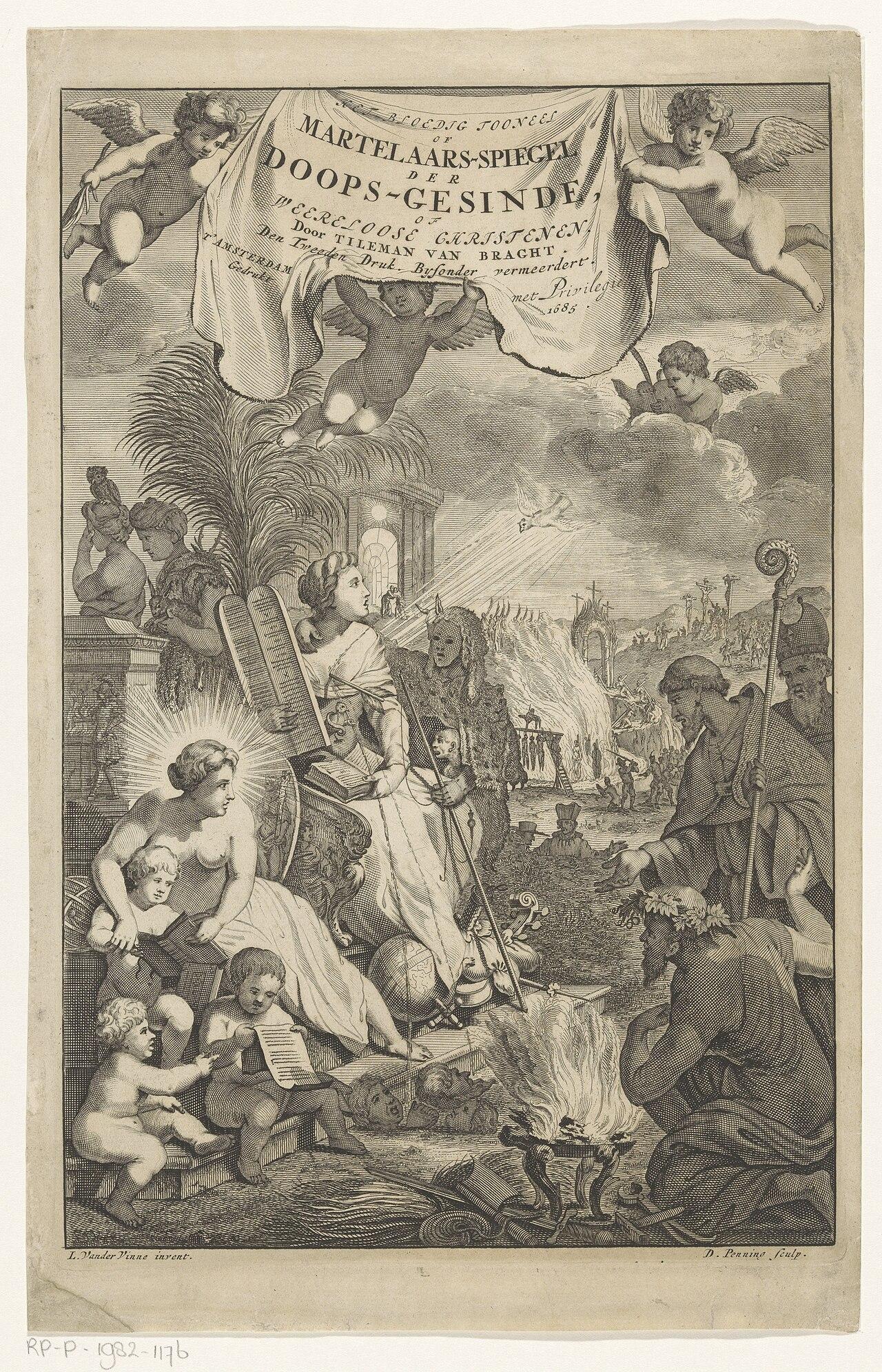
Daniël met de Penningen after Laurens Vincentsz. van der Vinne, title print for the Martyrs Mirror, 1685. Public domain.
1562 to 1660 · Subject · Featured Study
The Martyrs Mirror
Thieleman van Braght's book gathers the Anabaptists who died for their faith, from the apostles to his own century.
The compiler wrote in a quiet age that he thought more dangerous for the church than the age of the fires.
What will it profit a man if he gains the whole world, yet forfeits his soul? Or what can a man give in exchange for his soul?
What will it profit a man if he gains the whole world, yet forfeits his soul? Or what can a man give in exchange for his soul?
- Books
- Matthew, 2 Corinthians, Hebrews
- Hold in memory
- Matthew 16:26
Summary
The Martyrs Mirror is the Anabaptists' own book of their martyrs. Thieleman J. van Braght of Dort compiled it, and his title carries the record from the time of Christ to his own day.
- Its second part grew from a Dutch martyr book first printed in 1562.
- Van Braght dated his letters of dedication at Dort in July 1659.
- A second Dutch edition followed in 1685.
- Joseph F. Sohm's English translation was printed at Elkhart, Indiana.
The Verses of the Preface
The preface sets Matthew 16, 2 Corinthians 11 and Hebrews 11 beside its warning to a church at ease.
On the eighth page of his preface the compiler argues that the believers of his day stood in greater danger than the martyrs had. He cites Matthew 16:26 there first, the verse set under the title above, and the two verses below follow it.
The preface, page 8
And no wonder, for Satan himself masquerades as an angel of light.
He cites it for the enemy who comes in his day as an angel of light, in a pleasing form.
And without faith it is impossible to please God, because anyone who approaches Him must believe that He exists and that He rewards those who earnestly seek Him.
He cites it for the faith the enemy tries to make seem of small importance.
Hebrews 11:6BSB
How the Book Grew
The dated steps run from the first Dutch martyr book to the English printed at Elkhart.
Between those two printings, the record grew through at least five Dutch forms.
- Het Offer des Heeren, printed in Holland1562The publishers' note in Sohm's English, page 398
- The quarto of 863 pages, Hoorn1617The same note
- The folio of 1056 pages, Haarlem1631The same note
- The letters signed at DortJuly 1659The letters, in Sohm's English
- The Bloody Theatre, or Martyrs Mirror1660Sohm's title page
- The enlarged reprint, with Jan Luyken's etchings1685The Rijksmuseum's prints RP-P-1982-1176 and RP-P-OB-44.272
- Joseph F. Sohm's translation, Elkhart1886Sohm's title page
A timeline of the book's forms, each row naming the record that fixes its date.
The Two Parts of the Book
The title names the martyrs the book keeps, and an older Dutch book supplied its second half.
The full title names the martyrs as the defenseless Christians "who baptized only upon Confession of Faith". The first part follows such believers century by century from the time of Christ, and the second part gathers those who died between 1500 and 1660.
The publishers of 1886 trace that second half to an older martyr book, reprinted at least eight times before 1600 and enlarged twice in the next century. The compiler took its last form into his own work, adding what he judged profitable.
Under the year 1525 the compiler writes that the papists were joined by "the Zwinglians or so-called Reformed" of Zurich in laying hands on his people. The book records believers put to death or imprisoned by Catholic and Reformed courts alike.
The translator consulted the Dutch printing of 1685 and the German editions whenever a reading was in doubt, as the publishers note.
Why the Compiler Feared the Quiet Times
He wrote for free and comfortable readers, and he held their danger to be greater than the martyrs' danger.
He wrote that in his own day it was "better, quieter and more comfortable" for his people than in the time of the martyrs. He held that the comfort itself was the danger, and his preface says why in the words quoted below.
The book's best-known entry, Dirk Willems at Asperen in 1569, stands on page 711 of the English.
In Their Own Words
Thieleman J. van Braght
The Bloody Theatre, or Martyrs Mirror (1660), the preface, The preface, before the part on the greater danger of this time
He told his readers where to look.
“But, before all things, fix your eyes upon the martyrs themselves, note the steadfastness of their faith, and follow their example.”
Anabaptist, Mennonite
About this saying1 paragraph
This counsel stands early in the preface, written in the seventeenth century.
Thieleman J. van Braght
The Bloody Theatre, or Martyrs Mirror (1660), the preface, Of the greater danger there is at this time, the opening sentence
His own day held the greater danger.
“These are sad times, in which we live; nay, truly, there is more danger now than in the time of our fathers, who suffered death for the testimony of the Lord.”
Anabaptist, Mennonite
About this saying1 paragraph
The same preface of 1660 opens its warning with this sentence.
Thieleman J. van Braght
The Bloody Theatre, or Martyrs Mirror (1660), the preface, Of the greater danger there is at this time, the second paragraph
The enemy came openly then and in the twilight now.
“These times are certainly more dangerous; for then Satan came openly, through his servants, even at noon-day, as a roaring lion, so that he could be known, and it now and then was possible to hide from him; besides, his chief design then was to destroy the body: but now he comes as in the night, or in the twilight, in a strange but yet pleasing form”
Anabaptist, Mennonite
About this saying1 paragraph
A few lines later in the preface of 1660, he sets the open enemy of the martyrs' century beside the hidden one of his own.
Hans Koch and Leonhard Meister
Their prayer before their death, as given in Thieleman J. van Braght, The Bloody Theatre, or Martyrs Mirror (1660), Prayer of Hans Koch and Leonhard Meister, A. D. 1524
Two men prayed at Augsburg before their deaths in 1524.
“Give us steadfast patience through Christ thy Son, our Captain, who can vanquish Satan with all his host. To him be honor, and praise to his holy name. Amen.”
Anabaptist
About this saying1 paragraph
The book keeps the prayer of Hans Koch and Leonhard Meister, put to death at Augsburg in 1524.
Whose Record It Is
The book is one tradition's witness to its own dead, and it prints documents a reader can weigh.
The compiler writes as an Anabaptist to Anabaptists, and he addresses his readers as his beloved friends in Christ Jesus. His accounts of the courts that condemned his people are the accounts of the condemned.
The book also prints records from the other side. The sentence of Asperen in 1569 was copied from the town's own records, so a reader can set the judges' words beside the martyr book's report.
Books to Read Next
The Bloody Theatre, or Martyrs Mirror of the Defenseless Christians
Thieleman J. van Braght, translated by Joseph F. Sohm · 1886
It carries the publishers' note on the book's forerunners and the whole preface, free to read.
Free scan of Sohm's EnglishWhat the Mirror Keeps
The Mirror keeps the names, the confessions and the sentences of believers burned, drowned and beheaded for their baptism. Its compiler gathered them so that a church at ease would remember what its faith had cost.
Sources
Scripture is the Berean Standard Bible.
- The Holy Bible, Berean Standard Bible (read 2026)
- Thieleman J. van Braght, The Bloody Theatre, or Martyrs Mirror of the Defenseless Christians (1660), translated by Joseph F. Sohm (Elkhart, Indiana: Mennonite Publishing Company, 1886), the title page, the publishers' note, the letters of dedication, the preface page 8 and pages 398 to 399.
Keep Studying
People and groups2
Trials of life1