
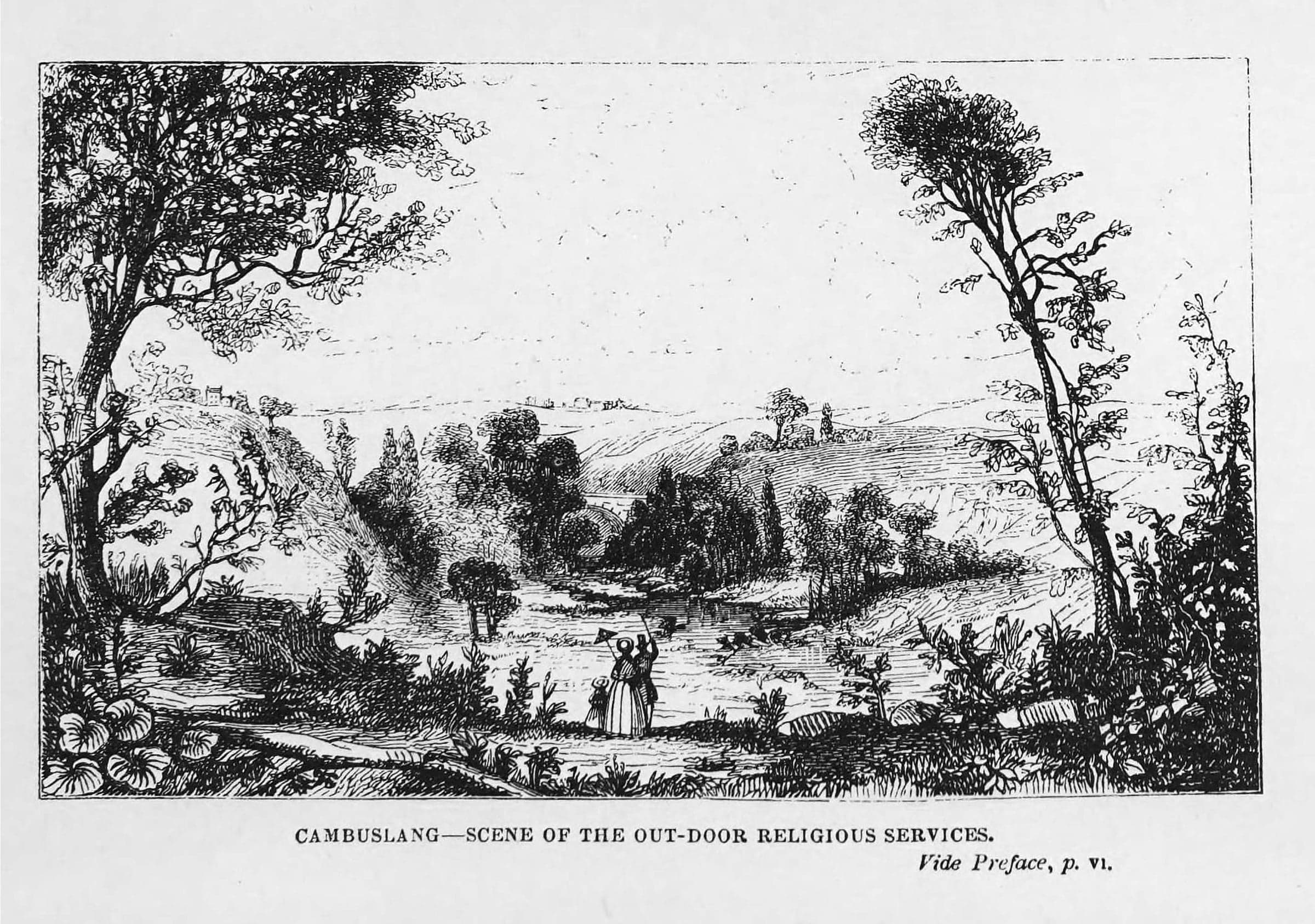
Cambuslang, the scene of the out-door religious services, Macfarlan, 1847. Public domain.
1742 · Story · Featured Study
Cambuslang, 1742
The minister of a small parish near Glasgow wrote down the awakening there, and nine years later he counted those who had held.
- When
- 18 February to August 1742
One Thursday in February 1742, after the weekday sermon, about thirty people, as some present reckoned, came to the minister's house at Cambuslang in alarm about the state of their souls.
For He says: “In the time of favor I heard you, and in the day of salvation I helped you.” Behold, now is the time of favor; now is the day of salvation!
Summary
Cambuslang is a parish four miles south-east of Glasgow. Its minister was William McCulloch, and James Robe dates its awakening from 18 February 1742.
- Whitefield preached at its two summer communions.
- Its communion tables were served in the open air.
- The Seceders opposed it. They were ministers who had left the Church of Scotland.
The Texts of the Communions
The converts' cases name the sermons that reached them.
His mouth is most sweet; he is altogether lovely. This is my beloved, and this is my friend, O daughters of Jerusalem.
McCulloch preached the action sermon on it at the July communion.
For your husband is your Maker—the LORD of Hosts is His name—the Holy One of Israel is your Redeemer; He is called the God of all the earth.
Whitefield preached on it that Sabbath evening, and the converts' cases cite it more than any other of his sermons.
Isaiah 54:5BSB
The Crowds and Who Counted Them
The crowd figures are estimates, and the communicant figures are counts of tokens.
The August communion drew more people than the July one in every count.
| The communion | The crowd | The communicants | Who counted |
|---|---|---|---|
| 11 July 1742 | Upwards of twenty thousand | Not given | Whitefield, in his letter of 15 July |
| 11 July 1742 | Not fewer than thirty thousand by others' reckoning, twenty thousand by Whitefield's | Upwards of seventeen hundred, by the tokens | McCulloch, in his letter of the Wednesday after |
| August 1742 | Fifty thousand, forty, or upwards of thirty thousand, the lowest being Whitefield's | About three thousand, by the tokens | McCulloch |
| August 1742 | Between thirty and forty thousand, as was supposed | Three thousand | Whitefield, in his letter of 27 August |
The Story of the Summer of 1742
It moves from a Thursday in February to the August communion.
Before 18 February the parish had weekday sermons only on Thursdays, and people under concern had come to the minister one at a time. McCulloch had preached on 2 Corinthians 6:1 to 2 in December 1741, and he attested the Short Narrative of the work on 8 May 1742.
The communion was fixed for Sabbath 11 July. Whitefield preached on the Saturday, and two ministers preached all day from two tents.
McCulloch wrote that the tables were served seventeen times, and that each but the last held about a hundred.
A second communion followed in August with three tents. McCulloch reckoned the tables at twenty-four, and a man who sat near them with a pen counted twenty-five.
Whitefield preached again about ten o'clock at night to a great number in the churchyard. He wrote that the voice of prayer and praise was heard all night.
The Converts' Accounts
The cases follow one plan, as if the same questions were put to each convert, Macfarlan judged.
McCulloch wrote that upwards of a fourth, perhaps, of those who held gave him particular accounts of their awakening. They told of their comforts from 1742 to 1744, and some down to 1748. He took down many from their own mouths, he said, "very much also in their own words".
Two quarto volumes of 105 cases were kept by his family, much of them in his hand and some in other hands. His granddaughter Mrs Coutts of Edinburgh gave them to the Free Church Library in 1844.
The Fast Against the Work
The presbytery's Act named Whitefield, and a historian of its own church later weighed it.
Meeting at Dunfermline on 15 July 1742, the Associate Presbytery appointed 4 August as a day of fasting. Among its causes, as McKerrow reports it, was "the work of delusion". Its Act blamed "the fond reception that Mr. George Whitefield has met with".
Whitefield wrote on 31 July that one of the presbytery had published the most virulent pamphlet he had ever seen. A century later John McKerrow, writing the Secession Church's own history, judged that calling the work a delusion cannot be justified.
For the time will come when men will not tolerate sound doctrine, but with itching ears they will gather around themselves teachers to suit their own desires.The presbytery's Act cites this warning against the people who flocked to Whitefield.
The People of the Story
Five people made or kept the record.
The record of Cambuslang comes from its minister, two visiting preachers, a convert and an editor.
| Who | Their part | The record |
|---|---|---|
| William McCulloch | He was the parish minister, and he wrote the letters and kept the converts' cases. | Macfarlan; Robe |
| Whitefield | He wrote of the crowds and the tables in his letters of July and August. | Whitefield's Works; Tyerman |
| James Robe | He was minister of Kilsyth, where a like work followed in the same year. | Robe |
| Elizabeth Dykes | She was one of the awakened, and her case is the seventh in McCulloch's volumes. | Macfarlan |
| D. Macfarlan | He was minister of Renfrew. | Macfarlan, title page |
What Held by 1751
The attestation set the fruit beside the falling away.
In 1751 McCulloch cited a list dated 27 April of about four hundred people awakened in 1742 who had lived since as becomes the gospel. His elders added on 30 April that seventy of them lived in the parish.
He gave the communicants year by year: about two thousand in 1743, fifteen hundred in 1744, thirteen hundred in 1745 and twelve hundred in 1746.
He owned that a considerable number of the hearers of 1742 had since proved like the poor ground of the parable of the sower. He left out of his count all who had remarkably backslidden.
How the Key Verse Was Taught
Four writers from the fourth century to the eighteenth taught Paul's call.
Basil of Caesarea (died 379)
The Long Rules
Basil gives the earliest of the four readings, in The Long Rules.
“‘Now is the acceptable time,’ says the apostle, ‘now is the day of salvation.’ This is the time for repentance; the next life, for reward. Now is the time to endure; then will be the day of consolation. Now God is the helper of such as turn aside from the evil way; then he will be the dread and unerring inquisitor of the thoughts and words and deeds of humankind.”
on 2 Corinthians 6:2Patristic
Ambrosiaster (died 384)
Commentary on Paul's Epistles
Ambrosiaster's reading comes from his commentary on Paul's letters.
“Paul is teaching that God's grace in Christ was predestined. God decreed that his mercy would be poured out in this way, that help would be lavished on those who called for it in the name of Christ.”
on 2 Corinthians 6:2Patristic
John Chrysostom (died 407)
Homily 12 on 2 Corinthians
Chrysostom, a generation after Basil, sets the time of grace against the time of judgment.
“‘The acceptable time.’ What is this? That of the Gift, that of the Grace, when it is appointed not that an account should be required of our sins nor penalty exacted; but besides being delivered, that we should also enjoy ten thousand goods, righteousness, sanctification, and all the rest. For how much toil would it have behoved us to undergo in order to obtain this ‘time!’ But, behold, without our toiling at all it hath come, bringing remission of all that was before. Wherefore also He calls it ‘acceptable,’ because He both accepted those that had transgressed in ten thousand things, and not acceded merely, but advanced them to the highest honor; just as when a monarch arrives, it is a time not for judgment, but for grace and pardon. Wherefore also He calleth it acceptable.”
on 2 Corinthians 6:2Patristic
Matthew Henry (1662 to 1714)
Commentary on the Whole Bible
Henry's commentary of 1710 gives a Puritan reading from a generation before Cambuslang.
“The gospel day is a day of salvation, the means of grace the means of salvation, the offers of the gospel the offers of salvation, and the present time the only proper time to accept of these offers: To-day, while it is called to-day.”
on 2 Corinthians 6:2Puritan
John Chrysostom, Matthew Henry
In Their Own Words
The minister, a young woman, a married man and Whitefield left these words.
George Whitefield (1714 to 1770)
Letter from Cambuslang, 27 August 1742, in L. Tyerman, The Life of the Rev. George Whitefield, volume 2
A passover
“Such a passover has not been heard of.”
Calvinistic Methodist
About this saying1 paragraph
Whitefield wrote this in August 1742, a fortnight after he came to Cambuslang for the second communion.
William McCulloch
Letter after the July communion of 1742, in D. Macfarlan, The Revivals of the Eighteenth Century, Particularly at Cambuslang, page 64
Five months of the work
“It is not quite five months since the work began, and during that time, I have reason to believe that upwards of five hundred souls have been awakened, brought under deep convictions of sin, and a feeling sense of their lost condition.”
Church of Scotland
About this saying1 paragraph
McCulloch wrote this in July 1742, before anyone could tell who among the awakened would hold.
Elizabeth Dykes
Her case, in McCulloch's manuscripts, in D. Macfarlan, The Revivals of the Eighteenth Century, Particularly at Cambuslang, page 146
On the brae
“I could not find any one to whom I could apply for a token, and so I sat on the brae and heard the tables served. My longings were great to be there, and my love to Christ was so strong that I would have given all I had for a token., and my love to Christ was so strong that I would have given all I had for a token., and my love to Christ was so strong that I would have given all I had for a token., and my love to Christ was so strong that I would have given all I had for a token.”
Church of Scotland
About this saying1 paragraph
Elizabeth Dykes, about sixteen, gave this account of the second communion of 1742, as her case stands in McCulloch's volumes.
George Tassie
His case, in McCulloch's manuscripts, in D. Macfarlan, The Revivals of the Eighteenth Century, Particularly at Cambuslang, page 136
Under great concern
“I fell under great concern, and was made to tremble and shake, although I made no noise. I felt as in the immediate presence of God, and was therefore filled with fear.”
Church of Scotland
About this saying1 paragraph
George Tassie, a married man of forty-one, told how a sermon of May 1742 shook him.
Elizabeth Dykes, George Tassie
Where Historians Disagree
Two questions divide the writers on the work.
A work of God or a delusion?1 paragraph
McCulloch and his elders held it a work of God in their attestation of 1751. The Associate Presbytery held it a work of delusion in its Act of July 1742.
Were the outcries part of the work?1 paragraph
Robe wrote that some of the awakened were seized with trembling and fainting, and some few women with hysterics. Macfarlan set down in 1847 the objection that such outcries and faintings did not look well. He answered that they were effects of the work and nothing contrary to reason or Scripture.
Books to Read Next
Four free books keep the record, the first printed in the year of the work.
A Faithful Narrative of the Extraordinary Work of the Spirit of God at Kilsyth
James Robe · 1742
Robe's narrative of Kilsyth is bound with the first printed account of Cambuslang.
Read it free onlineThe Revivals of the Eighteenth Century, Particularly at Cambuslang
D. Macfarlan · 1847
It prints McCulloch's letters, his count of 1751 and a selection of the cases.
Read it free onlineThe Life of the Rev. George Whitefield, volume 2
L. Tyerman · 1877
It gathers Whitefield's letters from Scotland in 1742.
Read it free onlineHistory of the Secession Church
John McKerrow · 1841
It tells the Secession's side of the quarrel of 1742.
Read it free onlineWhat Cambuslang Left
McCulloch wrote that the parish's communicants stayed far above the four or five hundred of the years before 1742.
Sources
Scripture is the Berean Standard Bible.
- The Holy Bible, Berean Standard Bible (read 2026)
- James Robe, A Faithful Narrative of the Extraordinary Work of the Spirit of God at Kilsyth, with A Short Narrative of the Extraordinary Work at Cambuslang, second edition (London: Samuel Mason, 1742), the preface and the Cambuslang narrative.
- D. Macfarlan, The Revivals of the Eighteenth Century, Particularly at Cambuslang (Edinburgh: Johnstone and Hunter, 1847), McCulloch's letters, his attestation of 1751 and the cases.
- The Works of the Reverend George Whitefield, volume 1 (London: Edward and Charles Dilly, 1771), letters of 15 and 31 July 1742.
- L. Tyerman, The Life of the Rev. George Whitefield, volume 2 (London: Hodder and Stoughton, 1877), Whitefield's letter of 27 August 1742.
- John McKerrow, History of the Secession Church (Glasgow: A. Fullarton, 1841), the Associate Presbytery's Act of July 1742 and the author's judgment.
Keep Studying
Studies1
People and groups9