
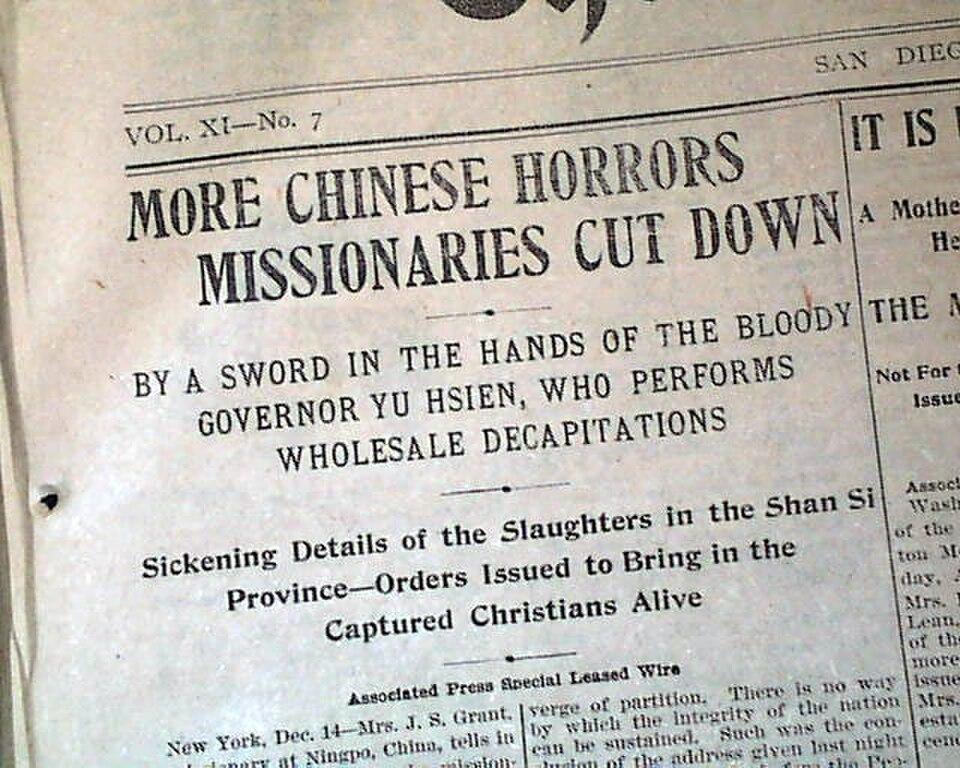
Front page of a San Diego newspaper, 14 December 1900. Public domain.
1899 to 1904 · Subject · Featured Study
The China Martyrs of 1900: The Book
Robert Coventry Forsyth's roll of the Protestant dead of the Boxer rising was printed in 1904.
- Books
- Revelation, Romans, Hebrews
- Hold in memory
- Romans 8:35
Forsyth feared the churches of Europe and America would forget 1900 too soon, so he set the whole story down in one volume.
“Sir,” I answered, “you know.” So he replied, “These are the ones who have come out of the great tribulation; they have washed their robes and made them white in the blood of the Lamb.
Summary
Robert Coventry Forsyth, a Baptist missionary in Shantung, made this book. It puts the letters, diaries and stories of the Boxer rising in one place. It lists the dead by mission and by town, and it tells how the officials were punished. It also tells of those who gave way.
- Forsyth kept the book to the Protestant missions and their converts.
- It counts 102 missionary adults and 41 children killed in Shanxi alone.
- It prints letters written by missionaries who expected to die.
- It asks if converts killed with no choice to recant are martyrs.
The Verses Over the Record
The book names its chapters from Hebrews 11 and 2 Corinthians 11, and its writers read the deaths through Revelation 7 and Romans 8.
Forsyth's chapter titles and the writers he prints draw on a few passages again and again. Two titles come from Paul and from Hebrews, three verses stand behind the question of who is a martyr, and one passage carried a pastor back from his recantation. Read in order, they move from suffering endured to the company of the faithful and the love that holds them.
The chapter titles
Are they servants of Christ? I am speaking like I am out of my mind, but I am so much more: in harder labor, in more imprisonments, in worse beatings, in frequent danger of death.
Chapter V takes its title from the King James wording of Paul's list of his own sufferings.
They were stoned, they were sawed in two, they were put to death by the sword. They went around in sheepskins and goatskins, destitute, oppressed, and mistreated.
Forsyth heads Chapter VI with three words of this verse as the King James Version gives them.
The question of the name
Women received back their dead, raised to life again. Others were tortured and refused their release, so that they might gain a better resurrection.
The chapter on the Chinese Christians calls the confessors those not accepting deliverance.
When Herod saw that he had been outwitted by the Magi, he was filled with rage. Sending orders, he put to death all the boys in Bethlehem and its vicinity who were two years old and under, according to the time he had learned from the Magi.
The book names the children Herod killed at Bethlehem to defend calling every Christian who was killed a martyr.
Matthew 2:16BSB
The pastors who recanted
Who shall separate us from the love of Christ? Shall trouble or distress or persecution or famine or nakedness or danger or sword?
Pastor Wang Ming read Romans 8 after his recantation and saw that death could not part them from Christ's love.
Romans 8:35BSB
Hebrews 11:35, Matthew 2:16, Romans 8:35
The Year as the Book Dates It
The book dates its events from the last days of 1899 to the year after the rising.
The book's dated events span from December 1899 to its printing in 1904.
- Mr. Brooks is killed in Shantung30 December 1899Chapter IX, page 99
- The missionaries at Taiyuan are killed by the governor's order9 July 1900Chapter XVIII, page 367
- Elizabeth Atwater writes her last letter home3 August 1900Chapter VI, page 73
- The Atwater party from Fenzhou is killed15 August 1900, twelve days after the letterChapter VI, page 73
- A memorial service is held at Taiyuan9 July 1901Appendix I
- Fleming H. Revell prints the book1904The title page
A timeline of the dates Forsyth's volume gives, each row with the place in the book that gives it.
The era of the missionary century holds the wider story of the missions that sent these men and women.
What the Roll Leaves Out
The book counts the Protestant dead by name and names the Catholic dead only as a number.
Forsyth's own count for Shanxi names three groups and numbers one of them only roughly.
| Group | The book's figure for Shanxi |
|---|---|
| Protestant missionary adults | 102 |
| Children of the missionaries | 41 |
| Protestant Chinese converts | About four hundred |
| Catholic Christians | Thousands |
The preface leaves out the Catholic defence of the Pei-tang cathedral in Peking and of Ma Cheng in Shanxi. It also gives only a selection of the escapes.
The book adds that outside Shanxi, except at Paotingfu and Chu-chou-fu, the missionaries nearly all escaped with their lives.
How Forsyth Made the Roll
Forsyth gathered what others had printed and kept their words as they first appeared.
Forsyth had been a missionary of the Baptist Missionary Society in Shantung for eighteen years. His title page calls him the compiler and editor.
In his preface he says the accounts had appeared in sections and mostly by denomination. He wanted the story in one permanent form, so that it would not stay buried in books, magazines and pamphlets.
The China Inland Mission, which lost the most, gave him leave to use its books and pamphlets as he pleased. He gave the narratives mainly as they first appeared, or from the pens of those closest to the events.
The book runs to twenty-two chapters and three appendices. Chapter XXI gathers the early lives and training of the martyrs, and Appendix III records the punishment of officials.
The Recantation at Ching-chou Fu
The book prints the recantation of four pastors beside the deaths, and it prints their repentance.
Chapter XX, told by the missionary J. P. Bruce, records that four pastors of the Ching-chou Fu church went through the form of recanting. They hoped to spare their people suffering and death, and said afterward that the sin was theirs alone.
Reading Romans 8 with Bruce afterward, Wang Ming said he now saw that persecution and even death could not separate them from Christ's love. The pastors then confessed their action in prayer as sin.
In Their Own Words
Elizabeth Graham Atwater
Letter to her family, in Forsyth, The China Martyrs
Elizabeth Atwater wrote home twelve days before she died.
“We have tried to get away to the hills, but the plans do not work. Our things are being stolen right and left, for the people know we are condemned. Why our lives have been spared we cannot tell. . . . Dear ones, I long for a sight of your dear faces, but I fear we shall not meet on earth. I have loved you so much, and know you will not forget the one who lies in China. . . . I am preparing for the end very quietly and calmly. The Lord is wonderfully near, and He will not fail me. I was very restless and excited while there seemed a chance of life, but God has taken away that feeling, and now I just pray for grace to meet the terrible end bravely. The pain will soon be over, and oh! the sweetness of the welcome above. . . . I do not regret coming to China, but I am sorry I have done so little.”
American Board
About this saying1 paragraph
Forsyth prints her letter of 3 August 1900 from Fenzhou in Shanxi.
Robert Coventry Forsyth
The China Martyrs
The book answers those who would narrow the name of martyr.
“In many instances, say some, they were given no choice to confess or to recant, and hence they are not martyrs in the strict sense. . . . We call the little innocents whom Herod slew in Bethlehem the first martyrs for Christ. So also do these Chinese babes in Christ deserve the name.”
Protestant missions in China
About this saying1 paragraph
The chapter on the Chinese Christians, written in the early 20th century, sets out the objection and its answer.
J. P. Bruce
The Story of a Recantation, in Robert Coventry Forsyth, The China Martyrs of 1900, chapter XX, page 407
A pastor who had recanted saw what Romans 8 said to him.
“When we were reading the eighth chapter of Paul's Epistle to the Romans, Wang Ming said he now saw that, when they tried to save the people by recantation, they had lost sight of the fact that persecution, and even death, could not separate them from Christ's love.”
Baptist
About this saying1 paragraph
J. P. Bruce of the Baptist Mission set down this conversation for Forsyth's volume, printed in 1904.
Who Counts as a Martyr
The book records a narrow reading and a wide one, and takes the wide one.
On the narrow reading a martyr chose death over denial, so a convert killed without being offered a choice is not a martyr in the strict sense.
On the wide reading every Christian killed for being a Christian bears the name, as the church has long given it to the children of Bethlehem.
Books to Read Next
The China Martyrs of 1900
Robert Coventry Forsyth, compiler and editor · 1904
The Princeton Theological Seminary copy is scanned whole and free to read.
Free at the Internet ArchiveWhat the Roll Handed On
Forsyth's volume kept the names and last letters of the Protestant dead of that year in one place. It kept the recantations beside the deaths and told the reader what it had left out.
Sources
Scripture is the Berean Standard Bible.
- The Holy Bible, Berean Standard Bible (read 2026)
- Robert Coventry Forsyth, compiler and editor, The China Martyrs of 1900: A Complete Roll of the Christian Heroes Martyred in China in 1900, with Narratives of Survivors (New York, Chicago, Toronto: Fleming H. Revell, 1904)
Keep Studying
People and groups2
Subjects3
Church history6
Trials of life1