
AD 910 to 1156 · Story · Featured Study
Cluny and the Reform
A duke's charter of 910 founded a Burgundian abbey whose reform became practically an order of its own within the Benedictine family.
William of Aquitaine's charter says that no prince, no count, no bishop and not even the pontiff of the Roman see may invade the monks' property.
- When
- 910 to 1156
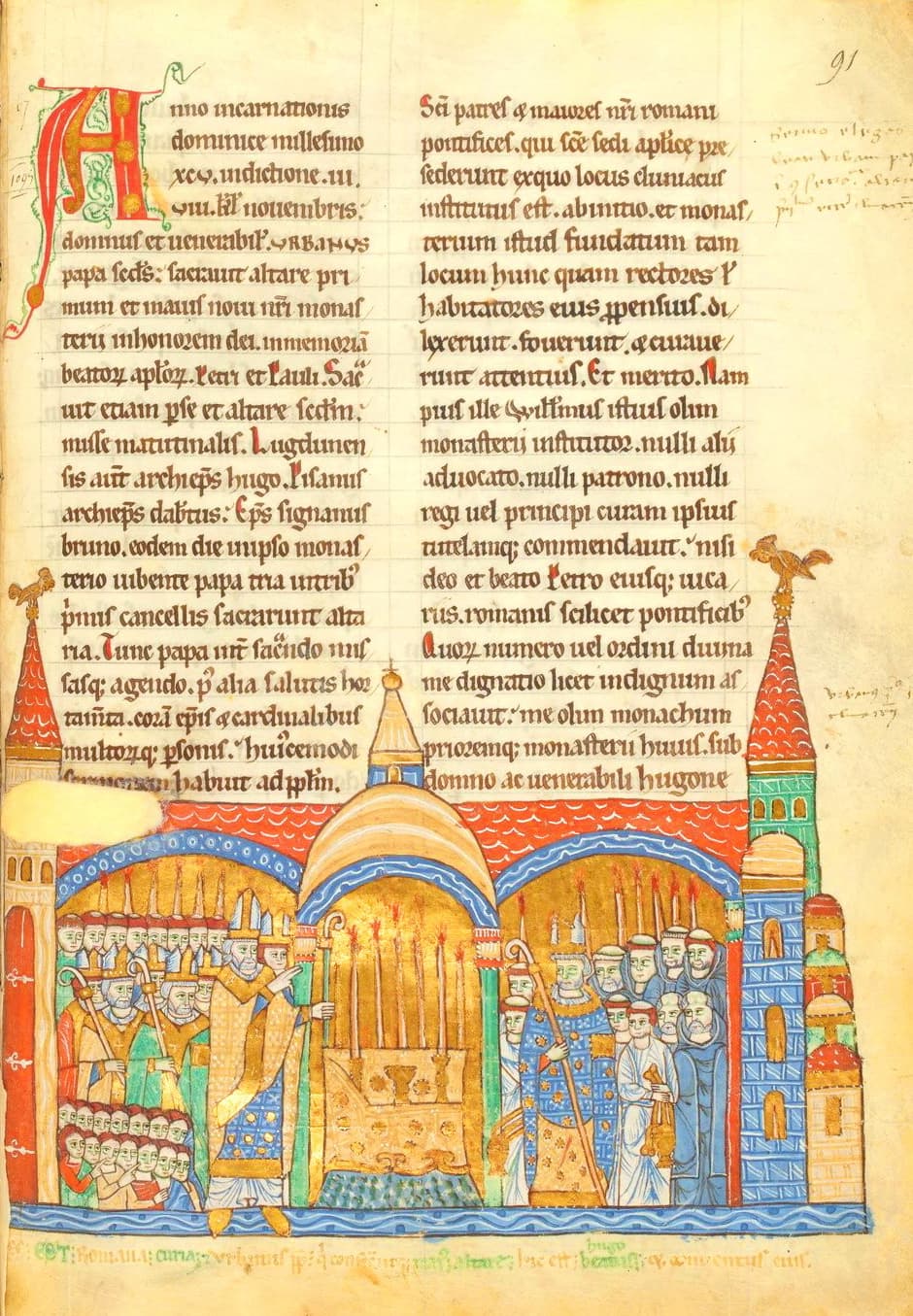
Unknown illuminator, Urban II at the altar of Cluny in 1095, CC BY-SA 4.0
I tell you, use worldly wealth to make friends for yourselves, so that when it is gone, they will welcome you into eternal dwellings.
Summary
In 910 a duke founded the abbey of Cluny under the Rule of Benedict and let its monks choose their own abbot. Its abbots came to counsel emperors and popes, and Bernard of Clairvaux wrote against the gold of its churches.
- Its great church was the largest in Christendom until St Peter's.
- Urban II had served as its prior before he became pope.
- Only one tower and part of a transept of the abbey stand today.
The Verses in the Charter and in the Charge
William grounded his gift on Proverbs and on Christ's word in Luke 16, and Bernard answered Cluny's wealth from Ecclesiastes.
William opened his charter with the reason for the gift. He wrote that God provides for some rich men so that, by their passing goods used well, they may merit everlasting rewards. He gave Proverbs as the word that says so.
He gave Cluny to support a congregation of monks at his own expense, following what he called the precept of Christ. He hoped so to receive the reward of the righteous.
About 1125 Bernard of Clairvaux answered the wealth of the Cluniac houses from Ecclesiastes.
The founder's texts
Riches may ransom a man’s life, but a poor man hears no threat.
The charter quotes Proverbs 13 for it: the riches of a man are the redemption of his soul.
The critic's text
“Futility of futilities,” says the Teacher, “futility of futilities! Everything is futile!”
Bernard's Apologia cries “O vanity of vanities” at the splendour of the monks' churches.
Ecclesiastes 1:2
The Abbots of Cluny From Berno to Peter the Venerable
Seven of the first nine abbots, from Berno to Peter the Venerable.
Six abbots ruled Cluny from 910 to 1109, and Peter the Venerable, the ninth, from 1122 to 1156.
| Abbot | Years | Witness |
|---|---|---|
| Berno | 910 to 927 | The charter names him; Schaff dates his death to 927 and writes his name as Bruno |
| Odo | 927 to 941 in Schaff; his death on 18 November 942 in Löffler | Schaff; Löffler in the Catholic Encyclopedia |
| Aymard | 941 to 948 | Schaff |
| Majolus | To 994 | Schaff; Löffler |
| Odilo | 994 to his death on 31 December 1048 | Löffler |
| Hugh | 1049 to his death on 28 April 1109 | Kennedy |
| Peter the Venerable | 1122 to his death on 25 December 1156 | Schaff; Fournet |
From the Charter to the Great Church
The house grew from one abbey under Berno to the head of a family of houses under Hugh.
William and his wife Ingelberga gave the town of Cluny, its church and its lands to the apostles Peter and Paul. The deed was done publicly at Bourges.
Berno was to rule the monks for life under the Rule. After him they were to elect any one of their order whom they pleased, so that no power could hinder a canonical election.
Every five years the monks were to pay ten shillings to the church of the apostles at Rome for its lights. In return they had the defence of the Roman pontiff.
Odo, the second abbot, was authorized by a privilege of John XI in 931 to reform monasteries in Aquitaine, northern France and Italy.
In a severe famine, as Schaff tells it, Odilo emptied the convent's stores and even melted the sacred vessels. He established the commemoration of all the faithful departed on 2 November in Cluny's houses, and Löffler doubts the year 998.
Hugh began a new church in 1089, and G. Cyprian Alston, writing in the Catholic Encyclopedia, gives its length as 555 feet.
Urban II had been professed at Cluny under Hugh. As pope he consecrated the high altar of the new church on 25 October 1095. Innocent II consecrated the finished church in 1131 or 1132.
Under Peter the Venerable, Cluny received the philosopher Abelard.
How One Abbey Ruled Hundreds
Three counts of the houses stand in the sources, each with its counter.
Every house Cluny founded or took in stayed dependent on it. Its prior was the abbot of Cluny's nominee, every profession needed his sanction, and every monk spent some years at Cluny itself.
Before Cluny, Alston says, every Benedictine monastery had been independent and its community chose its own superior.
By the twelfth century Cluny headed some 314 monasteries, by Alston's count. A register printed at Paris in 1614, the Bibliotheca Cluniacensis, gives 825 houses in the fifteenth century.
Schaff gives two thousand houses at the height. Alston calls that number an exaggeration that may count houses which only took up Cluny's customs.
Bernard's Charge and Cluny's Decline
The charge came from a monk of another order, and the losses came from within and at the suppression of 1790.
Bernard of Clairvaux wrote his Apologia to William of Saint-Thierry about 1125. He marvelled that monks could grow used to such excess in eating and drinking, clothing and bedding, riding abroad and building.
He wrote of an abbot with a train of sixty horses and more, who seemed “not fathers of monasteries but lords of castles.”
Bernard was a Cistercian, and Coulton notes that he began the work by rebuking his fellow Cistercians who carped at the Cluniacs out of jealousy.
Schaff names an unworthy abbot, Pontius, who wasted the funds and was deposed and excommunicated by the pope as a robber of the church.
The first commendatory abbot was named in 1528. At the suppression of 1790 the town bought the abbey and almost entirely destroyed it.
In Their Own Words
Bernard of Clairvaux (died 1153)
Apologia to William of Saint-Thierry (about 1125), in G. G. Coulton, A Medieval Garner (London, 1910), number 27, St Bernard as Puritan
Bernard on the gilded church
“The church is resplendent in her walls, beggarly in her poor; she clothes her stones in gold, and leaves her sons naked; the rich man's eye is fed at the expense of the indigent.”
Patristic
About this saying1 paragraph
In the twelfth century the charge came from a fellow monk of another order.
Peter the Venerable (1092 to 1156)
Letter to Heloise, in O. W. Wight, Lives and Letters of Abelard and Heloise (New York, 1861), the life of Abelard, on his last years at Cluny
Peter the Venerable on Abelard at Cluny
“Words will not easily express the high testimony which Cluny bears to his humble and religious deportment within these walls. Never did I behold abjection so lowly, or abstemiousness so exemplary.”
Roman Catholic
About this saying1 paragraph
Peter the Venerable, abbot from 1122, praises a guest of his own house.
William of Aquitaine
The Foundation Charter of the Order of Cluny (11 September 910), in Ernest F. Henderson, Select Historical Documents of the Middle Ages (London, 1896), book IV, page 332
William on the monks' freedom
“those same monks there congregated shall be subject neither to our yoke, nor to that of our relatives, nor to the sway of the royal might, nor to that of any earthly power.”
Roman Catholic
About this saying1 paragraph
William wrote this clause in 910 into the charter he made at Bourges.
How Cluny Has Been Judged
Schaff gave Cluny the church's reform, and two articles of one encyclopedia differ on Gregory VII.
Did Cluny lead the reform of the papacy?3 paragraphs
Schaff wrote in 1885 that a reformation went out from Cluny and affected the whole church. Odilo and Hugh, he wrote, inspired the reform of the papacy.
The strongest evidence against a direct line from Cluny is the Catholic Encyclopedia's article on Gregory VII. Urban II had helped that pope in reforming the Church. It says he made his profession as a Benedictine monk at Rome and not in Cluny, the house and the year undetermined.
The same encyclopedia's article on Cluny names Gregory VII, Hildebrand, among the popes called from its cloisters. Schaff places Hildebrand at Cluny with Bruno of Toul. Whether he was a monk of Cluny is not known.
What Cluny Left
Cluny's reform began in a charter's freedom and grew heavy with its own wealth. A monk of another order called its gold a wrong done to the poor.
Sources
Scripture is the Berean Standard Bible.
- The Holy Bible, Berean Standard Bible (read 2026)
- The Foundation Charter of the Order of Cluny (11 September 910), in Ernest F. Henderson, Select Historical Documents of the Middle Ages (London, 1896), book IV.
- Philip Schaff, History of the Christian Church, vol. 4 (New York, 1885), section 84, the Reformation of Cluny.
- G. Cyprian Alston, "Congregation of Cluny", The Catholic Encyclopedia, vol. 4.
- Klemens Löffler, "St. Odo" and "St. Odilo" (vol. 11); Thomas Kennedy, "St. Hugh the Great" (vol. 7); Pierre Auguste Fournet, "Bl. Peter of Montboissier" (vol. 10), The Catholic Encyclopedia.
- Richard Urban Butler, "Pope Bl. Urban II" (vol. 15); Thomas Oestreich, "Pope St. Gregory VII" (vol. 6), The Catholic Encyclopedia.
- Bernard of Clairvaux, Apologia to William of Saint-Thierry (about 1125), in G. G. Coulton, A Medieval Garner (London, 1910), number 27.
- Peter the Venerable, letter to Heloise, in O. W. Wight, Lives and Letters of Abelard and Heloise (New York, 1861)
Keep Studying
Trials of life1
People and groups1
Church history1
Subjects1
Values1