
Britain and Ireland, the fifth century · Person · Featured Study
Patrick of Ireland
He wrote the Confession and the Letter to the Soldiers of Coroticus, the two writings of his that survive.
Kidnapped into Irish slavery at sixteen, he escaped home, and then went back on purpose to the people who took him.
- Born
- perhaps 389, in J. B. Bury's reckoning (proposed)
- Died
- 461 by Bury and the older annals; the later legend gives 493 (probable)
- Family
- father: Calpornius; grandfather: Potitus
- Places
- Bannavem Taburniae in Britain, Ireland, Saul
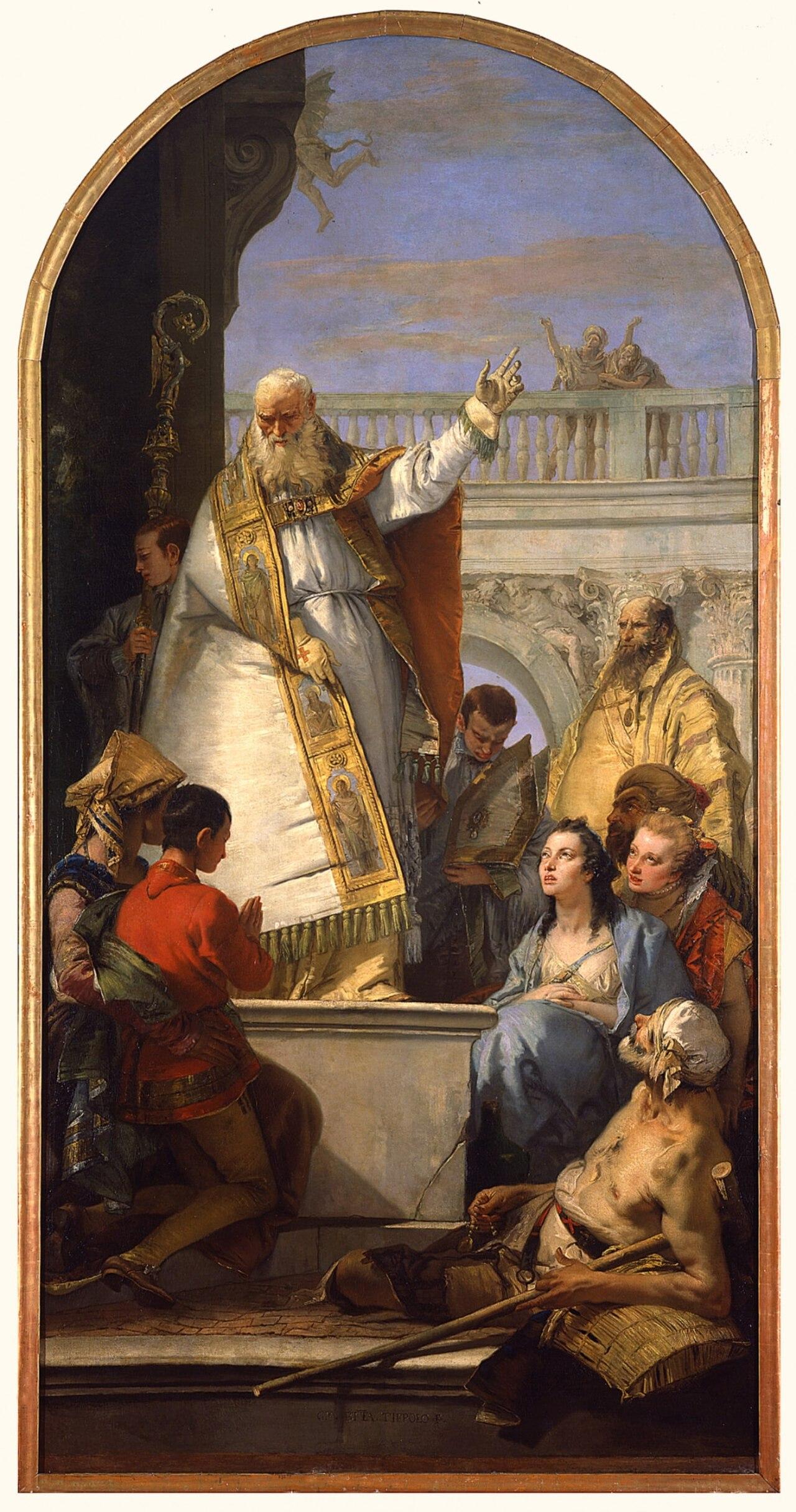
Saint Patrick, Giovanni Battista Tiepolo, 1746. Public domain.
For this is what the Lord has commanded us: ‘I have made you a light for the Gentiles, to bring salvation to the ends of the earth.’”
Summary
Patrick was a Briton of the fifth century, the son of a deacon and the grandson of a priest. After six years as a slave in Ireland he escaped, and he returned as a bishop.
- He names few people and almost no dates.
- Prosper of Aquitaine and Bede say that Palladius was sent to the Irish first, in 431.
- The year of his death stands at two dates thirty-two years apart.
The Ends of the Earth
He quotes Acts 13:47 and Matthew 28:19 in his Confession to explain why he went.
The question of this life is what two short writings can tell a reader when every other account was written centuries later. He leaves out almost every date and place, and he says a great deal about why he went. He quotes Acts 13:47 in chapter 38 of the Confession, of the people newly come to belief in Ireland.
And this gospel of the kingdom will be preached in all the world as a testimony to all nations, and then the end will come.He quotes this line in chapter 40, of the Gospel as a witness to all nations.
Therefore go and make disciples of all nations, baptizing them in the name of the Father, and of the Son, and of the Holy Spirit,He quotes this command in chapter 40, and he adds that clergy were needed to baptize.
The Life in Order
The order comes from the Confession, which gives ages and spans, and the years come from Bury.
His own writings give spans of years and no year of the calendar.
- Perhaps 389, by BuryHe was born in Roman BritainBury (1905), Appendix C
- At about sixteenHe was taken captive to Ireland with many thousandsConfession 1
- For six yearsHe tended flocks and prayed in the woods and on the mountainConfession 16 and 17
- ThenHe walked to a ship perhaps two hundred miles awayConfession 17
- After a few yearsHe was in Britain and saw Victoricus in the nightConfession 23
- 431Palladius went to the Irish before himBede 1.13
- 432, by BuryHe was consecrated and went to IrelandBury (1905), chapter 3
- 444, by BuryHe founded ArmaghBury (1905)
- After a raidHe wrote the Letter to the Soldiers of CoroticusLetter 2 and 3
- In old ageHe wrote the Confession before he diedConfession 10 and 62
- 461, by BuryHe died and was buried at SaulBury (1905), chapter 9
Each step of the life stands with its witness.
432, by Bury, 444, by Bury, After a raid, In old age, 461, by Bury
From Captivity to the Bishop's Chair
He gives the story of his youth himself, and the Letter gives the worst day of his work.
Patrick wrote two short documents, and they are the only reliable sources for his life. The fire on the hill of Slane comes from Muirchu's Life, written late in the seventh century, and the snakes from Jocelin in the twelfth.
He was born in Roman Britain, at a place he calls Bannavem Taburniae, which nobody has located. His father Calpornius was a deacon and a town councillor; his grandfather Potitus was a priest. Patrick says frankly that his own family's religion meant little to him as a boy and that he did not know the true God.
At sixteen he was taken by Irish raiders, along with thousands of others, and sold into slavery in Ireland. He spent six years there herding animals in the open. It was in that hunger and cold, he says, that he began to pray. He prayed a hundred prayers in the day and nearly as many at night, in the woods and on the mountain, before dawn, in snow and frost and rain. Then a voice in a dream told him his ship was ready. He walked about two hundred miles to a coast he did not know, talked his way onto a boat, and got out.
He reached his family in Britain, and they begged him never to leave again. Then he dreamed of a man carrying letters from Ireland, and heard in the dream the voice of the Irish calling him to come and walk among them once more.
He went back, trained as a cleric, ordained, and eventually consecrated bishop. He spent the rest of his life in the north of Ireland, baptising, ordaining clergy, and planting churches among a people with no Roman administration and no towns. He paid protection money to local kings to travel, gave gifts to their sons, and says he was robbed, seized, and put in irons more than once, and once held fourteen days expecting death.
His Confession was written as a defence. Church authorities in Britain had accused him of something, and he never says exactly what. He mentions a sin confessed to a friend before he was ordained, which the friend later used against him. They also questioned his fitness and his learning. The Confession is his answer: an unpolished, urgent, deeply Scriptural account of a man who knows his Latin is rough and says so.
The other document, the Letter to the Soldiers of Coroticus, is a public excommunication. A British warlord's men had raided newly baptised Irish Christians, killed some and sold others to the Picts. Patrick, recalling that the chrism was still on their foreheads when they were killed, calls Coroticus's soldiers fellow citizens of demons, and orders that the letter be read aloud in their presence. It is a protest against the slave trade, written by a former slave.
He died in the fifth century; tradition places it on 17 March, and the annals give 461 or 493.
The Two Writings and the Later Lives
The writings are his own, and the Lives came centuries afterward.
The Confession closes with its own title line, "And this is my confession before I die". White notes that Patrick himself describes the other writing as sent to the soldiers of Coroticus, and he calls it a manifesto and a protest.
Muirchu lived and wrote in the latter part of the seventh century, as Bury shows from the death of his friend Bishop Aed in 700. Jocelin's Life, of the twelfth century, tells how Patrick gathered the poisonous creatures of the island together and drove them out. Those are the later Lives' claims, and the two writings say nothing of Slane or of snakes.
Bede's History does not name him. A. M. Sellar's note says, "Bede only mentions him once, viz., in the 'Martyrology,'" and that the Martyrology is "perhaps, not his genuine work". Bede tells of Columba at Iona in 3.4 and of Aidan in 3.3, and he draws no line from Patrick to either.
In Their Own Words
Five passages from his two writings in White's English of 1920, each with its place.
A hundred prayers in a day1 quotation, 1 paragraph
He tells of his years as a slave in chapter 16 of the Confession, which he wrote in old age and gives no year.
The Voice of the Irish1 quotation, 1 paragraph
He tells this vision in chapter 23 of the Confession, and he had it in Britain after his escape.
The Gospel and His Promises1 quotation, 1 paragraph
Near the close of the Confession, written in the fifth century, he states his one reason for going back.
Fellow-citizens of demons1 quotation, 1 paragraph
He wrote this in chapter 2 of the Letter after a raid on the newly baptized, and the writing gives no year.
A slave in Christ1 quotation, 1 paragraph
In this fifth-century Letter he names his father a decurion and says he sold his noble rank for the profit of others.
The People Around Him
He names few people, and most of these ties stand on his own word.
He names his father, his grandfather and Victoricus, and few others.
| Person | Tie to Patrick | The witness |
|---|---|---|
| Calpornius | His father was a deacon and a decurion. | Confession 1; Letter 10 |
| Potitus | His grandfather was a presbyter. | Confession 1 |
| Victoricus | A man of this name brought the letters in his vision. | Confession 23 |
| His dearest friend | He told Patrick he would be made bishop and later shamed him publicly. | Confession 27 and 32 |
| Coroticus | This British ruler's soldiers raided his converts. | Letter 2, 6 and 12 |
| Palladius | Pope Celestine sent him to the Irish believers before Patrick. | Bede 1.13 |
| Benignus | This disciple followed him at Armagh, by the old lists. | Bury (1905), chapter 9 |
The Places of His Life
He names two small places and the lands of Britain, Gaul and Ireland, and later witnesses add the rest.
Of towns and woods he names only his home village and the Wood of Foclut.
| Place | What the witnesses say | The witness |
|---|---|---|
| Bannavem Taburniae | His father's village, with a small farm hard by, where he was taken. | Confession 1 |
| The Wood of Foclut | The voice of the Irish came from there, beside the western sea. | Confession 23 |
| Britain | His kindred lived there and begged him to stay. | Confession 23 |
| Armagh | Bury dates its founding to 444. | Bury (1905), chapter 8 |
| Saul | Bury writes that he certainly died there. | Bury (1905), chapter 9 |
What He Held About His Calling
He ties his going to the promise that the Gospel would reach the ends of the earth.
He writes that his brethren saw only danger and his lack of learning, and that God "overcometh in me". Chapter 4 of the Confession holds a rule of faith in the Father, the Son and the Spirit. He thanks God again and again, and he credits the whole work to "the gift of God" at the end of the book.
How His Two Verses Were Taught
Tertullian read the verse in Acts, and John Wesley and William Carey read the verse in Matthew.
Tertullian (died 220)
Against Marcion Book V
Tertullian asked who had spoken these words to Christ, and he answered Marcion with the Creator.
“Now who was it that said; ‘Let there be light? ‘ And who was it that said to Christ concerning giving light to the world: ‘I have set Thee as a light to the Gentiles’ -to them, that is, ‘who sit in darkness and in the shadow of death? ‘ (None else, surely, than He), to whom the Spirit in the Psalm answers, in His foresight of the future, saying, ‘The light of Thy countenance, O Lord, hath been displayed upon us.”
on Acts 13:47Patristic
John Wesley (1703 to 1791)
Explanatory Notes upon the New Testament, on Matthew 28:19
John Wesley named the design of the command in Matthew 28:19.
“Make them my disciples. This includes the whole design of Christ's commission. Baptizing and teaching are the two great branches of that general design.”
Evangelical
William Carey (1761 to 1834)
An Enquiry, Section I (1792)
William Carey read the same command as binding on every generation of the church.
“This commission was as extensive as possible, and laid them under obligation to disperse themselves into every country of the habitable globe, and preach to all the inhabitants, without exception, or limitation.”
Particular Baptist
What the Witnesses Leave Open
Readers differ on his death, on who came first, on the hymn under his name and on Coroticus.
The year of his deathJ. B. Bury; the later annals
Bury calls the later date "the legendary date of his death" and argues for the earlier. He notes that no notice in the annals treats Patrick as alive in the years between.
Who came firstBede after Prosper; A. M. Sellar
Bede writes that Palladius was sent "to the Scots that believed in Christ, to be their first bishop". Sellar's note says this shows the Irish "as in part already Christian", and that later accounts make Palladius an unsuccessful forerunner of Patrick.
The hymn called his BreastplateN. J. D. White; the Irish preface
The Irish preface says, "Patrick made this hymn". White calls it "undoubtedly very ancient" and reports the suggestion that it is a group of charm-hymns "thrown together either by St. Patrick or some other very early composer".
Who Coroticus wasN. J. D. White; J. H. Todd
White says Coroticus is not the Caredig of Cardigan, as Todd held, and identifies him with Ceretic, who ruled in Strathclyde. The Letter itself says only that his men are allies of the Scots and the Picts.
Books to Read Next
St. Patrick: His Writings and Life
Newport J. D. White · 1920
This volume holds the Confession, the Letter and the Lorica in English, with notes.
Read White free at the Internet ArchiveThe Life of St. Patrick and His Place in History
J. B. Bury · 1905
Bury weighs the annals and the Lives.
Read Bury free at the Internet ArchiveWhat Patrick Left
Patrick left a Confession and a Letter, and he says he baptized many thousands. He asked those who read the Confession to judge that what he did "was the gift of God".
Sources
Scripture is the Berean Standard Bible.
- The Holy Bible, Berean Standard Bible (read 2026)
- Newport J. D. White, St. Patrick: His Writings and Life, with the Confession, the Letter and the Lorica in his English and with Atkinson's preface to the Lorica (1920)
- J. B. Bury, The Life of St. Patrick and His Place in History (1905)
- Bede, Ecclesiastical History, A. M. Sellar's revised translation, with her notes (1907)
- Jocelin, The Life of Saint Patrick, in Louis O'Leary, The Most Ancient Lives of Saint Patrick (1904)
- Tertullian, Against Marcion, book 5, on Acts 13:47.
- John Wesley, Explanatory Notes upon the New Testament (1755), on Matthew 28:19.
- William Carey, An Enquiry, section 1 (1792), on Matthew 28:19.
Keep Studying
Studies1
People and groups8