
Psalms 119:46
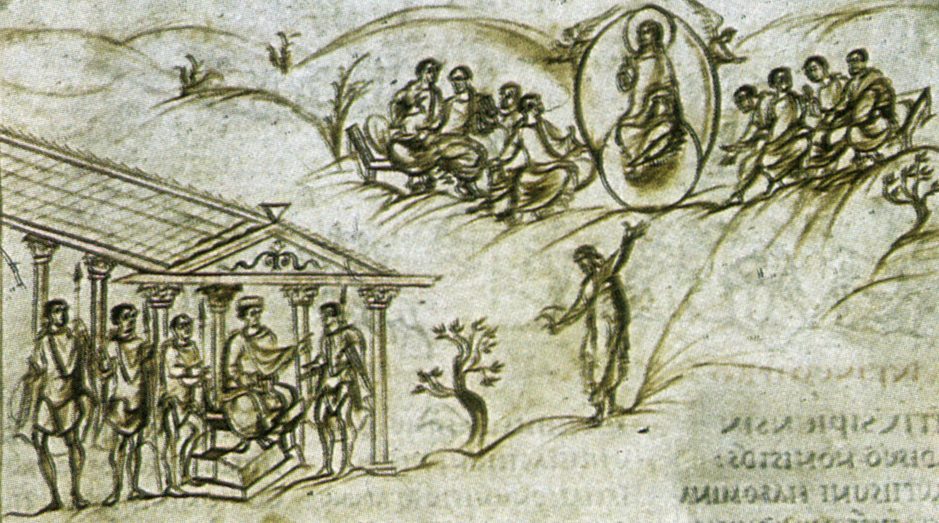
in Psalms 119I will speak of Your testimonies before kings, and I will not be ashamed.
BSB
The same verse in ASV and KJV ▾
ASV
I will also speak of thy testimonies before kings, And shall not be put to shame.
KJV
I will speak of thy testimonies also before kings, and will not be ashamed.
⋯
This verse in Psalms 119
Commentary
8 notes on this verseThis site's exposition
May Your loving devotion come to me
on Psalms 119:41-48
Mercy comes first here, the loving devotion and the salvation asked for before any promise to obey. Then the word is for speaking: an answer to the man who taunts, and testimonies spoken before kings without shame. Verse 48 lifts the hands to the commandments.
The record, by era
The Church Fathers1 voice
"I spoke of Your testimonies also," he says, "before kings, and I was not ashamed" [Psalm 119:46]: as one who had sought and had received grace to answer those who reproached him with the word, and the promise that the word of truth should not be taken from his mouth. Struggling for this truth even unto death, not even before kings was he ashamed to speak of it. For testimonies, whereof he does avow that he was speaking, are in Greek styled μαρτύρια, a word which we now employ instead of the Latin. The name of "Martyrs," unto whom Jesus foretold, that they should confess Him even before kings, [Matthew 10:18] is derived hence.
The Puritans and the Awakening1 voice
I will speak of thy testimonies also before kings,....
The Nineteenth Century3 voices
A commentator
Jamieson, Fausset & Brown1802–1910
Commentary Critical and Explanatory on the Whole Bible (1871)
proposed
To freedom from reproach, when imbued with God's truth, there is added "great boldness in the faith" [1Ti 3:13], accompanied with increasing delight in the holy law itself, which becomes an element of happiness.
"I will speak of thy testimonies also before kings, and will not be ashamed." This is part of his liberty; he is free from fear of the greatest, proudest, and most tyrannical of men. David was called to stand before kings when he was an exile; and afterwards, when he was himself a monarch, he knew the tendency of men to sacrifice their religion to pomp and statecraft; but it was his resolve to do nothing of the kind. He would sanctify politics, and make cabinets know that the Lord alone is governor among the nations.
"I will speak of thy testimonies also before kings, and will not be ashamed." This is part of his liberty; he is free from fear of the greatest, proudest, and most tyrannical of men. David was called to stand before kings when he was an exile; and afterwards, when he was himself a monarch, he knew the tendency of men to sacrifice their religion to pomp and statecraft; but it was his resolve to do nothing of the kind. He would sanctify politics, and make cabinets know that the Lord alone is governor among the nations. As a king he would speak to kings concerning the King of kings. He says, "I will speak:" prudence might have suggested that his life and conduct would be enough, and that it would be better not to touch upon religion in the presence of royal personages who worshipped other gods, and claimed to be right in so doing. He had already most fittingly preceded this resolve by the declaration, "I will walk," but he does not make his personal conduct an excuse for sinful silence, for he adds, "I will speak." David claimed religious liberty, and took care to use it, for he spoke out what he believed, even when he was in the highest company. In what he said he took care to keep to God's own word, for he says, "I will speak of thy testimonies." No theme is like this, and there is no way of handling that theme like keeping close to the book, and using its thought and language. The great hindrance to our speaking upon holy topics in all companies is shame, but the Psalmist will "not be ashamed;" there is nothing to be ashamed of, and there is no excuse for being ashamed, and yet many are as quiet as the dead for fear some creature like themselves should be offended. When God gives grace, cowardice soon vanishes.
2 more voices on this verse
The Nineteenth Century2 voices
I will speak - before kings - Dr. Delaney supposes that this is spoken in reference to Achish, king of Gath, whom David had instructed in the Jewish religion; but we have already seen that it is most likely that the Psalm was compiled under the Babylonish captivity. But the words may with more propriety be referred to the case of Daniel, and other bold and faithful Israelites, who spoke courageously before Nebuchadnezzar, Belshazzar, and Darius. See the books of Daniel, Ezra, and Nehemiah.
A commentator
Albert Barnes1798–1870
Notes, Explanatory and Practical, on the Old and New Testaments (1832-1869)
proposed
I will speak of thy testimonies also before kings ... - In the presence of men of most elevated rank. I will not be ashamed to avow my belief in thy word before those in power - whether friendly or unfriendly to thee and to thy cause. I will not disguise my belief in thy truth with any desire to secure their favor; I will not be intimidated from expressing my faith by any dread of their frowns. Compare Mat 10:18-19; Act 4:19; Act 5:29; Act 26:2.
The words behind it
6 Hebrew wordsEvery Hebrew word of this verse in the order it stands, with what it means and the door to its own study. The last column counts the times a word stands in the whole Bible: the rarer the word, the more the places it appears belong together.
| Hebrew | Sound | Meaning | Word study | In the Bible |
|---|---|---|---|---|
| וַאֲדַבְּרָ֣ה | vaadaberah | and I will speak | H1696 → | 1141 times |
| בְ֭עֵדֹתֶיךָ | veedoteikha | in testimonies your | H5713 → | 26 times |
| נֶ֥גֶד | neged | before | H5048 → | 151 times |
| מְלָכִ֗ים | melakhim | kings | H4428 → | 2525 times |
| וְלֹ֣א | velo' | and not | H3808 → | 5168 times |
| אֵבֽוֹשׁ׃ | ʾevoosh | I will be ashamed | H954 → | 127 times |
וַאֲדַבְּרָ֣הand I will speak
vaadaberahH1696 →1141 times
בְ֭עֵדֹתֶיךָin testimonies your
veedoteikhaH5713 →26 times
נֶ֥גֶדbefore
negedH5048 →151 times
מְלָכִ֗יםkings
melakhimH4428 →2525 times
וְלֹ֣אand not
velo'H3808 →5168 times
אֵבֽוֹשׁ׃I will be ashamed
ʾevooshH954 →127 times
A shaded row is a word that stands 400 times or fewer in the Bible.
The walk
8 stopsEach card is a verse this one points to, and under it the verses that one points to in turn. Where several paths arrive at the same place, that place is listed first: the text keeps returning to it.
Through
Romans 1:16I am not ashamed of the gospel, because it is the power of God for salvation to everyone who believes, first to the Jew, then to the Greek.
it leads to
- Mark 8:38
If anyone is ashamed of Me and My words in this adulterous and sinful generation, the Son of Man will also be ashamed of him when He comes in His Father’s glory with the…
- 2 Timothy 1:8
So do not be ashamed of the testimony of our Lord, or of me, His prisoner. Instead, join me in suffering for the gospel by the power of God.
- 1 Peter 4:16
But if you suffer as a Christian, do not be ashamed, but glorify God that you bear that name.
- 2 Timothy 1:12
For this reason, even though I suffer as I do, I am not ashamed; for I know whom I have believed, and I am convinced that He is able to guard what I have…
- Psalms 40:9–10
I proclaim righteousness in the great assembly; behold, I do not seal my lips, as You, O LORD, do know.
- Mark 8:38
Through
Mark 8:38If anyone is ashamed of Me and My words in this adulterous and sinful generation, the Son of Man will also be ashamed of him when He comes in His Father’s glory with the…
it leads to
- Luke 12:8–9
I tell you, everyone who confesses Me before men, the Son of Man will also confess him before the angels of God.
- Romans 1:16
I am not ashamed of the gospel, because it is the power of God for salvation to everyone who believes, first to the Jew, then to the Greek.
- 1 John 2:23
Whoever denies the Son does not have the Father, but whoever confesses the Son has the Father as well.
- Luke 12:8–9
Where this verse is studied
About Psalms
This page draws on Adam Clarke, Commentary on the Bible; Albert Barnes, Notes, Explanatory and Practical, on the Old and New Testaments (1832-1869); Augustine of Hippo, Exposition on Psalm 119; Charles Spurgeon, The Treasury of David, Vol. 6; Jamieson, Fausset & Brown, Commentary Critical and Explanatory on the Whole Bible; John Gill, Exposition of the Old Testament; John Gill, Exposition of the Old Testament (1748-1763) and Matthew Henry, Commentary on the Whole Bible.