
Philemon 1:16
in Philemon 1no longer as a slave, but better than a slave, as a beloved brother. He is especially beloved to me, but even more so to you, both in person and in the Lord.
BSB
The same verse in ASV and KJV ▾
ASV
no longer as a servant, but more than a servant, a brother beloved, specially to me, but how much rather to thee, both in the flesh and in the Lord.
KJV
Not now as a servant, but above a servant, a brother beloved, specially to me, but how much more unto thee, both in the flesh, and in the Lord?
⋯
This verse in Philemon 1
Commentary
15 notes on this verseNot now as a servant? - Do not receive him merely as thy slave, nor treat him according to that condition; but as a brother - as a genuine Christian, and particularly dear to me. Both in the flesh and in the Lord? - There is no reason to believe that Onesimus was of the kindred of Philemon; and we must take the term flesh, here, as referring to the right which Philemon had in him.
This site's exposition
I would have liked to keep him with me
on Philemon 1:13-16
Paul would keep Onesimus only with Philemon's consent. Perhaps he was separated from you for a while, so that you might have him back for good. He returns no longer as a slave, but better than a slave, as a beloved brother.
This site's exposition
both in person and in the Lord
The phrase at the close names two ties. Jamieson, Fausset and Brown read it as a slave in the house who is now a beloved brother in the Lord. Chrysostom called slave and free mere names beside the freedom Onesimus found in Christ.
The record, by era
The Church Fathers5 voices
Since Onesimus has changed his mind from being a wicked one, he himself turns it to the doubtful, as if he said: For perhaps he fled for reasons of caution. "for this reason he was separated". With a euphemistic name, Paul called it separation, so …
Perhaps for this reason he departed from you for a time, so that you might receive him forever. No longer as a servant, but more than a servant, a beloved brother, especially to me: but how much more to you both in the flesh, and in the Lord." Sometimes, evil is the cause of good things, and God can turn the wicked intentions of men to good. What I am saying will become clearer through an example. Joseph's brothers, incited by jealousy, sold him to the Ishmaelites for twenty pieces of silver (Gen. 37). From this evil beginning, good things came to his father, his brothers, and all of Egypt. Finally, he said to his brothers: "You thought evil of me: but God turned it into good." (Gen. 45:8). We can understand a similar thing in the case of Onesimus, that bad beginnings were the occasion of a good thing. For if he had not fled his master, he would never have come to Rome where Paul was imprisoned. If he had not seen Paul in chains, he would not have received faith in Christ. If he had not had faith in Christ, he would never have been sent out for the work of the gospel as Paul's son. Thus little by little, and by its own steps, with changing judgments, Onesimus became a minister of the gospel, because he had fled from his master. And with a beautiful addition, he tempered his judgment, saying, "perhaps." The judgments of God are hidden, and it is reckless to pronounce as certain what is doubtful. "Perhaps," he said, "this happened": cautiously, timidly, tremblingly, without taking a firm stand: as if he had not said "perhaps," all the slaves would have fled, and become as apostates. But what he added, "for an hour," we must take for a time. For in comparison with eternity, all time is brief. "That you might receive him as if he were eternal." No eternal lord has a servant: for his power, and the condition of each, ends in death. […]
He has well said, "perhaps," that the master may yield. For since the flight arose from perverseness, and a corrupt mind, and not from such intention, he has said, "perhaps." And he has not said, therefore he fled, but, therefore he was "separated," by a more fair sounding expression softening him the more. And he has not said, He separated himself, but, "he was separated." For it was not his own arrangement that he should depart either for this purpose or for that. Which also Joseph says, in making excuse for his brethren, "For God did send me hither" (Gen. xlv. 5), that is, He made use of their wickedness for a good end. "Therefore," he says, "he was parted for a season." Thus he contracts the time, acknowledges the offense, and turns it all to a providence. "That thou shouldest receive him," he says, "for ever," not for the present season only, but even for the future, that thou mightest always have him, no longer a slave, but more honorable than a slave. For thou wilt have a slave abiding with thee, more well-disposed than a brother, so that thou hast gained both in time, and in the quality of thy slave. For hereafter he will not run away. "That thou shouldest receive him," he says, "for ever," that is, have him again. "No longer as a bond-servant, but more than a bond-servant, a brother beloved, especially to me." Thou hast lost a slave for a short time, but thou wilt find a brother for ever, not only thy brother, but mine also. Here also there is much virtue. But if he is my brother, thou also wilt not be ashamed of him. By calling him his son, he hath shown his natural affection; and by calling him his brother, his great good will for him, and his equality in honor.
Shall I show you freedom arising from slavery? There was a certain Onesimus, a slave, a good-for-nothing runaway. He escaped and went to Paul. He obtained baptism, washed away his sins and remained at Paul's feet.… Do you see his nobility? Do you see a character that brings freedom? Slave and free are simply names. What is a slave? It is a mere name. How many masters lie drunken upon their beds, while slaves stand by sober? Whom shall I call a slave? The one who is sober, or the one who is drunk? The one who is the slave of a man, or the one who is the captive of passion? The former has his slavery on the outside; the latter wears his captivity on the inside.
Onesimus, having offended his own master, fled on a long journey to the Apostle; to show that he did not depart for the purpose of being guilty of a crime, but so that, with sins forgiven, he might return useful to such an extent that …
7 more voices on this verse
The Medieval Church2 voices
Much, he says, benefit the flight brought: instead of one hour, you have him forever. For even the whole life of a man, in comparison with eternity, is nothing; much more so the time of flight. So instead of a slave, receive a brother; instead …
And he says instead of a slave, that is, in place of a slave. Matthew 23:8: 'For one is your master and all are your brothers.' And not only yours, but mine in comparison to God, though he is a son to the ministry. How …
The Puritans and the Awakening3 voices
Love to Christ, and faith in him, are prime Christian graces, for which there is great ground of praise to God, where he has blessed any with them, as Rom. i. 8 , I thank my God because your faith is published throughout the world; and, in reference to the Colossians ( ch. i.
quarantine:debris (2026-07-29) — unbalanced-parens
Not now as a servant,....
(2.) Religious servants are more than mere ordinary servants; they have grace in their hearts, and have found grace in God's sight, and so will in the sight of religious masters. 6 , Mine eyes are upon the faithful of the land, that they may dwell with me.
The Nineteenth Century2 voices
A commentator
Jamieson, Fausset & Brown1802–1910
Commentary Critical and Explanatory on the Whole Bible (1871)
No longer as a mere servant or slave (though still he is that), but above a servant, so that thou shalt derive from him not merely the services of a slave, but higher benefits: a servant "in the flesh," he is a brother "in the Lord." beloved, specially to me--who am his spiritual father, and who have experienced his faithful attentions.
A commentator
Albert Barnes1798–1870
Notes, Explanatory and Practical, on the Old and New Testaments (1832-1869)
proposed
Not now as a servant - The adverb rendered “not now” (οὐκέτι ouketi), means “no more, no further, no longer.” It implies that he had been before in this condition, but was not to be now; compare Mat 19:6, “They are no more twain.” They were once so, but they are not to be regarded as such now; Mat 22:46, “Neither durst any man, from that day forth ask him any more questions.” They once did it, but now they did not dare to do it; Luk 15:19, “And am no more worthy to be called thy son,” though I once was; Joh 6:66, “And walked no more with him,” though they once did; see also Joh 11:54; Joh 14:19; Joh 17:11; Act 8:39; Gal 4:7; Eph 2:19. This passage then proves that he had been before a servant - δοῦλος doulos - a slave. But still, it is not certain what kind of a servant he was. The word does not necessarily mean slave, nor can it be proved from this passage, or from any other part of the Epistle, that he was at any time a slave; see the Eph 6:5 note, and 1Ti 6:1 note. The word denotes servant of any kind, and it should never be assumed that those to whom it was applied were slaves. It is true that slavery existed in the heathen nations when the gospel was first preached, and it is doubtless true that many slaves were converted (compare the notes at 1Co 7:21), but the mere use of the word does not necessarily prove that he to whom it is applied was a slave. If Onesimus was a slave, there is reason to think that he was of a most respectable character (compare the notes at Col 4:9), and indeed all that is implied in the use of the term here, and all that is said of him, would be met by the supposition that he was a voluntary servant, and that he had been in fact intrusted with important business by Philemon. […]
The words behind it
20 Greek wordsEvery Greek word of this verse in the order it stands, with what it means and the door to its own study. The last column counts the times a word stands in the whole Bible: the rarer the word, the more the places it appears belong together.
| Greek | Sound | Meaning | Word study | In the Bible |
|---|---|---|---|---|
| οὐκέτι | ouketi | no longer | G3756 →G2089 → | |
| ὡς | hos | as | G5613 → | 500 times |
| δοῦλον | doulon | a slave | G1401 → | |
| ἀλλ᾽ | all᾽ | but | G235 → | |
| ὑπὲρ | huper | above | G5228 → | 155 times |
| δοῦλον, | doulon | a slave, | G1401 → | |
| ἀδελφὸν | adelphon | a brother | G80 → | 343 times |
| ἀγαπητόν, | agapeton | beloved, | G27 → | |
| μάλιστα | malista | especially | G3122 → | |
| ἐμοί, | emoi | to me myself, | G1473 → | 839 times |
| πόσῳ | poso | how much | G4214 → | |
| δὲ | de | however | G1161 → | 2765 times |
| μᾶλλον | mallon | more | G3123 → | |
| σοὶ | soi | to you | G4771 → | 2973 times |
| καὶ | kai | both | G2532 → | 9120 times |
| ἐν | en | in | G1722 → | 2738 times |
| σαρκὶ | sarki | [the] flesh | G4561 → | |
| καὶ | kai | and | G2532 → | 9120 times |
| ἐν | en | in | G1722 → | 2738 times |
| κυρίῳ; | kurio | [the] Lord? | G2962 → | 711 times |
οὐκέτιno longer
ὡςas
hosG5613 →500 times
δοῦλονa slave
doulonG1401 →
ἀλλ᾽but
all᾽G235 →
ὑπὲρabove
huperG5228 →155 times
δοῦλον,a slave,
doulonG1401 →
ἀδελφὸνa brother
adelphonG80 →343 times
ἀγαπητόν,beloved,
agapetonG27 →
μάλισταespecially
malistaG3122 →
ἐμοί,to me myself,
emoiG1473 →839 times
πόσῳhow much
posoG4214 →
δὲhowever
deG1161 →2765 times
μᾶλλονmore
mallonG3123 →
σοὶto you
soiG4771 →2973 times
καὶboth
kaiG2532 →9120 times
ἐνin
enG1722 →2738 times
σαρκὶ[the] flesh
sarkiG4561 →
καὶand
kaiG2532 →9120 times
ἐνin
enG1722 →2738 times
κυρίῳ;[the] Lord?
kurioG2962 →711 times
A shaded row is a word that stands 400 times or fewer in the Bible.
The walk
8 stopsEach card is a verse this one points to, and under it the verses that one points to in turn. Where several paths arrive at the same place, that place is listed first: the text keeps returning to it.
Through
Matthew 23:8But you are not to be called ‘Rabbi,’ for you have one Teacher, and you are all brothers.
it leads to
- James 3:1
Not many of you should become teachers, my brothers, because you know that we who teach will be judged more strictly.
- Luke 22:32
But I have prayed for you, Simon, that your faith will not fail. And when you have turned back, strengthen your brothers.”
- 1 Corinthians 1:12–13
What I mean is this: Individuals among you are saying, “I follow Paul,” “I follow Apollos,” “I follow Cephas,” or “I follow Christ.”
- James 3:1
Through
1 Corinthians 7:22For he who was a slave when he was called by the Lord is the Lord’s freedman. Conversely, he who was a free man when he was called is Christ’s slave.
it leads to
- 1 Peter 2:16
Live in freedom, but do not use your freedom as a cover-up for evil; live as servants of God.
- 1 Peter 2:16
Through
Colossians 3:22Slaves, obey your earthly masters in everything, not only to please them while they are watching, but with sincerity of heart and fear of the Lord.
it leads to
- Ephesians 6:5–7
Slaves, obey your earthly masters with respect and fear and sincerity of heart, just as you would obey Christ.
- Galatians 1:10
Am I now seeking the approval of men, or of God? Or am I striving to please men? If I were still trying to please men, I would not be a servant of Christ.
- 1 Timothy 6:1–2
All who are under the yoke of slavery should regard their masters as fully worthy of honor, so that God’s name and our teaching will not be discredited.
- 1 Peter 2:18–19
Servants, submit yourselves to your masters with all respect, not only to those who are good and gentle, but even to those who are unreasonable.
- Ephesians 6:5–7
Where this verse is studied
On this page
About Philemon
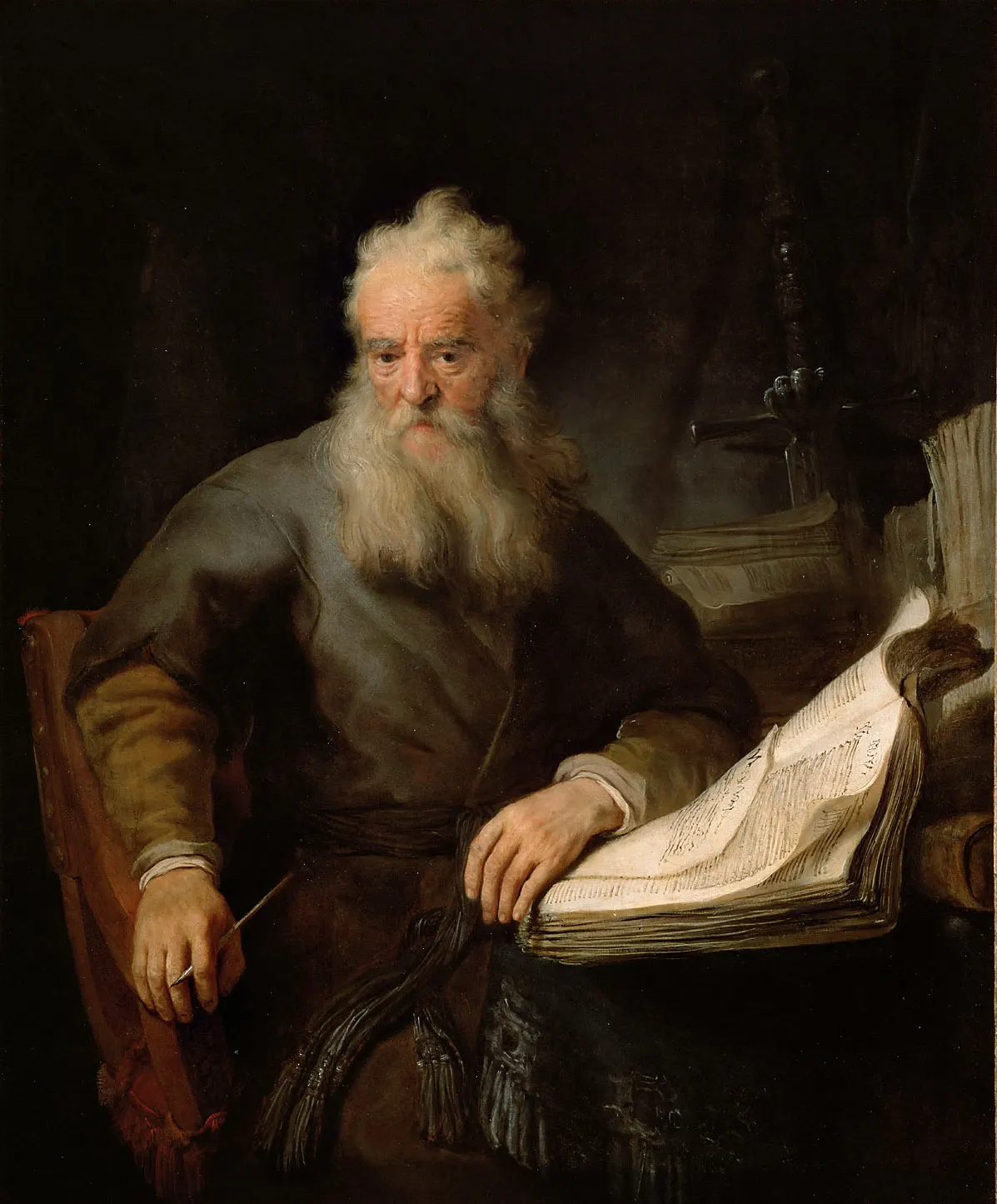
This page draws on 14 works. Open the list of works
This page draws on Adam Clarke, Commentary on the Bible; Albert Barnes, Notes, Explanatory and Practical, on the Old and New Testaments (1832-1869); Ambrosiaster, Commentary on Philemon; J. B. Lightfoot, Saint Paul's Epistles to the Colossians and to Philemon; Jamieson, Fausset & Brown, Commentary Critical and Explanatory on the Whole Bible; Jerome, Commentary on Philemon; John Chrysostom, On Lazarus and the Rich Man 6; John Chrysostom, Homily on Philemon 2; John Chrysostom, ON LAZARUS AND THE RICH MAN 6; John Gill, Exposition of the New Testament (1746-1748); Matthew Henry, Commentary on the Whole Bible; Oecumenius, COMMENTARY ON PHILEMON; Theophylact of Ohrid, Commentary on Philemon and Thomas Aquinas, Commentary on Philemon.