
Song of Solomonchapter 1
17 verses · Solomon, by tradition · 10th century BC · Wisdom and poetry
This is Solomon’s Song of Songs.
Introduction
Solomon, by tradition, Wisdom and poetry, Song of Solomon Overview.
This book is a set of love songs, and its title gives it to Solomon, the king of Israel's richest years. It was sung among a people who knew vineyards, flocks, perfume and the court at Jerusalem from their own lives. The chapter opens with no narrator and no setting, so the reader learns who is speaking only from how each voice speaks. Listen for three voices, the woman, the man and a group of friends. Hear how every picture is taken from smell and sight. Jews and Christians have both read the book as a picture of God's love for His people.
Context
- Who
- Israelites at a wedding celebration, hearing love sung out loud
- What
- The opening of a love song in which a young woman and the king speak their desire for each other and a group of friends answers them.
- Where
- The court of the king in Jerusalem, the pastures of the shepherds and the oasis of En-gedi on the western shore of the Dead Sea.
- When
- The reign of Solomon, about 970 to 930 BC, by the title; the date of writing is argued, and some place the book later on the evidence of its Hebrew.
- Why
- To sing the love between a man and a woman as a good gift, which later readers also took as a picture of the love between God and His people.
Historical context
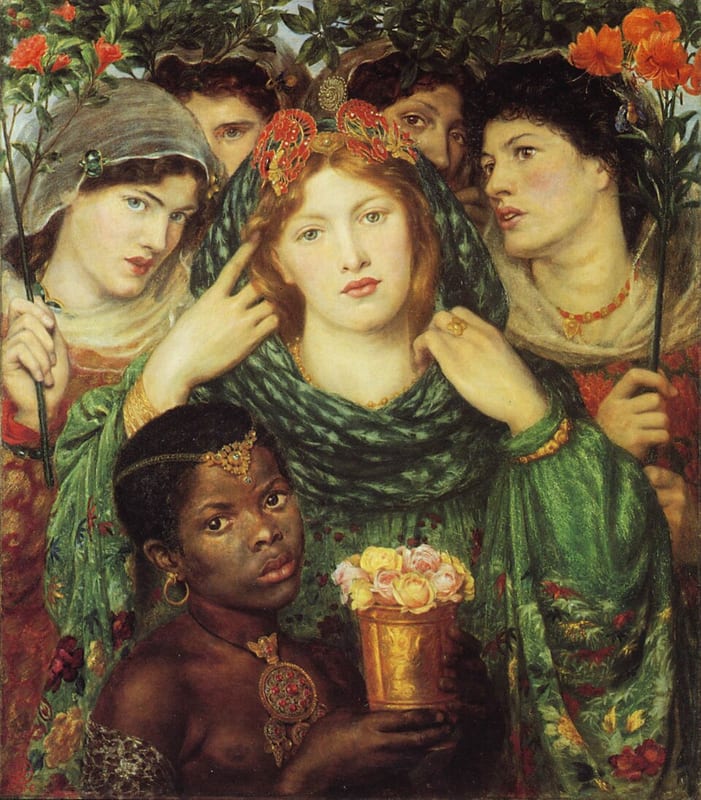
"I am black, but comely… look not upon me, because I am black, because the sun hath looked upon me: my mother's children were angry with me; they made me the keeper of the vineyards." This is about field labour, not ancestry. A woman put out to guard vineyards worked in the open all day through the dry season, and a deep tan marked her as someone who worked outdoors, in contrast to the sheltered women of a court. She says it defensively and then refuses to apologise for it.
Show the rest of the historical context, 4 more paragraphs
"As the tents of Kedar, as the curtains of Solomon." Kedar was a north Arabian people whose tents were woven from black goat hair, dark on the outside, and the same cloth that made the tabernacle's covering. She compares herself to something dark and beautiful in the same breath.
"I have compared thee, O my love, to a company of horses in Pharaoh's chariots." Solomon's records describe horses imported from Egypt and Kue, and Egyptian chariot teams were harnessed with ornamented headstalls and plumes. It is a compliment about magnificence and matched grace, from a king who bought horses for a living.
The perfumes name the trade routes. Spikenard came from the Himalayan foothills by way of long-distance trade; myrrh came up from Arabia and was carried in a small cloth sachet worn at the breast overnight; henna, the "camphire" of the older translation, grew in the oasis of Engedi on the Dead Sea shore and produced both a scent and a reddish dye for hands and hair.
"The beams of our house are cedar, and our rafters of fir" points at the timber Solomon imported from Lebanon by raft down the coast. The lovers are describing the outdoors as their house, but the wood they name is palace wood.
Significance
The first hearers received this as a wedding song sung in public, at a celebration that ran for days. Israel did not treat married love as something to be whispered about; it was sung with musicians in the room.
Show the rest of the significance, 1 more paragraph
The woman speaks first and speaks most, and she speaks about her own desire without embarrassment. In the ancient world that is unusual enough to be the first thing worth noticing about the book.
This chapter in Jewish lifeWhat this chapter is in Jewish life and reading.
What is done
The whole Song is read in the synagogue once a year, at Passover, on the Sabbath that falls in the festival week. The site's festival table in src/lib/hebraic/readings.ts records the practice and cites Tractate Soferim 14:3 for it, and Mishnah Yadayim 3:5 for Rabbi Akiva's ruling on the standing of the book. Probed for this lane, the same table printed parashot total 0 and haftarah uses total 0 for the book. No chapter of the Song is a weekly portion, and none is read as a Haftarah.
The commentary on this chapter shows why the Song belongs to that feast. Rashi reads the steeds in the chariots of Pharaoh at the ninth verse as the gathering of God's camps at the sea. God speaks in the note: "for I gathered My camps to go out toward you against the chariots of Pharaoh to save you" (Rashi on Song of Songs 1:9:1). He reads the circlets of gold at the eleventh verse as treasure for Israel. God hardened Pharaoh's heart to pursue her "with all the best of his hidden treasures" (Rashi on Song of Songs 1:11:1). A congregation that hears this chapter in the week of the exodus hears it through the same event.
How it is read
Rashi is the one commentator on this chapter whose English the corpus carries, quoted here from The Metsudah Five Megillot, Lakewood, N.J., 2001, which Sefaria reports as CC-BY. Each quotation is held to fifty words or fewer because the translation is modern, and the translator's bracketed glosses are kept as the translation prints them. The two notes at the opening are in a second translation, the Sefaria Community Translation, which Sefaria reports as CC0.
Rashi opens the book with a rule for reading it. He grants that one verse yields several explanations, and then holds that "a verse does not depart from its literal sense and meaning" (Rashi on Song of Songs 1:1:1). He also says that the midrashim on the Song came to him in two forms. "Some organize this entire book in one complete compilation of midrash" while others scatter it (Rashi on Song of Songs 1:1:2). His own commentary keeps both halves. At the second verse he gives the plain sense first, that every feast of pleasure is named after its wine. He then says "This is the explanation of its apparent meaning" before turning to the allegory (Rashi on Song of Songs 1:2:2).
The allegory he gives is Israel speaking in exile. The bride of the second verse "recites this song with her mouth in her exile and in her widowhood" (Rashi on Song of Songs 1:2:1). The kisses she asks for he reads as the giving of the Torah, "when He gave them His Torah and spoke to them face to face" (Rashi on Song of Songs 1:2:2). The good oils of the third verse are the good name that spread when God did awesome deeds in Egypt (Rashi on Song of Songs 1:3:2).
The dark bride of the fifth verse is where his reading is sharpest. The congregation of Israel says to the nations, "I am black in my deeds [i.e., sins], but I am comely by virtue of the deeds of my ancestors" (Rashi on Song of Songs 1:5:1). The same note names the golden calf as the sin and the acceptance of the Torah as the merit that offsets it. At the twelfth verse Israel confesses that she repaid good with evil while the King was still at His wedding banquet (Rashi on Song of Songs 1:12:1). The translator's note places the banquet at Mount Sinai. At the fifteenth God forgives, and Rashi carries the praise to the answer Israel gave at Sinai, "Let us do" and "Let us hear" (Rashi on Song of Songs 1:15:1). At the sixteenth the bride turns the praise back: "The beauty is not mine, but Yours; You are the handsome one" (Rashi on Song of Songs 1:16:1).
A Christian reader should hear how close and how far this lies from the church's own allegory. The site's dossier on the book records that Rashi read the Song as God's love for Israel in exile. It records that Origen founded the Christian form of the reading, with the bride as the church and the soul. Both hold that the poem speaks of God and His people. They part on who the bride is, and neither tradition should be folded into the other.
The corpus carries six further notes on this chapter that it marks linked, so they are named here and never quoted or paraphrased. One stands cited and unquoted because Sefaria holds no English version of the ref, at Ibn Ezra on Song of Songs 1:5:1. Five stand cited and unquoted because the licence Sefaria reports is none, at Rashi on Song of Songs 1:7:1, 1:7:2, 1:8:1, 1:13:1 and 1:17:1.
What the rabbis say
The corpus carries forty locators on this chapter and the text of none. Each is cited and linked here, and none is quoted. Thirty-seven of them are Midrash and Talmud, and the rest are named at the end. On the first verse it holds Mekhilta DeRabbi Shimon Ben Yochai 15:1 and Midrash Aggadah, Exodus 27:1:2. On the second verse it holds Avodah Zarah 29b:8, Avodah Zarah 35a:6 and Avodah Zarah 35a:7. On the third verse it holds Avodah Zarah 29b:9, Avodah Zarah 35b:7 and Avodah Zarah 35b:8. On the fourth verse it holds Bereshit Rabbah 48:6, Bereshit Rabbah 49:2 and Bereshit Rabbah 86:1.
On the fifth verse it holds Aggadat Bereshit 84:3, Midrash Aggadah, Exodus 26:7:2 and Midrash Lekach Tov on Song of Songs 1:5:1. On the sixth verse it holds Avot DeRabbi Natan 20:1, Jerusalem Talmud Eruvin 3:9:3 and Midrash Aggadah, Exodus 2:20:1. On the eighth verse it holds Avot DeRabbi Natan 17:3 and Avot DeRabbi Natan 17:4. On the ninth verse it holds Avot DeRabbi Natan 27:1 and Avot DeRabbi Natan 27:2.
On the tenth verse it holds Mekhilta DeRabbi Yishmael, Tractate Shirah 10:1 and Midrash Lekach Tov on Song of Songs 1:10:1. On the eleventh verse it holds Bamidbar Rabbah 13:20 and Mekhilta DeRabbi Shimon Ben Yochai 12:36. On the twelfth verse it holds Ein Yaakov (Glick Edition), Gittin 4:2 and Ein Yaakov (Glick Edition), Shabbat 9:12. On the thirteenth verse it holds Aggadat Bereshit 63:1 and Ein Yaakov (Glick Edition), Shabbat 9:14.
On the fourteenth verse it holds Midrash Lekach Tov on Song of Songs 1:14:1 and Midrash Lekach Tov on Song of Songs 1:14:2. On the fifteenth verse it holds Midrash Lekach Tov on Song of Songs 1:15:1 and Midrash Lekach Tov on Song of Songs 1:15:2. On the sixteenth verse it holds Midrash Lekach Tov on Song of Songs 1:16:1 and Midrash Lekach Tov on Song of Songs 1:16:2. On the seventeenth verse it holds Bereshit Rabbah 68:11 and Midrash Lekach Tov on Song of Songs 1:17:1.
The corpus also files three passages of Learning to Read Midrash, a modern reference work, among the locators, anchored at Song of Songs 1:1-8 and Song of Songs 1:7. Their full refs stand in the sources of this row, and they are cited by ref alone. What each of them teaches is a saying of the rabbis, and is reported as theirs wherever this site quotes one. The quotations wait on a fetch that carries the text.
Sources: Rashi, Rashi on Song of Songs 1:1:1 to 1:1:2, Sefaria Community Translation, reported CC0, 2 notes kept; Rashi, Rashi on Song of Songs 1:2:1 to 1:16:1, The Metsudah Five Megillot, Lakewood, N.J., 2001, reported CC-BY, 16 notes kept; Ibn Ezra, Ibn Ezra on Song of Songs 1:5:1, cited by ref because the corpus carries no English text; Rashi, the notes not kept, Rashi on Song of Songs 1:7:1, 1:7:2, 1:8:1, 1:13:1 and 1:17:1, cited by ref because the licence Sefaria reports is none; The site's book dossier, src/components/book/dossier-content/song-of-solomon.ts, the reception section on the Targum, Rashi and Origen; Learning to Read Midrash, a modern reference work the corpus files among its locators, cited by ref alone: Learning to Read Midrash, Chapter 12; Interpreting Dialogue I; Moshe Resists His Mission 90, anchored at Song of Songs 1:1-8 | Learning to Read Midrash, Appendix; Hebrew Sources 12:3, anchored at Song of Songs 1:7 | Learning to Read Midrash, Chapter 12; Interpreting Dialogue I; Moshe Resists His Mission 31, anchored at Song of Songs 1:7; The Sefaria corpus, scripts/data/sources/sefaria/song-of-solomon/1.json, the 40 locators of this chapter; The site's own files, src/lib/hebraic/readings.ts, the festival entry for the Song at Passover citing Tractate Soferim 14:3 and Mishnah Yadayim 3:5, probed for this book and printing parashot total 0 and haftarah uses total 0.
The heads below are this chapter's scenes. The numbered points under each are its verses.
Let Him Kiss Me: I Am Black, but Comely
Song of Solomon 1:1-4
Solomon’s Song of Songs: "Song of Songs" is the Hebrew superlative, the finest of songs, from a king credited with a thousand and five songs (1 Kings 4:32). The bride's voice opens the poem, wishing for "the kisses of his mouth" and calling his love "more delightful than wine".
Song of Solomon 1:1
“The “Song of songs,” i. e., the best or most excellent of songs. Which is Solomon’s - literally, “to” or “for Solomon,” i. e., belonging to Solomon as its author or concerning him as its subject. In a title or inscription, the former interpretation is to be preferred.”
1 more voice on this verseWhat preachers and commentators have said about this verse, in their own words.
Song of Solomon 1:1
“This Book was written by Solomon and composed throughout from beginning to e mystically, by way of enigmatical allegory for the meaning of its doctrines is not open but hid. Nevertheless, if diligently sought after, it is found wherefore it becomes those who have understanding, to address them selves to the whole of this book as to a allegory, lest, through the ignorance of the unlearned, the things spoken in it fall into contempt.”
Athanasius of Alexandria · written before 373 · Commentary (church-history corpus)patristic
kisses of his mouth!: The verse begins by speaking of him in the third person and turns to address him. Adam Clarke read the third person as modesty and respect. He noted that the ancient versions read the Hebrew word for love as breasts, which some took spiritually as the Old and New Testaments.
Song of Solomon 1:2
“But why do we doubt? The church has believed in his goodness all these ages and has confessed its faith in the saying, "Let him kiss me with the kisses of his mouth; for your breasts are better than wine," and again, "And your throat is like the goodliest wine." Of his goodness, therefore, he nourishes us with the breasts of the law and grace, soothing our sorrows by telling of heavenly things.”
Ambrose of Milan · written before 397 · Exposition of the Christian Faith 2.2.32patristic
1 more voice on this verse
Song of Solomon 1:2
“Let him kiss me, etc. - She speaks of the bridegroom in the third person, to testify her own modesty, and to show him the greater respect. Thy love is better than wine - The versions in general translate דדיך dodeyca, thy breasts; and they are said to represent, spiritually, the Old and New Testaments.”
Adam Clarke · Commentary on the Bible (1810-1826)evangelical
your name is like perfume poured out: Adam Clarke noted perfumes were used constantly at Eastern feasts, and he read his name as refreshing her heart the way scent fills a room. The maidens, Clarke thought, are herself. Matthew Henry read perfume poured out as Christ's grace given freely and in full.
Song of Solomon 1:3
After this, you went up to the priest. Consider what followed. Was it not that of which David speaks: "Like the ointment upon the head, which went down to the beard, even Aaron's beard"? This is the ointment of which Solomon, too, says, "Your name is ointment poured out, therefore have the maidens loved you and drawn you."
Ambrose of Milan · written before 397 · On the Mysteries 6:29-30patristic
2 more voices on this verse
Song of Solomon 1:3
“Wisdom, like oil, makes the face to shine; but the Redeemer outshines, in beauty, all others. The name of Christ is not now like ointment sealed up, as it had been long ( Ask not after my name, for it is secret ), but like ointment poured forth, which denotes both the freeness and fulness of the communications of his grace by the gospel.”
Matthew Henry · Commentary on the Whole Bible (1707-1721)puritan
Song of Solomon 1:3
“Thy name is as ointment poured forth - Ointments and perfumes were, and still are, in great request among the Asiatics. They occur constantly in their entertainments. Thy name is as refreshing to my heart, as the best perfumes diffused through a chamber are to the senses of the guests. Therefore do the virgins love thee - She means herself; but uses this periphrasis through modesty.”
Adam Clarke · Commentary on the Bible (1810-1826)evangelical
May the king bring me to his chambers: The verse moves from her own request to a chorus that speaks as we. Adam Clarke heard modesty in that plural. Matthew Henry read the order as grace first and effort after, since she asks to be taken away before she promises to hurry.
Song of Solomon 1:4
“Draw me - Let me have the full assurance of thy affection. We will run after thee - Speaking in the plural through modesty, while still herself is meant. The king hath brought me - My spouse is a potentate, a mighty king, no ordinary person. Into his chambers - He has favored me with his utmost confidence. The upright love thee - The most perfect and accomplished find thee worthy of their highest esteem.”
Adam Clarke · Commentary on the Bible (1810-1826)evangelical
1 more voice on this verse
Song of Solomon 1:4
There also—the Lord himself is my witness—when I had shed copious tears and had strained my eyes toward heaven, I sometimes felt myself among angelic hosts and for joy and gladness sang, "Because of the sweet smell of your good ointments, we will run after you."
Jerome · written before 420 · LETTER 22.7patristic
Song of Solomon 1:5-6
I am dark, yet lovely: She calls herself "dark, yet lovely," darkened like "the tents of Kedar" and lovely like "the curtains of Solomon." Verse 6 gives the cause: her mother's sons were angry and made her "a keeper of the vineyards". The same word then turns on herself, "my own vineyard I have neglected."
Song of Solomon 1:5
“It is written, "Ethiopia shall stretch out her hand unto God." In this is signified the appearance of holy church, who says in the Song of Solomon, "I am black and comely, O daughters of Jerusalem": black through sin, comely through grace; black by natural condition, comely through redemption, or certainly, black with the dust of her labors. So it is black while fighting but comely when it is crowned with the ornaments of victory.”
Ambrose of Milan · written before 397 · On the Holy Spirit 2.10.112patristic
the sun has gazed upon me: The verse sets two kinds of looking side by side. The daughters stare at her, and the sun has already gazed on her through her days in the vineyards. Jamieson, Fausset and Brown read her plea as the feeling that her darkness is so great that everyone must be looking.
Song of Solomon 1:6
“Because the sun hath looked upon me - The bride gives here certain reasons why she was dark complexioned. “The sun hath looked upon me.” I am sunburnt, tanned by the sun; being obliged, perhaps, through some domestic jealously or uneasiness, to keep much without: “My mother’s children were angry; they made me keeper of the vineyards.” Here the brown complexion of the Egyptians is attributed to the influence of the sun or climate. My mother’s children were angry with me - Acted severely.”
Adam Clarke · Commentary on the Bible (1810-1826)evangelical
2 more voices on this verse
Song of Solomon 1:6
“Therefore, that visible sun does indeed blacken and burn those bodies upon which it settles at noon, but it preserves in its brightness those bodies that are placed far off and far away from its overhead position. It does not at all burn them, but gives light to them.”
Origen of Alexandria · written before 253 · Commentary on the Song of Songs 2:2patristic
Song of Solomon 1:6
“She feels as if her blackness was so great as to be gazed at by all. mother's children-- (Mt 10:36). She is to forget "her own people and her father's house," that is, the worldly connections of her unregenerate state (Ps 45:10); they had maltreated her (Lu 15:15, 16).”
Jamieson, Fausset & Brown · Commentary Critical and Explanatory on the Whole Bible (1871)reformed
Song of Solomon 1:7-8
Tell me, O one I love: The bride asks where he shepherds his flock at noon, unwilling to go veiled among his companions' flocks. The reply sends her to the flock's footsteps and the shepherds' tents. Wesley and Henry both read the exchange as courtship's plain speech, one wanting the other's company without contrivance or delay.
Song of Solomon 1:7
“Tell me - where thou feedest - This is spoken as if the parties were shepherds, or employed in the pastoral life. But how this would apply either to Solomon, or the princes of Egypt, is not easy to ascertain. Probably in the marriage festival there was something like our masks, in which persons of quality assumed rural characters and their employments. See that fine one composed by Milton, called Comus. To rest at noon - In hot countries the shepherds and their flocks are obliged to retire to shelter during the burning heats of the noon-day sun.”
Adam Clarke · Commentary on the Bible (1810-1826)evangelical
1 more voice on this verse
Song of Solomon 1:7
Because Abraham received the angels at noon, and Joseph invited his brothers to a meal at noon. For both Abraham and Joseph were holy, and therefore their banquet was in clear light and full sun, therefore they feed at noon. And I too, if I have full knowledge of the Scriptures, although it be the third hour, nevertheless I feed you at noon. Indeed even the bride in the Song of Songs says: "Where do you feed, she says, where do you lie down at noon?"
Jerome · written before 420 · HOMILIES ON THE PSALMS 20 (Psalm 90)patristic
follow the tracks of the flock: She called herself dark in verse 6, and the answer now calls her the fairest of women. Matthew Henry drew from it that those who are low in their own eyes are lovely in the eyes of Christ. John Wesley heard Christ pointing her to older saints' paths.
Song of Solomon 1:8
“Therefore, this is what the present passage teaches the soul under the guise of a woman, so that she may know herself.…And for this reason, where she has neglected knowledge, it is is now necessary that she "be borne about by every wind of doctrine to be deceived by errors," so that now she pitches her tent now by that shepherd, that is, a teacher of the word, and now by another shepherd.”
Origen of Alexandria · written before 253 · Commentary on the Song of Songs 2:5patristic
3 more voices on this verse
Song of Solomon 1:8
“It was thus, literally, that Zipporah found her bridegroom (Ex 2:16). The bride unhesitatingly asks the watchmen afterwards (So 3:3). kids-- (Joh 21:15). Christ is to be found in active ministrations, as well as in prayer (Pr 11:25). shepherds' tents--ministers in the sanctuary (Ps 84:1).”
Jamieson, Fausset & Brown · Commentary Critical and Explanatory on the Whole Bible (1871)reformed
Song of Solomon 1:8
“If - This is Christ's answer. Go - Observe and follow the paths which my sheep have trodden before thee, my faithful servants, Abraham, and others. For the church in all ages is one and the same, and there is but one way for the substance, in which all the saints from the beginning of the world walk, Christ being the same yesterday, and to day, and forever.”
John Wesley · Explanatory Notes upon the Old Testament (1765)evangelical
Song of Solomon 1:8
“Christ sees a beauty in holiness, whether we do or no. The spouse has called herself black, but Christ calls her fair. Those that are low in their own eyes are so much the more amiable in the eyes of Jesus Christ.”
Matthew Henry · Commentary on the Whole Bible (1707-1721)puritan
A Bundle of Myrrh, and a Couch of Green
Song of Solomon 1:9-11
I compare you, my darling: The bride is compared to "a mare among Pharaoh’s chariots," praise drawn from Solomon's trade in Egyptian horses and chariots (1 Kings 10:28-29). Verse 10 carries the picture into her own ornaments, "your neck with strings of jewels". Verse 11 answers with "ornaments of gold, studded with beads of silver".
Song of Solomon 1:9
“This and the next Cant. 1:15–2:7 sections are regarded by ancient commentators (Jewish and Christian) as expressing “the love of espousals” Jer 2:2 between the Holy One and His Church, first in the wilderness of the Exodus, and then in the wilderness of the world Eze 20:35-36. Son 1:9 Or, to a mare of mine in the chariots of Pharaoh I liken thee, O my friend. (The last word is the feminine form of that rendered “friend” at Son 5:16.)”
1 more voice on this verse
Song of Solomon 1:9
“The ardor and beauty of the bride are the point of comparison; (So 1:5) "comely." Also, like Pharaoh's horses, she forms a great company (Re 19:7, 14). As Jesus Christ is both Shepherd and Conqueror, so believers are not only His sheep, but also, as a Church militant now, His chariots and horses (So 6:4).”
Jamieson, Fausset & Brown · Commentary Critical and Explanatory on the Whole Bible (1871)reformed
your neck with strings of jewels: Ornaments on the cheeks sound strange today. Adam Clarke cited the traveller D'Arvieux, who saw Arabian women wear many pearls and gold chains about the neck. Pieces of gold coin hung from their headdress across the forehead and both cheeks.
Song of Solomon 1:10
“Thy cheeks are comely - D’Arvieux has remarked that “the Arabian ladies wear a great many pearls about their necks and caps. They have golds chains about their necks which hang down upon their bosoms with strings of coloured gauze; the gauze itself bordered with zechins and other pieces of gold coin, which hang upon their foreheods and both cheeks.”
Adam Clarke · Commentary on the Bible (1810-1826)evangelical
ornaments of gold: The promise adds silver and gold to the jewels already praised in verse 10. Adam Clarke had seen Eastern shawls, handkerchiefs and headdresses worked at the borders with gold, silver and coloured silk. The effect, he wrote, was splendid.
Song of Solomon 1:11
“Let us hear what the bride says before that the bridegroom comes to earth, suffers, descends to the lower world, and rises again. "We will make for you likenesses of gold with ornaments of silver while the king sits at his table." Before the Lord rose again and the gospel shone, the bride had not gold but likenesses of gold. As for the silver, however, which she professes to have at the marriage, she not only had silver ornaments, but she had them in variety—in widows, in the continent and in the married.”
Jerome · written before 420 · Against Jovinianus 1.30patristic
2 more voices on this verse
Song of Solomon 1:11
"The Jews acknowledged God as king, and Messiah as king, in interpreting the Song, but did not know that these two are one" [LEIGHTON]. make--not merely give (Eph 2:10). borders of gold, with studs of silver--that is, "spots of silver"--Jesus Christ delights to give more "to him that hath" (Mt 25:29).
Jamieson, Fausset & Brown · Commentary Critical and Explanatory on the Whole Bible (1871)reformed
Song of Solomon 1:11
“Borders of gold - I have observed several of the handkerchiefs, shawls, and head attire of the Eastern women, curiously and expensively worked in the borders with gold and silver, and variously coloured silk, which has a splendid effect.”
Adam Clarke · Commentary on the Bible (1810-1826)evangelical
Song of Solomon 1:12-14
While the king was at his table: While the king sits at his table, "my perfume spread its fragrance." She calls him "a sachet of myrrh resting between my breasts." He is also "a cluster of henna blossoms in the vineyards of En-gedi," an oasis by the Dead Sea known for its balsam groves.
Song of Solomon 1:12
“While the king sitteth at his table - במסבו bimsibbo, in his circle, probably meaning the circle of his friends at the marriage festivals, or a round table.”
Adam Clarke · Commentary on the Bible (1810-1826)evangelical
2 more voices on this verse
Song of Solomon 1:12
“THIS passage may be read in several ways. Literally, when Christ tabled among men, when He did eat and drink with them, being found in fashion as a Man, the loving Spirit broke the alabaster box of precious ointment on His head while the King was sitting at His table. Three times did the Church thus anoint her Lord, once His head and twice His feet, as if she remembered His threefold office and the threefold anointing which He had received of God the Father to confirm and strengthen Him.”
Charles Spurgeon · written before 1892 · The Metropolitan Tabernacle Pulpit, Sermon No. 3480: “Fragrant Graces” (lightly modernized text, CCEL edition)Particular Baptist
Song of Solomon 1:12
“What grace that a table should be prepared for us, while still militant (Ps 23:5)! my spikenard--not boasting, but owning the Lord's grace to and in her. The spikenard is a lowly herb, the emblem of humility. She rejoices that He is well pleased with her graces, His own work (Php 4:18).”
Jamieson, Fausset & Brown · Commentary Critical and Explanatory on the Whole Bible (1871)reformed
a sachet of myrrh: Myrrh gives off a continual fragrance, so the sachet pictures a love that stays with her through the night. Adam Clarke, following Harmer, read the likeness that way. Gregory of Nyssa noted that the heart lies between the breasts, and he read the sachet as a heart kept for Christ.
Song of Solomon 1:13
“The location of the heart is said by experts to lie between the two breasts. Here is where the bride says that she has the sachet in which her treasure is kept. Also, the heart is said to be a source of warmth from which the body's heat is distributed through the arteries. The body's members are thereby heated, animated and nourished by the heart's fire. Therefore the bride has received the good odor of Christ in the governing part of the soul and has made her own heart a kind of sachet for such incense.”
Gregory of Nyssa · written before 395 · Homilies on the Song of Songs 3patristic
1 more voice on this verse
Song of Solomon 1:13
“He shall lie all night betwixt my breasts - Mr. Harmer contends that it is the bundle of myrrh which the bride says shall lie all night betwixt her breasts, to which she compares the bridegroom, his name being as pleasing and refreshing to her mind, as the myrrh or stacte was to her senses, by its continual fragrance.”
Adam Clarke · Commentary on the Bible (1810-1826)evangelical
henna blossoms: Matthew Henry noted the Hebrew word for henna, copher, is the same word for atonement, and he read the cluster as Christ's merit for believers. John Gill added that En-gedi was famous for palm trees. It was also called Hazazon-tamar.
Song of Solomon 1:14
“A cluster of camphire - Mr. Hasselquist supposes this to mean a bunch of the Cyprus grape; but this is supposed to mean a shrub so called, not any production of the isle of Cypress; the best kinds of which were found at En-gedi. This place belonged to the tribe of Judah. Perhaps the poet alludes to the dark color of the hair, which by the Greeks was not unfrequently compared to the bunches of grapes; by no means an unfit similitude for thick black clustering curls.”
Adam Clarke · Commentary on the Bible (1810-1826)evangelical
1 more voice on this verse
Song of Solomon 1:14
“We are not straitened in him whom there is all fulness. The word translated camphire is copher, the same word that signifies atonement or propitiation. Christ is a cluster of merit and righteousness to all believers; therefore he is dear to them because he is the propitiation for their sins.”
Matthew Henry · Commentary on the Whole Bible (1707-1721)puritan
Song of Solomon 1:15-17
How beautiful you are, my darling!: " is doubled for emphasis, and she answers with "How handsome you are, my beloved," so the praise is returned. "The soft grass is our bed" and "our rafters are fragrant firs" furnish the outdoors as a house, standing trees for a roof.
Song of Solomon 1:15
So that it may be that which is said in the Song of Songs: "You are wholly beautiful, my love, and there is no spot in you." And again: "Behold, you are fair, my near one, behold, you are fair, your eyes are doves." You who are fair and strong, when you have become like him of whom it is sung, "In your beauty and your comeliness," you will hear from the Bridegroom: "Forget your people and your father's house, and the King will desire your beauty."
Jerome · written before 420 · Homily 61, on Psalm 15 (Alternate Series)patristic
2 more voices on this verse
Song of Solomon 1:15
“Thou hast doves’ eyes - The large and beautiful dove of Syria is supposed to be here referred to, the eyes of which are remarkably fine.”
Adam Clarke · Commentary on the Bible (1810-1826)evangelical
Song of Solomon 1:15
“Behold - This is the speech of Christ. The words are doubled to manifest his fervent affection for her. Doves eyes - Which are mild and harmless, chaste and faithful.”
John Wesley · Explanatory Notes upon the Old Testament (1765)evangelical
The soft grass is our bed: The Hebrew word for bed usually means a mattress. Adam Clarke took it here as a green bank where the couple sat during a walk in the country. Bede heard in her answer an admission that any beauty she had came to her through him.
Song of Solomon 1:16
“Also our bed is green - ערס eres, from its use in several places of the Hebrew Bible, generally signifies a mattress; and here probably a green bank is meant, on which they sat down, being now on a walk in the country. Or it may mean a bower in a garden, or the nuptial bed.”
Adam Clarke · Commentary on the Bible (1810-1826)evangelical
our rafters are fragrant firs: Adam Clarke pictured a great cedar whose limbs wove together with a tree of the cypress kind. The couple sat in its shade out of the sun. Ambrose noted cedar suits roof beams because it is tall and light on the walls, and he read the house as the Church.
Song of Solomon 1:17
“The beams of our house are cedar - Perhaps it was under a cedar tree whose vast limbs were interwoven with the ברות beroth, a tree of the cypress kind, where they now sat. And this natural bower recommended itself to the poet’s attention by its strength, loftiness, and its affording them a shady cover and cool retreat. How natural to break out into the praise of a bower, by whose branches and foliage we are shielded from the intense heat of the sun!”
Adam Clarke · Commentary on the Bible (1810-1826)evangelical
2 more voices on this verse
Song of Solomon 1:17
“The cedar is suitable for hanging roofs, because this type of wood is tall and spacious, but not burdensome to the walls. The cypress is also suitable for ceilings and gables. Hence, the Church says in the Canticles: "The beams of our houses are made of cedar, our ceilings of cypress," explaining that the decorations of its structure are in these, as if the beams sustain the crown of the Church with their own strength and adorn its peak.”
Ambrose of Milan · written before 397 · The Six Days of Creationpatristic
Song of Solomon 1:17
“In this verse there is an incidental allusion, in So 1:15, to the offering (Lu 2:24). So the "cedar and fir" ceiling refers to the temple (1Ki 5:6-10; 6:15-18); type of the heavenly temple (Re 21:22).”
Jamieson, Fausset & Brown · Commentary Critical and Explanatory on the Whole Bible (1871)reformed
How this psalm is built
The form: A love song in dialogue, where the woman, the man and a chorus of friends speak in turn without a narrator, as Delitzsch classes it.
The patterns in this chapter
| Device | What it does | Where to see it |
|---|---|---|
| The title | The first verse is the book's heading. Song of songs is the Hebrew way of saying the best song of all. The words that give it to Solomon can mean by Solomon, for Solomon or about Solomon, and in a heading Albert Barnes prefers the first, that Solomon wrote it.Albert Barnes, Notes, Explanatory and Practical, on the Old and New Testaments, on Song of Solomon 1:1. | Song of Solomon 1:1 |
How this chapter is built
2 more paragraphs on the patterns
The chapter has no narrator, so the speakers are known from the Hebrew, which marks a word spoken to a man and a word spoken to a woman by different forms. The woman speaks first at verses 2 to 7, the man answers at verses 8 to 11, and the two praise each other in turn from verse 12 to the end. The friends speak once, at verse 4 and again at verse 11. Barnes reads the heading at verse 1 as naming Solomon the writer.
Sources: Albert Barnes, Notes, Explanatory and Practical, on the Old and New Testaments, on 1:1; Franz Delitzsch, Commentary on the Song of Songs and Ecclesiastes, 1875.
Keep studying
People and groups1
Sources for this chapter
The summary
Jamieson, Fausset & Brown, Commentary Critical and Explanatory; John Wesley, Notes on the Old Testament and Matthew Henry, Complete Commentary.
The form and classifications
Franz Delitzsch, Commentary on the Song of Songs and Ecclesiastes, 1875 and Matthew Henry, Commentary on the Whole Bible, 1710.
The exposition
Adam Clarke, Commentary on the Bible; Ambrose of Milan, The Six Days of Creation; Bede, Commentary on the Song of Songs; Bernard of Clairvaux, Sermons on the Song of Songs; Franz Delitzsch, Commentary on the Song of Songs and Ecclesiastes; Gregory of Nyssa, HOMILIES ON THE SONG OF SONGS 3; Jamieson, Fausset & Brown, Commentary Critical and Explanatory on the Whole Bible; John Gill, Exposition of the Old Testament; John Wesley, Explanatory Notes upon the Old Testament and Matthew Henry, Commentary on the Whole Bible.