
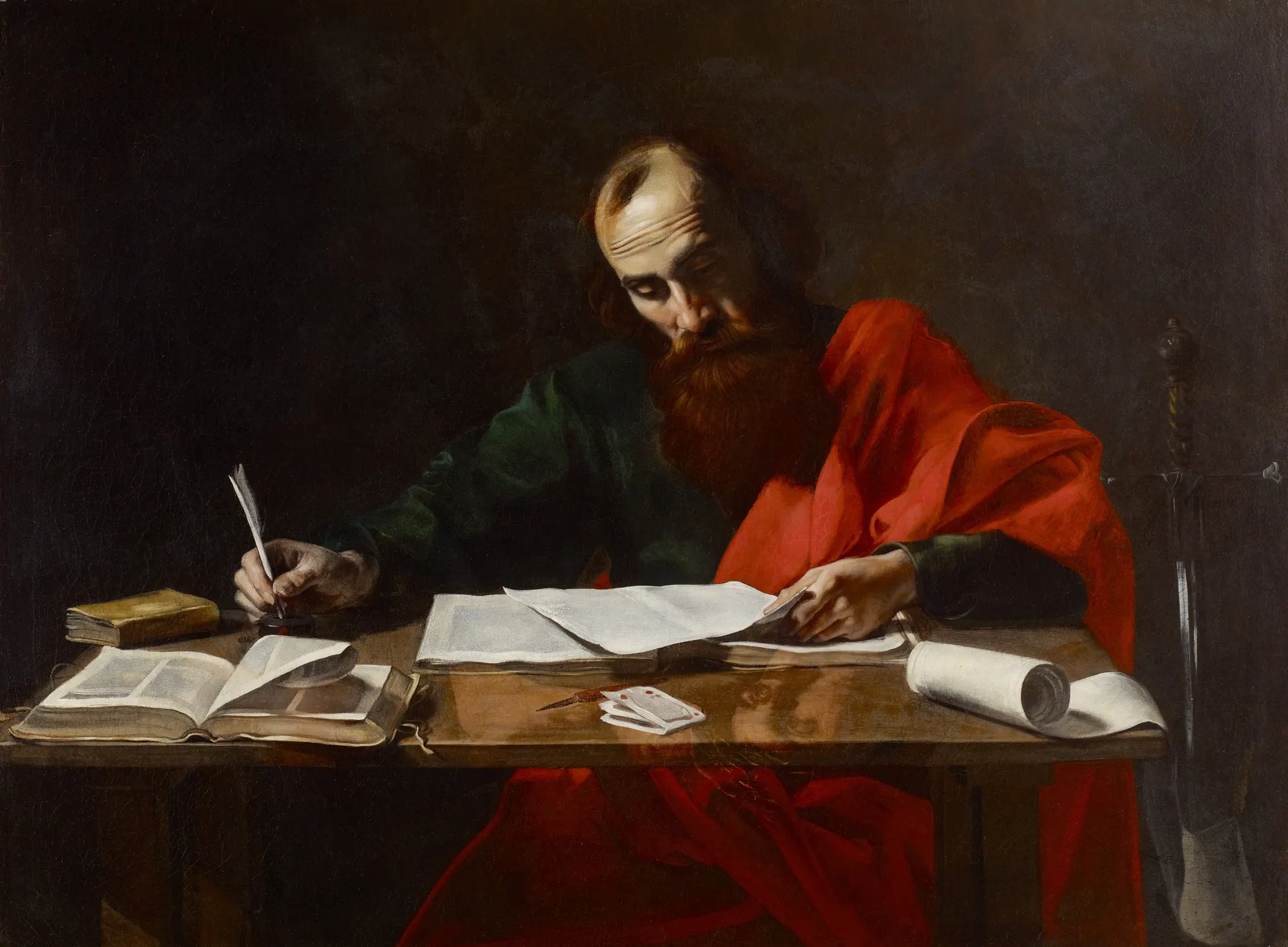
Romanschapter 7
25 verses · Paul · AD 56 or 57 · Paul's letters
What then shall we say? Is the law sin? Certainly not! Indeed, I would not have been mindful of sin if not for the law. For I would not have been aware of coveting if the law had not said, “Do not covet.”
Introduction
Paul, Paul's letters, Romans Overview.
Paul wrote this letter from Corinth about AD 57 to house churches in Rome he had never visited. Here he speaks to those who know the law, and he had been trained in it himself as a Pharisee. The chapter defends the law of God and then speaks in the first person with more feeling than any other part of the letter. Readers in every age of the church have argued over whose voice that is. Listen for the picture drawn from marriage at the start. Then listen for the change of tense, and for the cry near the end.
Context
- Who
- House churches in Rome, addressed here as people who know law, Jewish believers especially.
- What
- An argument that believers have died to the law, a defence of the law as holy, and a first-person account of the struggle between wanting the good and doing it.
- Where
- Written from Corinth to the house churches of Rome, to those among them who knew the law.
- When
- About AD 57, early in the reign of Nero.
- Why
- To show how a believer is freed from the law, to clear the law of blame for sin, and to bring the reader to the rescue that comes through Jesus Christ.
Historical context
The opening illustration depends on a legal fact both Jewish and Roman hearers accepted: a wife is bound to her husband while he lives, and his death releases her. Under Jewish law of the time a husband could divorce a wife far more easily than the reverse, so death was the clean example. Paul uses it only to make one point, obligation ends when one party dies.
Show the rest of the historical context, 2 more paragraphs
The commandment he singles out as the one that exposed him is the tenth, against coveting. It is the only one of the ten that no court can prosecute, because it happens entirely inside a person. That is precisely why it works as his example: the Law reached where behaviour could not be policed.
Whether the anguished "I" of the second half describes Paul's present experience, his life before Christ, or a representative figure standing for Israel under the Law has been argued since the church fathers and is not settled. The passage is written to be felt either way.
Significance
For Jewish believers, this chapter defended the Law against a conclusion they might have drawn from everything Paul had said. The Law is holy, righteous, and good; the problem is sin, which used a good commandment as a foothold.
Show the rest of the significance, 1 more paragraph
For anyone struggling, the honesty was the gift. The cry of a person who wants what is right and does not do it, ending in a plea for rescue rather than a technique, was as recognizable in a Roman tenement as anywhere since.
The heads below are this chapter's scenes. The numbered points under each are its verses.
Dead to the Law, Joined to Another
Romans 7:1-3
the law has authority over a man: The law holds authority over a man only while he lives. Paul proves it from marriage, where a wife is bound to her husband, and his death releases her from the law of marriage. Henry and Hodge read the picture for its one point, that death ends a legal claim.
Romans 7:1
“I speak to them that know the law - To the Jews chiefly here. As long - So long, and no longer. As it liveth - The law is here spoken of, by a common figure, as a person, to which, as to an husband, life and death are ascribed.”
John Wesley · Explanatory Notes upon the New Testament (1755)evangelical
2 more voices on this verseWhat preachers and commentators have said about this verse, in their own words.
Romans 7:1
“Know ye not, etc. Let the general proposition be that the law was given to men for no other end but to regulate the present life, and that it belongs not to those who are dead: to this he afterwards subjoins this truth -- that we are dead to it through the body of Christ.”
John Calvin · Commentaries (1554)reformed
Romans 7:1
“Know ye not, brethren,.... The apostle having asserted, Rom 6:14, that the believing Romans were "not under the law"; which he knew would be displeasing to many, and excepted to by them, especially the Jews that were among them, who though they believed in Christ, yet were zealous of the law, takes it up again, and explains and defends it.”
bound by law to her husband: In the picture the husband dies and the woman is released, and at verse 4 the believer is the one who died to the law. Calvin holds that Paul changed the terms on purpose, to spare the law the harsher saying that it had died.
Romans 7:2
“But that no one may be puzzled, because the different parts of the comparison do not altogether correspond, we are to be reminded, that the Apostle designedly intended, by a little change, to avoid the invidiousness of a stronger expression.”
John Calvin · Commentaries (1554)reformed
she is called an adulteress: Called renders chrematizo, which Barnes notes can mean named by an oracle and here means the name the woman is given by all. The husband's death releases her from the law, and a marriage that was adultery while he lived becomes lawful.
Romans 7:3
“And for this reason he says: "Therefore, while her husband lives, she will be called an adulteress if she be with another man," so as to show that the soul of a man too, if it has now come to Christ and has been joined to Christ as to a second husband, must in no way have the oldness of the letter — which is as it were the former husband — living in it, lest perchance, if it should have him living within it, she become an adulteress, having been so joined to the second that the former was…”
Origen of Alexandria · written before 253 · Commentary on the Epistle to the Romanspatristic
1 more voice on this verse
Romans 7:3
“So then if ... - compare Mat 5:32. She shall be called - She will be. The word used here χρηματίσει chrēmatisei is often used to denote being called by an oracle or by divine revelation. But it is here employed in the simple sense of being commonly called, or of being so regarded.”
died to the law through the body of Christ: In the application the one who dies is the believer, put to death through the body of Christ. The law stands where it stood. The believer belongs now to another, to the One raised from the dead, and the union bears fruit to God.
Romans 7:4
“Thus ye also - Are now as free from the Mosaic law as an husband is, when his wife is dead. By the body of Christ - Offered up; that is, by the merits of his death, that law expiring with him.”
John Wesley · Explanatory Notes upon the New Testament (1755)evangelical
1 more voice on this verse
Romans 7:4
“But this is to mistake the apostle's design in employing this figure, which was merely to illustrate the general principle that "death dissolves legal obligation." It was essential to his argument that we, not the law, should be the dying party, since it is we that are "crucified with Christ," and not the law.”
Jamieson, Fausset & Brown · Commentary Critical and Explanatory on the Whole Bible (1871)reformed
Romans 7:5-6
the sinful passions aroused by the law: Verse 5 describes the state before Christ, when sinful passions stirred by the law bore fruit for death. Release has come. Barnes and Gill read the new service of verse 6 as the way of the Spirit in place of the old written code.
Romans 7:5
“When ye were in the flesh - Carnally minded, in a state of nature; before we believed in Christ. Our sins which were by the law - Accidentally occasioned, or irritated thereby.”
John Wesley · Explanatory Notes upon the New Testament (1755)evangelical
1 more voice on this verse
Romans 7:5
“Lust, having conceived by the law (which is the strength of sin, 1 Cor. xv. 56 ), bringeth forth sin, and sin, when it is finished, bringeth forth death, Jam. i. This is the posterity that springs from this marriage to sin and the law.”
Matthew Henry · Commentary on the Whole Bible (1707-1721)puritan
the new way of the Spirit: The law still stands, and the ones released from it are those who died, now free to serve God by the Spirit. The verb katargeo is the one used of the woman released from the law of marriage in verse 2.
Romans 7:6
"But now we have been loosed from the law, having died to that in which we were held." From this law, then, in which we were held, we have now been loosed. "Now." When? Without doubt when we died with Christ, and were buried together with him through baptism, and were crucified with him; and therefore he says, "We have been loosed from the law, having died." For unless a man has died with Christ, he is not loosed from that law.
Origen of Alexandria · written before 253 · Commentary on the Epistle to the Romanspatristic
1 more voice on this verse
Romans 7:6
“But now we are delivered from the law,.... From the ministration of it, by Moses; from it, as a covenant of works; from its rigorous exaction; from its curse and condemnation, all this by Christ; and from its being an irritating, provoking law to sin, through the corruption of nature, by the Spirit and grace of Christ; but not from obedience to it, as in the hands of Christ.”
Is the Law Sin? Sin Exposed by the Commandment
Romans 7:7-8
Is the law sin?: Verse 7 answers the charge that the law is sin: the law makes sin known. Paul takes the tenth commandment, Do not covet, where the sin is an inward desire no outward act would convict. Verse 8 shows sin seizing that commandment and producing every kind of covetous desire.
Romans 7:7
“I had not known sin but by the law--It is important to fix what is meant by "sin" here. It certainly is not "the general nature of sin" [ALFORD, &c.], though it be true that this is learned from the law; for such a sense will not suit what is said of it in the following verses, where the meaning is the same as here.”
Jamieson, Fausset & Brown · Commentary Critical and Explanatory on the Whole Bible (1871)reformed
4 more voices on this verse
Romans 7:7
“Paul did not say that he had no sin apart from the law but rather that he was unaware of it. Therefore the law is not the cause of sin but rather the instrument which points it out, making it clear to those who did not know what it was. It did not do this in order that, once sin was made known, those who committed it should continue in what they were doing.… On the contrary, its intention was to convert people to better things by making their sins known to them.”
Cyril of Alexandria · written before 444 · Explanation of the Letter to the Romanspatristic
Romans 7:7
“Is the law sin - Sinful in itself, or a promoter of sin. I had not known lust - That is, evil desire. I had not known it to be a sin; nay, perhaps I should not have known that any such desire was in me: it did not appear, till it was stirred up by the prohibition.”
John Wesley · Explanatory Notes upon the New Testament (1755)evangelical
Romans 7:7
“What shall we say then? - The objection which is here urged is one that would very naturally rise, and which we may suppose would be urged with no slight indignation. The Jew would ask, “Are we then to suppose that the holy Law of God is not only insufficient to sanctify us, but that it is the mere occasion of increased sin?”
Romans 7:7
“It seems rather to be understood of the struggles that are maintained between grace and corruption in sanctified souls. That there are remainders of indwelling corruption, even where there is a living principle of grace, is past dispute; that this corruption is daily breaking forth in sins of infirmity (such as are consistent with a state of grace) is no less certain.”
Matthew Henry · Commentary on the Whole Bible (1707-1721)puritan
sin, seizing its opportunity through the commandment: Opportunity renders aphorme, a base for an attack, and sin uses the commandment as its base. Augustine reads sin is dead as sin lying hidden. Wesley adds that the command forbade the desire without subduing it, and every kind of covetous desire grew.
Romans 7:8
“But sin - My inbred corruption. Taking occasion by the commandment - Forbidding, but not subduing it, was only fretted, and wrought in me so much the more all manner of evil desire. For while I was without the knowledge of the law, sin was dead - Neither so apparent, nor so active; nor was I under the least apprehensions of any danger from it.”
John Wesley · Explanatory Notes upon the New Testament (1755)evangelical
3 more voices on this verse
Romans 7:8
“But how high an encomium of the law (do we obtain) from this fact, that by it there comes to light the latent presence of sin! It was not the law, therefore, which led me astray, but "sin, taking occasion by the commandment." Why then do you, (O Marcion, ) impute to the God of the law what His apostle dares not impute even to the law itself? Nay, he adds a climax: "The law is holy, and its commandment just and good.”
Tertullian · written before 220 · Against Marcion Book Vpatristic
Romans 7:8
“Sin, taking occasion by the commandment - I think the pointing, both in this and in the 11th verse, to be wrong: the comma should be after occasion, and not after commandment. But sin taking occasion, wrought in me by this commandment all manner of concupiscence. There are different opinions concerning the meaning of the word αφορμη, which we here translate occasion. Dr. Waterland translates the clause, Sin, taking Advantage. Dr. Taylor contends that all commentators have mistaken the meaning of it, and that it should be rendered having received Force.”
Adam Clarke · Commentary on the Bible (1810-1826)evangelical
Romans 7:8
“And it was sin that wrought it, indwelling sin, his corrupt nature (he speaks of a sin that did work sin), and it took occasion by the commandment. The corrupt nature would not have swelled and raged so much if it had not been for the restraints of the law; as the peccant humours in the body are raised, and more inflamed, by a purge that is not strong enough to carry them off.”
Matthew Henry · Commentary on the Whole Bible (1707-1721)puritan
Romans 7:9-11
when the commandment came: , sin sprang to life and Paul died. The commandment meant to bring life brought death. Verse 11 gives the cause, sin seizing the commandment and deceiving him as it deceived Eve at Genesis 3:13.
Romans 7:9
“When the commandment, i.e., the power of the discernment of the good, came, the mind did not prevail over the baser thoughts but permitted its reason to be enslaved by the passions. Then sin revived but the mind died, suffering death because of its transgressions.”
Basil of Caesarea · written before 379 · Exegetic Homilies 10.5patristic
2 more voices on this verse
Romans 7:9
“Came - In its spiritual meaning, to my heart, with the power of God. Sin revived, and I died - My inbred sin took fire, and all my virtue and strength died away; and I then saw myself to be dead in sin, and liable to death eternal.”
John Wesley · Explanatory Notes upon the New Testament (1755)evangelical
Romans 7:9
“For I - There seems to be no doubt that the apostle here refers to his own past experience. Yet in this he speaks the sentiment of all who are unconverted, and who are depending on their own righteousness. Was alive - This is opposed to what he immediately adds respecting another state, in which he was when he died. It must mean, therefore, that he had a certain kind of peace; he deemed himself secure; he was free from the convictions of conscience and the agitations of alarm.”
meant to bring life: Clarke traces the promise of life to Leviticus 18:5, where the one who keeps the statutes lives by them. Chrysostom weighs the verb discovered. Paul found the commandment to be death for him, and the fault lay with sin, as verse 11 goes on to say.
Romans 7:10
“And the commandment - Meaning the law in general, which was ordained to life; the rule of righteousness teaching those statutes which if a man do he shall live in them, Lev 18:5, I found, by transgressing it, to be unto death; for it only presented the duty and laid down the penalty, without affording any strength to resist sin or subdue evil propensities.”
Adam Clarke · Commentary on the Bible (1810-1826)evangelical
1 more voice on this verse
Romans 7:10
“The commandment which was intended for life - Doubtless it was originally intended by God as a grand means of preserving and increasing spiritual life, and leading to life everlasting.”
John Wesley · Explanatory Notes upon the New Testament (1755)evangelical
deceived me and through the commandment: Ambrosiaster and Didymus the Blind take sin here as the devil, who seized the commandment to put man to death. Augustine explains the deceit from life. A desire the law forbids looks sweeter, and the sweetness ends in death.
Romans 7:12-13
the law is holy: Verse 12 clears the law with three words, holy, righteous and good. Verse 13 asks whether the good thing became death. Hodge and Clarke read the purpose clause as the point: sin produced death through what is good to show sin as utterly sinful.
Romans 7:12
“But lest anyone should ascribe to the commandment of the law the fact that by occasion of the precept the soul was deceived by sin and slain, the Apostle adds and says: "And so the law indeed is holy, and the commandment holy and just and good." For the commandment is good, and the law is holy. For it enjoins good things, and commands the observance of good things.”
Origen of Alexandria · written before 253 · Commentary on the Epistle to the Romanspatristic
2 more voices on this verse
Romans 7:12
“The commandment - That is, every branch of the law. Is holy, and just, and good - It springs from, and partakes of, the holy nature of God; it is every way just and right in itself; it is designed wholly for the good of man.”
John Wesley · Explanatory Notes upon the New Testament (1755)evangelical
Romans 7:12
“Laws are as the law-makers are. God, the great lawgiver, is holy, just, and good, therefore his law must needs be so. The matter of it is holy: it commands holiness, encourages holiness; it is holy, for it is agreeable to the holy will of God, the original of holiness.”
Matthew Henry · Commentary on the Whole Bible (1707-1721)puritan
sin might become utterly sinful: Clarke hears the question as a Jewish objector's: can a good law be blamed for a death? Matthew Henry answers from the other side. The worst work of sin is to turn a holy law into its tool, and only beside that law does its full poison show.
Romans 7:13
“But it was sin, which was made death to me, inasmuch as it wrought death in me even by that which is good - By the good law. So that sin by the commandment became exceeding sinful - The consequence of which was, that inbred sin, thus driving furiously in spite of the commandment, became exceeding sinful; the guilt thereof being greatly aggravated.”
John Wesley · Explanatory Notes upon the New Testament (1755)evangelical
1 more voice on this verse
Romans 7:13
“Thus by the commandment it becomes exceedingly sinful; that is, it appears to be so. We never see the desperate venom or malignity there is in sin, till we come to compare it with the law, and the spiritual nature of the law, and then we see it to be an evil and a bitter thing.”
Matthew Henry · Commentary on the Whole Bible (1707-1721)puritan
The War Within: O Wretched Man That I Am!
Romans 7:14-16
the law is spiritual: Verse 14 sets a spiritual law against a speaker sold as a slave to sin, and the tense turns to the present. Verse 15 describes a divided will, and verse 16 treats that struggle as agreement that the law is good.
Romans 7:14
“For we know that the law is spiritual--in its demands. but I am carnal--fleshly (see on Ro 7:5), and as such, incapable of yielding spiritual obedience. sold under sin--enslaved to it. The "I" here, though of course not the regenerate, is neither the unregenerate, but the sinful principle of the renewed man, as is expressly stated in Ro 7:18.”
Jamieson, Fausset & Brown · Commentary Critical and Explanatory on the Whole Bible (1871)reformed
3 more voices on this verse
Romans 7:14
“Even where there is spiritual life there are remainders of carnal affections, and so far a man may be sold under sin; he does not sell himself to work wickedness, as Ahab did ( 1 Kings xxi. 25 ), but he was sold by Adam when he sinned and fell--sold, as a poor slave that does his master's will against his own will--sold under sin, because conceived in iniquity and born in sin.”
Matthew Henry · Commentary on the Whole Bible (1707-1721)puritan
Romans 7:14
“Who can draw a distinction, and say that there are two gods, one just and the other good, when He ought to be believed to be both one and the other, whose commandment is both "just and good? "Then, again, when affirming the law to be "spiritual" he thereby implies that it is prophetic, and that it is figurative.”
Tertullian · written before 220 · Against Marcion Book Vpatristic
Romans 7:14
“For, we know that the law is spiritual - This is a general proposition, and probably, in the apostle’s autograph, concluded the above sentence. The law is not to be considered as a system of external rites and ceremonies; nor even as a rule of moral action: it is a spiritual system; it reaches to the most hidden purposes, thoughts, dispositions, and desires of the heart and soul; and it reproves and condemns every thing, without hope of reprieve or pardon, that is contrary to eternal truth and rectitude.”
Adam Clarke · Commentary on the Bible (1810-1826)evangelical
I do not understand what I do: Understand renders ginosko, and Augustine and Barnes take it as approve: the man knows what he does and cannot approve it. Origen agrees that he knows the deed itself. Theodoret holds that desire overcomes him and he does the evil he hates, with no compulsion.
Romans 7:15
"For what I work, I do not know. For I do not do what I will; but what I hate, this I do." Now as to what he says, that "I do not know what I work," it is not the thing itself which one works that he is ignorant of, though he be carnal, but he is said to be ignorant of the cause of the thing which he does.
Origen of Alexandria · written before 253 · Commentary on the Epistle to the Romanspatristic
I admit that the law is good: Admit renders symphemi, to speak together with, and Matthew Henry glosses it as casting a vote for the law. Wesley hears in the single word good all three words of verse 12, holy, righteous and good. The protest against the deed is a verdict for the law.
Romans 7:16
“Nevertheless, in that part by which he does not will the evil, he consents to the law of God that it is good, since it forbids evil; and the natural law is brought into a certain harmony with the law of God, so that they will the same things and do not will the same things.”
Origen of Alexandria · written before 253 · Commentary on the Epistle to the Romanspatristic
1 more voice on this verse
Romans 7:16
“If then I do that which I would not, etc. - Knowing that the law condemns it, and that therefore it must be evil. I consent unto the law; I show by this circumstance that I acknowledge the law to be good.”
Adam Clarke · Commentary on the Bible (1810-1826)evangelical
Romans 7:17-18
sin living in me: Verse 17 separates the acting self from sin living in me. Verse 18 says that sin lives in the flesh. The will is set toward good and cannot carry it out.
Romans 7:17
"For the law," says he, "of the Spirit of life in Christ Jesus hath made me free from the law of sin and death," -that, surely, which he previously mentioned as dwelling in our members. Our members, therefore, will no longer be subject to the law of death, because they cease to serve that of sin, from both which they have been set free.
Tertullian · written before 220 · On the Resurrection of the Fleshpatristic
2 more voices on this verse
Romans 7:17
“It is no more I that do it - This is evidently figurative language, for it is really the man that sins when evil is committed. But the apostle makes a distinction between sin and what he intends by the pronoun “I”. By the former he evidently means his corrupt nature. By the latter he refers to his renewed nature, his Christian principles. He means to say that he does not approve or love it in his present state, but that it is the result of his native propensities and passions.”
Romans 7:17
“It is no more I that can properly be said to do it, but rather sin that dwelleth in me - That makes, as it were, another person, and tyrannizes over me.”
John Wesley · Explanatory Notes upon the New Testament (1755)evangelical
that is, in my flesh: Ambrosiaster and Barnes weigh the words in my flesh. Sin lives in the flesh, the unrenewed nature, and the flesh as God made it stays good. Origen and Prosper of Aquitaine see a man who wants to do good and lacks the power until grace gives it.
Romans 7:18
“For I know that in me, etc. - I have learned by experience that in an unregenerate man there is no good. There is no principle by which the soul can be brought into the light; no principle by which it can be restored to purity: fleshly appetites alone prevail; and the brute runs away with the man.”
Adam Clarke · Commentary on the Bible (1810-1826)evangelical
1 more voice on this verse
Romans 7:18
“The parable of the two sons also: those who are sent into the vineyard, of whom one indeed opposed his father, but afterwards repented, when repentance profited him nothing; the other, however, promised to go, at once assuring his father, but he did not go (for "every man is a liar;" "to will is present with him, but he finds not means to perform"),-[this parable, I say], points out one and the same Father.”
Irenaeus · written before 202 · Irenaeus Against Heresies Book 4patristic
Romans 7:19-20
the good I want to do: Verse 19 puts the same thing in reverse, the good left undone and the evil done instead. Verse 20 repeats the words of verse 17, that sin living in me does it. Barnes and Clarke read this as confession, the doing owned and the sin named.
Romans 7:19
“Fain he would be free from all sin, and perfectly do the will of God, such was his settled judgment; but his corrupt nature drew him another way: it was like a clog, that checked and kept him down when he would have soared upward, like the bias in a bowl, which, when it is thrown straight, yet draws it aside.”
Matthew Henry · Commentary on the Whole Bible (1707-1721)puritan
sin living in me that does it: Ambrosiaster asks whether an outside power forces the man. He answers that the man first bound himself to sin, and sin living in him now rules what he does. Clarke says the man still wants the good, and his mind and conscience condemn the evil he does.
Romans 7:20
"For what the law could not do, in that it was weak through the flesh, God sending His own Son in the likeness of sinful flesh, and through sin condemned sin in the flesh " -not the flesh in sin, for the house is not to be condemned with its inhabitant. He said, indeed, that "sin dwelleth in our body." But the condemnation of sin is the acquittal of the flesh, just as its non-condemnation subjugates it to the law of sin and death.
Tertullian · written before 220 · On the Resurrection of the Fleshpatristic
1 more voice on this verse
Romans 7:20
“It is no more I - My will is against it; my reason and conscience condemn it. But sin that dwelleth in me - the principle of sin, which has possessed itself of all my carnal appetites and passions, and thus subjects my reason and domineers over my soul. Thus I am in perpetual contradiction to myself. Two principles are continually contending in me for the mastery: my reason, on which the light of God shines, to show what is evil; and my passions, in which the principle of sin works, to bring forth fruit unto death.”
Adam Clarke · Commentary on the Bible (1810-1826)evangelical
Romans 7:21-23
the principle I have discovered: Verse 21 names a principle found by experience, that evil stands ready whenever the good is wanted. Verse 23 sets another law in the body, warring against the law of the mind and holding the man captive to the law of sin.
Romans 7:21
“If sin inheres in my flesh and corrupts it, it may well be that the law offers help and gives advice, but even so it does not set me free from sin. Yet for those who are bound by the weakness of sin, it is hardly enough to know that they should be doing better; what they need is the strength to do what is right and in accordance with the law.”
Cyril of Alexandria · written before 444 · Explanation of the Letter to the Romanspatristic
1 more voice on this verse
Romans 7:21
“I find then a law - There is a law whose operation I experience whenever I attempt to do good. There have been various opinions about the meaning of the word “law” in this place. It is evident that it is used here in a sense somewhat unusual. But it retains the notion which commonly attaches to it of what binds, or controls.”
in my inner being: Delight renders synedomai, found only here in the New Testament, and Wesley marks it as more than the admission of verse 16. Clarke grants such delight in God's law to any devout Jew, and others hold that only a renewed mind can know it.
Romans 7:22
“I delight in the law of God after the inward man - Every Jew, and every unregenerate man, who receives the Old Testament as a revelation from God, must acknowledge the great purity, excellence and utility of its maxims, etc., though he will ever find that without the grace of our Lord Jesus he can never act according to those heavenly maxims; and without the mercy of God, can never be redeemed from the curse entailed upon him for his past transgressions.”
Adam Clarke · Commentary on the Bible (1810-1826)evangelical
2 more voices on this verse
Romans 7:22
“After the inward man; that is, First, The mind or rational faculties, in opposition to the sensitive appetites and wills of the flesh. The soul is the inward man, and that is the seat of gracious delights, which are therefore sincere and serious, but secret; it is the renewing of the inward man, 2 Cor. iv.”
Matthew Henry · Commentary on the Whole Bible (1707-1721)puritan
Romans 7:22
“For I delight in the law of God after the inward man--"from the bottom of my heart." The word here rendered "delight" is indeed stronger than "consent" in Ro 7:16; but both express a state of mind and heart to which the unregenerate man is a stranger.”
Jamieson, Fausset & Brown · Commentary Critical and Explanatory on the Whole Bible (1871)reformed
another law at work in my body: Augustine read this verse two ways. In his early notes on Romans the captive is a man still under the law and without grace. Later, in On Nature and Grace, he hears the apostle himself, warring now against the law of sin within him.
Romans 7:23
“If Paul the apostle, the vessel of election, chastised his body and brought it into subjection, lest, having preached to others, he himself should be found a castaway: if he says 'But I see another law resisting the law of my mind and leading me into captivity,' and afterward says 'Unhappy man that I am, who shall deliver me from the body of this death?' — if he fears the snares of the body, are we secure?”
Jerome · written before 420 · Homily 41, on Psalm 119patristic
2 more voices on this verse
Romans 7:23
“The apostle found two such laws within him; the one "the law of sin in his members," called (in Ga 5:17, 24) "the flesh which lusteth against the spirit," "the flesh with the affections and lusts," that is, the sinful principle in the regenerate; the other, "the law of the mind," or the holy principle of the renewed nature.”
Jamieson, Fausset & Brown · Commentary Critical and Explanatory on the Whole Bible (1871)reformed
Romans 7:23
“It is said to be seated in his members, because, Christ having set up his throne in his heart, it was only the rebellious members of the body that were the instruments of sin--in the sensitive appetite; or we may take it more generally for all that corrupt nature which is the seat not only of sensual but of more refined lusts.”
Matthew Henry · Commentary on the Whole Bible (1707-1721)puritan
Romans 7:24-25
this body of death?: Verse 24 is the cry of the chapter, a wretched man asking who will rescue him from this body of death. Thanks is given through Jesus Christ our Lord before the question settles.
Romans 7:24
On this account, therefore, the Lord Himself, who is Emmanuel from the Virgin, is the sign of our salvation, since it was the Lord Himself who saved them, because they could not be saved by their own instrumentality; and, therefore, when Paul sets forth human infirmity, he says: "For I know that there dwelleth in my flesh no good thing," showing that the "good thing" of our salvation is not from us, but from God. And again: "Wretched man that I am, who shall deliver me from the body of this death?"
Irenaeus · written before 202 · Irenaeus Against Heresies Book 3patristic
3 more voices on this verse
Romans 7:24
“The thing he complains of is a body of death; either the body of flesh, which is a mortal dying body (while we carry this body about with us, we shall be troubled with corruption; when we are dead, we shall be freed from sin, and not before), or the body of sin, the old man, the corrupt nature, which tends to death, that is, to the ruin of the soul.”
Matthew Henry · Commentary on the Whole Bible (1707-1721)puritan
Romans 7:24
“IF I chose to occupy your time with controversial matter, I might prove to a demonstration that the apostle Paul is here describing his own experience as a Christian. Some have affirmed that he is merely declaring what he was before conversion, and not what he was when he became the recipient of the grace of God. But such persons are evidently mistaken, and I believe wilfully mistaken; for any ample-hearted, candid mind, reading through this chapter, could not fall into such an error.”
Romans 7:24
“Wretched man that I am - The struggle is now come to the height; and the man, finding there is no help in himself, begins almost unawares to pray, Who shall deliver me? He then seeks and looks for deliverance, till God in Christ appears to answer his question. The word which we translate deliver, implies force.”
John Wesley · Explanatory Notes upon the New Testament (1755)evangelical
Thanks be to God: Clarke reports manuscripts, with the Vulgate and several fathers, that read the grace of God in place of the thanks. Augustine in his later work takes the closing sentence as the voice of a man under grace. He still feels the desires he resists, and he refuses them.
Romans 7:25
"Therefore I myself with the mind serve the law of God, but with the flesh the law of sin." Perhaps someone will say that the Apostle, who up to this point has been speaking not as it were in his own person but having assumed the person of another, now, as though marking a change of person, says, "I myself," so as to show that these things which are to be said pertain to that same Apostle himself.
Origen of Alexandria · written before 253 · Commentary on the Epistle to the Romanspatristic
2 more voices on this verse
Romans 7:25
“I thank God, through Jesus Christ our Lord,.... There is a different reading of this passage; some copies read, and so the Vulgate Latin version, thus, "the grace of God, through Jesus Christ our Lord"; which may be considered as an answer to the apostle's earnest request for deliverance, "who shall deliver me?" the grace of God shall deliver me.”
Romans 7:25
“I thank God - That is, I thank God for effecting a deliverance to which I am myself incompetent. There is a way of rescue, and I trace it altogether to his mercy in the Lord Jesus Christ. What conscience could not do, what the Law could not do, what unaided human strength could not do, has been accomplished by the plan of the gospel; and complete deliverance can be expected there, and there alone.”
How this psalm is built
The form: A marriage picture, a defence of the law, and the apostle speaking in the person of a man under the law, as Alexandria classes it.
The patterns in this chapter
| Device | What it does | Where to see it |
|---|---|---|
| The marriage picture | Verses 1 to 3 draw a legal fact from marriage, that a wife is bound while her husband lives and released at his death. Verse 4 applies it with the terms moved, so the believer is the one who dies to the law. Calvin holds that Paul changed the terms on purpose, to spare the law a harsher saying.John Calvin, Commentaries, 1554, on Romans 7:2. | Romans 7:2, Romans 7:3, Romans 7:4 |
| Question and refusal | Verses 7 and 13 each ask whether the law is to blame, and each answers Certainly not. Chrysostom notes how Paul keeps the charge on sin throughout and clears the law of accusation.John Chrysostom, Homily on Romans 12, 407, on Romans 7:11. | Romans 7:7, Romans 7:13 |
| The I of verses 14 to 25 | The pronoun I stands twenty-eight times in the Berean text of verses 14 to 25, against five times in verses 7 to 13, and the tense turns to the present at verse 14. Augustine read the speaker first as a man under the law before grace and later as the apostle himself, pressed by a present fight.Augustine of Hippo, ON NATURE AND GRACE 55.65, 430, on Romans 7:23. | Romans 7:15, Romans 7:19, Romans 7:24 |
How this chapter is built
6 more paragraphs on the patterns
Verses 1 to 6 argue from marriage that death ends the claim of the law, and apply the point to believers who died to the law through the body of Christ. Verses 7 to 13 ask twice whether the law is to blame and answer twice Certainly not, placing the fault on sin. Verses 14 to 25 turn to the present tense and to the first person, and the pronoun I stands twenty-eight times in the Berean text of those twelve verses. The section ends on a cry for rescue, thanks to God, and a divided service of mind and flesh.
Where it stands in the letter
Chapter 6 told believers that they are under grace and not under law, and chapter 7 explains how a person dies to the law and why the law is still holy. The divided service of its last verse is left open for chapter 8, which begins with no condemnation for those who are in Christ Jesus and with the law of the Spirit of life.
Where to go deeper
The struggle of verses 14 to 25 has its own page at /featured/the-divided-self, and the word flesh at /featured/the-flesh. The chapter it opens into stands at /featured/no-condemnation.
Sources: John Calvin, Commentaries, 1554, on Romans 7:2. John Chrysostom, Homily on Romans 12, 407, on Romans 7:11. Augustine of Hippo, ON NATURE AND GRACE 55.65, 430, on Romans 7:23. Origen of Alexandria, COMMENTARY ON THE EPISTLE TO THE ROMANS, 253, on Romans 7:25.
Keep studying
Sources for this chapter
The summary
Jamieson, Fausset & Brown, Commentary Critical and Explanatory; John Calvin, Commentaries; John Wesley, Explanatory Notes Upon the New Testament and Matthew Henry, Complete Commentary.
The form and classifications
Augustine of Hippo, AGAINST JULIAN 6.23.73, 430, on Romans 7:25; Diodorus of Tarsus, PAULINE COMMENTARY FROM THE GREEK CHURCH, 390, on Romans 7:15 and Origen of Alexandria, COMMENTARY ON THE EPISTLE TO THE ROMANS, 253, on Romans 7:25.
The exposition
Adam Clarke, Commentary on the Bible; Albert Barnes; Ambrosiaster, COMMENTARY ON PAUL'S EPISTLES; Augustine of Hippo; Charles Hodge, Commentary on the Epistle to the Romans; Charles Spurgeon, Metropolitan Tabernacle Pulpit, sermons on Romans 7; Didymus the Blind, PAULINE COMMENTARY FROM THE GREEK CHURCH; Frederic Godet, Commentary on St. Paul's Epistle to the Romans; Jamieson, Fausset & Brown, Commentary Critical and Explanatory on the Whole Bible; John Calvin; John Chrysostom; John Gill, Exposition of the New Testament; John Wesley, Explanatory Notes upon the New Testament; Matthew Henry, Commentary on the Whole Bible; Origen of Alexandria, COMMENTARY ON THE EPISTLE TO THE ROMANS; Prosper of Aquitaine, GRACE AND FREE WILL 4.2; Robert Haldane, Exposition of the Epistle to the Romans and Theodoret of Cyrus, INTERPRETATION OF THE LETTER TO THE ROMANS.