
Psalm 99
9 verses · Psalm of the LORD's kingship, with a refrain
The LORD reigns; let the nations tremble! He is enthroned above the cherubim; let the earth quake!
Introduction
Author unstated, the Holy King, Book 4: The LORD reigns, Poetry, Psalms Overview.
This psalm has no title in the Hebrew and names no writer. It is the last of the psalms in the fourth book that begin by announcing that the LORD is King, and it carries a refrain of its own. The writer looks at the ark in the temple and at leaders from Israel's past who prayed and were answered. It was sung by worshippers who knew that God's nearness was both a gift and a danger. Listen for the short refrain that returns three times, and for the names of three men from Israel's history.
Context
- Who
- Worshippers at the temple, told three times that He is holy
- What
- A hymn to the LORD as the holy King enthroned in Zion, marked by the refrain that He is holy.
- Where
- Zion, the temple hill in Jerusalem, where the ark stood.
- When
- Undated and untitled in the Hebrew.
- Why
- To teach worshippers that the King's first quality is holiness, joined to justice and forgiveness.
Historical context
Enthroned above the cherubim in verse 1 names a piece of furniture. Exodus 25:22 has God say He will meet Moses and speak with him from above the mercy seat between the two cherubim, and 1 Samuel 4:4 calls Him the LORD of Hosts who is enthroned between the cherubim. The footstool of verse 5 is named the same way at Psalm 132:7 and Lamentations 2:1, and it stood for the ark, a place a worshipper could walk toward. Moses, Aaron and Samuel in verse 6 are the three men the nation remembered as having asked God for it and been answered. The pillar of cloud in verse 7 came down at the tent door in Exodus 33:9 when Moses went in, the visible sign that God was speaking.
Significance
The threefold He is holy divided the psalm for its singers and told them what the reign was for: the King they were praising was first holy. Verse 8 held two things together that a worshipper had to carry at once, that He was a forgiving God to those men and an avenger of their misdeeds.
This chapter in Jewish lifeWhat this chapter is in Jewish life and reading.
How it is read
The psalm closes the group this site calls the enthronement psalms, Psalms 93 and 95 to 99 (src/components/book/dossier-content/psalms-structure.ts). That is a statement about the collection rather than about any service, and it is given here as one.
Rashi reads the quaking of the nations in verse 1 as the war of Gog and Magog, and sends the reader to Zechariah 14:12 for the plague named there (Rashi on Psalms 99:1:1, Rashi on Psalms, The Judaica Press complete Tanach with Rashi, translated by A. J. Rosenberg, CC-BY). Radak reads verse 2 to the same end and sets a time to it, holding that God will be great in Zion "because there He will be magnified above all the nations when He executes judgement on the wicked" (Radak on Psalms 99:2:1, Radak on Psalms, Rabbi Mike Feuer, Jerusalem Anthology, CC-BY).
Radak then quotes the midrash in his own comment, reporting that Shocher Tov reads the greatness of God in Zion as the moment He returns His Presence there (Radak on Psalms 99:2:1, same edition). The equity of verse 4 Rashi reads as peacemaking between persons, grounded in the law of the enemy's fallen donkey at Exodus 23:5, and he asks who could see an enemy being kind to him without wanting to embrace him (Rashi on Psalms 99:4:2, citing Tanchuma).
The pillar of cloud in verse 7 Rashi extends past Moses and Aaron to Samuel, reading the cloud at the seer's doorway out of 1 Samuel 9:11 (Rashi on Psalms 99:7:1). On verse 9 he gives the reason for the holiness named there, that God is strict with the righteous and is sanctified in the world through them (Rashi on Psalms 99:9:1). Ibn Ezra, Metzudat David and Radak carry thirteen comments for which Sefaria holds no English version, and they are cited by reference (Ibn Ezra on Psalms 99:1:1 and the twelve references beside it).
What the rabbis say
The corpus records forty places where the Midrash and the Talmud cite this psalm, thirty seven under Midrash and three under Talmud, and it carries the locator for each one with no text. The Babylonian Talmud cites the first verse at Avodah Zarah 24b:16, verse 6 at Berakhot 31b:17 and the psalm again at Taanit 8a:16.
Verse 6, which names Moses, Aaron and Samuel, draws seven locators, among them Bamidbar Rabbah 9:45, 10:5 and 18:8. Midrash Tehillim treats verse 2 at 99:1 and reads it from three other psalms at 14:7, 48:1 and 145:1, and Pirkei DeRabbi Eliezer takes up verse 5 at 31:14. The site reports where the rabbis cite the verse and reports no saying, because the locator carries none.
Sources: MannaFest, the enthronement psalms, at src/components/book/dossier-content/psalms-structure.ts, 2026; Rashi, Rashi on Psalms 99, in The Judaica Press complete Tanach with Rashi, translated by A. J. Rosenberg, CC-BY; Radak, Radak on Psalms 99, in Rabbi Mike Feuer, Jerusalem Anthology, CC-BY; Ibn Ezra and Metzudat David, their comments on Psalms 99, cited by reference; Sefaria holds no English version; The Midrash and the Talmud, the forty locators on Psalms 99 in scripts/data/sources/sefaria/psalms/99.json.
Psalms 99:1-3
He is enthroned above the cherubim: Enthroned above the cherubim puts Him over the mercy seat of the ark, the seat Exodus 25:22 says He speaks from. The nations tremble and the earth quakes at that throne. He is holy closes the first section and sounds again at verses 5 and 9.
Psalms 99:1
“The Lord has reigned, let the peoples be angry. Three psalms have the same beginning: the ninety-second, the ninety-sixth, and the ninety-eighth. But although they have the same beginning in the opening verse, at the end they are different. For how does it read in the ninety-second? 'The Lord has reigned, he has clothed himself in beauty.' But in the ninety-sixth: 'The Lord has reigned, let the earth rejoice'; and in the ninety-eighth: 'The Lord has reigned, let the peoples be angry.' The sequence seems as it were to be contrary to itself.”
Jerome · written before 420 · Homily 26, on Psalm 98patristic
Great is the LORD in Zion: His greatness is placed on one hill, Zion, where the ark stood. From there He is exalted above all the peoples. The God of the whole earth chose a place to be known.
Psalms 99:2
“The Lord is great in Zion. Of old the temple's sacred hill was the centre of the worship of the great King, and the place where his grandeur was most clearly beheld: his church is now his favoured palace, where his greatness is displayed, acknowledged, and adored. He there unveils his attributes and commands the lowliest homage; the ignorant forget him, the wicked despise him, the atheistical oppose him, but among his own chosen he is great beyond comparison.”
Charles Spurgeon · The Treasury of David, Vol. 4 (1874)Particular Baptist
1 more voice on this verse
Psalms 99:2
“He is high there above all people; as that which is high is exposed to view, and looked up to, so in Zion the perfections of the divine nature appear more conspicuous and more illustrious than any where else. Therefore let those that dwell in Zion, and worship there, praise thy great and terrible name, and give thee the glory due unto it, for it is holy.”
Matthew Henry · Commentary on the Whole Bible (1707-1721)puritan
Your great and awesome name—: The nations are called to praise His name, great and awesome. The first refrain, He is holy, closes the section. Holy means set apart, wholly other than all He has made.
Psalms 99:3
“Let them praise thy great and terrible name: let all the dwellers in Zion and all the nations upon the earth praise the Lord, or "acknowledge thankfully" the goodness of his divine nature, albeit that there is so much in it which must inspire their awe. Under the most terrible aspect the Lord is still to be praised.”
Charles Spurgeon · The Treasury of David, Vol. 4 (1874)Particular Baptist
Psalms 99:4-5
The mighty King loves justice: The King's might and His love of justice stand together. In Jacob He established equity and carried out justice and righteousness, the nation called by the patriarch's own name. Worship comes at His footstool, the same footstool named at Psalm 132:7 and Lamentations 2:1.
Psalms 99:4
“And the king's honor loves judgment. Whoever is a sinner fears the judgment of God: for he does not want to know a judge, but a merciful one. But whoever is holy, and hears God, and glorifies him in his body, this man does not fear the judge, but loves him. For example, if some most severe judge should come, and is said to be cruel and as it were drinking blood—if anyone is a murderer, he fears such a judge as this.”
Jerome · written before 420 · Homily 26, on Psalm 98patristic
2 more voices on this verse
Psalms 99:4
“Judgment - Though his dominion be absolute, and his power irresistible, yet he manages it with righteousness. The king's strength is by a known Hebraism put for the strong, or powerful king.”
John Wesley · Explanatory Notes upon the Old Testament (1765)evangelical
Psalms 99:4
“He is strong; all his strength he has from God; and his strength is not abused for the support of any wrong, as the power of great princes often is, but it loves judgment. He does justice with his power, and does it with delight; and herein he was a type of Christ, to whom God would give the throne of his father David, to do judgment and justice.”
Matthew Henry · Commentary on the Whole Bible (1707-1721)puritan
worship at His footstool: Exalt the LORD is paired with worship at His footstool, so lifting Him high means bowing low. The footstool is the ark, where His throne met the earth. The second refrain follows, He is holy.
Psalms 99:5
And the apostles worshiped, and, therefore, they who bore the testimony of the faith received authority of faith. And the angels worshiped God, of whom it is written: "And let all his angels worship him."But they worship not only his Godhead but also his footstool, as it is written: "And worship his footstool, for it is holy."
Ambrose of Milan · written before 397 · On the Holy Spirit 3.11.75-76patristic
1 more voice on this verse
Psalms 99:5
“We must worship at his footstool, at his ark, which was as the footstool to the mercy-seat between the cherubim; or we must cast ourselves down upon the pavement of his courts; and good reason we have to be thus reverent, for he is holy, and his holiness should strike an awe upon us, as it does on the angels themselves, Isa. vi. Divine Justice and Mercy.”
Matthew Henry · Commentary on the Whole Bible (1707-1721)puritan
Psalms 99:6-9
Moses and Aaron were among His priests: Moses is listed among the priests though the priesthood belonged to Aaron, and at Leviticus 8:15 and 19 Moses puts the blood on the altar. God spoke to these men from the pillar of cloud, which came down in Exodus 33:9. He forgave them and still answered their misdeeds.
Psalms 99:6
“Moses and Aaron among his priests, and Samuel among those who call upon his name. Many err, and think that blessed Samuel was a priest. He was not a priest, he was a Levite. Finally, even his garment was not made as for a priest, but as for a Levite. For it is written: 'And his mother made for him,' it says, 'an ephod bad garment.' Ephod means garment, but bad means linen. Now, none had the linen garment except the Levites.”
Jerome · written before 420 · Homily 26, on Psalm 98patristic
1 more voice on this verse
Psalms 99:6
“Moses and Aaron among his priests, and Samuel among them that call upon his name. Though not ordained to the typical priesthood, Moses was a true priest, even as Melchizedek had been before him. God has ever had a priesthood beside and above that of the law. The three holy men here mentioned all stood in his courts, and saw his holiness, each one after his own order.”
Charles Spurgeon · The Treasury of David, Vol. 4 (1874)Particular Baptist
He spoke to them from the pillar of cloud: The pillar of cloud was where God met Moses and Aaron, as at Numbers 12:5. Samuel heard His voice at 1 Samuel 3, and the verse joins all three under one answer. They kept the decrees He gave them.
Psalms 99:7
“He spake unto them in the cloudy pillar. We have had mention of the ark and the shekinah, and now of the fiery cloudy pillar, which was another visible token of the presence of God in the midst of Israel. Responses came to Moses and Aaron out of that glorious overshadowing cloud, and though Samuel saw it not, yet to him also came the mystic voice which was wont to thunder forth from that divine canopy. Men have had converse with God, let men therefore speak to God in return.”
Charles Spurgeon · The Treasury of David, Vol. 4 (1874)Particular Baptist
You were a forgiving God to them: The LORD our God answered them and forgave them, yet He was an avenger of their misdeeds. Moses and Aaron never entered the land after Meribah, at Numbers 20:12. Both were true of the same men.
Psalms 99:8
“Thou answeredst them, 0 Lord our God. A sweet title and a cheering fact. Our covenant God in a very special manner heard his three servants when they pleaded for the people. Thou wast a God that forgavest them, though thou tookest vengeance of their inventions. He forgave the sinners, but he slew their sins. Some apply this verse to Moses, Aaron, and Samuel, and remind us that each of these fell into a fault and received chastisement.”
Charles Spurgeon · The Treasury of David, Vol. 4 (1874)Particular Baptist
worship at His holy mountain: The last refrain is longer than the first two: for the LORD our God is holy. The footstool of verse 5 widens to the holy mountain, the whole of Zion. The psalm ends by calling the holy God their own.
Psalms 99:9
“Exalt the Lord our God. A second time the delightful title of Jehovah our God is used, and it is quickly followed by a third. The Psalm is Trinitarian in its whole structure. In each of his sacred persons the Lord is the God of his people; the Father is ours, the Son is ours, and the Holy Spirit is ours: let us exalt him with all our ransomed powers. And worship at his holy hill. Where he appoints his temple let us resort.”
Charles Spurgeon · The Treasury of David, Vol. 4 (1874)Particular Baptist
How this psalm is built
The form: A psalm of the LORD great in Zion, high above all peoples, where the perfections of the divine nature appear more conspicuous than anywhere else, as Henry classes it.
The patterns in this chapter
| Device | What it does | Where to see it |
|---|---|---|
| He is holy, three times | The line He is holy closes verse 3, closes verse 5 and closes verse 9, and each time it ends a section rather than opening one. The three sayings divide the psalm into three parts of unequal length, so the refrain is the structure and not an ornament on it.Charles Spurgeon, The Treasury of David, Vol. 4, 1874, on Psalm 99:3. | Psalm 99:3, Psalm 99:5, Psalm 99:9 |
| The three who called | Verse 6 names Moses, Aaron and Samuel together, two among His priests and one among those who called on His name. The list is chosen for men who were answered rather than for men who held office, which is what verse 6 says of all three.Albert Barnes, Notes, Explanatory and Practical, on the Old and New Testaments, 1832 to 1869, on Psalm 99:6. | Psalm 99:6 |
| Exalt Him and worship, said twice | Verse 5 says exalt the LORD our God and worship at His footstool, and verse 9 says exalt the LORD our God and worship at His holy mountain. The command is the same and the place moves from the footstool to the mountain, so the second saying is the first one raised.Matthew Henry, Commentary on the Whole Bible, 1710, on Psalm 99:5. | Psalm 99:5, Psalm 99:9 |
The structure
9 more paragraphs on the patterns
The threefold He is holy is the psalm's frame, and it is the only place in the Psalter where the word is repeated in that pattern. Isaiah 6:3 has the seraphim say holy three times over, and a reader who knows the two passages will hear them together, though neither text quotes the other.
Its historical value
Enthroned above the cherubim is not a figure of speech. Exodus 25:22 has God say He will meet Moses and speak with him from above the mercy seat between the two cherubim, and 1 Samuel 4:4 names the ark of the LORD of Hosts who is enthroned between the cherubim. The psalm is naming a piece of furniture that stood in a room. The footstool of verse 5 is named the same way at Psalm 132:7 and Lamentations 2:1, and Matthew Henry reads it as the ark, which stood as a footstool to the mercy seat between the cherubim.
The debated point
Moses is listed among His priests at verse 6, though the priesthood by descent belonged to Aaron. The answer the commentators give is from the narrative: at Leviticus 8:15 and 19 Moses kills the offering and puts the blood on the altar himself, so he acted as a priest at the consecration whatever his line. Jamieson, Fausset and Brown and Albert Barnes both take that road, and the site carries it as the reading the text of Leviticus supports rather than as a settled doctrine of the priesthood.
In the Psalter
Psalm 99 closes the run that Psalm 93 opened. Psalm 93 states the reign, Psalm 96 sends it to the nations, Psalm 97 shows the storm of it, Psalm 98 sings the victory, and Psalm 99 names what the King is. Psalm 100 follows as the doxology of the whole group.
The door
The mercy seat carries the seat named at verse 1, and The ark of the covenant carries the footstool of verse 5.
Keep studying
Places1
Words11
Subjects1
Sources for this chapter
The summary
Jamieson, Fausset & Brown, Commentary Critical and Explanatory; John Calvin, Commentaries; John Wesley, Notes on the Old Testament and Matthew Henry, Complete Commentary.
The form and classifications
Charles Spurgeon, The Treasury of David, Vol. 4, 1874, on Psalm 99:4; Jamieson, Fausset and Brown, Commentary Critical and Explanatory on the Whole Bible, 1871, on Psalm 99:3 and Matthew Henry, Commentary on the Whole Bible, 1710, on Psalm 99:2.
The exposition
Albert Barnes, Notes on the Book of Psalms; Charles Spurgeon, The Treasury of David; Franz Delitzsch, Biblical Commentary on the Psalms; Jamieson, Fausset and Brown, Commentary Critical and Explanatory on the Whole Bible; John Gill, Exposition of the Old Testament and Matthew Henry, Commentary on the Whole Bible.
The painting
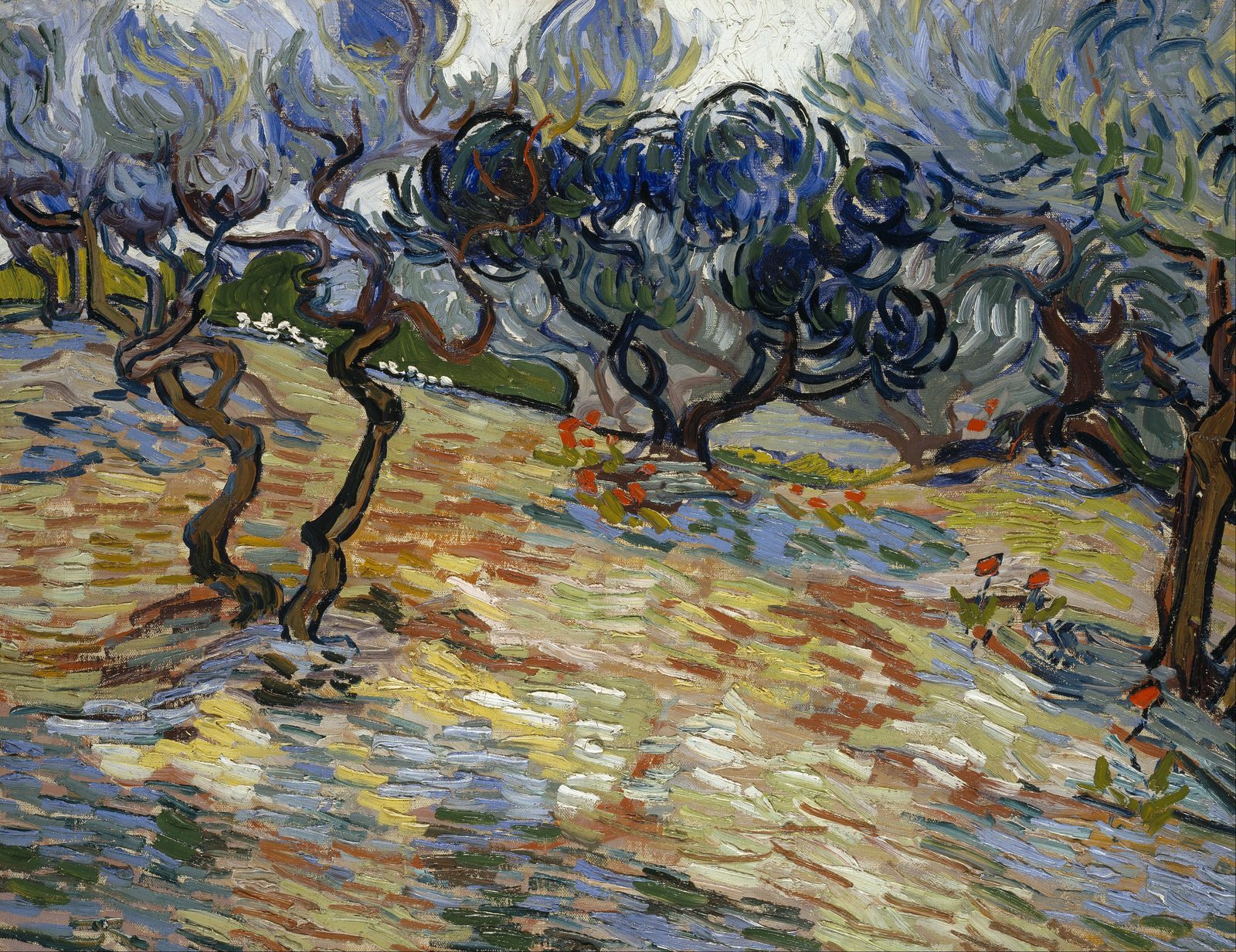
Olive Trees. Vincent van Gogh, Saint-Rémy-de-Provence, November 1889. Wikimedia Commons. Public domain.