
Psalm 87
7 verses · Song of Zion
“I will mention Rahab and Babylon among those who know Me— along with Philistia, Tyre, and Cush— when I say, ‘This one was born in Zion.’”
Introduction
The sons of Korah, the Register of Zion, Book 3: The crisis of the throne, Poetry, Psalms Overview.
The sons of Korah, who kept the gates of the sanctuary, wrote this, one of the shortest songs in the Psalter. Their work was deciding who came in, and the psalm is about that very question: who is written down as belonging to the city of God. It names nations Israel had every reason to fear, and says something about them the congregation did not expect to hear. Listen for the names and for the word about birth that keeps returning. Read it as a glimpse, long before the gospel went out, of a city opened to the nations.
Context
- Who
- Israelites who defined themselves against the nations the song names
- What
- A short song of Zion in which foreign nations are entered in the register as born in the city.
- Where
- The gates of Jerusalem, where the citizen rolls decided who belonged
- When
- The monarchy, while Zion's gates stood, and no date or event is stated.
- Why
- To declare that God will count people from the nations among the citizens of His city.
Historical context
The psalm is headed for the sons of Korah, whose line served as gatekeepers in the sanctuary and physically decided who came through. It carries no date and no event, and what fixes it in a world is the practice it turns on, which is a register. Cities and empires kept birth and census lists, and where a person was entered decided his standing for life: his rights, his taxes, his protection, and whether the gate opened for him at all. Legal cases, market business and control of entry all happened in the gateway of a walled town, so a psalm about who is written down is a psalm about who gets through the gate. The nations entered on the list are Israel's historic tormentors: Rahab, a name for Egypt taken from a sea monster, then Babylon, which burned the temple, Philistia, which raided the coast for centuries, Tyre, the trading power to the north, and Cush, the kingdom up the Nile. Of each the psalm says that this one was born in Zion, which enters them as native citizens with full standing.
Significance
Gatekeepers sang that the gate would be opened to Babylon, and to a congregation that measured itself against those exact nations that was a jolt. It is also one of the shortest psalms in the book, over almost before the shock has time to land, and it ends with singers and pipers saying that all their springs of joy are in the city.
This chapter in Jewish lifeWhat this chapter is in Jewish life and reading.
How it is read
Three commentators carry English in the corpus on this short psalm, so the classical reading of Zion can be heard in three voices. Radak explains why verse 2 names the gates of Zion rather than the city. The elders and the wise sit in the gates, as Deuteronomy 25:7 and Ruth 4:11 show. God loves those gates above the other dwellings of Jacob "because there the wise are occupied with the service of Gd" (Radak on Psalms 87:2:2). Metzudat David reads the glorious things of verse 3 the same way, that they are said of Zion "because the Sanhedrin dwells within you, occupied with Torah" (Metzudat David on Psalms 87:3:1). Radak adds a geography to it. The settled world is divided into seven portions and Jerusalem stands in the middle one, which he reads with the navel of the earth at Ezekiel 38:12. He also quotes the saying that the air of the land of Israel makes one wise, from Bava Batra 158b (Radak on Psalms 87:3:1). Rashi takes the nations of verse 4 as nations that will bring Israel home, reading Isaiah 66:20, where the brethren are brought as a tribute to the LORD (Rashi on Psalms 87:4:1). The counting of the peoples in verse 6 he reads as a future reckoning. God finds the Israelites assimilated among the nations, extracts them, and says of each that this one was born in Zion (Rashi on Psalms 87:6:1). Rashi is quoted here from the Judaica Press complete Tanach with Rashi, translated by A. J. Rosenberg, under CC-BY. Radak and Metzudat David are quoted from Rabbi Mike Feuer's Jerusalem Anthology under CC-BY.
What the rabbis say
The corpus records thirty places where the Midrash and the Talmud draw on this psalm, cited here by reference, and Midrash Tehillim carries most of them. It treats the psalm at 87:1 to 87:7, and cites its verses again at 8:3, 36:4, 48:5 and 90:9. Verse 2, on the gates of Zion, is drawn into the Babylonian Talmud at Berakhot 8a:17 and into Avot DeRabbi Natan, Recension B 43:21. Verse 5, on the man born in her, stands at Ketubot 75a:14 and in the Jerusalem Talmud at Sheviit 4:8:5. Verse 6 is read in the Jerusalem Talmud at Kilayim 9:3:1. Verse 7, the singers and the players, is carried into Pirkei DeRabbi Eliezer 41:6.
Sources: Rashi, Rashi on Psalms 87:1 to 87:7, the Judaica Press complete Tanach with Rashi, translated by A. J. Rosenberg, CC-BY, 1040 to 1105; Radak, Radak on Psalms 87:2:2 and 87:3:1, Rabbi Mike Feuer, Jerusalem Anthology, CC-BY, 1160 to 1236; Metzudat David, Metzudat David on Psalms 87:3:1, Rabbi Mike Feuer, Jerusalem Anthology, CC-BY; Babylonian Talmud, Bava Batra 158b, cited by Radak, and Berakhot 8a:17 and Ketubot 75a:14, cited by reference; Midrash Tehillim, 87:1 to 87:7, cited by reference; The Sefaria corpus, scripts/data/sources/sefaria/psalms/87.json, fetched 2026-09-19, 2026.
Psalms 87:1-3
on the holy mountains: God founded the city himself, and He founded it on the holy mountains. Verse 2 sets the gates of Zion above every dwelling of Jacob, where the Hebrew is mishkan, the noun used for the tabernacle. Verse 3 says glorious things are ascribed to this city.
Psalms 87:1
“His foundation is in the holy mountains. The Psalm begins abruptly, the poet's heart was full, and it gained vent on a sudden. Sudden passion is evil, but bursts of holy joy are most precious. God has chosen to found his earthly temple upon the mountains; he might have selected other spots, but it was his pleasure to have his chosen abode upon Zion. His election made the mountains holy, they were by his determination ordained and set apart for the Lord's use.”
Charles Spurgeon · The Treasury of David, Vol. 4 (1874)Particular Baptist
2 more voices on this verseWhat preachers and commentators have said about this verse, in their own words.
Psalms 87:1
“Holiness is the strength and stability of the church: it is this that will support it and keep it from sinking; not so much that it is built upon mountains as that it is built upon holy mountains--upon the promise of God, for the confirming of which he has sworn by his holiness, upon the sanctification of the Spirit, which will secure the happiness of all the saints.”
Matthew Henry · Commentary on the Whole Bible (1707-1721)puritan
Psalms 87:1
“His--that is, God's foundation--or, what He has founded, that is, Zion (Isa 14:32). is in the holy mountains--the location of Zion, in the wide sense, for the capital, or Jerusalem, being on several hills.”
Jamieson, Fausset & Brown · Commentary Critical and Explanatory on the Whole Bible (1871)reformed
the gates of Zion: Charles Spurgeon took the gates as standing for the whole city. Albert Barnes pictured the crowds pressing through them at the great feasts to worship. Matthew Henry drew the lesson that God is worshiped in the homes of Jacob, yet He prizes the gathered worship of His people more.
Psalms 87:2
“And because each one builds upon the foundation—one gold, another silver, another precious stones—The Lord loves the gates of Zion above all the tabernacles of Jacob. Does he love those gates which we see have collapsed? Does he love those gates, and does he love that Zion, which has been plowed like a field? And see what he says, The Lord loves the gates of Zion above all the tabernacles of Jacob. See what he says: above all the cities of Jacob, that is of Judea, he loves this city alone.”
Jerome · written before 420 · Homily 18, on Psalm 86patristic
1 more voice on this verse
Psalms 87:2
“Zion - That is, Zion itself, or Jerusalem, which was built upon and near Mount Zion. He saith Zion rather than Jerusalem, to intimate that he loved Jerusalem for Zion's sake, or for the temple, which he chose for his peculiar dwelling place.”
John Wesley · Explanatory Notes upon the Old Testament (1765)evangelical
O city of God: Jerusalem is the city of God as His home on earth. Albert Barnes noted the verb may mean things already said or things yet to be said, and he preferred the first. Augustine found the glorious things in the next verse, where foreign nations are counted as Zion's own.
Psalms 87:3
“Glorious things are spoken of you, O city of God. Therefore that which was said, Its foundations are in the holy mountains, we can also say of God. But we can also say this. Glorious things are spoken of you, O city of God. What is this city? Where were glorious things spoken? In all the prophets it was spoken of this city. Isaiah says: 'Arise, arise, O Jerusalem, put on the strength of your arm.' Again Isaiah himself: 'I am the strong city, the city that is besieged.'”
Jerome · written before 420 · Homily 18, on Psalm 86patristic
Psalms 87:4-6
Rahab and Babylon: Rahab is Egypt, the name Isaiah 30:7 gives her, and Babylon, Philistia, Tyre and Cush stand beside her as foreign nations. Each is enrolled as born in Zion. Verse 6 puts that line in writing, where the LORD counts the peoples and records it himself.
Psalms 87:4
“I will make mention of Rahab and Babylon to them that know me. This shall be a glorious subject to speak of concerning Zion, that her old foes are new born and have become her friends, worshipping in the temple of her God. Rahab or Egypt which oppressed Israel shall become a sister nation, and Babylon in which the tribes endured their second great captivity, shall become a fellow worshipper; then shall there be mention made in familiar talk of the old enmities forgotten and the new friendships formed.”
Charles Spurgeon · The Treasury of David, Vol. 4 (1874)Particular Baptist
2 more voices on this verse
Psalms 87:4
“God says, " I will reckon Egypt and Babylon with those that know me. I will reckon them my people as much as Israel when they shall receive the gospel of Christ, and own them as born in Zion, born again there, and admitted to the privileges of Zion as freely as a true-born Israelite." Those that were strangers and foreigners became fellow-citizens with the saints, Eph. ii.”
Matthew Henry · Commentary on the Whole Bible (1707-1721)puritan
Psalms 87:4
“I will be mindful of Rahab and Babylon among those who know me. Since he said, Glorious things are spoken of you, O city of God, and yet we understand that very city as the Church gathered from the nations: therefore now it is said concerning the calling of the nations, I will be mindful of Rahab and Babylon among those who know me. Whoever is a sinner, let him be secure: the Lord was mindful of Rahab. I said secure, if he returns to the Lord: for otherwise security without tears has no remedy.”
Jerome · written before 420 · Homily 18, on Psalm 86patristic
Jamieson, Fausset and Brown gave the Hebrew literally as man and man, meaning many or all. Charles Spurgeon heard the count as one by one, so no person is lost in the crowd of nations. John Wesley read the establishing as a lasting work.
Psalms 87:5
“Will a man say to Zion, and a man is born in her? The Seventy translators rendered it thus: Will a man say to Zion? Many, then, expected, and did not understand what μήτη Σιὼν is: and they added a ρ, and they read μήτηρ Σιὼν ἐρεῖ ἄνθρωπος (mother Zion will a man say). And they say this because there follows, And a man is born in her: they expect that it also ought to be said in this way, Mother Zion will a man say.”
Jerome · written before 420 · Homily 18, on Psalm 86patristic
2 more voices on this verse
Psalms 87:5
“A man, a man was born in her, by which some understand Christ, that man, that son of man, who is fairer than the children of men; he was born at Bethlehem near Zion, and was the glory of his people Israel. The greatest honour that ever was put upon the Jewish nation was, that of them, as concerning the flesh, Christ came, Rom. ix.”
Matthew Henry · Commentary on the Whole Bible (1707-1721)puritan
Psalms 87:5
“The writer resumes-- This and that man--literally, "man and man," or many (Ge 14:10; Ex 8:10, 14), or all (Isa 44:5; Ga 3:28). the highest . . . her--God is her protector.”
Jamieson, Fausset & Brown · Commentary Critical and Explanatory on the Whole Bible (1871)reformed
the register of the peoples: Albert Barnes saw a step up from verse 5. There people honor a birth in Zion, and here the LORD Himself honors it. John Wesley heard an allusion to rulers who kept a register, and Barnes noted that peoples is plural, so the roll takes in the nations.
Psalms 87:6
“The Lord will tell in the writing of the peoples and of the princes, of these who have been in her. He did not say, who are in her; but, who have been in her. The Lord will tell. And how will he tell? not by word, but by writing. In whose writing? in that of the peoples. That is not enough, but he also says, of the princes. And of which princes? who are in her? He did not say this; but, who have been in her. See, then, how holy Scripture is full of sacraments.”
Jerome · written before 420 · Homily 18, on Psalm 86patristic
2 more voices on this verse
Psalms 87:6
“The Lord shall count, when he writeth up the people, that this man was born there. At the great census which the Lord himself shall take, he will number the nations without exception and make an exact registry of them, whether they were by their natural descent Babylonians or Tyrians, or other far off heathen. May it be our happy lot to be numbered with the Lord's chosen both in life and death, in the church roll below, and in the church roll above.”
Charles Spurgeon · The Treasury of David, Vol. 4 (1874)Particular Baptist
Psalms 87:6
“When - When God, the maker and governor of this city shall take a survey of all his citizens. It is an allusion to princes or governors of cities that use to write and keep a register of all their people.”
John Wesley · Explanatory Notes upon the Old Testament (1765)evangelical
Singers and pipers proclaim the closing line. The pronoun in You is feminine singular in the Hebrew, so the springs of joy stand in Zion, the city of verse 3. Springs is mayan, a fountain of water, and the psalm makes the city the source of a citizen's joy.
Psalms 87:7
“In thee - In Zion or the church. These words may be here added as the burden of the song, which these singers are supposed to have sung, in the name of all the people of God. All our desires and delights are in thee, all the springs of mercy, grace, and glory, flow to us only in and thro' thee.”
John Wesley · Explanatory Notes upon the Old Testament (1765)evangelical
2 more voices on this verse
Psalms 87:7
“It does one good to think that there are such things in the world as springs bubbling up in the shady nooks. Places of sweet refreshment in this dusty earth. The mouth waters at the very thought of the palms of Elim and the wells there. If even to us fresh springs are a blessing, much more must they have been so to the Psalmist who lived in a dry and thirsty land which owed almost all its fertility to irrigation. Nothing is more precious to the Oriental than a well.”
Charles Spurgeon · written before 1892 · The Metropolitan Tabernacle Pulpit, Sermon No. 3213: “Blessings Traced to Their Source” (lightly modernized text, CCEL edition)Particular Baptist
Psalms 87:7
“As it were the dwelling of all who rejoice is in you. The prophet speaks to the Church, and says to her: As it were the dwelling of all who rejoice is in you. Why did he not say, The dwelling of all who rejoice is in you, but said, As it were of those who rejoice? It is said in another psalm: 'When the Lord turned back the captivity of Zion, we became as those who are consoled'; and he did not say, consoled.”
Jerome · written before 420 · Homily 18, on Psalm 86patristic
How this psalm is built
The form: A psalm whose first words are so abrupt that the opening line reads as part of its own title, as Barnes classes it.
The patterns in this chapter
| Device | What it does | Where to see it |
|---|---|---|
| This one was born in Zion | The sentence stands three times, at verse 4 in God's mouth, at verse 5 as what will be said of Zion, and at verse 6 as what the LORD will record in the register of the peoples. Each return moves it to a different speaker, so the same clause is first a declaration, then a report, then an entry in a book. | Psalm 87:4, Psalm 87:5, Psalm 87:6 |
| The nations entered by name | Verse 4 lists Rahab and Babylon, then Philistia, Tyre and Cush. Every one of them is a power Israel had reason to fear or to hate, and the psalm enters them in the register without comment on their history. | Psalm 87:4 |
| The city spoken to | Verse 3 turns from describing Zion to speaking to her, saying that glorious things are ascribed to her, O city of God. The psalm addresses the city as a person for one verse and then hands the speech to God for verse 4. | Psalm 87:3, Psalm 87:4 |
| Springs at the end and foundations at the start | The psalm opens on what God founded on the holy mountains and closes on singers and pipers saying that all their springs of joy are in Zion. The first image is rock and the last is water, and the two hold the seven verses between them. | Psalm 87:1, Psalm 87:7 |
The psalm belongs with the songs of Zion, and it is the one among them that faces outward. Psalm 48 walks the walls and counts the towers. Psalm 76 reports the weapons broken before them. Psalm 87 opens the gates and writes foreign names inside.
9 more paragraphs on the patterns
The five names at verse 4 are the psalm's link to the rest of the Old Testament. Rahab is a name used of Egypt, Babylon is the empire of the exile, Philistia and Tyre are the coastal neighbours, and Cush lies south beyond Egypt. The list runs from the oldest enemy to the furthest one, and it includes the two powers that destroyed the northern and southern kingdoms.
Inside the psalm the pattern is a sentence that gains authority each time it is said. At verse 4 it is God's declaration. At verse 5 it is what will be said of Zion by others. At verse 6 it is written down, and the psalm specifies the book: the register of the peoples. What began as speech ends as record.
The New Testament's use
No verse of Psalm 87 is quoted in the New Testament. Its subject stands behind Galatians 4:26, where the Jerusalem above is called the mother of us all, and behind the register language of the book of life, and the fathers read the psalm that way from early on. The psalm is not cited by chapter and verse in the New Testament.
The debated point
What verse 1 is doing is contested at the level of the text. Albert Barnes sets out the position that the words of the opening belong to the psalm's title, since the psalm begins with a pronoun whose antecedent has not been given, and he reports the reading rather than adopting it. The alternative is to take the abruptness as deliberate, so that the psalm opens in the middle of a subject the singers already knew.
The larger dispute is who the born of verse 4 are. One position reads the psalm of proselytes, foreigners who come into Israel and are counted as native born. The other reads it as a prophecy of the nations brought in through the gospel, and the fathers hold it almost without exception. Both readings are held by teachers the site cites, and both rest on the same three-times-repeated sentence.
Where to go deeper
The city is set out at Zion and Jerusalem and the city. The nations named are set out at Egypt, Babylon and Rahab and the scarlet cord where the name has its own page. The register of verse 6 stands with the scroll and the book.
Keep studying
Words7
Sources for this chapter
The summary
Jamieson, Fausset & Brown, Commentary Critical and Explanatory; John Calvin, Commentaries; John Wesley, Notes on the Old Testament and Matthew Henry, Complete Commentary.
The form and classifications
Albert Barnes, Notes, Explanatory and Practical, on the Old and New Testaments, 1832 to 1869, on Psalm 87:1; Charles Spurgeon, The Treasury of David, Vol. 4, 1874, on Psalm 87:4 and Jerome, Homily on Psalm 86, 420.
The exposition
Albert Barnes, Notes on the Book of Psalms; Augustine of Hippo, Exposition on Psalm 87; Charles Spurgeon, The Treasury of David; Franz Delitzsch, Biblical Commentary on the Psalms; Jamieson, Fausset & Brown, Commentary Critical and Explanatory on the Whole Bible; John Gill, Exposition of the Old Testament; John Wesley, Explanatory Notes upon the Old Testament and Matthew Henry, Commentary on the Whole Bible.
The painting
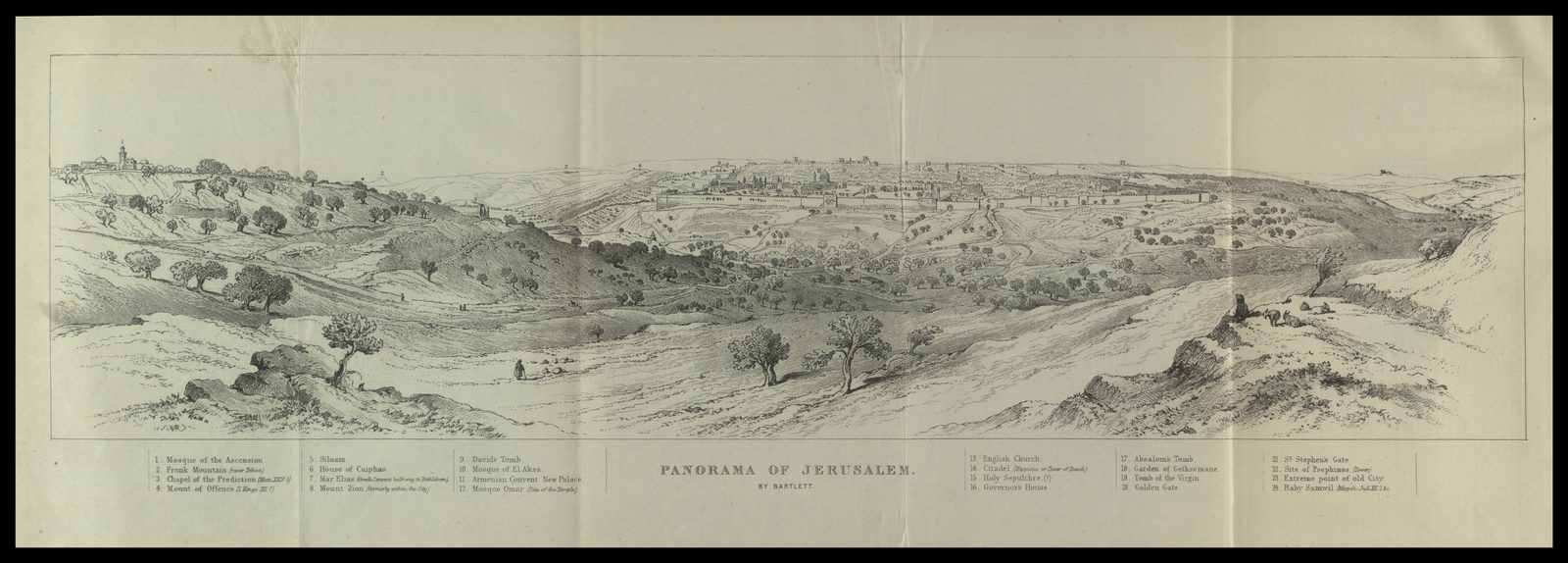
Panorama of Jerusalem. William Henry Bartlett, not stated on the file page. Wikimedia Commons. Public domain.