
Psalm 45
17 verses · Royal psalm
My heart is stirred by a noble theme as I recite my verses to the king; my tongue is the pen of a skillful writer.
Introduction
The sons of Korah, the Royal Wedding Song, Book 2: The Elohistic Psalter, Poetry, Psalms Overview.
The sons of Korah wrote this song for a royal wedding in Jerusalem, and its heading calls it a song of loves. The song leaves the king and his bride, a princess from another nation, unnamed. The singer first praises the king and his reign, then turns to the bride and tells her what the marriage will ask of her. Listen for the line where the king is addressed as God, which the letter to the Hebrews applies to the Son. The song closes on a promise that the royal line will go on.
Context
- Who
- The court and the congregation at a royal wedding, and the nation whose dynasty it continued
- What
- A wedding song for a king of David's line and his bride from another nation.
- Where
- A royal court with ivory-panelled rooms, at the marriage of the king to a foreign princess
- When
- The monarchy, with the date unstated; the song names neither the king nor the bride.
- Why
- To honour the king and his reign, to call the bride to her new house, and to pray for the dynasty's future.
Historical context
The psalm is ascribed to the sons of Korah and its own title calls it a song of loves, set to a tune named the Lilies. It names no king and no bride, and proposals have included Solomon, Ahab and Jehoram without agreement. A royal marriage in Israel was a matter of state, and kings married the daughters of neighbouring rulers to seal alliances, which is the Daughter of Tyre at verse 12. A foreign princess brought into Israel left her household, her gods and her standing behind her, so the instruction of verse 10 is the practical condition of the marriage. The ivory palaces of verse 8 are rooms panelled with carved ivory inlay, a technique of Phoenician workshops. The gold of Ophir at verse 9 was the finest gold known in Israel, brought by sea on Solomon's ships at 1 Kings 9:28.
Significance
For the first hearers the psalm celebrated the continuation of the dynasty God had promised David at 2 Samuel 7, and verse 16 is where that promise appears in the poem. It also fixed what kind of king was being praised. He rides out for truth and humility and justice at verse 4, and the scepter of his kingdom is a scepter of justice at verse 6, so the song sets a standard over the man it honours.
This chapter in Jewish lifeWhat this chapter is in Jewish life and reading.
How it is read
This chapter is the sharpest parting between the Jewish reading and the Christian one in the whole range, and it turns on a single line. This site's Psalms page lists Psalm 45 among the psalms the New Testament reads of Christ, and names Hebrews 1:8 and 9, where the throne of the psalm is addressed to the Son as God. Rashi reads the psalm as a song in honour of the scholars of the Torah, and he says so on the heading:
on shoshannim They founded this psalm in honor of the Torah scholars, who are as tender as roses and as beautiful as roses, and perform good deeds as fresh as roses. (Rashi on Psalms 45:1:1)
The handsome king of the third line is for him a teacher whose charm is the ruling of the law:
Because charm is poured into your lips to instruct according to the halachah. הוּצַק means “poured,” as (Exod. 38:27): “to cast (לצקת)”; (Gen. 28:18), “and he poured (ויצק) oil.” (Rashi on Psalms 45:3:1)
The sword of the fourth line is the war of the Torah, at Rashi on Psalms 45:4:1, and the sharpened arrows of the sixth are the disciples, at Rashi on Psalms 45:6:1. On the line Hebrews addresses to the Son he writes:
Your throne, O prince and judge, shall exist forever and ever, as the matter that is stated (Exod. 7:1): “I have made you a judge (נתתיך אלהים) over Pharaoh.” (Rashi on Psalms 45:7:1)
Rashi reads the Hebrew word there as judge and supports it from Exodus 7:1, where Moses is set as a judge over Pharaoh. Hebrews reads the same word as God and addresses the line to Christ. Both readings are old and both are held by serious readers of the same Hebrew. A Christian who wants to argue the point has to argue it from the word and from the psalm rather than by assuming the Jewish reading was never given. Ibn Ezra stands on this chapter at Ibn Ezra on Psalms 45:4:1 and 45:16:1, and Sefaria holds no English version of those references, so this card cites them without quotation.
What the rabbis say
The corpus records 40 places where the rabbinic literature takes up a line of this psalm, 34 of them in the Midrash. Bereshit Rabbah takes it up at Bereshit Rabbah 59:5, 93:2, 99:8, 39:6, 49:9, 39:1 and 43:6, Aggadat Bereshit at Aggadat Bereshit 16:1, 19:2, 43:2 and 40:1 and Bamidbar Rabbah at Bamidbar Rabbah 10:1, 1:3, 2:26 and 6:2. The Midrash on the Psalms treats it at Midrash Tehillim 1:14. The Talmud takes up lines of the psalm at Menachot 63a:2, Jerusalem Talmud Megillah 1:9:5, Jerusalem Talmud Shabbat 6:4:2, Menachot 88b:8, Avodah Zarah 65a:5 and Chagigah 15b:8. Each is a locator in this corpus, so the saying stands at its reference and is read there.
Sources: Rashi, Rashi on Psalms, in The Judaica Press complete Tanach with Rashi, translated by A. J. Rosenberg, under a CC-BY licence; Ibn Ezra, Ibn Ezra on Psalms, cited at Ibn Ezra on Psalms 45:4:1 and 45:16:1; Midrash Tehillim, the Midrash on the Psalms, cited at Midrash Tehillim 1:14; The Talmud, cited at Menachot 63a:2, Jerusalem Talmud Megillah 1:9:5, Jerusalem Talmud Shabbat 6:4:2, Menachot 88b:8, Avodah Zarah 65a:5 and Chagigah 15b:8; MannaFest, the psalms the New Testament reads of Christ, at /book/psalms, 2026; MannaFest, the Sefaria corpus at scripts/data/sources/sefaria/psalms/45.json, fetched 2026-09-19, 2026.
Psalms 45:1-2
stirred by a noble theme: The pen of a skillful writer is the poet's own tongue. The king is addressed as the most handsome of men, with grace anointed on his lips and God's blessing on him forever. Delitzsch reads the order as set, speech and grace before the sword of verse 3.
Psalms 45:1
“The Son lives by the Father, because he is the Son begotten of the Father; by the Father, because he is of one substance with the Father; by the Father, because he is the Word given forth from the heart of the Father, because he came forth from the Father, because he is begotten of the "bowels of the Father," because the Father is the fountain and root of the Son's being.”
Ambrose of Milan · written before 397 · Exposition of the Christian Faith 4.10.133patristic
1 more voice on this verseWhat preachers and commentators have said about this verse, in their own words.
Psalms 45:1
“The excellency of the management. This song was a confession with the mouth of faith in the heart concerning Christ and his church. (1.) The matter was well digested, as it well deserved: My heart is inditing it, which perhaps is meant of that Spirit of prophecy that dictated the psalm to David, that Spirit of Christ which was in the prophets, 1 Pet. i.”
Matthew Henry · Commentary on the Whole Bible (1707-1721)puritan
the most handsome of men: Barnes found the Hebrew for most handsome unusual, a word doubled to mean very fair. Wesley held the praise true of Christ more than of Solomon, whom many men excelled in righteousness. Grace on the king's lips is the gift of speech.
Psalms 45:2
“To rich personal attractions is added grace of the lips, captivating powers of speech. This is given, and becomes a source of power and proves a blessing. Christ is a prophet (Lu 4:22).”
Jamieson, Fausset & Brown · Commentary Critical and Explanatory on the Whole Bible (1871)reformed
2 more voices on this verse
Psalms 45:2
“Fairer - Than all other men: which is most true of Christ; but not of Solomon; whom many have excelled, in holiness and righteousness, which is the chief part of the beauty celebrated in this psalm. Grace - God hath plentifully poured into thy mind and tongue the gift of speaking wisely, eloquently, and acceptably.”
John Wesley · Explanatory Notes upon the Old Testament (1765)evangelical
Psalms 45:2
“He had no form or comeliness in the eyes of the Jews, but to David he is fairer than the children of people. And on the mountain he was bright as the lightning and became more luminous than the sun, initiating us into the mystery of the future.”
Gregory of Nazianzus · written before 390 · On the Son, Theological Oration 3(29).19patristic
Psalms 45:3-5
Strap your sword at your side: goes to a king dressed for war. He rides out for truth and humility and justice, and his arrows pierce the hearts of his foes. Henry notes the humility stands beside a drawn sword.
Psalms 45:3
“Gird thy sword upon thy thigh. Loving spirits jealous of the Redeemer's glory long to see him putting forth his power to vindicate his own most holy cause. Why should the sword of the Spirit lie still, like a weapon hung up in an armoury; it is sharp and strong, both for cutting and piercing: O that the divine power of Jesus were put forth to use against error. The words before us represent our great King as urged to arm himself for battle, by placing his sword where it is ready for use.”
Charles Spurgeon · The Treasury of David, Vol. 2 (1870)Particular Baptist
1 more voice on this verse
Psalms 45:3
“The word of God is the sword of the Spirit. By the promises of that word, and the grace contained in those promises, souls are made willing to submit to Jesus Christ and become his loyal subjects; by the threatenings of that word, and the judgments executed according to them, those that stand it out against Christ will, in due time, be brought down and ruined.”
Matthew Henry · Commentary on the Whole Bible (1707-1721)puritan
ride forth in victory: Spurgeon noted the words can be read as riding upon truth, humility and justice, three horses drawing the war chariot of the gospel. Chrysostom set this King beside rulers who make war for cities, wealth or vainglory. His war is waged for truth.
Psalms 45:4
“The word - That is, the gospel: which is called the word of truth, Eph. i, 13, and may no less truly be called the word of meekness, because it is not delivered with terror, as the law was at Sinai, but meekly and sweetly; and the word of righteousness, because it brings in everlasting righteousness, and strongly excites all men to the practice of righteousness and holiness.”
John Wesley · Explanatory Notes upon the Old Testament (1765)evangelical
Your arrows pierce: Basil of Caesarea read the arrows as well-aimed words that strike the hearts of those who hear. Augustine said the same words kindle love, so the nations fall in the heart. Wesley made the arrows and the sword of verse 3 one weapon.
Psalms 45:5
“The sharp arrows of the Mighty One are the well-aimed words that touch the hearts of the hearers, striking and wounding their keenly perceptive souls.”
Basil of Caesarea · written before 379 · Homilies on the Psalms 17:6 (Ps 45)patristic
Psalms 45:6-7
Your throne, O God: , endures forever, and justice is the scepter of the kingdom. Hebrews 1:8 and 9 quote both verses of the Son, introduced with But about the Son He says. The oil of joy marks a king anointed above his companions.
Psalms 45:6
“Thy throne, O God, is for ever and ever,.... This verse and Psa 45:7 are cited in Heb 1:8; and applied to the Son of God, the second Person in the Trinity; and therefore are not an apostrophe to the Father, as some have said; nor will they bear to be rendered, "thy throne is the throne of God", or "thy throne is God"; or be supplied thus, "God shall establish thy throne".”
2 more voices on this verse
Psalms 45:6
“Thy throne, O God, is for ever and ever. To whom can this be spoken but our Lord? The psalmist cannot restrain his adoration. His enlightened eye sees in the royal Husband of the church, God, God to be adored, God reigning, God reigning everlastingly. Blessed sight! Blind are the eyes that cannot see God in Christ Jesus! We never appreciate the tender condescension of our King in becoming one flesh with his church, and placing her at his right hand, until we have fully rejoiced in his essential glory and deity.”
Charles Spurgeon · The Treasury of David, Vol. 2 (1870)Particular Baptist
Psalms 45:6
“Even before he became man, he was King and Lord everlasting, being image and word of the Father.”
Athanasius of Alexandria · written before 373 · Discourses Against the Arians 2.13patristic
Cross references
Psalms 45:6
- Quoted inHebrews 1:8“But about the Son He says: “Your throne, O God, endures forever and ever, and justice is the scepter of Your kingdom.”
'Thy throne, O God, is for ever and ever' (the Son addressed as God)
ConnectionsHebrews 1:8
the oil of joy: Irenaeus heard two persons named God in this verse, the Son who is anointed and the Father who anoints. Athanasius read therefore as naming why He came down, the anointing given for the sake of His people. Clarke took the oil as a sign that mourning had ended.
Psalms 45:7
“Therefore - Therefore God hath exalted thee far above all men and angels, to a state of joy and endless glory at his right hand; which is fitly compared by the oil of gladness.”
John Wesley · Explanatory Notes upon the Old Testament (1765)evangelical
3 more voices on this verse
Psalms 45:7
“The word therefore does not imply the reward of virtue or conduct in the Word but the reason why he came down to us. It indicates that the Spirit's anointing took place in him for our sakes.”
Athanasius of Alexandria · written before 373 · Discourses Against the Arians 1.49patristic
Psalms 45:7
WE KNOW THAT THE ANOINTING received by our Lord Jesus Christ was the resting of the Spirit of God upon him without measure. We are not left to any guesswork about this, for in Isaiah 61 we are told, "The Spirit of the Lord is upon me, because the Lord hath anointed me." Our Lord appropriated these very words to himself when he went into the synagogue at Nazareth and opened the book at the place wherein these words are written, and said, "This day is this Scripture fulfilled in your ears."
Psalms 45:7
“As in Ps 45:6 the divine nature is made prominent, here the moral qualities of the human are alleged as the reason or ground of the mediatorial exultation.”
Jamieson, Fausset & Brown · Commentary Critical and Explanatory on the Whole Bible (1871)reformed
Psalms 45:8-9
fragrant with myrrh and aloes: The garments carry myrrh and aloes and cassia, and harps sound from palaces of ivory. The queen stands at his right hand in the gold of Ophir, the far country Solomon's ships sailed to for gold at 1 Kings 9:28. Barnes reads the ivory as inlay in royal building.
Psalms 45:8
“The sweet odor of Christ gives forth the fragrance of myrrh because of his passion, and of aloes because he did not remain motionless and inactive for three days and three nights but descended to the lower world to distribute the graces of the resurrection.… And it breathes forth the fragrance of cassia, a very delicate and fragrant bark, … because of the suffering of the cross undertaken in kindness to every creature.”
Basil of Caesarea · written before 379 · Homilies on the Psalms 17:9 (Ps 45)patristic
1 more voice on this verse
Psalms 45:8
“The king thus inaugurated is now presented as a bridegroom, who appears in garments richly perfumed, brought out from ivory palaces--His royal residence; by which, as indications of the happy bridal occasion, He has been gladdened.”
Jamieson, Fausset & Brown · Commentary Critical and Explanatory on the Whole Bible (1871)reformed
daughters of kings: Barnes took the word for honored women to mean precious or beloved, so the daughters of kings stand among his dear ones. Augustine set the queen at the right hand with the blessed of Matthew 25:34. Henry read her gold as her graces.
Psalms 45:9
“The queen … is the soul that is joined with the Word, its Bridegroom; not subjected by sin but sharing the kingdom of Christ, it stands on the right hand of the Savior in gilded clothing, that is to say, adorning itself charmingly and religiously with spiritual doctrines, interwoven and varied.”
Basil of Caesarea · written before 379 · Homilies on the Psalms 17:9 (Ps 45)patristic
2 more voices on this verse
Psalms 45:9
“This is the bride, the Lamb's wife, whose graces, which are her ornaments, are compared to fine linen, clean and white ( Rev. xix. 8 ), for their purity, here to gold of Ophir, for their costliness; for, as we owe our redemption, so we owe our adorning, not to corruptible things, but to the precious blood of the Son of God.”
Matthew Henry · Commentary on the Whole Bible (1707-1721)puritan
Psalms 45:9
“The relation of subjection to her spouse at once accords with the law of marriage, as given in Ge 3:16; 1Pe 3:5, 6, and the relation of the Church to Christ (Eph 5:24). The love of the husband is intimately connected with the entire devotion to which the bride is exhorted.”
Jamieson, Fausset & Brown · Commentary Critical and Explanatory on the Whole Bible (1871)reformed
Psalms 45:10-12
Listen, O daughter!: The bride is told to forget her people and her father's house and to bow to the king. The king will desire her beauty, the Daughter of Tyre comes with a gift, and men of wealth seek her favor. Calvin and Spurgeon read it as the church called to Christ.
Psalms 45:10
“Hearken, O daughter, and consider. Ever is this the great duty of the church. Faith cometh by hearing, and confirmation by consideration. No precept can be more worthy of the attention of those who are honoured to be espoused to Christ that that which follows. And incline thine ear. Lean forward so that no syllable may be unheard. The whole faculties of the mind should be bent upon receiving holy teaching. Forget also thine own people, and thy father's house.”
Charles Spurgeon · The Treasury of David, Vol. 2 (1870)Particular Baptist
the king will desire your beauty: The king's desire follows the call of verse 10 to leave her father's house. Chrysostom placed the beauty in the soul, arising from obedience, and Augustine called it the king's work, the sinner made white as Isaiah 1:18 promised. Wesley read lord as husband, king and God.
Psalms 45:11
“So - So thou shalt be acceptable to thy husband; which will abundantly recompence thee, for the loss of thy father's house. Thy Lord - As he is thy husband, and also as he is thy king, and God.”
John Wesley · Explanatory Notes upon the Old Testament (1765)evangelical
The Daughter of Tyre: Wesley took the Daughter of Tyre as her people, standing for all the nations. Jamieson, Fausset and Brown said Tyre was chosen for its wealth, and read the gift as a sign the richest people bow to the king. Augustine saw the Gentiles come to the king.
Psalms 45:12
“And the daughter of Tyre shall be there with a gift. When the church abounds in holiness, she shall know no lack of homage from the surrounding people. Her glory shall then impress and attract the heathen around, till they also unite in doing honour to her Lord. The power of missions abroad lies at home: a holy church will be a powerful church.”
Charles Spurgeon · The Treasury of David, Vol. 2 (1870)Particular Baptist
2 more voices on this verse
Psalms 45:12
“The daughter - The people of Tyre; as the daughter of Zion or Jerusalem, are put for their inhabitants: he mentions the Tyrians; because they among others, and before many others, were to be converted to Christ, but they are here put for all the Gentiles, whom that city fitly represents, as being the mart of the nations.”
John Wesley · Explanatory Notes upon the Old Testament (1765)evangelical
Psalms 45:12
“When the Gentiles, being converted to the faith of Christ, join themselves to the church, they then come with a gift, 2 Cor. viii. When with themselves they devote all they have to the honour of Christ, and the service of his kingdom, they then come with a gift.”
Matthew Henry · Commentary on the Whole Bible (1707-1721)puritan
Psalms 45:13-15
All glorious is the princess: The princess is all glorious in her chamber, her gown embroidered with gold. She is led to the king in colorful garments, her virgin companions with her, and the company enters the palace with joy and gladness. Augustine reads her beauty as given to her.
Psalms 45:13
“The king's daughter is all glorious within. Within her secret chambers her glory is great. Though unseen of men her Lord sees her, and commends her. "It doth not yet appear what we shall be." Or the passage may be understood as meaning within herself—her beauty is not outward only or mainly; the choicest of her charms are to be found in her heart, her secret character, her inward desires. Truth and wisdom in the hidden parts are what the Lord regards; mere skin deep beauty is nothing in his eyes.”
Charles Spurgeon · The Treasury of David, Vol. 2 (1870)Particular Baptist
In colorful garments: Henry set this beside Genesis 2:22, where the Lord God brought the woman to the man. Barnes saw an eastern marriage, the bride led in her colorful garments to the king with her virgin companions as bridesmaids. Henry has the Father bring them.
Psalms 45:14
“She shall be brought unto the king in raiment of needlework. The day comes when the celestial marriage shall be openly celebrated, and these words describe the nuptial procession wherein the queen is brought to her royal Husband attended by her handmaidens. In the latter-day glory, and in the consummation of all things, the glory of the bride, the Lamb's wife, shall be seen by all the universe with admiration.”
Charles Spurgeon · The Treasury of David, Vol. 2 (1870)Particular Baptist
with joy and gladness: The procession ends in the king's palace. Barnes saw the bride led with joy to the palace of her husband, and applied it to the church as it will enter heaven. Augustine took the palace as the temple of the King, built of living stones.
Psalms 45:15
“With gladness and rejoicing shall they be brought. Joy becomes a marriage feast. What joy will that be which will be seen at the feasts of paradise when all the redeemed shall be brought home! Gladness in the saints themselves, and rejoicing from the angels shall make the halls of the New Jerusalem ring again with shoutings. They shall enter into the King's palace. Their peaceful abodes shall be where Jesus the King reigns in state for ever. They shall not be shut out but shut in. Rights of free entrance into the holiest of all shall be accorded them.”
Charles Spurgeon · The Treasury of David, Vol. 2 (1870)Particular Baptist
Psalms 45:16-17
Your sons will succeed your fathers: , and they are made princes throughout the land. The song itself carries the promise, the king's name commemorated through all generations. The nations praise him forever.
Psalms 45:16
“For this reason did the Lord declare that the first should in truth be last, and the last first. And the prophet, too, indicates the same, saying, "instead of fathers, children have been born unto thee." For the Lord, having been born "the First-begotten of the dead," and receiving into His bosom the ancient fathers, has regenerated them into the life of God, He having been made Himself the beginning of those that live, as Adam became the beginning of those who die.”
Irenaeus · written before 202 · Against Heresies 3:22.4patristic
2 more voices on this verse
Psalms 45:16
“As earthly monarchs govern widely extended empires by viceroys, this glorious king is represented as supplying all the principalities of earth with princes of his own numerous progeny.”
Jamieson, Fausset & Brown · Commentary Critical and Explanatory on the Whole Bible (1871)reformed
Psalms 45:16
“This promise to Christ is of the same import with that Isa. liii. 10 , He shall see his seed; and these shall be made princes in all the earth; there shall be some of all nations brought into subjection to Christ, and so made princes, made to our God kings and priests, Rev. i.”
Matthew Henry · Commentary on the Whole Bible (1707-1721)puritan
I will commemorate your name: Two speakers are heard here. Spurgeon heard God promising to commemorate the king's name, and Barnes heard the writer of verse 1, whose song would carry that name through generations. Clarke saw the nations praise him in the church's constant use of this psalm.
Psalms 45:17
“I will make thy name to be remembered in all generations. Jehovah by the prophet's mouth promises to the Prince of Peace eternal fame as well as a continuous progeny. His name is his fame, his character, his person; these are dear to his people now—they never can forget them; and it shall be so as long as men exist. Names renowned in one generation have been unknown to the next era, but the laurels of Jesus shall ever be fresh, his renown ever new. God will see to this; his providence and his grace shall make it so.”
Charles Spurgeon · The Treasury of David, Vol. 2 (1870)Particular Baptist
1 more voice on this verse
Psalms 45:17
“Thus the union of Christ and the Church triumphant is set forth. On the other hand, in regard to its component parts, the relation of Christ as head, as husband, &c., already exists, and as these parts form an institution in this world, it is by His union with it, and the gifts and graces with which He endows it, that a spiritual seed arises and spreads in the world.”
Jamieson, Fausset & Brown · Commentary Critical and Explanatory on the Whole Bible (1871)reformed
How this psalm is built
The form: A royal wedding song, a maskil of the sons of Korah set to the tune of the Lilies, as Delitzsch classes it.
A The king anointed with the oil of joy above his companions
Psalm 45:7
B His robes are fragrant with myrrh and aloes and cassia
Psalm 45:8
C The queen stands at his right hand in the gold of Ophir
Psalm 45:9
B′ Her gown is interwoven with gold
Psalm 45:13
A′ The princess led in with her virgin companions
Psalm 45:14
The patterns in this chapter
| Device | What it does | Where to see it |
|---|---|---|
| The poet's own tongue, named at the front | Verse 1 is the only verse in the psalm about the writer. His heart is stirred, he recites his verses to the king, and his tongue is the pen of a skillful writer. The psalm opens by declaring itself a made thing, which is rare in the Psalter and is why the last verse can promise that the song itself will carry the king's name.Franz Delitzsch, Biblical Commentary on the Psalms, on Psalm 45:1. | Psalm 45:1, Psalm 45:17 |
| The king dressed, from the mouth down to the sword | Verses 2 to 9 clothe the king in order: grace on his lips, a sword on his thigh, splendour and majesty, arrows, a scepter, the oil of joy, garments of myrrh and aloes and cassia. Delitzsch reads the order as set, speech and grace before the sword of verse 3, and Matthew Henry notes that the humility of verse 4 stands beside a drawn blade.Franz Delitzsch, Biblical Commentary on the Psalms, on Psalm 45:2. | Psalm 45:2, Psalm 45:3, Psalm 45:4, Psalm 45:8 |
| Two panels, the king and then the bride | Verses 2 to 9 are addressed to the king and verses 10 to 15 to the bride, and the two panels match: he is anointed with oil and she is dressed in gold, his garments are perfumed and her gown is embroidered, his companions stand near him and her virgin companions follow her. Verses 16 and 17 close by joining the two in their sons.Matthew Henry, Commentary on the Whole Bible, 1710, on Psalm 45:10 to 17. | Psalm 45:8, Psalm 45:9, Psalm 45:13, Psalm 45:14 |
| Forget your people and your father's house | Verse 10 tells the bride to forget her own household and bow to the king as her lord, which is the language of a foreign princess brought into Israel. The Daughter of Tyre with a gift at verse 12 sits in the same picture. John Calvin and Charles Spurgeon both read the command as the church called away from what it was.John Calvin, Commentary on the Book of Psalms, 1557, on Psalm 45:10. | Psalm 45:10, Psalm 45:11, Psalm 45:12 |
The New Testament's use
7 more paragraphs on the patterns
Hebrews 1:8 and 9 quote verses 6 and 7 whole and introduce them with the words But about the Son He says. The quotation is the fourth in the chain of Old Testament texts by which the writer of Hebrews proves the Son greater than the angels, and it is the one that addresses Him as God: Your throne, O God, endures forever, and the scepter of Your kingdom is a scepter of justice.
This is the psalm's greatest weight and it should be read carefully. The Hebrew of verse 6 can be rendered more than one way, and Jewish and Christian readings have differed over whether the king is addressed as God or as one whose throne is God's. The writer of Hebrews follows the Greek of the Septuagint and reads the address as made to the Son, and the church has held that reading since. The psalm's own verse 7 then distinguishes the one addressed from God your God who anointed him, which is the feature both readings have to account for and which Hebrews takes as the Father anointing the Son.
The debated concept
The question the psalm raises is how much of it is about a king of Israel and how much about Christ. Charles Spurgeon reads the whole psalm as messianic and treats the historical wedding as scaffolding. John Calvin reads it as a real royal marriage that becomes a figure of Christ and the church, and argues that verse 16, which promises the king sons, cannot be said of Christ in the same sense. Albert Barnes holds the historical occasion firmly and reads the messianic sense as the psalm's fulfilment rather than its first meaning. Hebrews 1:8 settles that verses 6 and 7 are spoken of the Son; it does not settle the other fifteen verses, and the commentators named here divide on those.
Inside the psalm
The psalm opens and closes on its own words. Verse 1 calls the writer's tongue the pen of a skillful writer, and verse 17 promises that the king's name will be remembered through all generations, which the song itself is doing. The poem names its own function.
Augustine read the bride's beauty at verse 13 as given to her rather than her own, which is the reading behind the church's use of the psalm for itself.
Keep studying
Sources for this chapter
The summary
Jamieson, Fausset & Brown, Commentary Critical and Explanatory; John Calvin, Commentaries; John Wesley, Notes on the Old Testament and Matthew Henry, Complete Commentary.
The form and classifications
Albert Barnes, Notes on the Book of Psalms, 1832 to 1869, on Psalm 45, title; Charles Spurgeon, The Treasury of David, Vol. 2, 1870, on Psalm 45; Franz Delitzsch, Biblical Commentary on the Psalms, on Psalm 45 and John Calvin, Commentary on the Book of Psalms, 1557, on Psalm 45:10.
The exposition
Adam Clarke, Commentary on the Bible; Albert Barnes; Alexander Maclaren, The Psalms, Expositor's Bible; Athanasius of Alexandria, Discourses Against the Arians; Augustine, Expositions on the Psalms; Augustine of Hippo, Exposition on Psalm 45; Basil of Caesarea, Homilies on the Psalms; Charles Spurgeon, The Treasury of David; Franz Delitzsch, Biblical Commentary on the Psalms; Irenaeus, Against Heresies; Jamieson, Fausset & Brown, Commentary Critical and Explanatory on the Whole Bible; John Calvin, Commentary on the Book of Psalms; John Chrysostom, Commentary on the Psalms; John Gill, Exposition of the Old Testament; John Wesley, Explanatory Notes upon the Old Testament and Matthew Henry, Commentary on the Whole Bible.
The painting
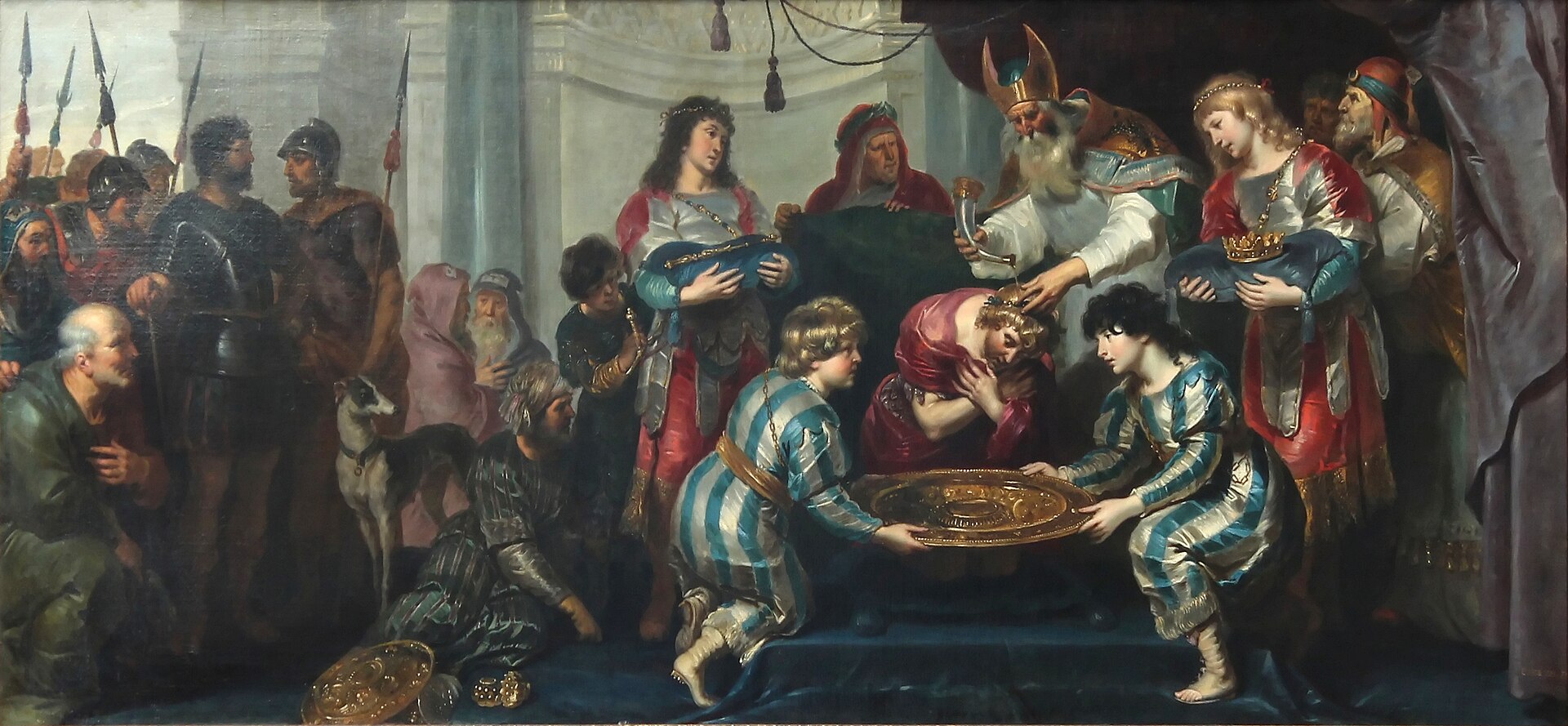
The anointing of Solomon. Cornelis de Vos, 17th century. Wikimedia Commons. Public domain.