
Psalm 2
12 verses · Royal psalm
Why do the nations rage and the peoples plot in vain?
Introduction
Author unstated, the Anointed King, Book 1: The book of David, Poetry, Psalms Overview.
This psalm has no heading, and it stands beside Psalm 1 at the door of the book. The first psalm spoke of one man and his road, and this one speaks of nations, kings and a throne. It was sung for the crowning of a son of David, at the hour when subject peoples tested every new reign. Listen for the change of speakers, as the rebels talk, then heaven answers, then the king himself repeats what was said to him. The apostles read it of Jesus, and a reader should hear why.
Context
- Who
- Israelites watching a son of David take the throne while subject peoples tested the new reign
- Where
- Mount Zion in Jerusalem on a coronation day, with the vassal nations in view
- When
- The united monarchy, sung at the crowning of a king in Jerusalem. c. 1010 to 970 BC if the psalm is David's, which Acts 4:25 states; the psalm itself carries no superscription
Historical context
The New Testament names the author when the church at prayer quotes verses 1 and 2 at Acts 4:25 as the words God spoke through David His servant. In that world the death of a king was the hour a subject people moved, since treaties were personal and sworn to one ruler. A new king spent his first year putting down the provinces that had stopped paying. The decree of verse 7 is a coronation document, a charter read aloud declaring the king's authority and his relation to the god who installed him. Israel used the same language with one difference, since the LORD installs the king by grant and by adoption. Egyptian kings wrote the names of rebel cities on clay bowls and then smashed them, which is the shattered pottery of verse 9. Vassals kissed the hand, the foot or the ground before a sovereign, which is the gesture of verse 12.
Significance
For Israel, wedged between empires, the psalm said that the noise of great powers is watched from a throne higher than theirs. It also set a bar that every son of David fell short of. Each new king was sung this psalm, and each one died with the ends of the earth still outside his reach, which kept Israel looking down the line for a king the words would fit.
This chapter in Jewish lifeWhat this chapter is in Jewish life and reading.
How it is read
This is the chapter where the classical Jewish reading divides in the open, and Rashi is the one who says so. He records the older reading first and then sets his own beside it. Rashi is quoted here from the Judaica Press Tanach with Rashi. "Our Sages expounded the passage as referring to the King Messiah, but according to its apparent meaning, it is proper to interpret it as referring to David himself" (Rashi on Psalms 2:1:1). He points the plain sense at the Philistines who came up when David was anointed king over Israel, and says they fell into his hands. Rashi names the Talmudic place he is reporting, and the corpus carries that same locator at Berakhot 7b:11 under this psalm. The corpus also preserves a third reading, at one remove. Writing on the next psalm, Radak refers to "our rabbis of blessed memory who have interpreted the Second Psalm of Gog and Magog" (Radak on Psalms 3:1:1, the Finch translation of 1919, public domain).
So three readings of one psalm stand in the corpus side by side: the King Messiah, David and the Philistines, and the last war of Gog and Magog. That is the shape a Christian reader should carry away from this chapter. The messianic reading is the old one, and the plain-sense reading of David is the one the great medieval commentator prefers. The New Testament takes the psalm the first way and applies it to Jesus, at Acts 4:25 and 26, at Acts 13:33 and at Hebrews 1:5. The parting is over who the anointed king of the sixth and seventh verses is, and the site holds that question open in front of the reader rather than behind him.
On the verses themselves the commentators keep close to the words. Radak reads the laughter of the fourth verse as a figure, "metaphorical, an accommodation to human language", and takes the sitting of God to mean abiding rather than posture (Radak on Psalms 2:4:1). Ibn Ezra glosses the sixth verse as installation in office, and reads it as "I have made king" (Ibn Ezra on Psalms 2:6:1, the Sefaria Community Translation). Rashi hears the same verse as the answer to the nations: "I have appointed this one for Me to govern and to reign on Zion, My holy mount" (Rashi on Psalms 2:6:1). At the decree of the seventh verse he keeps the speaker human. "Said David, This is an established decree, and one that I have received to tell this and to make known" (Rashi on Psalms 2:7:1). He adds that the Lord said it to David "through Nathan, Gad, and Samuel" (Rashi on Psalms 2:7:2).
The last three verses are read as an appeal to the kings rather than a threat. Ibn Ezra explains the asking of the eighth verse by a custom, that it is "the custom of a father to give an inheritance to the son" (Ibn Ezra on Psalms 2:8:1). Rashi turns it into a rule of prayer before battle (Rashi on Psalms 2:8:1), and takes the iron rod of the ninth verse for the sword (Rashi on Psalms 2:9:2). On the tenth verse he says something a Christian reader will want to weigh: "The Jewish prophets are merciful people. They reprove the heathens to turn away from their evil, for the Holy One, blessed be He, extends His hand to the wicked and to the righteous" (Rashi on Psalms 2:10:1). Ibn Ezra reads the service of the eleventh verse as the reverse of the third, where the kings wanted the cords broken (Ibn Ezra on Psalms 2:11:1). Rashi takes the hard last verse as a call to purity of the heart, and records that Menachem read the word as an expression of desire (Rashi on Psalms 2:12:1).
What the rabbis say
The corpus carries forty locators on this psalm and the text of none, so each is cited and linked here rather than quoted. The Talmudic ones cluster on two tractates. Avodah Zarah is anchored on the first, third and fourth verses, at 3a:13, 3b:2, 3b:5 and 3b:6, with Jerusalem Talmud Avodah Zarah 2:1:3 beside it. Berakhot is anchored on the first, eleventh and twelfth verses, at 7b:11, 9b:28, 10a:1, 30b:19 and 30b:20. Two more stand at Sukkah 52a:6 on the seventh verse, and at Avot DeRabbi Natan 1:1 on the eleventh, with Recension B 43:26 on the eighth.
The midrashic locators run verse by verse. On the second verse the corpus carries Esther Rabbah 7:23, Midrash Tanchuma Buber, Emor 18:2 and Midrash Lekach Tov on Numbers 24:17:1. On the fourth it carries Bamidbar Rabbah 9:9 and Bereshit Rabbati, Parashat Noah 29. On the fifth, sixth and seventh verses it carries Midrash Tehillim 2:7, 2:8 and 2:9, with Midrash Shmuel 19:1 and Ruth Rabbah 5:6:7 in the Lerner edition. On the eighth and ninth verses it carries Bereshit Rabbah 44:8 and 14:7, Midrash Tehillim 2:10 and 120:2, and Tanna DeBei Eliyahu Rabbah 18:10. On the tenth and twelfth it carries Midrash Tehillim 2:13, Bamidbar Rabbah 10:4 and Bereshit Rabbah 83:5. Two entries in Ein Yaakov, Avodah Zarah 1:3 and 1:4 in the Glick Edition, and Aggadat Bereshit 2:2, stand on the first three verses. What each of them teaches is a saying of the rabbis, and is reported as theirs wherever this site quotes one. The quotations wait on a fetch that carries the text.
Sources: Rashi, Rashi on Psalms 2:1:1 to 2:12:2, the Judaica Press complete Tanach with Rashi, translated by A. J. Rosenberg; Ibn Ezra, Ibn Ezra on Psalms 2:5:1 to 2:11:1, the Sefaria Community Translation; Radak, Radak on Psalms 2:4:1 and on Psalms 3:1:1, R. David Kimhi on the first book of Psalms, translated by R. G. Finch, London, 1919; The Sefaria corpus, scripts/data/sources/sefaria/psalms/2.json, the 13 Talmud and 27 Midrash locators of this chapter.
Psalms 2:1-3
Why do the nations rage: The nations rage, the kings stand against the LORD and His Anointed One, and the rebels speak of breaking Their chains and cords. Acts 4:25 to 27 quotes it as David's words and sets them against Jesus, whom God anointed. Matthew Henry read those cords as Christ's own rule.
Psalms 2:1
We have, in these first three verses, a description of the hatred of human nature against the Christ of God. No better comment is needed upon it than the apostolic song in Acts 4:27, 28: "For of a truth against thy holy child Jesus, whom thou hast anointed, both Herod, and Pontius Pilate, with the Gentiles, and the people of Israel, were gathered together, for to do whatsoever thy hand and thy counsel determined before to be done."
Charles Spurgeon · The Treasury of David, Vol. 1 (1869)Particular Baptist
Cross references
Psalms 2:1
- Quoted inActs 4:25“You spoke by the Holy Spirit through the mouth of Your servant, our father David: ‘Why do the nations rage and the peoples plot in vain?”
'Why did the heathen rage', the believers' prayer ('who by the mouth of thy servant David hast said')
ConnectionsActs 4:25, Psalms 110:1
against the LORD and against His Anointed One: His Anointed One translates mashiach, the source of the title Messiah. The kings of the earth and the rulers gather against the LORD and His King together, the King installed on Zion in verse 6. Albert Barnes took the Anointed One here as the Messiah.
Psalms 2:2
“Against his anointed - על משיחיה al Meshichiah, “Against his Messiah.” - Chaldee. But as this signifies the anointed person, it may refer first to David, as it does secondly to Christ.”
Adam Clarke · Commentary on the Bible (1810-1826)evangelical
1 more voice on this verse
Psalms 2:2
“The kings - Herod, and Pilate and others with or after them. Earth - So called in way of contempt and to shew their madness in opposing the God of heaven. Set - The word denotes the combination of their counsels and forces.”
John Wesley · Explanatory Notes upon the Old Testament (1765)evangelical
ConnectionsActs 4:26
The kings of verse 2 speak these words in their council. Their is plural, and the chains belong to the LORD and His Anointed One together. Jeremiah 5:5 uses the same picture of a broken yoke for the leaders of Judah.
Psalms 2:3
“Let us break their bands asunder - The bands of Yahweh and of his Anointed. They who are engaged in this combination or conspiracy regard Yahweh and his Anointed as one, and as having one object - to set up a dominion over the world. Hence, they take counsel against both; and, with the same purpose and design, endeavor to cast off the authority of each. The word “bands” here refers to the restraints imposed by their authority.”
2 more voices on this verse
Psalms 2:3
“Let us break, etc. This is a prosopopoeia, in which the prophet introduces his-enemies as speaking; and he employs this figure the better to express their ungodly and traitorous design.”
John Calvin · Commentaries (1554)reformed
Psalms 2:3
“Christ has bands and cords for us; those that will be saved by him must be ruled by him; but they are cords of a man, agreeable to right reason, and bands of love, conducive to our true interest: and yet against those the quarrel is. Why do men oppose religion but because they are impatient of its restraints and obligations?”
Matthew Henry · Commentary on the Whole Bible (1707-1721)puritan
Psalms 2:4-6
The One enthroned in heaven laughs: Heaven's answer to the council of kings is laughter, and then a taunt. Spurgeon marked the order of verses 4 and 5, that God laughs before He speaks, and His speech is rebuke and fury. Verse 6 is God's own word, His King installed on Zion.
Psalms 2:4
“He that sitteth in the heavens - Whose kingdom ruleth over all, and is above all might and power, human and diabolical. Shall laugh. Words spoken after the manner of men; shall utterly contemn their puny efforts; shall beat down their pride, assuage their malice, and confound their devices.”
Adam Clarke · Commentary on the Bible (1810-1826)evangelical
1 more voice on this verse
Psalms 2:4
“God laughs at them as a company of fools. He has them, and all their attempts, in derision, and therefore the virgin, the daughter of Zion, has despised them, Isa. xxxvii. Sinners' follies are the just sport of God's infinite wisdom and power; and those attempts of the kingdom of Satan which in our eyes are formidable in his are despicable.”
Matthew Henry · Commentary on the Whole Bible (1707-1721)puritan
Then He rebukes them in His anger: The colon at the end of verse 5 points ahead. The rebuke spoken in anger is the sentence of verse 6. Terrifies translates bahal, the verb Exodus 15:15 uses for the chiefs of Edom dismayed after the crossing of the sea.
Psalms 2:5
“These are words of destruction that are pronounced in anger. Moreover, the evils that God had said he was going to inflict, he promises that he will withdraw if the listeners will become penitent. God in his anger spoke through Jonah to the Ninevites, and since they repented in ash and sackcloth, they endured nothing of those things about which they had heard. Actually, God knew beforehand when he sent Jonah that they were going to repent if he sent Jonah for their deliverance. Right now he also is speaking deliverance to those sinners who are in his wrath.”
Origen of Alexandria · written before 253 · Selections from the Psalms 2:5patristic
2 more voices on this verse
Psalms 2:5
“After he has laughed he shall speak; he needs not smite; the breath of his lips is enough. At the moment when their power is at its height, and their fury most violent, then shall his Word go forth against them. And what is it that he says?—it is a very galling sentence— "Yet, " says he, "despite your malice, despite your tumultuous gatherings, despite the wisdom of your counsels, despite the craft of your lawgivers, 'yet have I set my king upon my holy hill of Zion'." Is not that a grand exclamation!”
Charles Spurgeon · The Treasury of David, Vol. 1 (1869)Particular Baptist
Psalms 2:5
“Then shall he speak unto them in his wrath,.... Or, "and he shall speak to them"; so Noldius: that is, the Lord that sits in the heavens, and laughs, and has the Heathen, the people, the kings and rulers in derision, shall not only silently despise their furious and concerted opposition to him and his Messiah, but shall at last speak out unto them, not in his word, but in his providences; and not in love, as to his own people, when he chastises them, but in great wrath, inflicting severe and just punishment.”
Installed translates nasak, a verb for pouring out an offering or casting metal. Franz Delitzsch read it as setting the King firmly on Zion, His holy mountain. This King is the Anointed One of verse 2.
Psalms 2:6
“I set my king upon my holy hill of Zion - Here the Gospel shall be first preached; here the kingdom of Christ shall be founded; and from hence shall the doctrine of the Lord go out into all the earth.”
Adam Clarke · Commentary on the Bible (1810-1826)evangelical
2 more voices on this verse
Psalms 2:6
“Zion strictly taken, was an hill on the north part of Jerusalem, where there was a strong fort, called the city of David, but in a more large sense it is put for the city of Jerusalem, for the temple of Jerusalem, built upon the hill of Moriah, which was either a part of mount Sion, or adjoining to it; for the church of the Jews, and for the Christian church.”
John Wesley · Explanatory Notes upon the Old Testament (1765)evangelical
Psalms 2:6
“The first four verses are spoken by a prophet or an angel wondering why human rashness had risen up against the Son of God. From the fifth verse, though, the Lord himself responds, exhorting the Gentiles and all the people from the Jews who are going to believe in him, so that they may loosen the binding chains and cast off the heavy burden of the law that their own ancestors were unable to carry, so they may follow him whose yoke is easy, and burden light.”
Jerome · written before 420 · Brief Commentary on Psalm 2patristic
Psalms 2:7-9
Verse 7 names the King as God's Son. Acts 13:33 quotes it of the raising of Jesus, and Hebrews 1:5 quotes it as a word God never said to any angel. Verse 8 hands Him the nations, and verse 9 an iron scepter, as at Revelation 2:27 and 19:15.
Psalms 2:7
“The word today indicates the present time in which he was made in the flesh—he who nevertheless in his own nature was the Lord of everything. John testifies to this, that he came among his own, calling the world his own. Having been called into a kingdom in accordance with his accustomed glory, he said, "I have been made king by him," that is, by God the Father. Furthermore, he fulfilled this by being made the Son in his humanity even if then he was the Son in his own nature.”
Cyril of Alexandria · written before 444 · Exposition of the Psalms 2:7patristic
4 more voices on this verse
Psalms 2:7
“I will declare the decree,.... These are the words of Jehovah's Anointed and King, exercising his kingly office, according to the decree and commandment of the Father: for these words refer not to the following, concerning the generation of the Son, which does not depend on the decree and arbitrary will of God, but is from his nature; but these words relate to what go before.”
Psalms 2:7
“This Psalm wears something of a dramatic form, for now another person is introduced as speaking. We have looked into the council-chamber of the wicked, and to the throne of God, and now we behold the Anointed declaring his rights of sovereignty, and warning the traitors of their doom. God has laughed at the counsel and ravings of the wicked, and now Christ the Anointed himself comes forward, as the Risen Redeemer, "declared to be the Son of God with power, according to the spirit of holiness, by the resurrection from the dead." Romans 1:4.”
Charles Spurgeon · The Treasury of David, Vol. 1 (1869)Particular Baptist
Psalms 2:7
“The decree - The will and appointment of God concerning this. My son - Which tho' it may in some sort be said to, or of David, yet much more properly belongs to Christ, who is commonly known by this title both in the Old and New Testament, and to whom this title is expressly appropriated by the holy ghost, who is the best interpreter of his own words, Acts xiii, 33 Heb. i, 5.”
John Wesley · Explanatory Notes upon the Old Testament (1765)evangelical
Psalms 2:7
“Christ is said to be the first-begotten and first-born from the dead, Rev. i. Immediately after his resurrection he entered upon the administration of his mediatorial kingdom; it was then that he said, All power is given unto me, and to that especially he had an eye when he taught his disciples to pray, Thy kingdom come.”
Matthew Henry · Commentary on the Whole Bible (1707-1721)puritan
Cross references
Psalms 2:7
- Quoted inActs 13:33“He has fulfilled for us, their children, by raising up Jesus. As it is written in the second Psalm: ‘You are My Son; today I have become Your Father.’”
'Thou art my Son, this day have I begotten thee' ('as it is written in the second psalm')
- Quoted inHebrews 1:5“For to which of the angels did God ever say: “You are My Son; today I have become Your Father”? Or again: “I will be His Father, and He will be My Son”?”
'Thou art my Son, this day have I begotten thee' (Son superior to angels, w/ 2Sa 7:14)
- Quoted inHebrews 5:5So also Christ did not take upon Himself the glory of becoming a high priest, but He was called by the One who said to Him: “You are My Son; today I have become Your Father.”
'Thou art my Son, to day have I begotten thee' (Christ's high-priestly appointment)
ConnectionsActs 13:33, Hebrews 1:5
make the nations Your inheritance: The inheritance follows from verse 7, where the LORD calls the King His Son. A son is the one who inherits. The ends of the earth reach past any border David ruled, and Psalm 72:8 asks for a king whose rule reaches that far.
Psalms 2:8
It may perhaps be a dogma of some kind that no one receives a divine gift who does not request it. The Father, indeed, through the psalm, urges the Savior to ask that it may be given to him, as the Son teaches us when he says, "The Lord said to me, You are my son; ask from me, and I will give you the Gentiles as your inheritance and the ends of the earth as your possession." And the Savior says, "Ask and it will be given to you … for everyone who asks receives."
Origen of Alexandria · written before 253 · Commentary on the Gospel of John 13:5patristic
1 more voice on this verse
Psalms 2:8
“The hopes of the rebels are thus overthrown, and not only so; the kingdom they opposed is destined to be coextensive with the earth. heathen--or, "nations" (Ps 2:1). and the uttermost parts of the earth-- (Ps 22:27); denotes universality.”
Jamieson, Fausset & Brown · Commentary Critical and Explanatory on the Whole Bible (1871)reformed
You will break them with an iron scepter: The words break them can also be read, from the same Hebrew letters, as shepherd them. The Greek Septuagint read shepherd, and Revelation 2:27 follows it with an iron scepter. Franz Delitzsch kept break, to match shatter them like pottery.
Psalms 2:9
“Thou shalt break them with a rod of iron,.... Not his inheritance and possession among the Gentiles, the chosen ones given him by the Father; these he delights in, takes care of, protects, and preserves: but the stubborn and rebellious ones among the Heathen, and in each of the parts of the world, who will not have him to reign over them; who treat his person with contempt, reject his government, disobey his Gospel, and despise his commands; towards these Christ will use severity, and will exert his power and break them in pieces.”
2 more voices on this verse
Psalms 2:9
“His enemies shall be subject to His terrible power (Job 4:9; 2Th 2:8), as His people to His grace (Ps 110:2, 3). rod of iron--denotes severity (Re 2:27). a potter's vessel--when shivered cannot be mended, which will describe utter destruction.”
Jamieson, Fausset & Brown · Commentary Critical and Explanatory on the Whole Bible (1871)reformed
Psalms 2:9
“This was in part fulfilled, when the Jews who persisted in unbelief, were destroyed by the Roman power: And in the destruction of the Pagan power, when the Christian religion came to be established. But it will not be compleatly fulfilled, 'till all opposing power and principality be put down.”
John Wesley · Explanatory Notes upon the Old Testament (1765)evangelical
Psalms 2:10-12
Therefore be wise, O kings: The kings and judges of the earth are called to fear the LORD and to rejoice with trembling. John Gill read bar in Kiss the Son as the word rendered son at Proverbs 31:2. The blessing rests on all who take refuge in Him.
Psalms 2:10
“Be wise - O ye kings - An exhortation of the Gospel to the rulers of all kingdoms, nations, and states, to whom it may be sent. All these should listen to its maxims, be governed by its precepts, and rule their subjects according to its dictates. Be instructed, ye judges - Rather, Be ye reformed - cast away all your idolatrous maxims; and receive the Gospel as the law, or the basis of the law, of the land.”
Adam Clarke · Commentary on the Bible (1810-1826)evangelical
Serve the LORD with fear: Serve answers verse 3, where the kings wanted to throw off the LORD's cords. Charles Spurgeon held fear and joy together, since fear without joy torments and joy without holy fear presumes. Philippians 2:12 joins fear and trembling.
Psalms 2:11
“Serve the Lord with fear - With reverence, and with deep apprehensions of the consequences of not serving and obeying him. That is, serve him in not opposing, but in promoting his purpose of establishing a kingdom under the Messiah, with the deep apprehension that if you do not do it, he will arise and crush you in his wrath. And rejoice - Prof. Alexander renders this “shout,” and supposes that it refers to the customary recognition of a present sovereign.”
2 more voices on this verse
Psalms 2:11
“Fear - With an awful sense of his great and glorious majesty. Rejoice - Do not esteem his yoke your dishonour and grievance; but rejoice in this inestimable grace and benefit. Trembling - This is added to warn them of taking heed that they do not turn this grace of God into wantonness.”
John Wesley · Explanatory Notes upon the Old Testament (1765)evangelical
Psalms 2:11
“Our salvation must be wrought out with fear and trembling, Phil. ii. We ought to rejoice in the setting up of the kingdom of Christ, but to rejoice with trembling, with a holy awe of him, a holy fear for ourselves, lest we come short, and a tender concern for the many precious souls to whom his gospel and kingdom are a savour of death unto death.”
Matthew Henry · Commentary on the Whole Bible (1707-1721)puritan
Kiss the Son, lest He be angry: Kiss the Son calls the kings and judges of verse 10 to homage, as Samuel kissed Saul at 1 Samuel 10:1. The closing blessing on all who take refuge in Him answers the Blessed that opens Psalm 1. Franz Delitzsch read the pair as a frame around both psalms.
Psalms 2:12
“Kiss the Son, lest he be angry - It is remarkable that the word son (בר bar, a Chaldee word) is not found in any of the versions except the Syriac, nor indeed any thing equivalent to it.”
Adam Clarke · Commentary on the Bible (1810-1826)evangelical
2 more voices on this verse
Psalms 2:12
“Kiss - In token of your subjection and adoration; whereof this was a sign among the eastern nations. The son - The son of God. Ye perish - Be taken out of the way by death or destruction.”
John Wesley · Explanatory Notes upon the Old Testament (1765)evangelical
Psalms 2:12
“Blessed are all they that put their trust in him. We have here the practical application of this gospel doctrine concerning the kingdom of the Messiah, by way of exhortation to the kings and judges of the earth. They hear that it is in vain to oppose Christ's government; let them therefore be so wise for themselves as to submit to it.”
Matthew Henry · Commentary on the Whole Bible (1707-1721)puritan
How this psalm is built
The form: A psalm in a dramatic form, where the council of the wicked, the throne of God and the Anointed each speak in turn, as Spurgeon classes it.
The patterns in this chapter
| Device | What it does | Where to see it |
|---|---|---|
| Four speakers, three verses each | The psalm hands the floor to a new voice every three verses. Verses 1 to 3 are the nations and their kings, verses 4 to 6 are the One enthroned in heaven, verses 7 to 9 are the Anointed reciting the decree spoken to Him, and verses 10 to 12 are the call to the kings and judges. Charles Spurgeon marks the change at verse 7, where another person is introduced as speaking and declares His rights of sovereignty.Charles Spurgeon, The Treasury of David, Vol. 1, 1869, on Psalm 2:7. | Psalm 2:1, Psalm 2:4, Psalm 2:7, Psalm 2:10 |
| The words put in the rebels' mouths | Verse 3 quotes the conspirators rather than describing them, which John Calvin names as the figure of prosopopoeia, used here to bring out the treason of the design by letting it speak. Matthew Henry answers the line by saying that the bands are the rule of Christ, cords of a man and bands of love.John Calvin, Commentaries, 1554, on Psalm 2:3. | Psalm 2:3 |
| What they break against what breaks them | The rebels plan to break chains and cast away cords at verse 3, and at verse 9 the King breaks them with an iron scepter and shatters them like pottery. Jamieson, Fausset and Brown read the rod of iron as severity and the potter's vessel as a thing that cannot be mended once shivered.Jamieson, Fausset and Brown, Commentary Critical and Explanatory on the Whole Bible, 1871, on Psalm 2:9. | Psalm 2:3, Psalm 2:9 |
| The blessing at the end of the door | The psalm opens on nations plotting in vain and closes on a blessing for all who take refuge in Him, which is the word Psalm 1 opened with. The two untitled psalms at the head of the Psalter are bound by that one word at the start of the first and the end of the second.Matthew Henry, Commentary on the Whole Bible, 1710, on Psalm 2:12. | Psalm 1:1, Psalm 2:12 |
In the New Testament
11 more paragraphs on the patterns
No psalm is quoted more often in the New Testament. Acts 4:25 to 27 takes verses 1 and 2 and names Herod, Pontius Pilate, the Gentiles and the peoples of Israel as the gathering. Acts 13:33 quotes verse 7 of the raising up of Jesus. Hebrews 1:5 quotes the same verse as a word God never said to any angel, and Hebrews 5:5 quotes it of the appointment of the high priest. Revelation 2:27 and 19:15 carry the iron scepter of verse 9 into the last book.
Where it sits in the Psalter
Inside the Psalter, Psalm 2 belongs with Psalm 1 as the second half of one door. The first psalm sets the two ways before a man and the second sets them before the nations, and both end on the fate of those who take the wrong road. John Wesley reads the kings of verse 2 as Herod and Pilate and those with them, which keeps the psalm's history and its fulfilment in the same frame.
The royal pattern
The psalm is also the pattern for the royal psalms that follow. A son of David is crowned, the nations are named as his inheritance, and the promise reaches further than any king of Judah ever did, which is what leaves the psalm pointing forward.
The debated concept: the Anointed of verse 2 and the Son of verse 7
The question is how much of the psalm belongs to a king of Judah and how much to Christ. Adam Clarke holds that the anointed of verse 2 refers first to David and secondly to Christ, which keeps the psalm's first hearers in view and lets the fulfilment stand (Commentary on the Bible, 1832). John Wesley holds that the title Son may in some sort be said of David and belongs much more properly to Christ, who is known by it through both Testaments (Explanatory Notes upon the Old Testament, 1765). John Gill reads verse 7 as the words of Jehovah's Anointed exercising his kingly office according to the decree of the Father (Exposition of the Old Testament, 1748 to 1763). Matthew Henry fixes the day the decree names by the resurrection, since Christ is the first-begotten from the dead and entered on the administration of His mediatorial kingdom immediately after He rose (Commentary on the Whole Bible, 1710), which is the reading Paul gives it at Acts 13:33.
The debated concept: the word rendered Son at verse 12
The word at verse 12 is argued over because it is an Aramaic word standing in a Hebrew psalm. John Gill holds that the word used is the one rendered son at Proverbs 31:2, and notes that it comes from another word meaning to choose and to be pure, which is why some render it the elect One or the pure One (Exposition of the Old Testament, 1748 to 1763). Adam Clarke marks the difficulty from the other side, that the word bar is Chaldee and that nothing equivalent to it is found in the versions except the Syriac (Commentary on the Bible, 1832). John Wesley reads the line as it stands and explains the act, since a kiss was the sign of subjection and adoration among the eastern nations and the son here is the Son of God (Explanatory Notes upon the Old Testament, 1765). A reader who follows Gill stands on the psalm's own verse 7, and a reader who follows Clarke stands on what the old versions carried.
How the apostles read the decree
Charles Spurgeon reads verse 7 through Paul's words at Romans 1:4, since the Anointed steps forward here as the Risen Redeemer declared to be the Son of God with power according to the spirit of holiness by the resurrection from the dead (The Treasury of David, Vol. 1, 1869). That reading holds the decree and the day together, which is how Paul himself uses the verse at Acts 13:33. Jamieson, Fausset and Brown read the last line of verse 12 against Hebrews 10:29, and hold that ruin is certain for men who cherish opposition to Christ in their hearts while happiness in His favour is equally sure for those who trust Him (Commentary Critical and Explanatory on the Whole Bible, 1871).
Keep studying
Studies12
Places1
Subjects1
Sources for this chapter
The summary
Jamieson, Fausset & Brown, Commentary Critical and Explanatory; John Calvin, Commentaries; John Wesley, Notes on the Old Testament and Matthew Henry, Complete Commentary.
The form and classifications
Charles Spurgeon and Jerome, Brief Commentary on Psalm 2, 420.
The exposition
Albert Barnes, Notes on the Book of Psalms; Charles Spurgeon, The Treasury of David; Franz Delitzsch, Biblical Commentary on the Psalms; Jamieson Fausset and Brown, Commentary Critical and Explanatory on the Whole Bible; John Calvin, Commentary on the Book of Psalms; John Gill, Exposition of the Old Testament and Matthew Henry, Commentary on the Whole Bible.
The painting
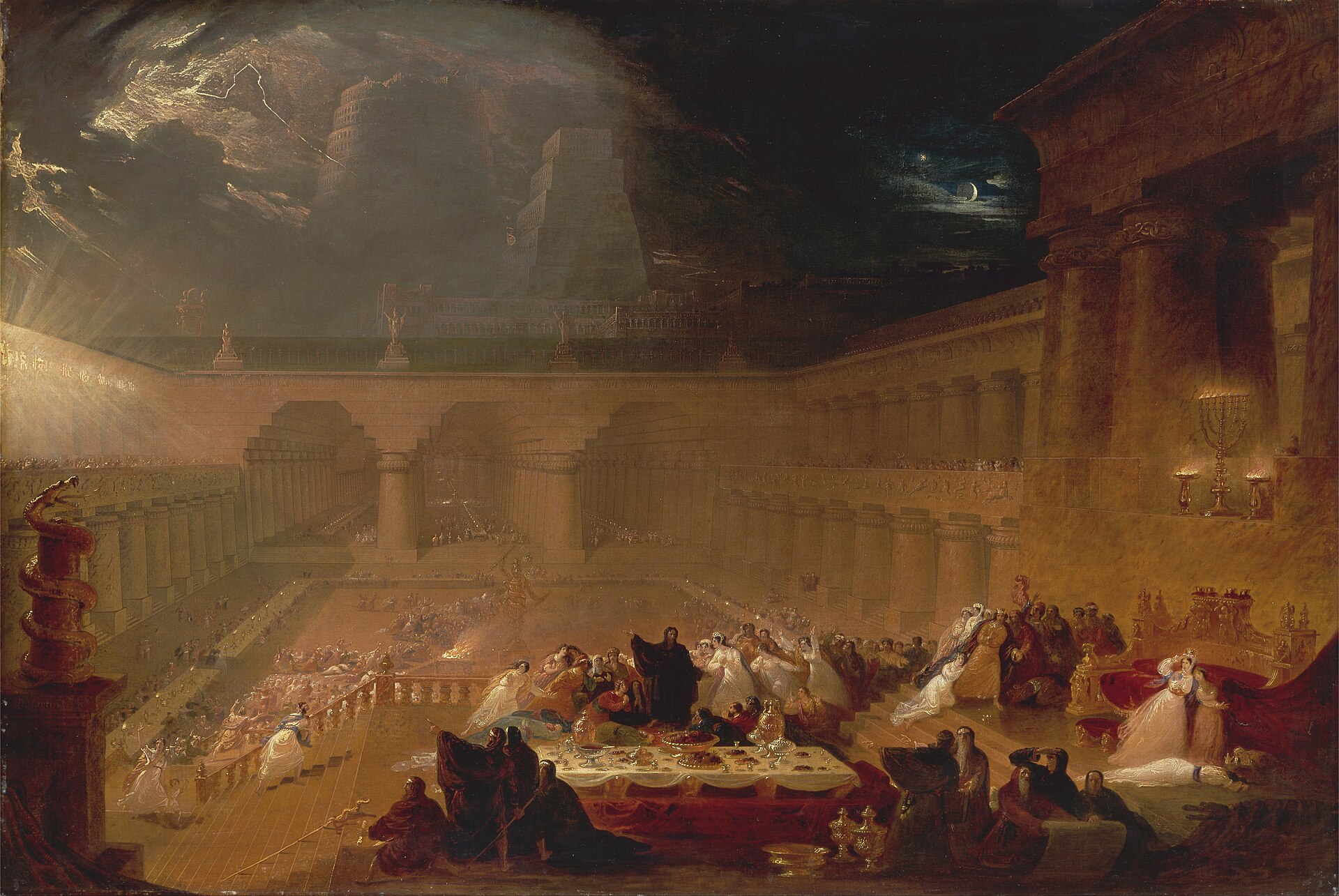
Belshazzar's Feast. John Martin, 1820. Wikimedia Commons. Public domain.